HAN DYNASTY: HOW AN EMPIRE SHAPED CHINA FOR 2,000 YEARS
From Liu Bang’s rise to the wars that broke the dynasty, discover how Han government, farming, scholarship and Silk Road connections reshaped China.
An empire can disappear from the political map and remain embedded in the way later generations understand their world. The Han Dynasty did both. Its imperial house finally lost the throne in 220 CE, yet its name, institutions and cultural achievements continued to shape Chinese history long after its armies stopped obeying a single court.
The conventional dates—**206 BCE–220 CE**—cover a history of conquest, consolidation, interruption and restoration. They do not describe four uninterrupted centuries of stability. The Han built on the Qin state before it, governed a diverse population and helped extend connections across Eurasia. Its legacy was powerful precisely because later societies kept reinterpreting it. Metropolitan Museum of Art: the Han Dynasty
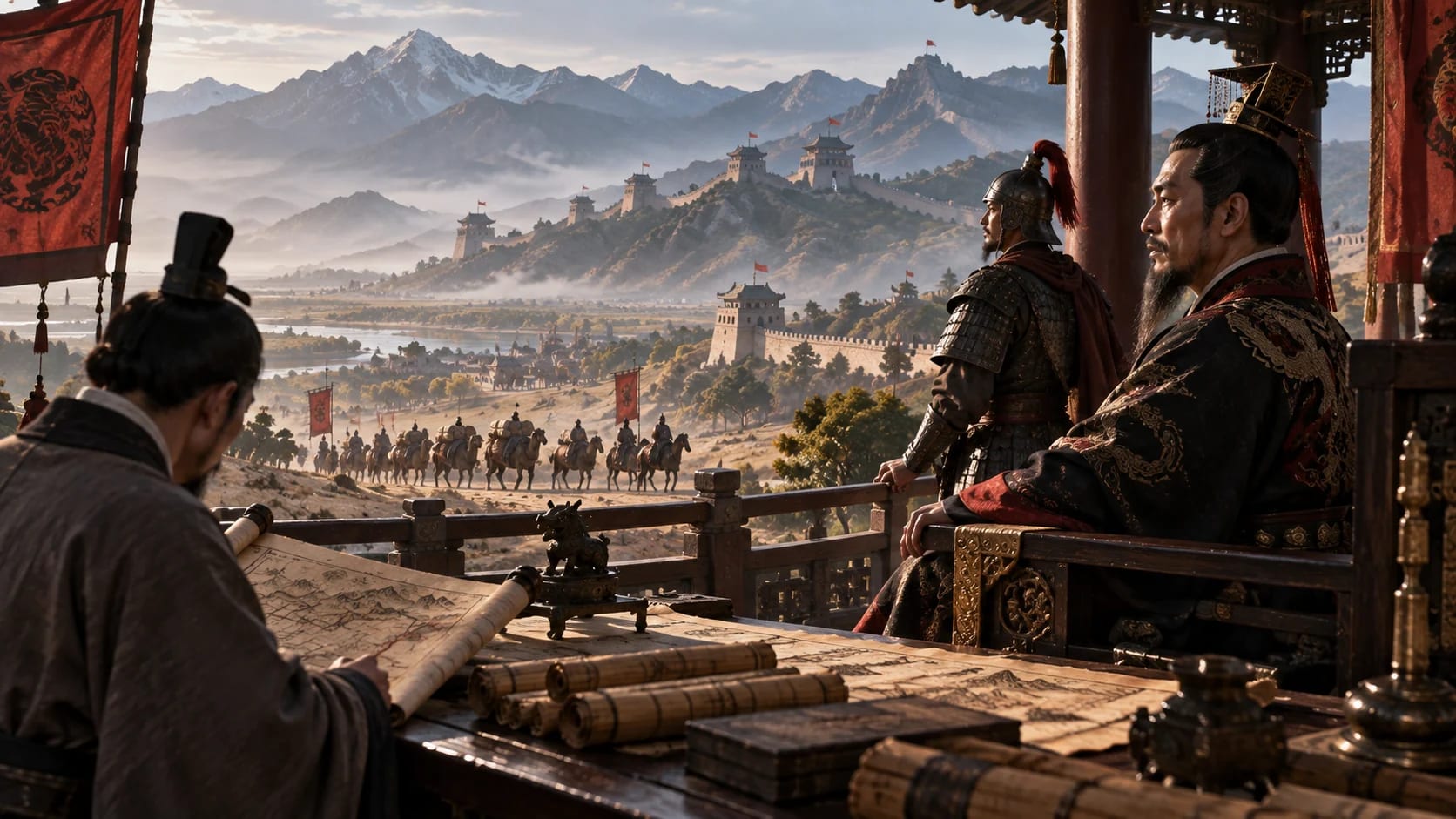
*Image note: the hero is an editorial historical reconstruction. Its ruler, buildings, fortifications and landscape are imaginative, stylized elements, not a literal portrait or an archaeologically verified reconstruction of a specific Han setting.*
FROM QIN COLLAPSE TO LIU BANG’S VICTORY
The Han did not invent imperial government in China. Qin had defeated rival states and established a unified empire in 221 BCE. After the First Emperor’s death in 210 BCE, succession struggles, rebellion and warfare rapidly undermined that achievement. The institutional framework proved more durable than the dynasty that created it.
Among the contenders for power was **Liu Bang**, a man of relatively modest origins who had served as a minor official. His principal rival, Xiang Yu, came from an aristocratic military background. Their struggle was not simply a contest of personalities: victory required armies, supplies, alliances and the ability to retain the support of other powerful men. Columbia University: the rise and organization of the Han Empire
Why do accounts give both 206 and 202 BCE as the beginning? **206 BCE** marks the conventional foundation date associated with Liu Bang’s kingship of Han. **202 BCE** marks his victory over Xiang Yu and accession as emperor. Known to history as Emperor Gaozu, Liu Bang therefore became emperor several years into the period conventionally labeled “Han.” Robert Eno, Indiana University: the rise of the Han
MAKING THE EMPIRE GOVERNABLE
Winning a civil war did not provide Gaozu with unlimited control. Early Han government combined centrally administered commanderies with substantial kingdoms granted to allies and members of the ruling family. Such arrangements rewarded support but also created competing centers of power.
Over succeeding reigns, the court reduced the independence of these kingdoms. The failed rebellion of seven kingdoms in **154 BCE** was an important stage in that process. Consolidation unfolded over generations, rather than arriving fully formed with the founding emperor. Indiana University: early Chinese historical chronology
Han rulers preserved much of Qin’s administrative machinery while presenting their rule as a correction to its failures. Registers, laws, local officials and written orders made distant populations legible to the state. An emperor could claim universal authority; turning that claim into grain deliveries, court judgments or military service required countless routine decisions below the palace. Cambridge History of China: the structure and practice of government
EMPEROR WU: EXPANSION AND ITS PRICE
Emperor Wu, who reigned from **141 to 87 BCE**, transformed the scale of Han ambitions. His campaigns extended imperial power into new regions, including areas of what are now southern China, northern Vietnam and the Korean Peninsula. Expansion also pushed northwest toward the corridor linking the Chinese heartland with Central Asian routes.
These were not empty frontiers. They contained established societies, rulers and trading networks. Military success could produce new commanderies, garrisons and political dependencies, but control was uneven and could be reversed. An ancient empire’s influence should not be confused with the continuous territorial sovereignty suggested by a modern national map. University of Washington: the Han Empire and its expansion
The Xiongnu were a rival power, not a background threat
The Xiongnu confederation north of the Han realm commanded formidable mounted forces and extensive political connections. Earlier Han rulers had used marriage diplomacy, gifts and negotiated arrangements alongside military action. Under Wu, large offensive campaigns became a defining feature of the relationship.
The conflict involved pasture, access to resources, trade, prestige and the allegiance of frontier communities. Han policy alternated between coercion and accommodation; the Xiongnu also pursued their own changing strategies. Describing the relationship only as civilization defending itself against “barbarians” reproduces the prejudices of imperial sources. Cambridge History of China: Han foreign relations
Expansion was expensive. Soldiers needed food, horses needed fodder, and distant garrisons needed supply lines. State intervention in salt and iron production helped raise revenue. After Wu’s death, the famous **81 BCE debate on salt and iron** exposed disagreement over whether such policies strengthened the empire or impoverished the people supporting it. The surviving text preserves arguments, not an uncontested verdict. Columbia University: a record of the debate on salt and iron
ZHANG QIAN: A DIPLOMATIC MISSION WITH UNEXPECTED CONSEQUENCES
In the second century BCE, Wu sent **Zhang Qian** west to seek allies against the Xiongnu, particularly among the Yuezhi. His journey included prolonged captivity. Although the desired military alliance did not materialize, his reports greatly expanded the Han court’s knowledge of Central Asian peoples, economies and political possibilities.
This was not a lone explorer discovering an unconnected continent. Communities already exchanged goods across Inner Asia. Zhang Qian’s importance lay in bringing those worlds into a more sustained relationship with Han diplomacy and imperial ambition. Horses, in particular, connected strategic needs with long-distance exchange. UNESCO: Main Street of Eurasia
HOW DID THE SILK ROAD REALLY WORK?
**It was a network, not a single road.** Routes branched around deserts, followed oasis chains, crossed mountain passes and connected with maritime trade. Their importance shifted with political conditions, water supplies, security and demand. The familiar name “Silk Road” is a much later scholarly label, not the official name of a Han highway.
Most exchange occurred through overlapping journeys. A piece of silk could pass through several merchants and political jurisdictions without any one person traveling from Chang’an to Rome. Regional traders, interpreters, pastoral communities and local rulers were indispensable. Silk was valuable, but horses, textiles, metals and other goods also moved. UNESCO: about the Silk Roads
Han involvement helped develop a major east–west corridor, supported in places by fortified posts and administrative infrastructure. UNESCO’s Chang’an–Tianshan World Heritage designation recognizes part of this much larger historical network. Its listed corridor should not be mistaken for either the full length of the Silk Roads or a road built all at once by one emperor. UNESCO: the Chang’an–Tianshan routes network
Trade and conquest were intertwined, but neither permanently guaranteed the other. Political fragmentation could obstruct routes or redirect them rather than ending exchange altogether. Much later, the Mongol Empire would reshape Eurasian connections under very different conditions. It did not create the earlier networks from nothing.
GOVERNMENT, TAXATION AND CONFUCIAN POLITICAL THOUGHT
The empire depended on agricultural households. Taxes could draw on crops and money, while labor and military obligations made demands on people’s time. A household’s burden therefore cannot be understood by quoting one land-tax rate as though it represented everything the state required. Institutions and obligations also changed across the Han period. Research on Qin–Han economic institutions and taxation
Officials needed more than the ability to enforce orders. Court-sponsored learning increasingly valued classical texts, moral conduct, ritual and arguments about legitimate government. Confucian political thought emphasized relationships and responsibilities: rulers were supposed to govern well, not merely possess force.
Yet “the Han adopted Confucianism” can conceal the richness of the period. Thinkers combined traditions now labeled Confucian, Daoist and Legalist; cosmology, medicine and divination also intersected with political reasoning. Practical government retained law, punishment and administrative techniques alongside moral language. There was no single intellectual switch that replaced every other way of thinking. Stanford Encyclopedia of Philosophy: philosophy in Han China
Did the Han invent the familiar imperial examination system?
Han recruitment included recommendation, education, assessment and patronage. Classical learning could support an official career, but this was not yet the mature competitive examination system familiar from later imperial history. Columbia’s account dates the beginnings of that later system to the Sui, with substantial development in subsequent dynasties. Projecting it backward makes Han government appear more open and standardized than it was. Columbia University: the Confucian classics and civil service examinations
LIFE BEYOND THE PALACE: FIELDS, MARKETS AND HOUSEHOLDS
For most people, the empire was experienced through farming, family obligations, local authorities and the uncertainty of harvests. Grain and cloth mattered more to daily survival than the prestige of distant diplomatic missions. Regional conditions differed, and there was no single Han way of life shared equally by a frontier soldier, an urban merchant and a tenant farmer.
Ironworking contributed to weapons and agricultural tools. Better implements could help cultivate land more effectively, but technology did not automatically produce prosperity for every household. Access to land, animals, labor and water shaped what an innovation could achieve. Field Museum: Han ironworking, farming and territorial power
Archaeology offers glimpses of ordinary infrastructure. Ceramic tomb models depict mills, animal pens, storehouses and other features of agricultural estates. These objects are valuable evidence, but they also represent what tomb owners wanted to carry symbolically into the afterlife. They are not neutral photographs of the lives of the poorest families. Metropolitan Museum of Art: an Eastern Han model mill
Chang’an, the Western Han capital, brought palaces, residential areas, markets and administrative activity together on an immense urban scale. Luoyang later performed the corresponding role for the Eastern Han. Their wealth depended on connections with the countryside, not separation from it. The city’s luxury and the village’s surplus were parts of the same political economy. Cambridge History of China: the economic and social history of Former Han
Women, work and unequal opportunities
Women’s activity extended beyond the tidy ideals prescribed in elite texts. Scholarship on Sichuan tomb art identifies women’s participation in the production and sale of alcohol, illustrating the overlap of household work, ritual and commerce. Prescriptive expectations tell us what authors wanted, not everything people actually did. Cambridge research: women and alcohol production in Han China
The scholar **Ban Zhao** offers another perspective. She helped complete the history of the Former Han and taught women at court. Her writings supported hierarchical gender expectations while also arguing for women’s education. Her exceptional access to scholarship should neither be erased nor treated as evidence that all women enjoyed the same opportunities. Columbia University: Ban Zhao’s Admonitions for Women
PAPER, NUMBERS AND THE OBSERVATION OF NATURE
The Han’s intellectual achievements were closely connected to practical needs. Government required records; agriculture and ritual required calendars; construction and taxation required calculation. Skilled craftspeople and officials contributed alongside the celebrated individuals remembered in later biographies.
Cai Lun and the paper that already existed
**105 CE** is traditionally associated with Cai Lun’s report to the court on papermaking. Archaeological finds, however, show that paper existed before him, including in the Western Han. He should therefore be understood as a major figure in its development and promotion, rather than the confidently identifiable first person ever to make a sheet of paper. Georgia Tech, Robert C. Williams Museum of Papermaking: early paper
Paper did not immediately sweep away every other writing material. Excavated wooden slips preserve the routines of administration and learning: writing practice, character lists and multiplication exercises. Their survival makes an empire of documents tangible, revealing the work behind its official voice. Academia Sinica: what Han wooden slips reveal about literacy
Mathematics and astronomy
Early Chinese mathematical texts developed across generations. The tradition represented by the **Nine Chapters on the Mathematical Art** organized problems involving measurement, distribution and calculation. Excavated Qin and Han manuscripts show that this achievement grew out of earlier methods and practical problems; it was not a complete mathematical system invented suddenly by one named genius. Peer-reviewed research on early Chinese mathematical texts
Astronomy likewise joined observation, calculation and questions of government. **Zhang Heng**, who lived from 78 to 139 CE, worked on astronomical instruments and cosmological models as well as mathematics. Such work belonged to a world in which explaining the heavens and understanding political order could overlap. Recognizing that context respects the sophistication of Han scholarship without pretending it used the categories of a modern physics department. University of St Andrews: Zhang Heng
A seismoscope, not an earthquake predictor
Historical descriptions credit Zhang Heng with a **seismoscope in 132 CE**: an instrument intended to indicate an earthquake and its direction. It was not a device for predicting the date of a future earthquake, nor a modern instrument producing a continuous graph of seismic waves. The original has not survived; familiar museum versions are reconstructions whose mechanisms involve interpretation. Science Museum Group: model of Zhang Heng’s seismoscope
WANG MANG AND THE XIN INTERRUPTION
Western Han politics became entangled in succession disputes and the influence of imperial relatives. In **9 CE**, Wang Mang took the throne and established the **Xin Dynasty**. His program invoked an idealized ancient order while attempting reforms involving land, currency and economic control.
Reform encountered entrenched interests and practical difficulties. Flooding, displacement and food crises intensified instability, and rebellions overwhelmed the regime. Wang Mang was killed in **23 CE**. Neither the image of a uniquely wicked usurper nor that of a straightforward modern social reformer adequately captures his position. Sarah Schneewind, UC San Diego: Wang Mang’s New Dynasty
The interpretation of his failure is also a source problem. Historians writing under a restored Han order had reasons to portray him as lacking legitimacy. Scholarship therefore examines both what those accounts preserve and how their assumptions about rightful rule shaped the story. Hans Bielenstein: Wang Mang and the restoration of Han
EASTERN HAN: RESTORATION, LUOYANG AND A WIDER WORLD
**Liu Xiu, Emperor Guangwu**, established the restored Han regime in **25 CE**, with its capital at Luoyang. Reunification required further campaigning. “Eastern Han” and “Western Han” refer to the relative locations of the capitals, not two simultaneous halves of a divided empire. Smithsonian: timeline of Chinese history, art and culture
Eastern Han power in Central Asia was renewed through campaigns and diplomacy, prominently associated with **Ban Chao**. Such influence was contested and uneven rather than a permanently secure bridge to the Mediterranean. Military officers, envoys and merchants moved through a political landscape containing other powerful states and independent communities. Metropolitan Museum of Art: the Han Dynasty
Connections with India and Central Asia also helped bring Buddhism into China. By the second century CE, foreign monks were teaching and translating texts. The religion’s later prominence should not be projected backward into an entirely Buddhist Han society: early communities were part of a much longer process of translation, adaptation and growth. Metropolitan Museum of Art: Chinese Buddhist sculpture and its early context
HAN CHINA AND ROME: WHAT DID THEY ACTUALLY KNOW ABOUT EACH OTHER?
Han China and the Roman Empire existed at opposite ends of interconnected commercial worlds. Silk reached Mediterranean markets, and goods associated with western regions traveled east. But objects could move much farther than the people who first made or purchased them. Trade does not, by itself, demonstrate routine direct diplomatic contact. Metropolitan Museum of Art: trade routes between Europe and Asia in antiquity
Chinese accounts described a distant realm called **Da Qin**, generally associated with the Roman world. In **97 CE**, Ban Chao sent Gan Ying toward it. He did not reach Rome. The route’s precise geography and the information he received require interpretation; the episode is evidence of curiosity and attempted contact, not a successful embassy to the Roman emperor. University of Washington: notes on Parthia and Gan Ying’s mission
The **Hou Hanshu**, compiled after the Han period from earlier materials, records visitors in **166 CE** claiming a connection with a ruler of Da Qin called Andun. Their gifts and claimed status have prompted debate over whether they were merchants presenting themselves as envoys. The account cannot independently establish that a Roman emperor officially dispatched them, still less that embassies traveled back and forth routinely. University of Washington: annotated translation of the Later Han account
Knowledge flowed through imperfect reports. Greco-Roman references to the **Seres**, associated with silk-producing peoples, did not amount to a precise modern understanding of Han geography or government. Classical scholarship emphasizes how flexible and uncertain these distant descriptions could be. Oxford Classical Dictionary: Seres
Comparing Han institutions with those of the Roman Empire can illuminate different ways of organizing power. Turning them into contestants in a hypothetical ranking obscures the varied circumstances that made each empire possible.
WHY DID THE HAN DYNASTY COLLAPSE?
No single explanation is sufficient. Court conflict weakened decision-making; local power challenged central control; economic pressures and rebellion increased military demands. The mechanisms used to defend the dynasty could also transfer authority away from it.
Court factions and control of the emperor
Young rulers and contested successions made access to the throne politically valuable. Imperial relatives, senior officials and palace eunuchs competed over appointments and influence. Eunuchs could act as an emperor’s allies against powerful families, not merely as an external force corrupting an otherwise healthy system. Accounts blaming an entire category of court servants flatten conflicts involving several groups. Cambridge History of China: the fall of Han
Land, dependency and the weakening of central power
The growth of large estates could draw vulnerable farmers into tenancy and dependence on powerful households. This mattered politically as well as economically: local patrons could command resources and loyalties that the central state struggled to reach. Francesca Bray’s research connects changes in landholding with shifts in agricultural technology and production, warning against treating technical improvement as automatically benefiting independent smallholders. Early China: agricultural technology and agrarian change
The Yellow Turban Rebellion
In **184 CE**, the Yellow Turban movement associated with **Zhang Jue** erupted into rebellion. Religious healing, collective organization and hopes for a transformed order helped mobilize followers. Its significance cannot be reduced to a spontaneous crowd of hungry peasants without ideas or leadership.
Imperial forces defeated major rebel armies, but suppression did not restore durable political stability. Continued unrest and the need for military mobilization increased the importance of commanders and regional forces. The court survived the uprising; the conditions that had made rebellion possible did not simply disappear. Rafe de Crespigny: annotated chronicle of the events of 184 CE
FROM WARLORDS TO THE THREE KINGDOMS
The crisis of **189 CE** brought violence at court and military intervention, with Dong Zhuo seizing power in the capital. Subsequent struggles left the emperor increasingly dependent on commanders who possessed armies of their own. Cao Cao eventually controlled the court while building a dominant position in northern China. Rafe de Crespigny: Imperial Warlord, a biography of Cao Cao
Cao Cao’s opponents included the forces of Liu Bei and Sun Quan. The campaign of Red Cliffs in **208 CE** helped prevent Cao Cao from imposing a rapid settlement over the south. Territorial division developed through prolonged warfare, not a neatly agreed partition on the day Han ended. Rafe de Crespigny: the Three Kingdoms and Western Jin
In **220 CE**, after Cao Cao’s death, his son **Cao Pi** received the abdication of Emperor Xian and established Wei. This was the formal end of the Han imperial house’s rule. The states conventionally known as Wei, Shu-Han and Wu emerged through a sequence of claims and consolidations; their leaders did not all assume imperial titles simultaneously. Cambridge History of China: the age of division and Wei’s foundation
The famous later novel **Romance of the Three Kingdoms** transformed this period into an enduring world of loyalty, strategy and heroic personalities. It is a work of literature drawing on history, not a transcript of what happened. The political collapse was real; many familiar dramatic details belong to later storytelling.
WHY ARE SO MANY CHINESE PEOPLE CALLED “HAN” TODAY?
The name of the dynasty became a lasting reference point for collective identity. But today’s **Han Chinese** population should not be imagined as an unchanged biological or cultural unit preserved intact since antiquity.
Migration, intermarriage, language change, political classification and regional histories shaped identities over many centuries. Han communities contain substantial internal diversity. Modern scholarship also examines how twentieth-century states promoted a shared Han identity while powerful local attachments persisted. A common name can connect people without making their histories identical. Journal of Asian Studies: Han identity, ethnicity and local diversity
The dynasty matters to this story because it supplied an exceptionally influential political and cultural precedent. Its legacy was inherited, expanded and redefined. Saying that it shaped China for 2,000 years therefore describes continued influence—not a claim that China’s institutions, population or borders remained unchanged for that time.
HAN DYNASTY: MYTH VS REALITY
Myth: the Han created Chinese civilization from nothing
It inherited centuries of statecraft, writing, agriculture and intellectual debate, including the Qin imperial framework. Its achievement was to adapt and sustain those resources on an expanded scale.
Myth: 206 BCE–220 CE was one uninterrupted reign
The conventional dates include the Xin interruption and a contested restoration. Liu Bang became emperor in 202 BCE; Eastern Han began in 25 CE.
Myth: the Silk Road was one road connecting two capitals
It was a changing network of regional routes and exchanges. Central Asian societies were participants with their own interests, not merely a corridor between China and Rome.
Myth: Han and Roman emperors maintained regular direct contact
Commercial connections and fragmentary reports are well supported. Routine official diplomacy is not. The visitors recorded in 166 CE do not settle every question about their origin or status.
Myth: Cai Lun invented paper from nothing in 105 CE
Earlier paper survives archaeologically. His traditional importance concerns the development and promotion of papermaking.
Myth: Han government was a modern meritocracy
Learning and ability mattered, but recommendation, family, wealth and patronage shaped access to office. The mature imperial examination system came later.
Myth: eunuchs or one rebellion single-handedly destroyed the dynasty
Court rivalry, local power, economic pressures and military decentralization interacted. The Yellow Turban uprising began in 184; formal abdication came in 220.
THE EMPIRE THAT OUTLIVED ITS DYNASTY
The Han legacy reached beyond a list of rulers or inventions. It helped establish powerful expectations about government through officials, the relationship between learning and public service, and the possibility of restoring political unity after fragmentation. Later dynasties repeatedly borrowed from that inheritance while changing it.
Its place in world history is equally revealing. Connections with Central Asia widened horizons without abolishing distance. Paper developed through accumulated craft knowledge rather than a single miraculous moment. Prosperity rested on farmers, laborers, traders and administrators whose names are usually absent from the grand narrative.
To understand the Han is therefore to hold two views together: an empire capable of extraordinary organization and a society marked by hierarchy, coercion and conflict. The institutions that made power durable could also create rivals to the throne. The networks that enriched the court could not guarantee its survival.
In 220 CE, the Han lost its throne. It did not lose its place in the imagination of the societies that followed. An imperial house had ended; one of the most enduring reference points in Chinese history had already taken shape.
FAQ
Frequently Asked Questions
What is this PRESDA article about?
From Liu Bang’s rise to the wars that broke the dynasty, discover how Han government, farming, scholarship and Silk Road connections reshaped China.
Which category does this story belong to?
This story is part of PRESDA's History coverage.
Who published this article?
HAN DYNASTY: HOW AN EMPIRE SHAPED CHINA FOR 2,000 YEARS was published by PRESDA Editorial on PRESDA.
PRESDA Dispatch
Stay Informed. Stay Aware.
A sharp briefing across AI, gaming, sport, business, world affairs, paparazzi, and lifestyle.
Related