AREA 51 AND ALIENS: WHAT IS THE U.S. REALLY HIDING IN THE DESERT?
Secret aircraft are documented. Alien spacecraft are not. Inside Groom Lake’s Cold War history, declassified files and the claims that turned a test base into a legend.
Area 51 has an unusual kind of fame. Almost everyone recognises its name, yet very few people can say precisely what happens there. A guarded installation beside a Nevada dry lake has become a stage onto which the world projects crashed spacecraft, alien bodies and technologies supposedly withheld from humanity.
The documented story is extraordinary enough without those additions. Groom Lake helped the United States develop secret reconnaissance aircraft, test ways to evade radar and study foreign military equipment. Declassified records establish that history. They do not establish that the base houses extraterrestrials.
The question is therefore not whether the government has hidden things in the desert. It unquestionably has. The harder question is what each piece of evidence actually supports. A real secret aircraft program, an unexplained sighting and a claim about alien engineering are three different things.
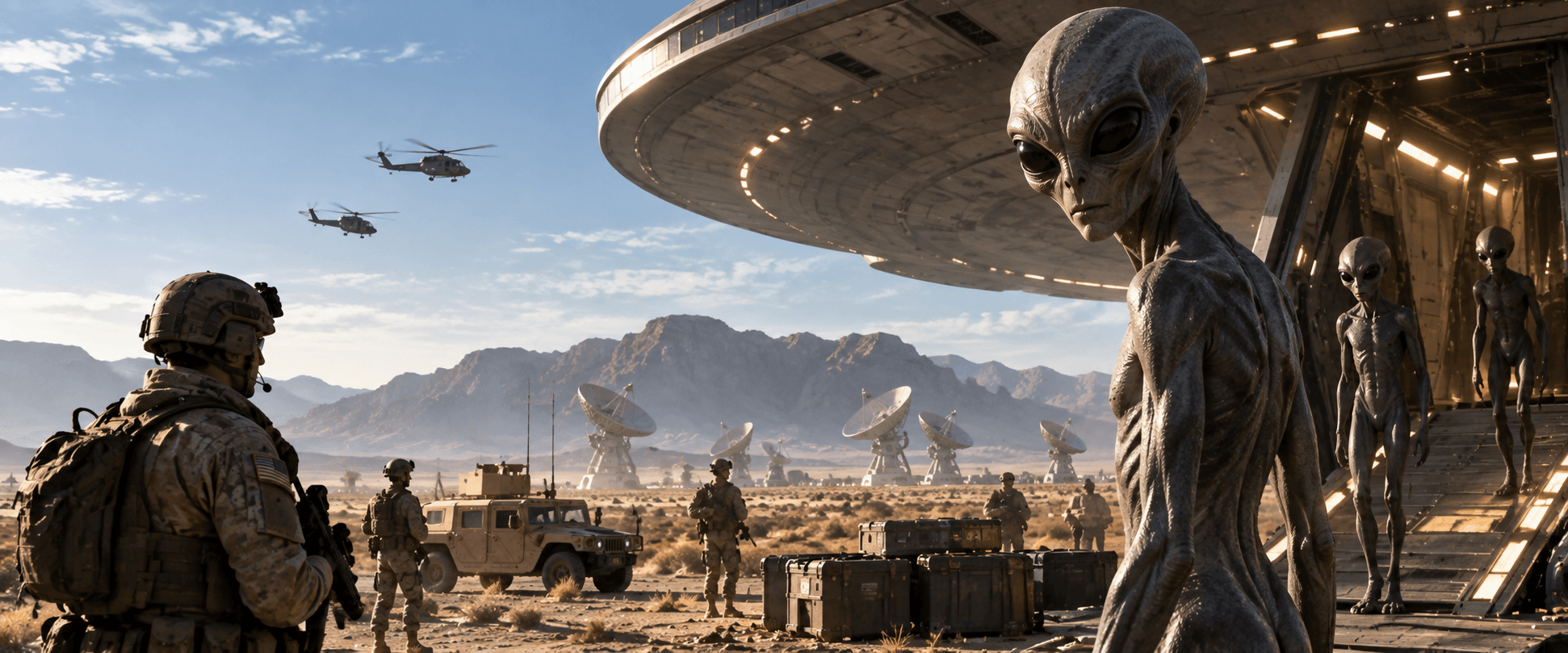
Illustration note: the supplied hero depicts a fictional alien encounter. It is an artistic illustration of Area 51 mythology, not a photograph or evidence of an actual event.
WHERE IS AREA 51, AND WHY GROOM LAKE?
Area 51 is the familiar name for the restricted installation at Groom Lake in southern Nevada, north of Las Vegas. It should not be confused with the whole Nevada Test and Training Range, the nearby nuclear testing landscape or every secret facility in the American Southwest. Those places have connected histories, but they are not interchangeable.
The CIA’s official reconnaissance history places the creation of the U-2 testing base in 1955. The Cold War problem was urgent: American leaders wanted better information about Soviet military capabilities, and a new high-altitude aircraft needed somewhere to be tested away from public observation. Groom Lake offered remoteness and a dry lakebed suited to flight testing. CIA: The CIA and the U-2 Program, 1954–1974
The setting made practical sense. A revolutionary aircraft could attract attention through its appearance, performance or even an accident. Keeping the testing site away from ordinary airport traffic made secrecy easier. The desert was part of the engineering project as well as its security.
Names helped soften or obscure that isolation. CIA accounts record Paradise Ranch, the Ranch and Watertown among the site’s nicknames. None is evidence of an extraterrestrial purpose. They belong to the language of a highly compartmented aviation program. CIA: Area 51 and the accidental test flight
THE U-2: A SECRET DESIGNED TO SEE OTHER SECRETS
The U-2’s purpose was aerial reconnaissance. Its great wings and high-altitude performance supported the collection of intelligence over places that were difficult to observe from the ground. Groom Lake was a testing and training site, not the destination of the intelligence the aircraft was built to gather. CIA: The CIA and the U-2 Program, 1954–1974
Its beginnings included an unexpectedly human moment. On August 1, 1955, Lockheed test pilot Tony LeVier inadvertently became airborne during a high-speed taxi test at Groom Lake. The CIA’s account describes the aircraft lifting off before the planned formal flight program had begun. Even an intensely controlled secret project could surprise its own pilot. CIA: Area 51 and the accidental test flight
The assumption that altitude would offer protection had limits. On May 1, 1960, a U-2 piloted by Francis Gary Powers was shot down over the Soviet Union. The incident exposed the reconnaissance operation and helped wreck the planned Paris summit. It also demonstrated why the story cannot be reduced to harmless experimentation: these machines operated inside a dangerous international confrontation. U.S. Department of State, Office of the Historian: The U-2 incident, 1960
The government’s failed attempt to conceal the purpose of that flight is a documented example of official deception. Recognising it is essential to understanding public mistrust. But it establishes deception about a spy mission, not the truth of every later story attached to the same institution.
A-12 OXCART: THE AIRCRAFT THAT LOOKED LIKE THE FUTURE
The CIA awarded Lockheed the OXCART contract in 1959. The resulting A-12 was designed to fly higher and much faster than the U-2 while reducing its vulnerability to detection. It began flight testing at Groom Lake in April 1962. CIA histories describe performance above Mach 3, more than three times the speed of sound. CIA: A-12 OXCART
The A-12 is often confused with the related SR-71 Blackbird. They belonged to the same extraordinary family of aircraft, but the CIA’s A-12 reconnaissance program was not simply another name for the Air Force’s SR-71. Getting that distinction right matters when assigning missions, dates and records.
OXCART combined demands that were difficult even separately: extreme speed, intense aerodynamic heating, long-distance reconnaissance and efforts to reduce radar visibility. Its existence was a genuine technological secret. Nothing about the documented development requires alien propulsion or recovered spacecraft. CIA: A-12 OXCART
From outside the program, however, seeing an unfamiliar aircraft could create a very different story. The observer might accurately report something unusual while lacking the information needed to identify it. Secrecy separated what a witness could see from what the government could explain.
STEALTH, EXPERIMENTAL AIRCRAFT AND REAL FOREIGN TECHNOLOGY
Groom Lake’s significance continued beyond the early spy planes. On December 1, 1977, the HAVE BLUE demonstrator made its first flight there. The Air Force identifies it as the predecessor of the F-117 stealth aircraft. Its sharply faceted form was the result of attempts to control radar reflections, not a requirement to resemble a familiar aeroplane. Holloman Air Force Base: HAVE BLUE’s first flight at Groom Lake
Stealth means reducing detectability, not becoming literally invisible. Different designs address radar returns, heat and other signatures, and their effectiveness depends on circumstances. The aircraft that looks most unusual to a human observer is not necessarily the hardest for a particular sensor to detect.
Tacit Blue demonstrated another route. The Air Force museum describes a secret experimental aircraft with curved surfaces, reduced radar and heat signatures, and digital flight controls to manage aerodynamic instability. The program ended in 1985; the aircraft was declassified and displayed in 1996. Its appearance was unusual because its design priorities were unusual. National Museum of the U.S. Air Force: Northrop Tacit Blue
The Bird of Prey was another technology demonstrator. According to the Air Force museum, it first flew in 1996 and was revealed in 2002 after its design methods had become standard practice. Its purpose included testing low-observable features and new construction techniques. A secret airplane could move into public view because its technical context changed. National Museum of the U.S. Air Force: Boeing Bird of Prey
There was also real work on foreign aircraft. Declassified material assembled by the National Security Archive documents evaluation of Soviet MiG-21 and MiG-17 fighters under programs including HAVE DOUGHNUT, HAVE DRILL and HAVE FERRY. Studying another country’s aircraft could reveal performance limits and improve tactics. This is credible evidence of secret foreign-technology exploitation, not evidence of technology from another planet. National Security Archive (2013): The Area 51 File, secret aircraft and Soviet MiGs
WHY UFO SIGHTINGS BECAME PART OF THE STORY
A UFO is unidentified from the standpoint of the available observation. It does not become extraterrestrial simply because a witness cannot name it. That distinction is especially important around a site whose purpose included flying aircraft the public was not supposed to recognise.
The CIA has stated that U-2 and later OXCART flights accounted for more than half of UFO reports during the late 1950s and 1960s. This should be presented as the agency’s retrospective estimate, not an independently established explanation for every sighting, every country or every later decade. CIA: What really went on at Area 51?
Secret flight activity gives a credible explanation for some unusual observations. It does not allow a historian to identify a particular light without checking the time, location, flight records and observation conditions. Replacing “everything is aliens” with “everything is a spy plane” would repeat the same mistake of explaining more than the evidence supports.
The National Archives preserves records from Project BLUE BOOK, the Air Force’s historical investigation of UFO reports. A file’s presence in a government archive establishes that a report or investigation existed. It does not mean the government verified every interpretation inside it. Archives contain observations, correspondence, hypotheses and rejected ideas as well as conclusions. National Archives: Project BLUE BOOK and UFO records
ROSWELL IS NOT AREA 51
Roswell belongs to New Mexico and July 1947. The Groom Lake U-2 base belongs to Nevada and 1955. Treating them as the same event collapses two locations and two different periods into a single cinematic story. Claims that material was later moved between secret sites would require their own evidence.
The Air Force’s 1994 investigation concluded that the Roswell debris came from Project MOGUL, a balloon-borne research program. Its later report addressed accounts of bodies, arguing that some recollections combined events from different years, including high-altitude dummy tests and accidents. These are the Air Force’s findings, and the chronology must be preserved: it did not demonstrate that later dummy tests took place in July 1947. U.S. Air Force: The Roswell Report
The Government Accountability Office separately published a records search in 1995. Its remit concerned the search for records and their handling. That is a different kind of inquiry from physically identifying a recovered object. An administrative report should not be turned into a claim that investigators inspected an alien craft. U.S. Government Accountability Office (1995): Search for records concerning the 1947 crash near Roswell
Roswell remains important to Area 51 mythology because the stories fit together so easily: an alleged recovery needs an alleged storage site. Narrative compatibility is not a documented chain of custody. The missing step is evidence connecting a particular object, its origin and its movements.
BOB LAZAR: AN INFLUENTIAL CLAIM IS NOT A VERIFIED PROGRAM
In 1989, Bob Lazar told Las Vegas television station KLAS that he had worked on alien spacecraft in the Nevada desert. His account became one of the most influential foundations of modern Area 51 lore. It offered an insider, a hidden workplace and a technical explanation for an extraordinary secret. National Geographic: How aliens and UFOs became part of Area 51 lore
National Geographic reports that MIT and Caltech, institutions Lazar said he attended, had no record of him. That is a significant problem for his claimed credentials. The central spacecraft claim nevertheless requires its own assessment: a convincing biography would not by itself prove alien engineering, just as questioning a biography does not identify every event in a person’s life.
A verified role around a laboratory, contractor or restricted site would establish that role. It would not automatically establish access to extraterrestrial hardware. The missing evidence is independently examinable material or documentation demonstrating the claimed program and its nonhuman origin. Repetition in interviews does not supply that missing step.
Element 115 is often invoked in discussions of Lazar. It is a real chemical element, now named moscovium. The Royal Society of Chemistry describes a highly radioactive, artificially produced element with no established use beyond research. Its existence does not verify claims about a stable alien fuel or a gravity-control system. Naming an atomic number and demonstrating a working propulsion technology are profoundly different achievements. Royal Society of Chemistry: Moscovium, element 115
The fair description is that Lazar made influential, disputed claims. They should not be presented as established engineering history, and the absence of publicly verifiable support should not be concealed behind the label “whistleblower.”
AREA 51 AND ALIENS: MYTH VS REALITY
This is where the evidence needs sorting. The categories below distinguish what records establish, what deserves investigation and what remains unsupported. They are not a ranking of how entertaining a story is.
CONFIRMED FACT: SECRET AIRCRAFT WERE TESTED AT GROOM LAKE
The U-2, A-12 and stealth-testing history is supported by official histories, declassified records and identifiable aircraft. The major question is no longer whether these programs existed, but how their surviving records explain decisions, performance and consequences. That evidentiary foundation is much stronger than an anonymous description of an unseen craft. CIA: The CIA and the U-2 Program, 1954–1974 Holloman Air Force Base: HAVE BLUE’s first flight at Groom Lake
CREDIBLE EVIDENCE: SECRECY CAN LEAVE OBSERVERS WITHOUT AN EXPLANATION
Classified flight activity can explain why a witness saw a real object that remained unidentified to them. Historical records support that mechanism. Applying it to any individual report still requires a match between the observation and a documented activity. A plausible mechanism is a starting point, not a completed investigation.
DISPUTED CLAIM: RECOVERED ALIEN CRAFT ARE BEING REVERSE-ENGINEERED
In its 2024 Historical Record Report, Volume I, the Pentagon’s All-domain Anomaly Resolution Office, or AARO, said it found no evidence that reviewed government investigations had confirmed extraterrestrial technology, and no empirical evidence for the alleged extraterrestrial reverse-engineering programs it examined. Those are attributed findings from a government review, not a claim that every classified file is open to the public. AARO (2024): Historical Record Report, Volume I
Associated Press independently reported the review’s conclusions and the continuing controversy around allegations of concealed recovery programs. Reporting a dispute does not require treating the competing claims as equally supported. Public evidence must still carry the conclusion. Associated Press (2024): Pentagon historical study finds no evidence of extraterrestrial technology
UNSUPPORTED THEORY: ALIEN BODIES OR A SECRET AGREEMENT EXPLAIN THE BASE
A guarded perimeter, a redaction or an official refusal to discuss operations does not demonstrate alien bodies, an extraterrestrial treaty or a hidden civilization. Those conclusions add specific content to an information gap. They need positive evidence of that content, not merely evidence that secrecy exists.
UNRESOLVED OBSERVATION: NOT ENOUGH INFORMATION TO IDENTIFY SOMETHING
Unresolved is a legitimate investigative status. AARO’s public imagery collection includes unresolved reports alongside assessed cases. That status does not certify extraordinary performance or nonhuman origin; it describes what investigators have been able to conclude from the available material. AARO: Official UAP imagery and case assessments
NASA’s 2023 independent study argued for better, more systematic data and an evidence-based approach to UAP. A short clip without reliable distance, timing or sensor context may be insufficient to establish the object’s motion. Missing information cannot be replaced with confidence, however striking the image looks. NASA (2023): UAP Independent Study Team report
WHAT THE DECLASSIFIED DOCUMENTS ACTUALLY REVEALED
The widely publicised 2013 release was a less-redacted CIA history obtained through a Freedom of Information Act request by Jeffrey Richelson of the National Security Archive. It included explicit references to Area 51 and Groom Lake and a map. This was a major disclosure about reconnaissance history, not a release of an alien inventory. National Security Archive (2013): The secret history of the U-2 and Area 51
The common claim that the government had never acknowledged the installation before 2013 is too broad. President Bill Clinton issued a determination in September 1995 concerning the Air Force’s operating location near Groom Lake. The document protected classified information from specified disclosure requirements. It was already an official reference to the location, even though it did not publish a full account of its activities. Clinton White House archives: Presidential determination on Groom Lake, issued in 1995
The same document illustrates why secrecy is a political issue as well as an aviation story. Its subject was disclosure in the context of hazardous- and solid-waste law. The precise scope matters: it was not a public declaration that the installation was exempt from every law or that anything done there was automatically justified.
Declassification is usually partial. A released history can establish that an aircraft flew from a base without revealing every sensor, contractor arrangement or operational lesson. The National Security Archive’s 2013 publication also included critical comments from aviation historian Chris Pocock, a reminder that even an official history can contain errors and merits comparison with other records. National Security Archive (2013): The secret history of the U-2 and Area 51
WHAT MIGHT STILL BE CLASSIFIED TODAY?
Public information does not supply a complete inventory of current Groom Lake projects. The broader Nevada Test and Training Range openly supports testing, tactics development and advanced training. That public mission is useful context, but it cannot identify a specific unannounced aircraft inside a particular hangar. Nellis Air Force Base: Nevada Test and Training Range
Based on the documented history, it is reasonable to infer that sensitive aerospace work could involve aircraft signatures, sensors, electronic systems, test methods or operational capabilities. These are plausible categories, not a confirmed list of today’s Area 51 programs. Assigning a secret project name or performance figure without supporting records would turn inference into invention.
Similarly, an image of a new building can establish that a structure exists. Its purpose is a separate question. A large roof does not disclose the origin of what might be beneath it. Physical secrecy creates limits on observation, not permission to choose whichever explanation is most dramatic.
As of this article’s September 2026 source check, NASA’s public UAP guidance states that it has found no credible evidence of extraterrestrial life and no evidence that UAP are extraterrestrial. This does not settle the larger question of whether life exists elsewhere. It states the evidentiary position, not a philosophical certainty that humanity is alone. NASA: Unidentified anomalous phenomena, frequently asked questions
That wider scientific question deserves its own methods. PRESDA’s article on Carl Sagan and the universe explores curiosity about our place in the cosmos. It is entirely consistent to take that question seriously while rejecting an unsupported conclusion about one military installation.
HOW TO READ THE NEXT AREA 51 REVELATION
First ask what has actually appeared: a contemporary document, an interview, a photograph, a physical sample or someone’s interpretation of another person’s account. Then ask whether its origin can be authenticated. Evidence that a claim was made is different from evidence that the claimed event occurred.
Next ask what would distinguish the proposed explanation from ordinary alternatives. A physical sample needs a documented chain of custody and independent testing. A video needs context. A document needs provenance and careful reading. A witness deserves a fair hearing, but confidence, rank or sincerity cannot substitute for corroboration.
Finally, keep the conclusion proportionate. One unexplained observation does not validate every story about the base. One mistaken witness does not make all observations worthless. This is a general problem in interpreting compelling experiences, also explored in PRESDA’s evidence-based account of deja vu: the experience and the explanation must be examined separately.
THE REAL MYSTERY IS HUMAN
Area 51’s documented history concerns the power to observe without being observed, and the cost of protecting that advantage from opponents and the public. It contains ambitious engineers, risky flights, official concealment and technologies that once seemed improbable. Those are substantial subjects for scrutiny.
The strongest answer to what the United States has hidden in the desert is therefore specific: secret aircraft and military capabilities, some now documented and others not publicly described. Alien theories remain claims requiring evidence. The boundary between those statements is where a responsible investigation begins.
SOURCES AND EDITORIAL METHOD
This article uses declassified histories, government records, museum documentation, scientific guidance and identified secondary reporting. Official assessments are attributed rather than treated as unlimited access to all classified activity. Hypotheses about current projects are labelled as inference. No private access, anonymous insider source or firsthand investigation inside the installation is claimed. The hero is a fictional illustration. Sources were checked in September 2026; dated findings retain their original scope.
CIA: The CIA and the U-2 Program, 1954–1974
CIA: Area 51 and the accidental test flight
U.S. Department of State, Office of the Historian: The U-2 incident, 1960
Holloman Air Force Base: HAVE BLUE’s first flight at Groom Lake
National Museum of the U.S. Air Force: Northrop Tacit Blue
National Museum of the U.S. Air Force: Boeing Bird of Prey
National Security Archive (2013): The Area 51 File, secret aircraft and Soviet MiGs
CIA: What really went on at Area 51?
National Security Archive (2013): The secret history of the U-2 and Area 51
Clinton White House archives: Presidential determination on Groom Lake, issued in 1995
U.S. Air Force: The Roswell Report
National Geographic: How aliens and UFOs became part of Area 51 lore
Royal Society of Chemistry: Moscovium, element 115
AARO (2024): Historical Record Report, Volume I
NASA (2023): UAP Independent Study Team report
NASA: Unidentified anomalous phenomena, frequently asked questions
Nellis Air Force Base: Nevada Test and Training Range
National Archives: Project BLUE BOOK and UFO records
Associated Press (2024): Pentagon historical study finds no evidence of extraterrestrial technology
AARO: Official UAP imagery and case assessments
FAQ
Frequently Asked Questions
What is this PRESDA article about?
Secret aircraft are documented. Alien spacecraft are not. Inside Groom Lake’s Cold War history, declassified files and the claims that turned a test base into a legend.
Which category does this story belong to?
This story is part of PRESDA's World coverage.
Who published this article?
AREA 51 AND ALIENS: WHAT IS THE U.S. REALLY HIDING IN THE DESERT? was published by PRESDA Editorial on PRESDA.
PRESDA Dispatch
Stay Informed. Stay Aware.
A sharp briefing across AI, gaming, sport, business, world affairs, paparazzi, and lifestyle.