BYZANTINE EMPIRE: THE ROME THAT SURVIVED FOR ANOTHER 1,000 YEARS
Rome did not disappear in 476. From Constantinople, its eastern empire endured through conquest, faith, catastrophe and reinvention—until a final siege opened a new imperial age.
When the western imperial throne fell in 476, the Roman Empire did not vanish. Across the Mediterranean, officials still collected Roman taxes, soldiers served a Roman emperor and a great capital stood between Europe and Asia. Its people did not know they were living in an empire that later historians would rename.
From Constantinople, Rome continued for another 977 years—roughly the millennium of this article's title—until the Ottoman conquest of 1453. That span was neither a thousand-year afterlife nor an uninterrupted age of decline. It contained reconquests, civil wars, religious transformations, artistic revivals and recoveries that contemporaries could not have assumed would happen.
The central question is therefore not simply why Byzantium eventually fell. It is how the eastern Roman state repeatedly found the resources, institutions and political will to survive when so much of the world around it changed.
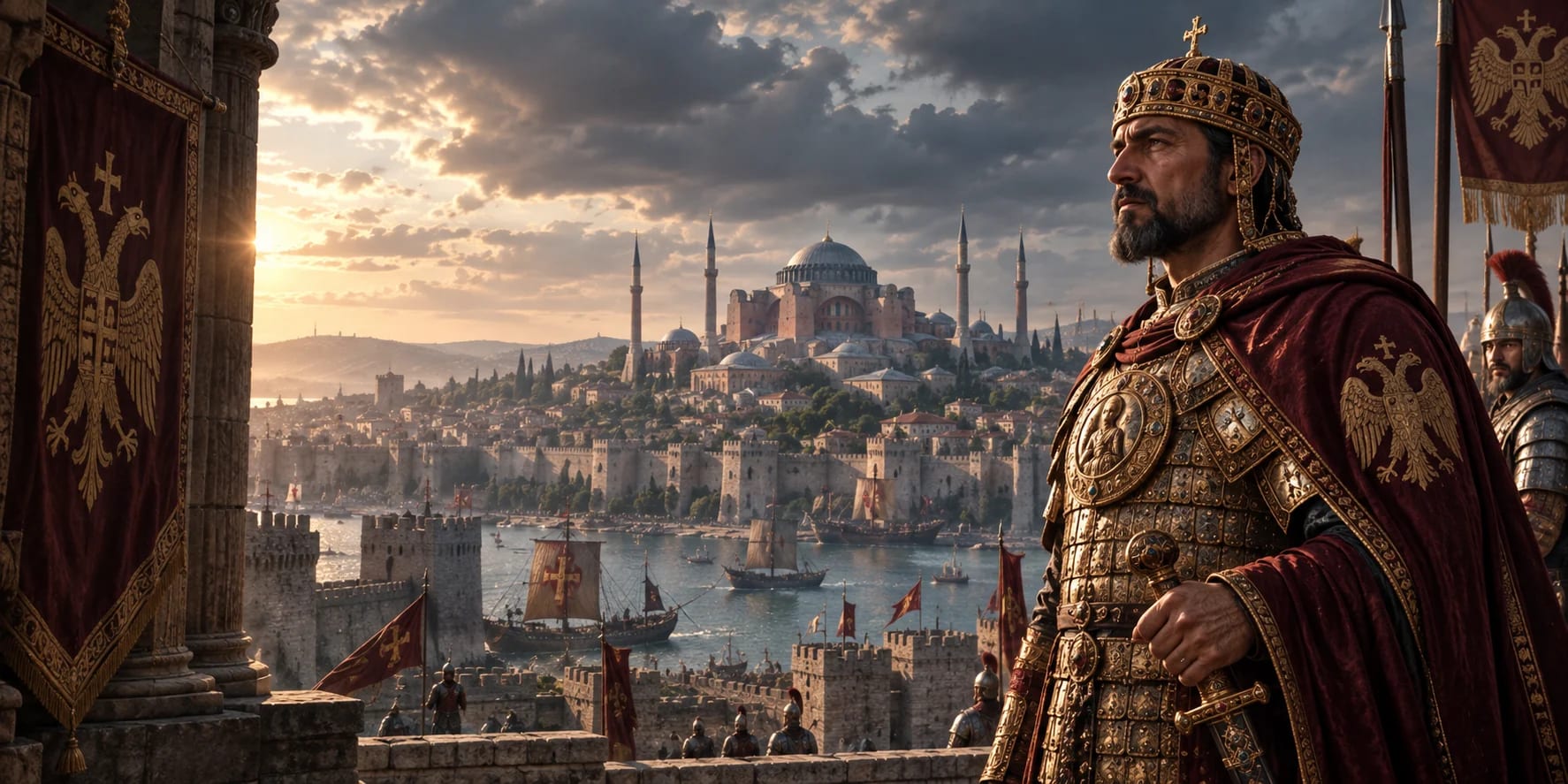
The supplied hero is an editorial historical reconstruction, not an authenticated portrait or a precise view of one Byzantine moment. Its skyline blends periods: the minarets around Hagia Sophia belong to the building's Ottoman history, after the medieval Roman city fell.
CONSTANTINE'S NEW ROME
In 330, Constantine inaugurated Constantinople on the site of the older city of Byzantion. The new imperial center took his name and became known as New Rome. Its position near the Bosporus placed it at the meeting of routes between the Mediterranean and Black Sea, and between the Balkans and Anatolia.
Constantine did not create a separate “Byzantine nation.” He was a Roman emperor reorganizing Roman power. Nor did a single ceremony instantly erase the importance of older capitals and regional centers. Constantinople's political, ecclesiastical and economic authority developed over time. The Metropolitan Museum of Art: Byzantium, ca. 330–1453
The site's advantages were substantial, but geography alone did not build a metropolis. Water supply, food imports, harbors and construction required investment. The capital's location could create opportunities only if a government could maintain the infrastructure that made them usable. Even this apparently ideal city had vulnerabilities, including dependence on its hinterland and the difficulty of providing drinking water. Oxford Classical Dictionary: Constantinople
WERE THE BYZANTINES ACTUALLY ROMANS?
Yes—in the central political sense that matters here. Their state continued the eastern Roman Empire, and many inhabitants called themselves *Rhomaioi*, Romans. “Byzantine Empire” is a later scholarly convention derived from Byzantion, the city's ancient name. It helps historians identify a period; it can mislead readers when it implies that Rome ended and an unrelated civilization took its place.
Language and religion changed across the centuries. Greek became dominant in administration and intellectual life, while Christianity shaped imperial authority and communal belonging. Neither development automatically abolished Roman identity. Rome had always governed people who spoke different languages, and its institutions had changed many times before Constantine. Anthony Kaldellis: The New Roman Empire
There is a useful qualification. Medieval authors could use words derived from Byzantion for Constantinople and its inhabitants. Saying that nobody ever used the word “Byzantine” would be too absolute. What is later is the standard practice of naming the entire medieval empire “Byzantine” as though that were its own official identity. Cambridge: Eastern Roman identity and the term Byzantine
The result is continuity with transformation. These were not the Romans of Augustus preserved unchanged behind walls. They were medieval Romans whose society had developed its own forms of government, worship and culture. Their history belongs within the larger story of the Roman Empire, not outside it.
WHY THE EAST SURVIVED WHEN THE WEST DID NOT
The conventional date 476 marks the deposition of the western emperor Romulus Augustulus. It is a useful landmark in the collapse of western imperial government, not a moment when Roman life, law or identity disappeared everywhere. The eastern imperial court and its institutions continued. Oxford Centre for Late Antiquity: the late Roman Empire
The East retained access to rich agricultural regions, important cities and systems for collecting revenue. Egypt was especially significant to the sixth-century state's economy. Taxes were the link between productive households and imperial armies: wealth mattered politically when officials could actually mobilize it. Landowners' ability to evade taxation could weaken that connection even in a prosperous region. Peter Sarris: Economy and Society in the Age of Justinian
The eastern state also retained an exceptionally defensible capital. Emperors could use armies, payments, negotiations and shifting alliances rather than rely on winning every battle. Survival did not mean avoiding humiliation or paying no price. It often meant accepting a temporary disadvantage while preserving the means to recover.
Scholarship on eastern Roman resilience emphasizes administration, access to resources and environmental conditions together. No single weapon or inspired ruler explains the outcome. The state could lose territory yet reorganize what remained, keeping institutions functioning at a reduced scale. That capacity would become even more important after the shocks of the seventh century. John Haldon and colleagues: managing the Roman Empire for the long term
WHY WAS CONSTANTINOPLE SO DIFFICULT TO CONQUER?
A capital protected by water and walls
The historic city occupied a peninsula, with the Golden Horn to the north and the Sea of Marmara to the south, near the Bosporus. An attacker needed to solve several problems at once: approach the land defenses, contest the water and prevent supplies or reinforcements from reaching the city.
The Theodosian land walls, originating in the early fifth century, protected the western approach. Their developed system combined a moat, an outer wall and a higher main wall with towers. This created successive obstacles rather than one surface an enemy could breach and immediately leave behind. Repairs and additions continued across centuries; the walls' effectiveness depended on people maintaining and defending them. Columbia University: the land walls of Constantinople
The Golden Horn provided a sheltered harbor. A defensive chain could obstruct hostile ships at its entrance, but it was part of a larger defensive arrangement involving vessels, fortifications and crews. A harbor barrier could buy security; it could not replace a navy or solve every threat from the sea. The defenses also had stronger and weaker sectors, a distinction that remained important in 1453. Anthony Kaldellis: the strategy of the defenders
Time was a defensive resource
A besieging army had to eat, remain organized and keep its political leadership committed. A city that resisted an initial assault forced its enemies into a prolonged and expensive undertaking. Constantinople's defenses repeatedly made that possible.
The walls were therefore more than an architectural achievement. They preserved time for diplomacy, relief, changes in enemy politics or a shift in military fortunes. Yet the captures of 1204 and 1453 demonstrate their limits. The city was extraordinarily difficult to take, never literally unconquerable.
JUSTINIAN AND THEODORA: IMPERIAL AMBITION AT ITS HEIGHT
Justinian I, who ruled from 527 to 565, envisioned an empire able to assert Roman authority through law, religion, building and war. Theodora was an influential imperial partner, not merely a decorative presence beside him. Their portraits in the mosaics of San Vitale at Ravenna embody the close relationship between sovereignty, ceremony and Christianity. The Metropolitan Museum of Art: the Byzantine state under Justinian
Their reign is difficult to reconstruct without confronting the literary character of its sources. Procopius could praise imperial achievements in one work and attack the rulers ferociously in another. His accounts preserve essential evidence, but neither courtly praise nor hostile scandal should be mistaken for unfiltered access to their personalities. Procopius: The Secret History, introduction and translation
The Nika riots
In January 532, unrest associated with Constantinople's racing factions developed into a major challenge to Justinian. Opposition spread beyond the Hippodrome, parts of the city burned and the regime's survival was in doubt. The old Hagia Sophia was among the buildings destroyed.
In Procopius's account, Theodora argues against flight, and imperial forces ultimately suppress the uprising with mass killing. His famous presentation of her speech is a literary reconstruction, not a transcript. The episode should not be reduced to a colorful story about sports fans: political grievances, elite interests and the coercive power of the state were involved. Procopius on the Nika revolt, via CUNY, Geoffrey Greatrex: the Nika riot reassessed
Hagia Sophia rises from the destruction
Justinian commissioned the surviving Hagia Sophia after the revolt. Designed by Anthemius of Tralles and Isidore of Miletus, it was built between 532 and 537 and inaugurated on December 27, 537. Its immense central space, colored marble and dome gave architectural form to imperial and religious ambition.
The achievement was not mechanically flawless. The original dome collapsed in 558 and was rebuilt, with the replacement completed in 562. Hagia Sophia's survival is a history of repairs and adaptation as well as sixth-century engineering. Its name means Holy Wisdom; it is not a dedication to a saint named Sophia. The Metropolitan Museum of Art: Hagia Sophia, 532–37
Recovering the West—and organizing Roman law
Justinian's armies defeated the Vandal kingdom in North Africa in 533–534. The campaign against the Ostrogoths in Italy began in 535 and became a long, destructive war. Imperial authority also returned to part of southern Spain. These were major reconquests, but not the recovery of the entire old western empire, and their costs fell heavily on the populations and resources involved. The Cambridge Companion to the Age of Justinian: introduction
His legal project had a different kind of longevity. The compilation later known collectively as the *Corpus iuris civilis* organized imperial enactments, selections from Roman jurists and an introductory legal textbook. The Code's revised edition appeared in 534, alongside the wider work of the Digest, Institutes and subsequent new laws. Justinian did not invent Roman law; his government selected, revised and made authoritative a vast inherited tradition. Cambridge University Press: Corpus iuris civilis, Treccani: the compilation and its chronology
The contrast within the reign is striking. Armies could win provinces that successors would struggle to hold. A legal compilation could travel into societies that Justinian's soldiers had never reached.
PERSIA, HERACLIUS AND THE SEVENTH-CENTURY EMERGENCY
The Sassanid Persian Empire was a formidable rival, not a temporary obstacle on Rome's eastern frontier. Their last great war, from 602 to 628, brought the eastern Roman state close to disaster. Persian armies took Jerusalem and Egypt and reached the Bosporus. Heraclius, emperor from 610, eventually carried the war into Persian territory, drawing on alliances as well as military campaigning. Peace in 628 reversed the territorial losses. James Howard-Johnston: the Persian Wars, 602–628
Victory did not restore an untouched empire. Fighting and occupation had disrupted regions that supported imperial power. Both great states faced a changing environment just as armies formed under the new Islamic polity expanded beyond Arabia.
The Byzantine defeat at Yarmuk in 636 was a decisive stage in the loss of Syria. Egypt followed in the early 640s, and imperial territory in North Africa was lost over the later seventh century. These conquests changed the eastern Mediterranean's political and fiscal geography. The loss was not only a matter of colored space disappearing from a map: it meant fewer taxpayers, different supply networks and the separation of long-connected communities. The Cambridge History of the Byzantine Empire: seventh-century transformation
The empire survived in a smaller form centered increasingly on Anatolia, the capital and its remaining European territories. Administration, military organization and patterns of settlement adapted unevenly. The military-administrative districts known as themes emerged through a process of change, not one perfectly documented reform imposed everywhere on a single date. Roman statehood persisted while much of the late antique world around it was transformed. John Haldon: The Empire That Would Not Die
ARAB SIEGES AND THE REALITY OF GREEK FIRE
Constantinople remained a major objective for the caliphate. The conventional account of a first prolonged Arab siege in 674–678 has been challenged by scholarship comparing Greek and non-Greek sources, including proposals for a different chronology. It is safer to recognize the major seventh-century attacks while acknowledging that their familiar sequence is contested. Marek Jankowiak: reassessing the first Arab siege
The siege of 717–718 is a firmer landmark. The Arab attempt to capture the city failed, preserving the imperial center. Even this struggle was not a simple collision of two undifferentiated religious blocs: research on Egyptian sailors who defected to the Roman side shows how loyalties and experience complicated the broad categories. Oxford research: Romans, Egyptians and the siege of 717–718
Greek Fire belongs to this history of naval defense. It was an incendiary weapon, not magic. Specialist research strongly supports a petroleum basis; popular claims identifying it as gunpowder or a supernatural substance are misleading. The precise historical preparation and the full details of its deployment remain uncertain. Medieval descriptions and images must be interpreted rather than treated as a surviving technical manual.
Its importance also lay in equipment, trained crews and the circumstances in which it was used. No substance could eliminate the need for ships, maintenance or judgment. The secret weapon is an arresting image; the state capable of sustaining its use is the larger historical story. John Haldon: Greek Fire revisited
ICONOCLASM: A CHRISTIAN EMPIRE ARGUES ABOUT IMAGES
In the eighth and ninth centuries, Byzantine rulers and churchmen disputed the proper use of religious images. Opponents of icons feared idolatry. Defenders distinguished reverence directed through an image from worship owed to God, and argued that Christ's incarnation made depiction possible.
The controversy had phases. The council at Nicaea in 787 supported the veneration of icons; imperial iconoclasm returned in 815; restoration in 843 became a defining moment in Orthodox memory. The evidence does not justify imagining a uniform campaign that destroyed every image everywhere. Regional practice, political power and later accounts of the dispute complicate that picture. The Metropolitan Museum of Art: understanding Iconoclasm
The debate changed subsequent art rather than ending it. Middle Byzantine objects show carefully developed religious imagery alongside evidence of contact with neighboring societies. Material culture makes visible a world of diplomacy, trade and exchange that a chronology of wars alone can miss. Dumbarton Oaks: Middle Byzantine art
THE MACEDONIAN REVIVAL AND BASIL II
The Macedonian dynasty, conventionally dated 867–1056, belongs to a period of renewed imperial strength and cultural confidence. Artists reworked classical forms, producing ivories and other objects valued well beyond the empire's borders. “Renaissance” here means creative engagement with inherited traditions, not the sudden rediscovery of a past that everyone had forgotten. Royal Ontario Museum: art of the Macedonian Renaissance
Basil II, whose senior reign lasted from 976 to 1025, illustrates the distance between difficulty and later reputation. His early years involved dangerous domestic opposition. By the end of his reign, the empire had greatly expanded its authority. Bulgaria was annexed in 1018 after prolonged warfare; imperial power also extended on eastern frontiers.
Basil's later reputation as the “Bulgar-slayer” should not replace analysis of how his government worked. Catherine Holmes's research emphasizes the interaction of force, persuasion and flexible administration. Conquest did not remove the need to work with local structures. The Christianization of the Rus under Vladimir, conventionally dated 988, also extended Byzantine religious influence far beyond direct imperial rule. Catherine Holmes: Basil II and the Governance of Empire, Holmes: administration on the western frontiers
This period alone disproves the idea of Byzantium as a civilization declining continuously from Constantine onward. Recovery was real. So were the violence, political struggles and administrative compromises through which it was achieved.
ORTHODOXY AND THE LONG ROAD TO SCHISM
Christianity was central to Byzantine government and everyday life, but the relationship between emperors, patriarchs, bishops and communities was never free of conflict. The empire's religious history also reached beyond its borders through worship, missions, translations and artistic influence.
The year 1054 conventionally marks the Great Schism between the churches of Rome and Constantinople. Papal legates and the patriarch's side exchanged condemnations amid disputes over authority and religious practice. But no single day instantly divided every Christian community into the modern Catholic and Orthodox worlds. The estrangement developed over a longer period, with arguments about papal primacy, liturgy and doctrine, including the Western addition of the *filioque*—meaning “and the Son”—to the creed’s statement about the Holy Spirit.
Treating 1054 as a landmark rather than a complete explanation makes later events easier to understand. Cooperation remained possible; so did deepening hostility. The violence of 1204 would give church division an especially bitter political and human meaning. Brett Edward Whalen: Rethinking the Schism of 1054
MANZIKERT AND THE CRUSADES: ALLIANCE WITHOUT TRUST
In 1071, the Seljuk ruler Alp Arslan defeated and captured Emperor Romanos IV at Manzikert. The battle became a symbol of Byzantine collapse in Anatolia, but it was not a single afternoon in which the whole eastern army and all imperial control disappeared. Civil war and aristocratic competition after the defeat helped turn a serious military setback into a broader political disaster. Turkish groups gained opportunities through these struggles as well as through conquest. Georgios Theotokis: The Campaign and Battle of Manzikert, 1071
Under Alexios I Komnenos, Byzantium sought military assistance from the Latin West. His appeals formed part of the background to the First Crusade. But an emperor hoping to recover territory and western leaders pursuing armed pilgrimage did not necessarily want the same political outcome. Assistance could become rivalry over cities, oaths and authority. Cambridge: Alexios I and the call from the East
Byzantine–Latin relations cannot be reduced to either permanent friendship or inevitable hatred. Trade and military cooperation existed beside suspicion and violence. The crusaders were not always imperial allies, and the empire's western connections were not limited to crusading armies. The catastrophe of the Fourth Crusade emerged from this complicated world rather than from an eternal conflict between two sealed civilizations.
1204 — THE WOUND BYZANTIUM NEVER FULLY RECOVERED FROM
The Fourth Crusade was intended to advance the campaign in the eastern Mediterranean, with Egypt as a planned target. Financial difficulties, Venetian involvement and a Byzantine succession dispute diverted it toward Constantinople. The claimant Alexios IV promised money and support that his restored regime could not securely deliver. Conflict escalated into the capture and sack of the city in April 1204.
The result was not merely a change of emperor. Crusaders and their partners seized territory and created a Latin Empire at Constantinople. Byzantine authority fragmented into competing successor centers, including Nicaea and Epirus; Trebizond also emerged as a separate Roman imperial polity. Cambridge: the Frankish conquest of Greece
The historian Niketas Choniates witnessed the catastrophe. His account describes plunder, desecration and violence against the population. It is an anguished, rhetorically powerful testimony, not a neutral inventory. Yet the city's suffering must remain central: the political map changed through events experienced by people as the destruction of homes, security and sacred places. Niketas Choniates: the sack of Constantinople
In 1261, forces of the Nicaean state recovered Constantinople, restoring imperial rule under Michael VIII Palaiologos. Restoration did not simply reverse fifty-seven years of fragmentation. Rival states, Latin possessions and competing interests endured. The recovered capital no longer commanded the same integrated political and economic world. The Metropolitan Museum of Art: Latin occupation and restoration
Historians regard 1204 as a major turning point because it broke institutions and territorial connections on which imperial strength depended. Even after 1261, political fragmentation persisted. Still, the next two centuries should not be treated as a prewritten countdown to Ottoman victory: later rulers made consequential choices, and Byzantine cultural life remained active. Judith Herrin and Guillaume Saint-Guillain, editors: identities after 1204
THE OTTOMAN RISE AND BYZANTIUM'S SHRINKING WORLD
The Ottoman polity emerged around 1300 in northwestern Anatolia and expanded into a major power on both sides of the straits. Its rise was a historical process, not an automatic transfer of all former Byzantine territory to a single successor. Regional competition, military resources and opportunities created by neighboring conflicts mattered. The Cambridge History of Turkey: Byzantium to Turkey, 1071–1453
For the restored Byzantine Empire, civil conflicts and territorial losses narrowed the resources available to defend the capital. By the fifteenth century, Constantinople was an imperial city with a drastically reduced state behind it. The dignity of the title could no longer conceal the imbalance in land, revenue and manpower.
Yet earlier Ottoman attempts had failed. Constantinople survived sieges in 1411 and 1422. The proposed union of the churches at Florence in 1439 became part of the effort to secure western support, while provoking intense opposition within Byzantine society. The final generation therefore lived amid difficult political choices, not simply passive expectation of an inevitable end. Nevra Necipoğlu: Constantinople's last fifty Byzantine years
1453: CONSTANTINE XI, MEHMED II AND THE FINAL SIEGE
Constantine XI faced a formidable Ottoman state under Mehmed II. The siege that culminated on May 29, 1453, lasted for weeks, with its main operations beginning in early April. It was an organized contest over fortifications, supply and endurance, not an effortless entry into a defenseless city. Cambridge History of Islam: the rise of the Ottoman Empire
Cannons, ships and stubborn resistance
Ottoman artillery battered the land defenses. Heavy guns could damage old masonry, but bombardment did not immediately make the walls irrelevant. Defenders repaired damage and reinforced threatened positions. Genoese and Venetian participants fought alongside the emperor's forces; Giovanni Giustiniani played a leading role in the defense.
At sea, the chain across the Golden Horn complicated Ottoman access. Mehmed's forces transported ships overland into the inlet, increasing pressure on the defenders and forcing them to consider threats on another front. This was an important development, not a single maneuver that instantly ended the siege. World History Encyclopedia: the fall of Constantinople
The Venetian eyewitness Niccolò Barbaro records the exhausting rhythm of alarms, bombardment and naval encounters. His diary also reveals confidence at particular moments, rather than universal despair. It is valuable precisely when read critically: he favors his own community, writes with religious hostility toward the attackers and gives figures that should not automatically be accepted as exact. Barbaro's diary, translated excerpt via De Re Militari
May 29, 1453
The final Ottoman assault broke the defense. Giustiniani was wounded and withdrew; Ottoman troops gained entry, and organized resistance collapsed. Constantine XI died during the fall. The precise circumstances of his last moments are uncertain, and later heroic scenes should not be presented as eyewitness certainty. World History Encyclopedia: the final assault
The consequences for civilians included killing, plunder and enslavement. Calling the event the end of an empire is accurate, but incomplete: it was also a catastrophe within households and communities. The captives' fate is part of the conquest's history, not an epilogue beneath the story of two rulers.
Anthony Kaldellis's 2026 Oxford University Press study argues that the defense was a serious undertaking and not a lost cause from the beginning. That interpretation does not deny Ottoman strength. It asks us to judge the siege through the options, pressures and uncertainties that participants faced, rather than infer inevitability from the result. Failure was possible for an attacker even when the defending state was much weaker. Kaldellis: 1453—The Conquest and Tragedy of Constantinople
CONSTANTINOPLE AFTER THE CONQUEST
Mehmed acquired more than a symbolic prize. Constantinople stood within the geographical heart of his expanding domains, and its conquest helped establish a new imperial center. Ottoman rule would rebuild and repopulate the city, giving it new institutions and monumental forms. Conquest brought rupture; the city that followed was not created on an empty site. Ebru Boyar and Kate Fleet: A Social History of Ottoman Istanbul
Hagia Sophia became a mosque after 1453. Minarets and other Ottoman interventions changed its appearance and use, while its sixth-century structure remained central to the building. Its later history included a period as a museum and conversion back to a mosque in 2020. The layers visible today belong to different eras. The Metropolitan Museum of Art: Hagia Sophia's later history, UNESCO: the 2020 change of status
The name Istanbul should not be projected unchanged across Byzantine history. Constantinople and New Rome belong to the city's medieval imperial vocabulary. Conversely, it is misleading to imagine every older name vanished on the morning of conquest. The city's names have a history as layered as its buildings.
BYZANTINE EMPIRE: MYTH VS REALITY
“Byzantium was a completely separate civilization from Rome.”
It was the continuation of the eastern Roman state, transformed across centuries. Greek language and Orthodox Christianity developed within that Roman history. A modern label should not erase the identity of the people being described.
“It was called Istanbul throughout the Byzantine period.”
Constantinople is the appropriate conventional name for the medieval Roman capital. Using today's name to locate it geographically is reasonable; substituting it for the empire's historical identity is not.
“Greek Fire was magical—or a fully solved secret.”
It was a real incendiary technology. A petroleum basis is strongly supported, but the precise historical system is incompletely understood. Confident modern recipes and claims of supernatural properties exceed the evidence.
“The empire declined continuously for a thousand years.”
The recoveries of the middle Byzantine period, Basil II's expansion and later cultural achievements contradict that picture. Decline describes particular developments, not an explanation that can substitute for eleven centuries of history.
“The crusaders were always Byzantine allies.”
Their interests sometimes overlapped with imperial goals and sometimes collided. The Fourth Crusade captured and partitioned a Christian empire. Shared religion did not prevent conquest.
“The Ottoman victory in 1453 was effortless.”
The city resisted a sustained siege. Artillery, maritime pressure, repair work, leadership and the final assault all mattered. A major Ottoman achievement does not become more impressive by pretending there was no serious defense.
WHAT SURVIVED THE EMPIRE?
Roman law outlived the state through the transmission and later study of Justinian's compilations. Orthodox Christianity continued in communities whose existence did not depend on one emperor. Byzantine artistic and architectural traditions shaped worship and visual culture far beyond former imperial borders.
Greek scholarship was another enduring contribution. Byzantine readers copied, corrected, interpreted and taught ancient texts. They were active intellectual participants, not merely custodians storing manuscripts for someone else's Renaissance. Modern access to much Greek literature depends on those medieval acts of selection and transmission. Other cultures also preserved and developed ancient learning; recognizing Byzantium's role does not require making it the sole savior of classical knowledge. The Cambridge Intellectual History of Byzantium: introduction
The late empire's intellectual activity also warns against equating political weakness with cultural emptiness. Scholarship and creativity continued while imperial territory contracted. The relationship between state power and cultural life was more complicated than a rising or falling line on a map. Steven Runciman: The Last Byzantine Renaissance
Its diplomacy leaves a further lesson: endurance may depend on negotiation, compromise and the preservation of options as much as on conquest. Like the Mongol Empire, Byzantium also belongs to a connected Eurasian history in which ideas and institutions moved across political and religious frontiers.
May 29, 1453, ended the Roman imperial government at Constantinople. It did not end the histories of its people, its buildings or its traditions. For the Ottomans, the conquest opened a new imperial era centered on the same extraordinary city.
The eastern Roman Empire survived for roughly another millennium because it repeatedly changed the means by which it remained Roman. Its walls mattered. So did its taxpayers, sailors, negotiators, soldiers, builders and scholars. The empire eventually lost its capital; the world continued to live among what it had made.
SOURCES AND HISTORICAL METHOD
This account draws on Oxford and Cambridge scholarship, university research, Dumbarton Oaks, museum collections and translated primary narratives. Links beside the discussion identify the evidence; the reference list below collects them for further reading.
Procopius, Choniates and Barbaro are treated as authors with particular loyalties and literary purposes, not transparent witnesses to every event. Disputed siege chronology, speeches, weapon details and accounts of Constantine XI's death are identified as uncertain. The article distinguishes established events from modern interpretations, including Kaldellis's reassessment of the defense in 1453.
FAQ
Frequently Asked Questions
What is this PRESDA article about?
Rome did not disappear in 476. From Constantinople, its eastern empire endured through conquest, faith, catastrophe and reinvention—until a final siege opened a new imperial age.
Which category does this story belong to?
This story is part of PRESDA's History coverage.
Who published this article?
BYZANTINE EMPIRE: THE ROME THAT SURVIVED FOR ANOTHER 1,000 YEARS was published by PRESDA Editorial on PRESDA.
PRESDA Dispatch
Stay Informed. Stay Aware.
A sharp briefing across AI, gaming, sport, business, world affairs, paparazzi, and lifestyle.