ANCIENT ARMENIA: TIGRANES THE GREAT AND THE KINGDOM BETWEEN ROME AND PERSIA
Ancient Armenia developed in the Armenian Highlands between Rome and Iranian empires, reached a brief peak under Tigranes the Great and preserved its identity through dynastic change and Christianity.
Ancient Armenia was not a single state with the borders of the modern Republic of Armenia. It was a changing collection of kingdoms and dynastic territories across the Armenian Highlands, a region that includes parts of today's eastern Turkey, Armenia, Georgia, Azerbaijan and northwestern Iran. At different moments, rulers in this highland crossroads negotiated with Assyria, Persia, Rome, Parthia and Byzantium. Tigranes II briefly turned Armenia into a major imperial power, but his expansion was more varied and temporary than later nationalist maps suggest.
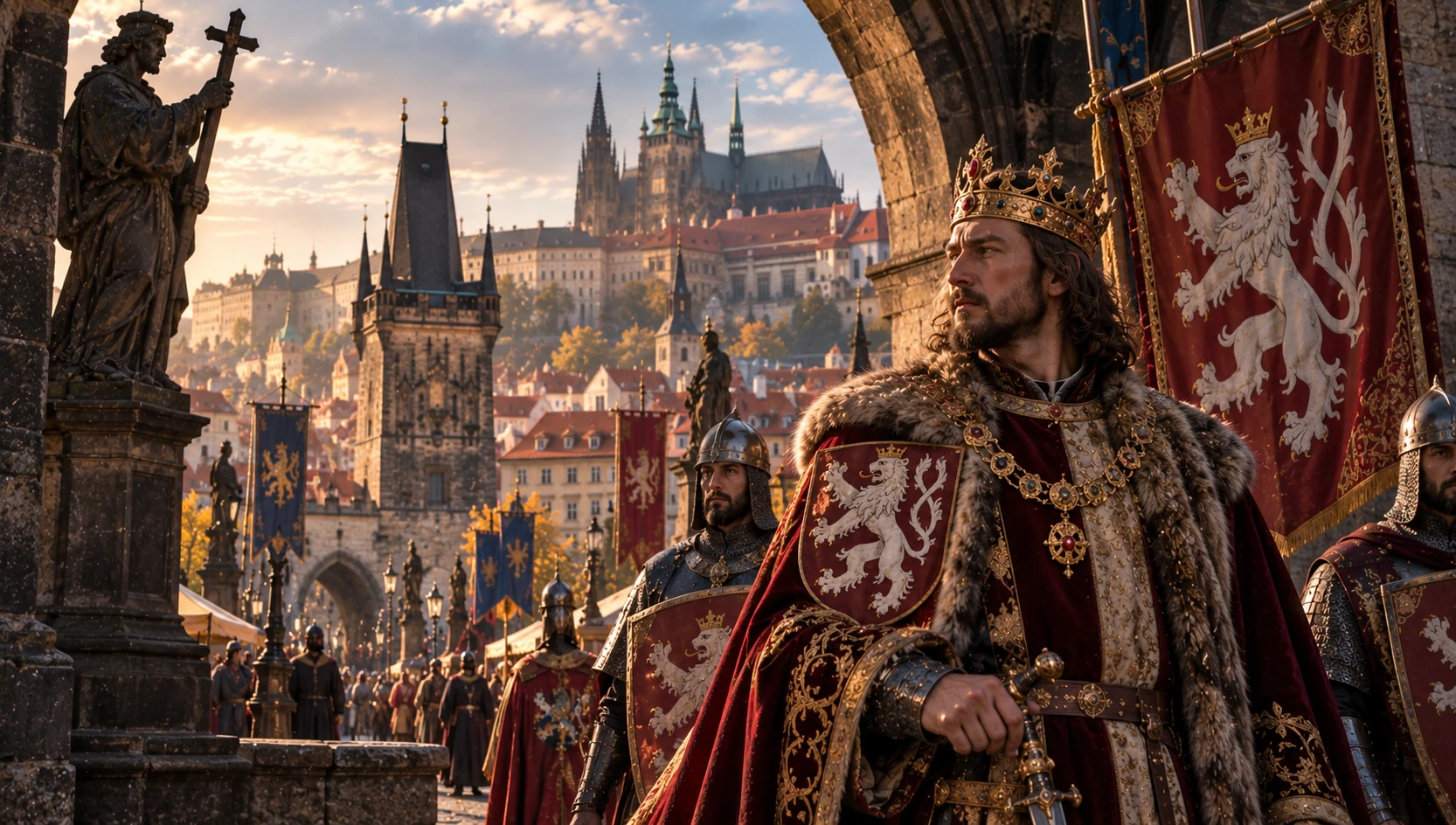
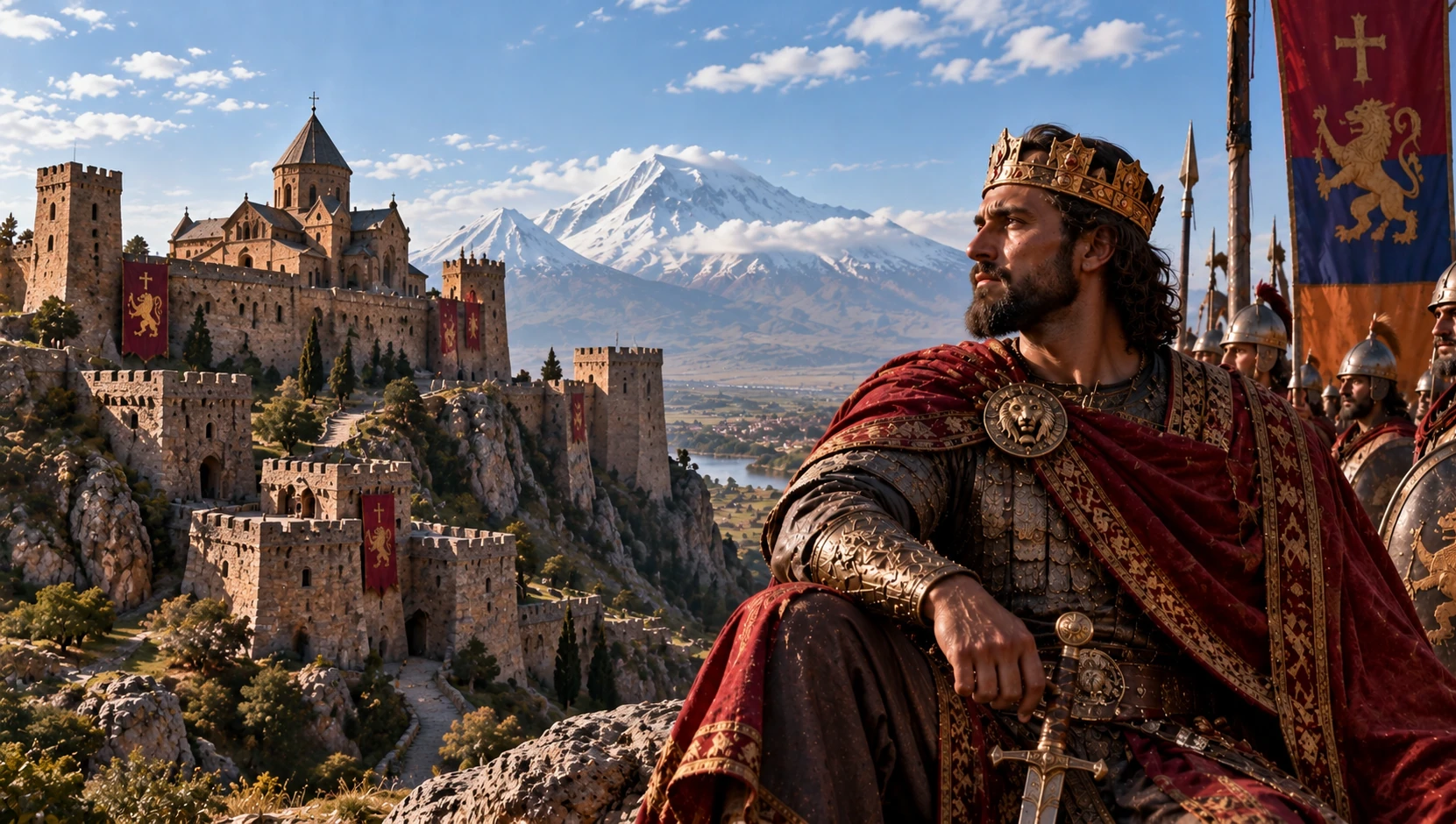
The supplied hero image is an editorial reconstruction. It is not an authentic portrait of Tigranes the Great, nor a documentary view of a particular ancient Armenian fortress.
URARTU AND THE ARMENIAN HIGHLANDS
From the ninth to the sixth centuries BCE, the kingdom known in its own inscriptions as Biainili and in Assyrian sources as Urartu controlled much of the territory around Lake Van. Its rulers built fortified centers, irrigation channels and monumental architecture, including the citadel at Tushpa, near modern Van. Cuneiform inscriptions show an organized state whose language was distinct from Armenian and whose political world was connected to Assyria, Anatolia and the Caucasus.
Urartu is part of Armenia's deep regional history, but it should not simply be renamed an Armenian kingdom. After Urartu's political collapse, local populations, institutions and place traditions continued in changing forms, while new Iranian and Anatolian powers ruled the region. Scholars debate how much demographic and cultural continuity linked Urartu to later Armenians. The Armenian language appears in later evidence, and no simple one-to-one ethnic succession can be demonstrated from the surviving record.
ORONTIDS AND THE EMERGENCE OF ARMENIA
After the Achaemenid Persian conquest, the Armenian Highlands were administered through satrapal and local dynastic structures. The Orontid, or Eruandid, family appears in Persian, Greek and later Armenian traditions, but the evidence does not describe an uninterrupted centralized kingdom with fixed borders. Greater Armenia, Lesser Armenia and Sophene were often distinct political units, and their rulers balanced Persian, Seleucid and regional interests.
Alexander's conquest of the Achaemenid Empire and the rise of the Seleucids changed the diplomatic map without erasing local dynasties. Armenian rulers adopted Iranian titles and court practices while participating in Hellenistic political culture. The result was a frontier society whose elite could use several languages and traditions. Armenia emerged as a recognizable kingdom through this gradual combination of local power, imperial competition and dynastic marriage.
ARTAXIAS I AND ARTASHAT
The Artaxiad dynasty rose after the Seleucid defeat by Rome at Magnesia in 190 BCE. Artaxias I, who had served the Seleucids, became king of a stronger Armenian state around 189 BCE. Greek and Roman writers describe his consolidation, while boundary stones and inscriptions associated with his reign provide important local evidence. Artaxias sought to bring neighboring districts under a more coherent monarchy, but the extent and durability of his control varied.
Artaxias founded Artashat on the Araxes River, a city that became a political and commercial center. Its location connected the highlands to routes toward Anatolia, the Iranian plateau and the Caucasus. The Artaxiad court used Iranian royal traditions alongside Hellenistic forms, and Armenian political culture developed through this mixture rather than through a clean break with earlier empires.
TIGRANES THE GREAT AND A SHORT IMPERIAL PEAK
Tigranes II ruled approximately from 95 to 55 BCE. He inherited a kingdom positioned between the Parthian Empire, the declining Seleucid realm and the expanding powers of Pontus and Rome. Ancient sources describe a period in which Tigranes recovered territories, strengthened the Artaxiad monarchy and projected authority far beyond the Armenian heartland. His title, King of Kings, expressed imperial ambition, but it did not mean that every region was governed through the same institutions.
Tigranes formed an alliance with Mithridates VI of Pontus and married Mithridates' daughter, Cleopatra of Pontus. The partnership joined two rulers who challenged Roman influence in Anatolia. Tigranes also benefited from the weakening Seleucid state. He annexed or subordinated parts of Syria and northern Mesopotamia, took control of important routes and extended influence toward the Mediterranean and the Caucasus. Some places paid tribute or accepted a client relationship rather than becoming directly administered Armenian provinces.
Tigranocerta, founded in the first century BCE, was intended as an imperial capital and royal showcase. Its precise location is debated, though it was probably in the region of modern Diyarbakir or nearby southeastern Anatolia. Tigranes transferred populations from conquered cities to help build and populate new centers, a common ancient imperial practice. The court gathered Armenian, Iranian, Greek, Syrian and other officials, soldiers and merchants. Tigranocerta's rapid rise also made it vulnerable when Roman armies attacked.
The court's wealth came from agricultural districts, customs on long-distance routes, tribute and the movement of armies. Armenian highland valleys produced grain, wine and livestock, while caravan roads connected Mesopotamia to the Black Sea and the Caucasus. Tigranes could draw on local noble retinues and on soldiers recruited from the many peoples under his authority. That military reach was impressive, yet maintaining garrisons and supplying distant campaigns placed heavy demands on a kingdom whose administrative machinery was still developing.
Royal building and coinage communicated a deliberate imperial language. Greek remained important for inscriptions and diplomacy, Iranian titles expressed kingship, and local traditions tied the monarchy to Artaxiad ancestors and sacred landscapes. The court was therefore neither a copy of Rome nor an isolated Armenian institution. Its hybrid culture reflected the position of Armenia at the meeting point of Hellenistic, Iranian and Caucasian worlds.
Armenian coinage helps show how Tigranes presented royal power. Tetradrachms portray him with a distinctive tiara and Greek legends, while mints associated with Damascus, Artashat and Tigranocerta reflect the geographical reach of his administration. Coins project authority, but they do not prove uniform control across every territory claimed in literary accounts. The maximum map of Tigranes' power was a political network of core lands, garrisons, tribute and allied rulers, not a permanently integrated nation-state.
ROME, LUCULLUS AND POMPEY
Tigranes initially tried to avoid becoming the main target of Rome's war against Mithridates. The Roman commander Lucius Licinius Lucullus demanded that he surrender Mithridates, who had taken refuge in Armenia. Tigranes refused, and Roman forces crossed into his kingdom in 69 BCE. At the Battle of Tigranocerta, Roman troops defeated an Armenian army and captured the new capital. Ancient authors provide dramatic figures for the armies, but their numbers are not reliable demographic statistics.
Lucullus then moved toward Artaxata, the older Armenian capital. Difficult terrain, resistance and dissatisfaction among Roman troops weakened his campaign. Tigranes recovered some positions, and Roman politics recalled Lucullus. In 66 BCE Pompey took command and pursued a settlement after a new Roman advance. Tigranes submitted, retained the Armenian core and his royal title, but surrendered western conquests, paid an indemnity and accepted a relationship in which Rome gained strategic leverage.
The loss of the short-lived empire did not erase Armenia. Its highland core remained valuable because it connected Mesopotamia, Anatolia, the Caucasus and the Iranian plateau. Armenian rulers could lose a city or province while retaining dynastic legitimacy, local aristocracies and a difficult mountainous base. Rome and Parthia therefore competed to influence Armenia without always being able to absorb it completely.
BETWEEN ROME AND PARTHIA
After Tigranes, Artaxiad rulers such as Artavasdes II navigated a dangerous relationship with Rome and Parthia. The kingdom could serve as an ally, buffer or battlefield depending on the reign. Roman intervention in Armenian succession was often balanced by Parthian support for rival candidates. This was not a passive borderland. Armenian kings, nobles and military leaders used imperial rivalry to preserve autonomy and pursue their own interests.
In the first century CE, the Arsacid dynasty, related to the Parthian royal house, became central to Armenian politics. Tiridates I was recognized as king after conflict involving Rome and Parthia. Nero's settlement in the 60s CE allowed Tiridates to receive his crown in Rome in 66, a carefully staged compromise: Armenia kept its own monarchy, while Rome claimed a role in confirming the ruler. The episode illustrates how sovereignty was negotiated through ceremony, military pressure and dynastic diplomacy.
ARSACID ARMENIA AND SASANIAN PRESSURE
Armenia remained contested after the Arsacid restoration. Roman emperors and Parthian, later Sasanian, kings intervened in succession and military affairs. The kingdom's rulers and nobles were not simply agents of either empire, and the Armenian church and aristocracy developed institutions that could resist external control. Dvin became an important political and commercial center, linking the plateau to the Caucasus and Mesopotamia.
The partition agreed between Rome and Sasanian Persia in 387 reduced the territory of the Armenian monarchy and placed different regions under different imperial authorities. In 428 the Arsacid monarchy in the Persian sphere ended, and a Sasanian governor, or marzpan, administered much of eastern Armenia. The Byzantine side also reorganized its Armenian territories. The end of a unified monarchy was not the end of Armenian society, language or religious institutions.
Partition also meant that Armenian nobles operated in more than one imperial legal and military system. Some served as cavalry commanders, tax intermediaries or governors; others defended hereditary estates and church foundations. Persian authorities could support Armenian aristocratic autonomy when it helped secure the frontier, while Roman authorities used titles and subsidies to cultivate loyal houses. These arrangements shifted with war, and local communities experienced taxation, conscription and religious pressure differently from one district to another.
CHRISTIANITY, GREGORY AND THE ARMENIAN ALPHABET
Christian communities existed in Armenia before royal conversion. According to Armenian tradition, Gregory the Illuminator converted King Tiridates III and became the founding bishop of the Armenian Church. The traditional date for the kingdom's conversion is 301, but historians debate the chronology and often place official adoption in the early fourth century, sometimes around 314. The evidence does not support treating 301 as an undisputed exact date.
Christianity gave Armenian institutions a durable framework during the loss of the monarchy. Monasteries, bishops and aristocratic patrons preserved manuscripts, landholding networks and sacred architecture. Armenian Christianity developed its own liturgical and theological traditions while remaining connected to broader late antique debates. The church's history should not be reduced to a single conversion ceremony or to a modern national identity projected backward.
Mesrop Mashtots created the Armenian alphabet around 405 with royal and ecclesiastical support. The script made it possible to translate the Bible and Christian literature into Armenian and to produce a large body of historical, theological and scientific writing. The translation movement strengthened a shared literary culture across communities divided by Roman, Persian and later Arab rule. Armenian language and script became institutions that outlasted ancient political borders.
LEGACY BEYOND THE ANCIENT MONARCHY
Armenian political power revived under the Bagratid dynasty. The kingdom established in 885 controlled parts of the highlands until the capture of Ani by Byzantium in 1045. Ani's churches, fortifications and urban remains show a sophisticated medieval state, but Bagratid Armenia was not simply the ancient Artaxiad kingdom returning unchanged. Its rulers operated in a different diplomatic world shaped by Byzantium, Muslim dynasties and steppe politics.
Cilician Armenia emerged on the Mediterranean coast from the late eleventh century and became a kingdom during the Crusader era. Its ports, castles and monasteries connected Armenian elites to Byzantine, Latin, Syrian and Muslim neighbors. Cilician rulers negotiated with Crusader states and Mongol powers while maintaining Armenian church and literary traditions. The kingdom ended in 1375, but its cultural networks continued through diaspora communities and ecclesiastical institutions.
Across these periods, Armenia's strategic location brought both opportunity and danger. Mountain passes, river valleys and trade routes linked the Black Sea, Anatolia, Iran, Mesopotamia and the Caucasus. Empires repeatedly sought control, yet local dynasties, nobles, churches and towns preserved forms of autonomy. Armenia's history is therefore not a simple story of uninterrupted independence or permanent subordination. It is a record of adaptation in a region where imperial borders rarely stayed fixed.
FREQUENTLY ASKED QUESTIONS
**Was Urartu the same as ancient Armenia?**
Urartu occupied much of the later Armenian Highlands and left major fortresses and irrigation works, but its language and political identity were distinct from later Armenian evidence. Some regional and cultural continuity is possible, yet historians do not treat Urartu and Armenia as identical states or peoples.
**How large was Tigranes the Great's empire?**
Tigranes ruled a powerful Armenian core and briefly extended authority across Syria, northern Mesopotamia and neighboring regions. Ancient accounts and later maps can overstate uniform control. Some areas were directly governed, while others paid tribute, hosted garrisons or followed allied rulers.
**Why did Rome defeat Tigranes?**
Roman armies combined disciplined logistics, experienced commanders and political pressure at a moment when Tigranes' expansion had outrun its administrative base. Lucullus captured Tigranocerta, and Pompey forced a settlement that left Armenia independent in its core but removed most western conquests.
**Did Armenia become Christian in exactly 301?**
301 is the traditional date associated with the conversion of Tiridates III and Gregory the Illuminator. The chronology is debated, and many scholars place official adoption in the early fourth century, sometimes around 314. The exact year should not be presented as settled fact.
**What happened to the ancient Armenian monarchy?**
Roman and Sasanian partition reduced its territory, and the Arsacid monarchy ended in the fifth century. Armenian nobles, bishops, towns and monasteries continued under imperial governors, preserving institutions that later supported the Bagratid and Cilician kingdoms.
SOURCES AND FURTHER READING
For comparison, see PRESDA's Kingdom of Sicily, Ethiopian Empire and Kingdom of Hungary histories.
> Ancient Armenia survived the fall of individual dynasties by carrying political memory, Christianity and language across changing imperial borders.
FAQ
Frequently Asked Questions
Was Urartu the same as ancient Armenia?
Urartu occupied much of the later Armenian Highlands, but its language and political identity were distinct from later Armenian evidence. Continuity is debated, so the two should not be treated as identical.
How large was Tigranes the Great's empire?
He ruled a powerful Armenian core and briefly extended authority across Syria, northern Mesopotamia and neighboring regions. Control ranged from direct administration to tribute and allied rulers.
Why did Rome defeat Tigranes?
Roman logistics, experienced commanders and political pressure exposed the limits of Tigranes' rapidly expanded imperial network. Pompey's settlement left Armenia's core independent but ended most western conquests.
Did Armenia become Christian in exactly 301?
301 is traditional, but the chronology is debated. Many scholars place official adoption in the early fourth century, sometimes around 314.
What happened to the ancient Armenian monarchy?
Roman and Sasanian partition reduced its territory, and the Arsacid monarchy ended in the fifth century. Armenian churches, nobles, towns and monasteries preserved cultural continuity.
PRESDA Dispatch
Stay Informed. Stay Aware.
A sharp briefing across AI, gaming, sport, business, world affairs, paparazzi, and lifestyle.