THE KINGDOM OF SICILY: WHERE NORMANS, ARABS AND BYZANTINES MET
From the Norman conquest and Roger II’s Palermo to Frederick II, the Sicilian Vespers and the Kingdom of the Two Sicilies, Sicily was a Mediterranean crossroads shaped by cooperation and conflict.
The medieval Kingdom of Sicily was created in 1130 under Roger II, but its history began long before that coronation and reached far beyond the island. At different times the kingdom included Sicily, Calabria, Apulia and much of southern Italy. Palermo was its royal capital, while Naples later became the political center of the mainland branch. The kingdom brought together Latin Christian, Greek Christian, Muslim and Jewish communities through administration, trade and culture, but it was never a perfect model of religious tolerance. Cooperation existed alongside conquest, discrimination, rebellion and forced displacement.
Sicily’s history is also a story of changing names. After the Sicilian Vespers of 1282, the island and mainland were ruled by rival dynasties even though both claimed the title Kingdom of Sicily. Historians often call the mainland state the Kingdom of Naples to avoid confusion. In 1816, the Bourbon monarchy formally created the Kingdom of the Two Sicilies, which ended during Italian unification in 1860–1861.
SICILY BEFORE THE NORMAN KINGDOM
By the ninth century, Sicily was a frontier between the Byzantine Empire and the Muslim powers of North Africa. Byzantine rule preserved Greek Christian institutions in parts of the island, while Arab conquest from the Aghlabid emirate of Ifriqiya established Muslim authority first in western Sicily and eventually across most of the island. Palermo grew into a major Muslim city with markets, gardens, irrigation works and connections to North Africa and the wider Mediterranean.
Muslim Sicily was not politically uniform. Governors and emirs competed, local communities negotiated authority and Byzantine strongholds survived in the northeast for long periods. Arabic became important in administration and commerce, while Greek remained a language of churches and communities. Jewish communities also lived in Sicilian towns. The island’s population was therefore already diverse when Norman adventurers began to intervene.
The mainland of southern Italy had its own complex political map. Byzantine territories, Lombard principalities, coastal cities and Muslim settlements coexisted with shifting alliances. The Roman world of the Mediterranean had left roads, cities and institutions, but no single successor power controlled the whole region. Norman warriors entered this contested environment as mercenaries and ambitious local rulers.
THE GRADUAL NORMAN CONQUEST
Robert Guiscard and his brother Roger I led the Hauteville family’s expansion in southern Italy and Sicily. Their conquest was not a single battle or a simple replacement of one population by another. Norman forces took towns, negotiated with local elites, exploited rivalries among Muslim rulers and fought long sieges. Messina fell in 1061, Palermo in 1072 and Syracuse in 1085, while Muslim resistance continued in the west and southeast. Noto, the last major Muslim stronghold, fell in 1091.
Roger I became Great Count of Sicily and ruled through a mixture of military authority, grants to Latin churches, agreements with Greek communities and pragmatic use of existing administrative practices. Norman power remained uneven. Muslim farmers and town residents continued to live on the island, and Greek Christian institutions survived, but conquest changed landholding, taxation, military obligations and the balance between religious communities.
The mainland and island were connected through the Hauteville dynasty, yet they were not governed as one uniform territory from the beginning. Robert Guiscard secured Apulia and Calabria, while Roger I built authority in Sicily. Their successors had to consolidate these gains and manage nobles who expected land and autonomy in return for military service.
ROGER II AND THE KINGDOM OF 1130
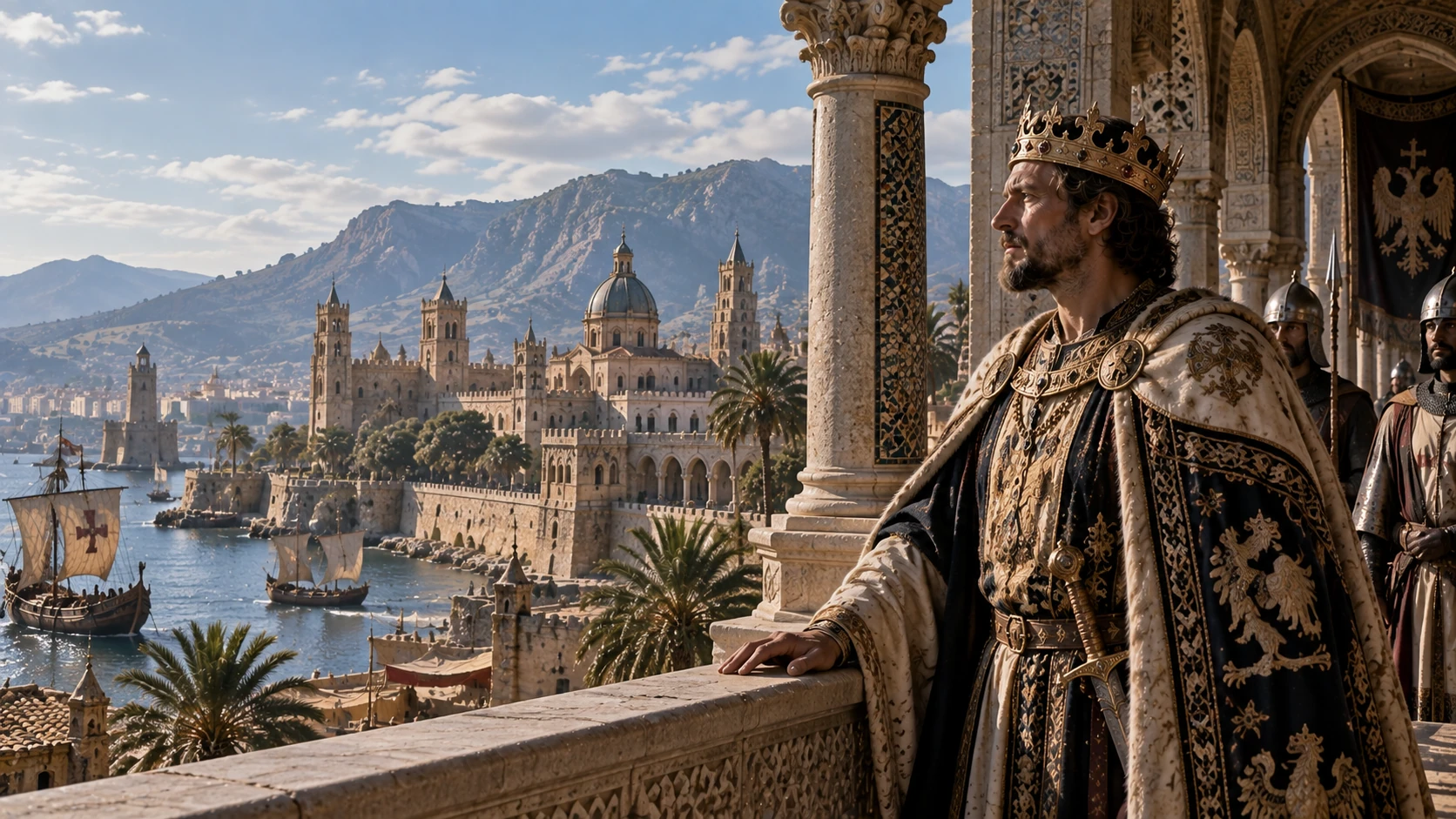
Roger II inherited the Sicilian county and the Hauteville claims in southern Italy. After years of warfare and diplomacy, he was crowned king at Palermo in 1130. Treccani records the political sequence from his acclamation at Salerno to his royal ceremony in Palermo and the papal disputes that followed. The new kingdom joined Sicily with Calabria and Apulia under a monarchy that sought unusually direct control over officials, courts and taxation. Treccani: Roger II of Sicily
Palermo became the center of royal government and ceremony. Roger’s chancery issued documents in Latin, Greek and Arabic, reflecting both the population and the administrative tools inherited from earlier rulers. Royal officials collected taxes, supervised ports and managed justice. The monarchy depended on feudal relationships, but it also used professional administrators and fiscal practices that limited the independence of local lords.
The kingdom’s society included Latin Christian settlers, Greek Christians, Muslims and Jews. Royal policy protected some communities and used their skills, while church institutions and noble colonization favored Latinization in other areas. Muslims could hold land, farm, trade and serve the state, but they also faced pressure, unequal status and periodic revolt. Cultural cooperation should therefore be described together with coercion and hierarchy.
PALERMO, AL-IDRISI AND A MEDITERRANEAN COURT
Roger II’s court connected Sicily to North Africa, Byzantium, the Latin West and the eastern Mediterranean. Merchants moved grain, textiles, metals, slaves, spices and luxury goods through ports including Palermo, Messina and Syracuse. The royal navy protected routes and projected power across the central Mediterranean. Roger’s campaigns briefly established possessions and tribute relationships in parts of coastal North Africa, but these were contested and did not amount to a permanent African empire.
The geographer Muhammad al-Idrisi worked at Roger’s court and produced the world map and geographical text known as the Tabula Rogeriana in 1154. It gathered information from travelers, merchants and earlier geographical traditions. The work demonstrates the kingdom’s intellectual connections, but it should not be treated as a neutral map drawn from modern measurements. Its value lies in how it records a medieval understanding of regions, routes and peoples linked to the Sicilian court.
Roger’s government also sponsored architecture that made the kingdom’s mixed inheritance visible. The Palatine Chapel in Palermo combines a Latin Christian liturgical setting with Byzantine mosaics, Arabic-style inscriptions and wooden ceilings made by skilled craftsmen. The buildings of Palermo, Cefalù and Monreale are evidence of artistic collaboration and royal propaganda, not proof that social relations were always harmonious. UNESCO identifies nine civic and religious monuments from the Norman period as the Arab-Norman Palermo and Cathedral Churches of Cefalù and Monreale World Heritage site. UNESCO: Arab-Norman Palermo
WILLIAM I, WILLIAM II AND THE END OF THE HAUTEVILLES
William I succeeded Roger II in 1154 and faced rebellions by nobles, cities and foreign powers. His government continued royal centralization while confronting Byzantine, German and Muslim rivals. William II, who ruled from 1166 to 1189, became known for his patronage of Monreale Cathedral and for attempts to preserve the kingdom’s influence in the eastern Mediterranean. Neither reign was simply a peaceful continuation of Roger’s cultural program; both involved coercion, warfare and negotiation.
William II died without a surviving son. Constance of Sicily, Roger II’s daughter, married Henry VI of the Hohenstaufen dynasty. Their marriage linked the Sicilian succession to the German kingship and the Holy Roman Empire. When William’s relative Tancred of Lecce took the Sicilian crown, Henry invaded to enforce his wife’s claim. After Tancred’s death, Henry VI conquered the kingdom in 1194, beginning Hohenstaufen rule.
FREDERICK II AND THE HOHENSTAUFEN KINGDOM
Frederick II became king of Sicily as a child and later ruled as Holy Roman Emperor. Palermo and southern Italy remained central to his political imagination, even as conflict with the papacy and northern Italian communes consumed much of his reign. Frederick strengthened royal courts, reorganized administration and issued the Constitutions of Melfi in 1231, a major legal and governmental program for the kingdom.
Frederick’s court supported scholarship, medicine, poetry and translations among Arabic, Greek and Latin traditions. The Sicilian School helped shape Italian literary history, and the emperor’s interest in science connected his court to Islamic and Byzantine intellectual worlds. These achievements coexisted with war, heavy taxation and authoritarian royal rule.
Relations between the crown and Sicilian Muslims deteriorated during the twelfth and thirteenth centuries. Muslim communities rebelled in the island’s interior, and Frederick responded with military campaigns and deportations. Many Sicilian Muslims were forcibly transferred to Lucera in Apulia, where they formed a protected but controlled Muslim settlement and served the crown as farmers, artisans and soldiers. Modern scholarship emphasizes both their institutional role and the violence of displacement. Later Angevin rule ended the community in 1300, when Charles II ordered its destruction and sale of many residents into slavery. Wiley: Muslim-Christian relations and Lucera
Frederick’s conflict with the papacy led to excommunication and repeated wars. After his death in 1250, the Hohenstaufen position weakened. Manfred, Frederick’s son, became king in Sicily, but Pope Urban IV invited Charles of Anjou to conquer the kingdom. Charles defeated Manfred at Benevento in 1266 and Manfred’s nephew Conradin at Tagliacozzo in 1268. Conradin’s execution in Naples ended the main Hohenstaufen claim, although the dynasty’s memory remained powerful in Sicily.
CHARLES OF ANJOU AND THE SICILIAN VESPERS
Charles I of Anjou moved the political center of the mainland kingdom toward Naples and imposed a French-led administration. His taxation, appointments and foreign wars generated opposition among Sicilian towns, nobles and groups connected to the old Hohenstaufen order. The revolt known as the Sicilian Vespers began in Palermo in 1282 and spread across the island. Its conventional story includes an insult at evening prayer, but that legendary detail cannot be treated as a complete explanation. The uprising grew from accumulated political, fiscal and social tensions.
The rebels offered the crown to Peter III of Aragon, who was married to Constance of Hohenstaufen. Peter’s intervention transformed a local revolt into a Mediterranean war involving the papacy, Angevins, Aragonese forces and Sicilian communities. Treccani describes the Vespers as an uprising against Charles I and emphasizes the wider international setting of Peter’s claim. Treccani: Sicilian Vespers
The Peace of Caltabellotta in 1302 confirmed a political division. The island was ruled by the Aragonese line, while the Angevins retained the mainland kingdom. Both rulers continued to use the title King of Sicily. To reduce confusion, historians often call the mainland realm the Kingdom of Naples and the island realm the Kingdom of Sicily or Trinacria. The split was political, not a clean cultural separation, and warfare continued for generations.
ARAGONESE, SPANISH AND BOURBON SICILY
Aragonese Sicily was integrated into a wider Mediterranean monarchy while retaining its own institutions, parliament and aristocracy. In 1442, Alfonso V of Aragon conquered Naples and briefly united the island and mainland under one ruler, but the union did not erase their separate political histories. Spanish Habsburg rule later governed both realms through changing arrangements, viceroys and local elites.
The names Kingdom of Sicily and Kingdom of Naples continued to carry legal and dynastic meanings. They were not interchangeable labels for a single uninterrupted state. Wars, inheritances and treaties repeatedly altered the relationship between the island, Calabria, Apulia, Campania and the other southern territories.
After the Napoleonic period, Ferdinand of Bourbon consolidated Naples and Sicily. On 18 December 1815 he created the Kingdom of the Two Sicilies, formally joining the two Bourbon kingdoms in one monarchy. The state was based in Naples and included the island of Sicily and most of southern continental Italy. The new kingdom had modernizing projects, ports and industries, but it also faced rural inequality, political repression and regional opposition. U.S. Office of the Historian: Two Sicilies
1860–1861 AND THE END OF THE BOURBON KINGDOM
In 1860, Giuseppe Garibaldi’s Expedition of the Thousand landed in Sicily and defeated Bourbon forces with the help of local revolts and changing elite alliances. Garibaldi crossed to the mainland, while Piedmontese forces advanced from the north. A plebiscite and military conquest transferred the Two Sicilies to Victor Emmanuel II, and the Kingdom of Italy was proclaimed in 1861. The transition involved competing visions of sovereignty and produced violence, resistance and long-lasting arguments about how unification transformed the south.
The end of the Bourbon monarchy did not end Sicily’s distinct history. The island’s languages, architecture, foodways, religious traditions and memories preserve layers from Greek, Roman, Byzantine, Muslim, Norman, Hohenstaufen, Angevin, Aragonese, Spanish and Bourbon rule. Palermo’s Arab-Norman monuments remain among the clearest material records of a medieval Mediterranean kingdom built through both conquest and cultural exchange.
LEGACY OF THE KINGDOM OF SICILY
The Kingdom of Sicily’s legacy is not a simple tale of harmonious multiculturalism or inevitable Italian unity. Its rulers used Arabic, Greek and Latin knowledge, employed people from different communities and sponsored extraordinary art. They also seized land, imposed unequal status, persecuted rebels and displaced Muslims. The same court that produced the Palatine Chapel could order military campaigns and deportations.
Sicily’s medieval history matters because it shows how political power worked across the Mediterranean. The island was a strategic center, but the kingdom also depended on southern mainland cities, ports, rural estates and maritime routes. Its story links Byzantine and Muslim Sicily to Norman state building, Hohenstaufen law, Angevin and Aragonese rivalry, and the Bourbon state that preceded modern Italy.
FREQUENTLY ASKED QUESTIONS
**When was the Kingdom of Sicily created?**
Roger II was crowned king in Palermo in 1130 after the Hauteville dynasty consolidated Sicily and much of southern mainland Italy. The conquest and state formation had developed gradually over earlier decades.
**Did the Kingdom of Sicily include mainland Italy?**
Yes. The medieval kingdom originally included Sicily, Calabria, Apulia and other southern mainland territories. After 1282, the island and mainland were ruled by rival dynasties and are often called Sicily and Naples for clarity.
**Was Norman Sicily religiously tolerant?**
Norman rulers allowed Latin Christian, Greek Christian, Muslim and Jewish communities to exist and used Arabic, Greek and Latin administration. This cooperation coexisted with discrimination, rebellion, religious pressure and later forced displacement of Muslims.
**What was the Sicilian Vespers?**
It was a revolt that began in Palermo in 1282 against Charles I of Anjou. Peter III of Aragon’s intervention turned it into a wider war. Later legendary details should not replace the documented political and social causes.
**What happened to Sicilian Muslims under Frederick II?**
After revolts, Frederick II deported many Sicilian Muslims to Lucera in Apulia, where they lived under controlled but protected status and served the crown. The settlement was destroyed by Charles II in 1300.
**When was the Kingdom of the Two Sicilies formed?**
Ferdinand of Bourbon created the Kingdom of the Two Sicilies in 1815, with Naples as its political center. It ended during Italian unification in 1860–1861.
> Medieval Sicily was a kingdom of cultural exchange and hard political power, where Arabic, Greek and Latin traditions met under rulers who could cooperate with communities and coerce them in the same reign.
FAQ
Frequently Asked Questions
When was the Kingdom of Sicily created?
Roger II was crowned king in Palermo in 1130 after decades of Norman conquest and consolidation in Sicily and southern Italy.
Did the Kingdom of Sicily include mainland Italy?
Yes. It originally included Sicily, Calabria, Apulia and other southern mainland territories. After 1282, the island and mainland were ruled by rival dynasties.
Was Norman Sicily religiously tolerant?
Different communities coexisted and served the state, but cooperation existed alongside discrimination, revolt, religious pressure and forced displacement.
What was the Sicilian Vespers?
It was a 1282 revolt against Charles I of Anjou that brought Peter III of Aragon into a wider war for control of the island.
When was the Kingdom of the Two Sicilies formed?
Ferdinand of Bourbon created it in 1815, and it ended during Italian unification in 1860–1861.
PRESDA Dispatch
Stay Informed. Stay Aware.
A sharp briefing across AI, gaming, sport, business, world affairs, paparazzi, and lifestyle.