THE ETHIOPIAN EMPIRE: 700 YEARS OF KINGS, FAITH AND RESISTANCE
From the Solomonic restoration of 1270 to Adwa, Italian occupation and the fall of Haile Selassie, Ethiopia's imperial history was shaped by faith, expansion, regional rivalry and determined resistance.
The Ethiopian Empire was not simply a kingdom that had existed unchanged since antiquity, and Ethiopia was not simply a country that was never colonized. The imperial state that took shape under the Solomonic dynasty after 1270 survived repeated wars, regional fragmentation and foreign invasion. Italy occupied Ethiopia from 1936 to 1941, but the occupation was relatively brief and followed a long history of Ethiopian sovereignty, state-building and resistance. The empire ended in 1974, when a military revolution deposed Emperor Haile Selassie.
Its history reaches back to Aksum, yet Aksum and the later Ethiopian Empire were different political formations. Aksum was a first-millennium kingdom centered in northern Ethiopia and Eritrea. The medieval and modern empire emerged through new dynasties, capitals, military systems and relationships among Christian highland societies, Muslim states and peoples speaking many languages. The distinction matters because continuity existed, but no single state ruled the same territory for 2,000 years.
AKSUM AND THE ROOTS OF CHRISTIAN ETHIOPIA
Aksum flourished from roughly the first century BCE into the first millennium CE, controlling Red Sea trade and maintaining links with Arabia, the eastern Mediterranean and the Nile world. Its rulers minted coins, erected monumental stelae and adopted Christianity in the fourth century under King Ezana. Aksum's decline shifted political power southward and inland, but Christian institutions, Ge'ez literature and memories of Aksum remained powerful resources for later rulers. Archaeology and written traditions point to both continuity and transformation rather than an unbroken imperial government. Smithsonian Libraries: Foundations of an African civilisation
The Zagwe dynasty ruled much of the Christian highlands before 1270. Its most famous legacy is the rock-hewn church complex at Lalibela, but later Solomonic chronicles presented Zagwe rule as an interruption that had to be corrected. Modern historians treat that dynastic transition with more care, recognizing that political legitimacy was built through competing memories as well as military power.
THE SOLOMONIC RESTORATION AND SACRED MONARCHY
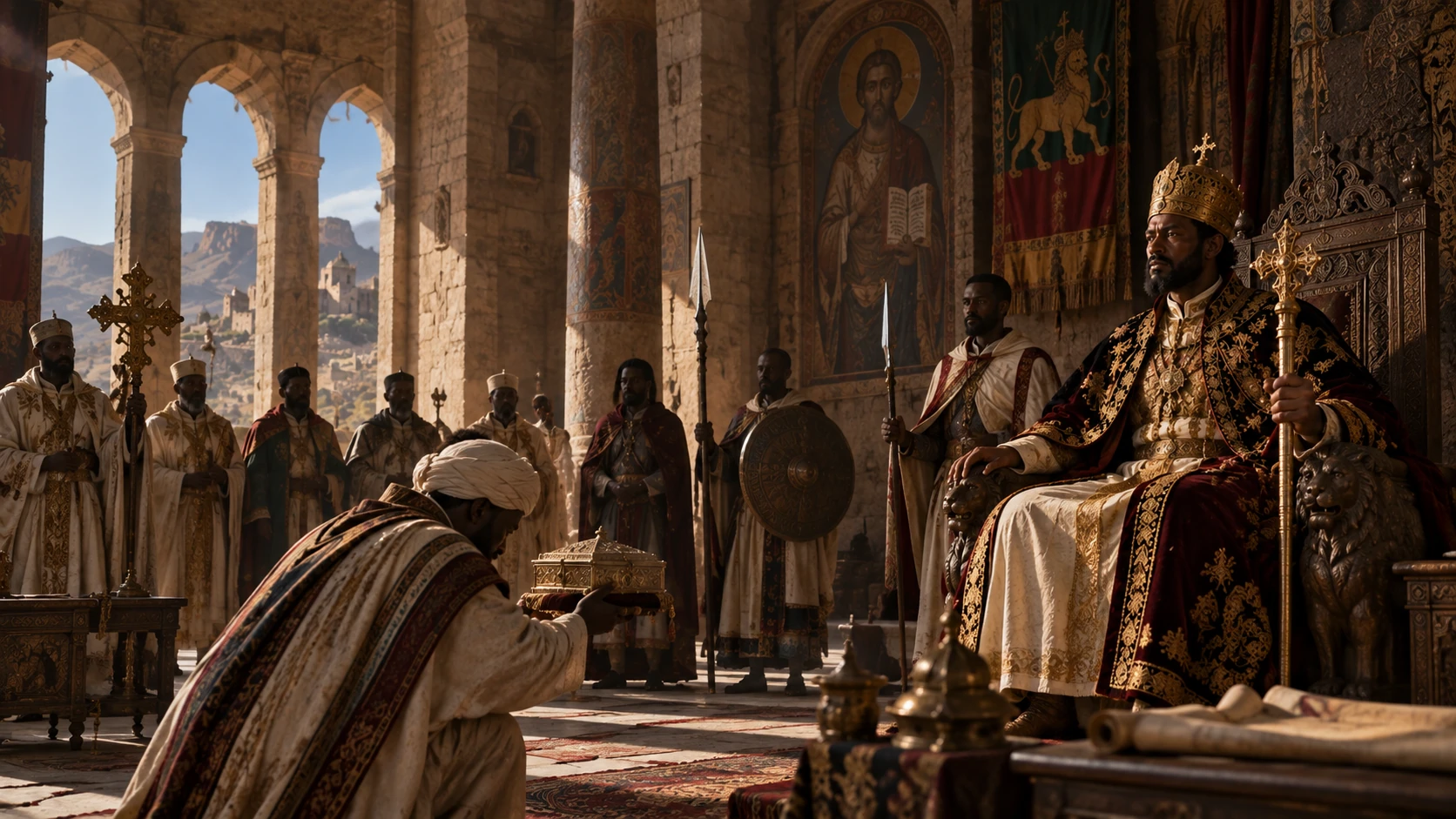
In 1270, Yekuno Amlak overthrew the last Zagwe ruler and established what became known as the Solomonic dynasty. Royal tradition claimed that the dynasty descended from Menelik I, the son of King Solomon and the Queen of Sheba, and therefore from the ancient kings of Israel. This genealogy was central to imperial ideology and later chronicles, but it is a royal tradition, not an established historical fact. Smithsonian Libraries: History of Ethiopia
The Ethiopian Orthodox Tewahedo Church was not merely a private faith within this system. Monasteries preserved manuscripts, bishops helped authorize coronations, and church land and clergy connected distant communities to the court. Emperors presented themselves as defenders of the faith, while the church depended on royal patronage and negotiated its own authority. Muslims, Jews and followers of indigenous religions also remained part of Ethiopian society, even when Christian kings pursued conversion or imposed unequal political arrangements.
Solomonic rulers expanded and contracted through cycles of war, tribute and alliance. Amda Seyon campaigned against Muslim sultanates in the fourteenth century, while later emperors sought access to trade routes toward the Red Sea and the eastern lowlands. These conflicts were political as well as religious. Christian and Muslim rulers traded, negotiated and sometimes allied even while chronicles described their wars in sacred language.
THE ADAL WAR AND PORTUGUESE INTERVENTION
In the early sixteenth century, the Adal Sultanate based around Harar mounted the most dangerous challenge yet to the Christian kingdom. Imam Ahmad ibn Ibrahim al-Ghazi, known in Ethiopian sources as Ahmad Gran, used firearms and Ottoman support to defeat Ethiopian armies beginning in 1529. Between 1529 and 1543, his forces overran much of the Christian highlands, destroying churches and royal centers while reshaping the region's religious and political balance. Encyclopedia.com: Ahmad ibn Ibrahim al-Ghazi
The Ottoman Empire supplied Adal with artillery and other military assistance because control of the Red Sea and Horn of Africa mattered to its rivalry with Portugal. Ethiopia turned to Portugal in response. A Portuguese expedition led by Cristóvão da Gama arrived in 1541 with musketeers. Da Gama was captured and executed, but the surviving Portuguese helped Emperor Galawdewos reorganize his forces. This intervention forms part of the wider maritime story told in PRESDA's history of Portugal. Ahmad al-Ghazi was killed at the Battle of Wayna Daga in 1543, and Adal's conquests rapidly unraveled. The war left both Christian Ethiopia and Muslim Adal weakened.
The conflict also helped open the way for major Oromo population movements from the south and east. Oromo communities were not a single invading army, and scholars emphasize varied migrations, settlement, incorporation and state formation. Over the sixteenth and seventeenth centuries, Oromo groups settled across a wide area, fought with and alongside Christian rulers, and became influential in regional courts. Their expansion transformed language, landholding, military power and the religious map of the empire. Cambridge University Press: Ethiopian state formation
GONDAR AND THE ERA OF THE PRINCES
After the Adal war and further Oromo movements, emperors ruled a smaller and more contested Christian core. Emperor Fasilides established Gondar as a capital in the seventeenth century. The city became a center of court architecture, manuscript culture and religious scholarship. The Gondarine period produced distinctive castles and churches, but it also saw disputes over theology, succession and the place of Muslims and other communities in imperial society. Metropolitan Museum of Art: Eastern Africa, 1600 to 1800
From about 1769 to the mid-nineteenth century, the Zemene Mesafint, or Era of the Princes, weakened the authority of the Gondar emperors. Powerful regional nobles and military leaders in Tigray, Gojjam, Wollo and Shewa made and unmade emperors, while the monarch retained sacred prestige without consistently controlling the army or tax system. Oromo leaders, including the Yejju rulers of Wollo, played major roles in this political order. Calling the period simple anarchy hides the regional institutions and negotiations that kept the imperial title alive. Oxford Academic: States of Violence and the Zemene Mesafint
TEWODROS II AND THE ATTEMPT TO REUNIFY THE EMPIRE
Kassa Hailu rose from western Ethiopia and became Emperor Tewodros II in 1855. He sought to reunify the empire, disarm rival nobles, reform taxation and create a standing army equipped with modern weapons. His centralizing program brought conflict with regional elites and the church. Tewodros also imprisoned British diplomats and missionaries after relations with Queen Victoria deteriorated.
Britain responded with the 1867 to 1868 expedition to Maqdala, led by Sir Robert Napier. British and Indian troops crossed difficult terrain, defeated Tewodros's forces at Aroge on 10 April 1868 and captured Maqdala on 13 April. Tewodros died by suicide rather than surrender. The expedition destroyed the fortress and looted royal and church treasures, including manuscripts and sacred objects that entered British collections. The British did not annex Ethiopia, but Maqdala remains a central case in debates over restitution. British Museum: the Maqdala collection
Yohannes IV, who ruled from 1872 to 1889, defended the northern highlands against Egyptian and Mahdist pressure and tried to strengthen imperial authority while managing powerful regional rulers. He promoted an Orthodox Christian political identity, yet his reign also depended on alliances across Ethiopia's diverse provinces. Yohannes died fighting Mahdist forces at Metemma in 1889.
MENELIK II, EXPANSION AND ADWA
Menelik II of Shewa succeeded Yohannes and moved the political center toward Addis Ababa. During the late nineteenth century, his government expanded south, east and west through conquest, treaties and incorporation. The campaigns brought new territories and resources into the empire, but they also involved land seizure, forced labor, tribute and violence. Oromo, Somali, Sidama, Gurage, Anuak and many other communities experienced imperial expansion differently. Some local rulers resisted, while others negotiated or joined Menelik's army. Describing this process as simple national reunification erases those contested experiences. Cambridge University Press: the Oromo and the Christian kingdom
Italy's ambitions made the new borders an international crisis. The Treaty of Wuchale, signed in 1889, contained different versions of a clause about foreign relations. Italy treated the Italian text as establishing a protectorate; Menelik rejected that interpretation. Italy invaded northern Ethiopia in 1895. On 1 March 1896, Menelik's army defeated the Italian force at Adwa, compelling Italy to recognize Ethiopian independence in the Treaty of Addis Ababa. Adwa became one of the most important anti-colonial victories in modern African history, even though Ethiopia's own expansion remained contested. UNESCO: Ethiopia, Eritrea and the Battle of Adua
HAILE SELASSIE AND THE ITALIAN OCCUPATION
Haile Selassie, who had been regent and ruler as Ras Tafari, became emperor in 1930. He introduced a written constitution, expanded schools and administration, and pursued diplomatic recognition through the League of Nations. These reforms coexisted with imperial centralization and social inequalities, and many communities continued to challenge the court's authority.
Mussolini's Italy invaded Ethiopia on 3 October 1935. Italian forces captured Addis Ababa in May 1936 and proclaimed an empire in East Africa, but Ethiopian resistance continued in the countryside. Italian troops used mustard gas and other chemical agents against soldiers and civilians, in violation of international agreements. Haile Selassie appealed to the League of Nations, but collective sanctions did not stop the conquest. U.S. Office of the Historian: Italian use of mustard gas in Ethiopia
The occupation lasted from 1936 to 1941. Italy never fully controlled the countryside, and Ethiopian resistance groups remained active. British and Commonwealth forces, together with Ethiopian fighters, drove Italian forces out during the East African campaign. Haile Selassie returned to Addis Ababa in 1941. The episode explains why the slogan that Ethiopia was never colonized is misleading: Italy did occupy the country, but the occupation was brief, fiercely resisted and did not erase Ethiopia's longer sovereign history. Library of Congress: Ethiopia country study
REVOLUTION AND THE END OF THE MONARCHY
After 1941, Haile Selassie pursued centralization, education and international diplomacy. Ethiopia became a founding member of the United Nations and hosted the Organization of African Unity in Addis Ababa in 1963. Yet the imperial government faced land inequality, regional rebellion, Eritrean conflict, political repression and criticism that modernization benefited the court more than rural people.
A famine, military mutinies and a crisis of legitimacy brought revolution in 1974. The Derg, a committee of military officers, deposed Haile Selassie in September and abolished the monarchy in 1975. The new government nationalized land and adopted Marxist policies, but it also ruled through executions, the Red Terror, war and coercion. The Derg remained in power until 1991. The imperial era therefore ended through a domestic political revolution, not through direct European conquest.
THE LEGACY OF THE ETHIOPIAN EMPIRE
The Ethiopian Empire left institutions and symbols that still shape the Horn of Africa: the prestige of the imperial title, Ethiopian Orthodox art and scholarship, Addis Ababa's diplomatic role, and memories of Adwa and resistance to fascism. It also left unresolved arguments about land, language, religion, center and periphery, and the violence of nineteenth-century expansion. Oromo, Amhara, Tigrayan, Somali, Eritrean and other historical perspectives do not fit one official story.
Ethiopia's imperial history is best understood as a long process of state formation rather than a single unbroken tradition. Aksum provided ancient precedents, the Solomonic dynasty built a Christian monarchy after 1270, regional powers repeatedly reshaped the state, and modern rulers expanded and centralized it under pressure from European empires. Comparing it with other African state traditions, such as the Kingdom of Benin, helps keep Ethiopia's story within the continent's wider history of institutions and power. Its legacy combines sovereignty and resistance with conquest, hierarchy and contested belonging.
FREQUENTLY ASKED QUESTIONS
**Was Aksum the same state as the Ethiopian Empire?**
No. Aksum was an ancient kingdom centered in northern Ethiopia and Eritrea. The Ethiopian Empire emerged through later medieval and modern dynasties, while retaining important religious, cultural and political connections to Aksum.
**Did the Solomonic dynasty really descend from Solomon and the Queen of Sheba?**
The dynasty claimed this descent through the story of Menelik I. It was an important royal tradition and source of legitimacy, but historians do not treat the genealogy as established historical fact.
**What happened at Adwa?**
On 1 March 1896, Menelik II's Ethiopian army defeated Italy's invading force. The victory forced Italy to recognize Ethiopian independence and became a major symbol of African resistance to European colonialism.
**Was Ethiopia colonized?**
Italy occupied Ethiopia from 1936 to 1941 and used brutal counterinsurgency and chemical weapons. The occupation was relatively brief and resisted, but saying Ethiopia was never colonized erases this period.
**When did the Ethiopian Empire end?**
The Derg deposed Haile Selassie in 1974 and abolished the monarchy in 1975. Military rule continued until 1991, but the imperial political system ended with the revolution.
> Ethiopia's imperial history was built through continuity and change, sovereignty and expansion, faith and resistance.
FAQ
Frequently Asked Questions
Was Aksum the same state as the Ethiopian Empire?
No. Aksum was an ancient kingdom centered in northern Ethiopia and Eritrea. The later Ethiopian Empire emerged through medieval and modern dynasties, while retaining important cultural and religious connections to Aksum.
What happened at the Battle of Adwa?
On 1 March 1896, Menelik II's Ethiopian army defeated Italy's invading force, forcing Italy to recognize Ethiopian independence and making Adwa a major symbol of African resistance to European colonialism.
Was Ethiopia ever colonized?
Italy occupied Ethiopia from 1936 to 1941 and used brutal counterinsurgency and chemical weapons. The occupation was relatively brief and resisted, but the phrase never colonized erases this period.
When did the Ethiopian Empire end?
The Derg deposed Haile Selassie in 1974 and abolished the monarchy in 1975, ending the imperial political system. Military rule continued until 1991.
PRESDA Dispatch
Stay Informed. Stay Aware.
A sharp briefing across AI, gaming, sport, business, world affairs, paparazzi, and lifestyle.