GOLD: HOW ONE METAL BECAME THE WORLD'S SYMBOL OF WEALTH
From ancient Egypt and the first gold coins to African empires, colonial conquest, the Gold Rush and modern central banks - why has humanity valued gold for thousands of years?
Gold is not useful because humans agreed to pretend it was useful.
It became powerful because it sits at a rare intersection of physics, geology, beauty, trust and history.
It shines without rusting. It can be hammered into thin sheets, drawn into wire, stamped into coins, hidden in vaults, worn on the body and recognized across cultures. It is scarce enough to matter but common enough to circulate.
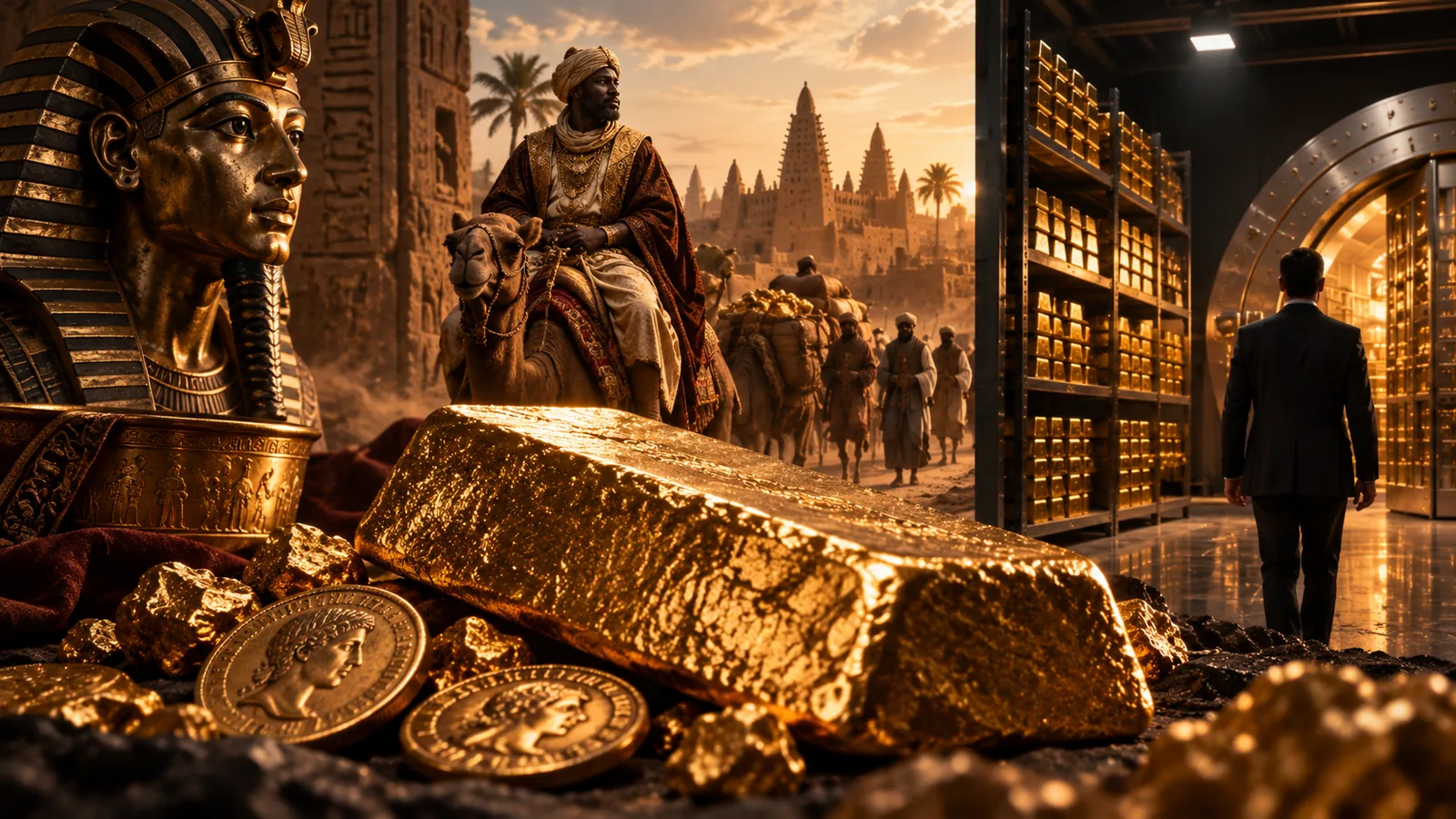
That combination made gold one of the few materials that could move from tombs to temples, from caravans to coinage, from empires to central banks.
The history of gold is therefore not just the history of a metal.
It is the history of how human beings learned to turn material into meaning.
Gold Before Money
Gold was valued long before formal money existed.
Archaeologists have found prehistoric gold objects in several regions, including some of the famous early gold work associated with southeastern Europe and the Varna cemetery in present-day Bulgaria, often dated to the fifth millennium BCE.
These early objects were not banknotes. They were symbols, ornaments and markers of status.
That matters because gold's social role began before coins, interest rates or central banks. Humans first encountered gold as something visually different from ordinary stone, bone, copper or clay.
It was rare in daily life, bright in firelight and unusually resistant to decay.
A shell necklace can break. Iron can rust. Cloth can rot. Gold survives.
That survival quality helped gold carry memory. A gold object could outlive the person who wore it, the ruler who commanded it and even the civilization that produced it.
Ancient Egypt: Gold, Pharaohs And Nubia
Few ancient cultures made gold more visibly political than Egypt.
Egyptian rulers associated gold with divine power, royal permanence and the brilliance of the sun. Tombs, funerary masks, jewelry and ritual objects made gold part of the visual language of eternity.
The most famous example is the burial equipment of Tutankhamun, but Egypt's relationship with gold was much older and much broader than one pharaoh.
Egypt also depended heavily on gold from Nubia, a region to the south that became central to Egyptian wealth and imperial ambition. The very word Nubia is often linked in scholarship with ancient associations of gold-rich lands.
Gold mining was hard, dangerous work. Ancient wealth did not float gently from riverbeds into royal treasuries. It was extracted by human labor, state power and organized control of land and people.
That tension appears throughout gold's history: the metal could symbolize purity and permanence while the systems built around it often involved coercion, conquest and inequality.
Why Gold?
Gold has several properties that made it unusually suitable as a store of value.
It is durable. Gold does not corrode easily, which means a coin or ornament can remain recognizable for centuries.
It is malleable. A small amount can be shaped, stamped, melted and reworked without losing its basic identity.
It is recognizable. Gold's color and density make it difficult to confuse with most everyday materials.
It is scarce. Gold is not so rare that almost nobody can own it, but it is rare enough that supply cannot be expanded quickly by political decree.
It is divisible. A bar can be made into coins, coins can be melted into jewelry, and jewelry can become bullion again.
No single property explains gold's status. Rarity alone is not enough. Many things are rarer than gold but never became global money.
Gold became trusted because its physical qualities matched social needs: portability, durability, prestige and limited supply.
The Birth Of Gold Money
The earliest coinage was not simply pure gold.
Many of the first standardized coins in western Anatolia were made from electrum, a natural alloy of gold and silver associated with Lydia and neighboring Greek cities in the seventh century BCE. The British Museum's discussion of early coins places Lydian electrum coinage among the earliest traditions of stamped money.
Electrum matters because it shows that money began as an institutional technology, not just a shiny object.
A lump of metal becomes money when weight, purity, authority and recognition are standardized.
Coinage allowed rulers and cities to pay soldiers, collect taxes, support trade and project authority through a stamped image.
Pure gold coins became more important later, but the beginning of coinage was more complicated than the phrase 'gold money' suggests.
Greece And Rome
Greek city-states and later Hellenistic kingdoms used precious-metal coinage to connect markets, armies and political power.
Silver was often more common in everyday coinage, while gold tended to appear in high-value payments, royal treasuries and moments of war or imperial expansion.
Rome also used gold, silver and bronze in different monetary roles. The gold aureus and later solidus helped finance imperial administration, armies and long-distance payments.
Gold did not replace every other form of money.
Ancient economies used mixed systems: barter, credit, tax obligations, bronze coins, silver coins, gold coins and payments in kind.
That is one reason the myth 'all ancient money was gold' is wrong.
Gold mattered enormously, but it was never the whole monetary world.
Gold In The Islamic World
Gold also became central to Islamic monetary and trade networks.
The gold dinar, especially from the late seventh century onward, became a powerful symbol of Islamic political authority and commercial connection.
Gold moved through routes linking North Africa, the Mediterranean, the Middle East, Central Asia, East Africa and the Indian Ocean.
Those networks did not only carry metal.
They carried textiles, books, spices, enslaved people, scholarship, religious authority and political influence.
Gold was part of a wider system of exchange in which cities, caravans, ports and states translated distance into value.
West Africa: Ghana, Mali And Timbuktu
West Africa was one of the great gold-producing regions of the medieval world.
Gold from the forests and river systems south of the Sahara moved north through trans-Saharan trade. Salt, textiles, horses, manuscripts and other goods moved in return.
The Ghana Empire and later the Mali Empire became linked to this trade, though historians caution that medieval political geography should not be flattened into modern national borders.
Timbuktu became famous not only for commerce but for scholarship, manuscript culture and Islamic learning.
Gold helped connect West Africa to the Mediterranean and the wider Islamic world.
But West African societies were not simply gold mines serving outsiders. They were political, cultural and commercial centers with their own rulers, institutions and strategies.
Mansa Musa And The Gold Of Mali
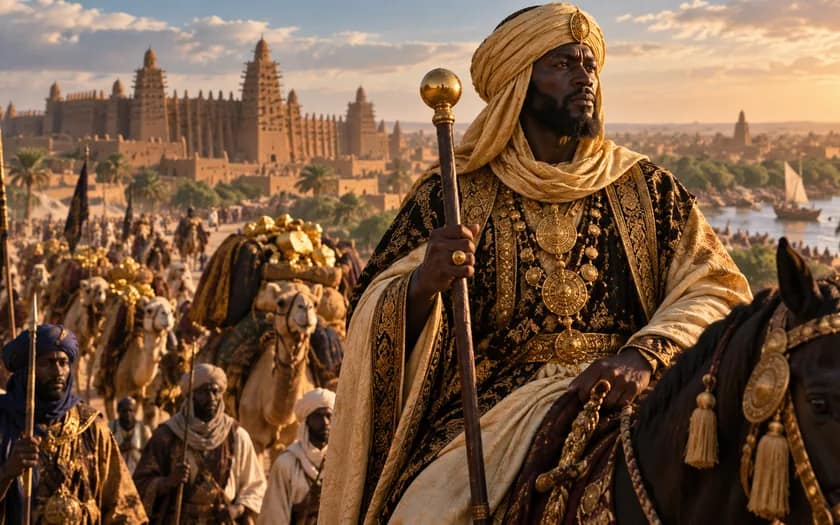
Mansa Musa, ruler of Mali in the fourteenth century, became one of history's most famous gold-linked figures.
His pilgrimage to Mecca in 1324 is widely recorded in historical accounts. Encyclopaedia Britannica notes the famous tradition that his distribution and spending of gold in Cairo affected local prices.
The broad point is reliable: Mansa Musa's journey displayed Mali's wealth to the Islamic world and helped cement his reputation.
The modern claim that he was 'the richest person ever' is much less precise.
We cannot convert the wealth of a fourteenth-century empire into a modern billionaire ranking with scientific accuracy. Land, labor, tribute, gold supply, political power and purchasing power do not translate cleanly into a single net-worth number.
Mansa Musa was extraordinarily wealthy and historically significant.
The exact meme version of his fortune is not something historians can calculate with confidence.
Europe Looks For Gold
European desire for gold was one driver of overseas expansion, but it was never the only driver.
Religion, trade, spices, land, rivalry, maritime technology and empire all mattered.
Gold stood at the center because European states needed money to finance war, bureaucracy and trade competition.
When European powers looked outward, they were often searching for direct access to wealth that had previously moved through older commercial networks.
The search for gold could become a search for conquest.
That shift changed the world.
Gold, Conquest And Colonialism In The Americas
In the Americas, European conquest connected gold to violence on a continental scale.
Spanish expansion in the Caribbean, Mexico and the Andes was driven by a mix of religious mission, imperial ambition, private greed and the search for precious metals.
Silver eventually became even more important than gold in parts of Spain's American empire, especially through major mining centers such as Potosi. But gold remained central to European imagination and colonial extraction.
This history should not be oversimplified into a story of Europeans finding treasure in an empty world.
The Americas were home to complex societies with their own economies, technologies, religions and political systems.
Conquest brought warfare, forced labor, epidemic disease, dispossession and extraction.
Gold's beauty did not soften the brutality of the systems built to seize it.
The Gold Rushes
Gold rushes turned geology into mass migration.
The California Gold Rush began after gold was found at Sutter's Mill in January 1848. The Library of Congress describes how the discovery drew huge numbers of migrants and transformed California's population, economy and politics.
The 'Forty-Niners' did not simply find wealth scattered on the ground.
Some miners made fortunes. Many did not. Indigenous communities suffered violence, land loss and demographic collapse. Merchants, transport firms and land speculators often profited more reliably than individual miners.
Australia experienced major gold rushes from 1851. The Klondike rush followed the discovery of gold in the Yukon region in 1896 and drew tens of thousands toward the northwestern edge of North America.
Gold rushes could build cities and states quickly.
They could also bring environmental damage, racial violence, speculation, fraud and broken lives.
South Africa And The Witwatersrand
The Witwatersrand discoveries in South Africa in 1886 created one of the most important gold-mining regions in modern history. Encyclopaedia Britannica links the region's gold deposits to the growth of Johannesburg and South Africa's mining economy.
Witwatersrand gold helped reshape global finance because its scale was so large and its extraction required deep industrial mining.
It also helped entrench harsh labor systems and racialized economic structures that fed into South Africa's later political history.
Gold mining here was not a romantic frontier adventure.
It was industrial capitalism underground.
Gold And The Modern Monetary System
Gold's modern monetary role came from trust.
Paper money is easier to move than metal, but paper only works when people believe it can be exchanged, accepted or enforced.
For centuries, states and banks used gold reserves to support confidence in currency.
A gold-backed system promised that paper represented a claim on something scarce and tangible.
But that promise also limited what governments and central banks could do in moments of crisis.
If currency must be convertible into gold, then money supply, interest rates and emergency spending can become constrained by metal reserves.
That tension eventually helped weaken the old gold-based order.
The Gold Standard
The gold standard tied a country's currency to a defined amount of gold.
In practice, the system varied by country and period. The nineteenth-century international gold standard was not a single machine with identical rules everywhere.
The Bank of England explains that the gold standard limited monetary policy because central banks had to maintain convertibility and defend gold reserves.
Supporters valued the system because it appeared to impose discipline and exchange-rate stability.
Critics point out that it could transmit financial stress, deepen downturns and force painful deflationary adjustments.
The First World War disrupted gold convertibility in many countries. Attempts to restore the old order after the war proved fragile.
By the Great Depression, the gold standard had become politically and economically difficult to maintain.
Bretton Woods
After the Second World War, the Bretton Woods system created a new international monetary order.
It did not simply restore the old classical gold standard.
Instead, the U.S. dollar became central. Other currencies were linked to the dollar, and foreign monetary authorities could convert dollars into gold at a fixed official price under the rules of the system.
This arrangement reflected American economic power after 1945 and the desire for exchange-rate stability after the chaos of war and depression.
Gold still mattered, but it now operated through a dollar-centered international framework.
Nixon, 1971 And The End Of Dollar Convertibility
On August 15, 1971, President Richard Nixon announced the suspension of the dollar's convertibility into gold for foreign official holders. The Federal Reserve History account describes this as the closing of the gold window and a key step in the end of Bretton Woods.
This did not mean every form of money everywhere instantly stopped being connected to gold in the same way at the same moment.
It meant the central dollar-gold convertibility promise at the heart of Bretton Woods was suspended.
The international monetary system moved toward floating exchange rates and fiat currencies whose value depends on law, central-bank credibility, economic productivity and public trust rather than direct gold redemption.
Modern currencies are generally not directly backed by gold.
That is not the same as saying gold stopped mattering.
Gold After The Gold Standard
After the gold standard, gold shifted rather than disappeared.
It remained a financial asset, a jewelry metal, a central-bank reserve, a technology material and a cultural symbol.
Gold is used in electronics because it conducts electricity and resists corrosion. It remains central to wedding jewelry, religious objects and status display in many societies.
Investors buy gold through coins, bars, exchange-traded products and mining shares, though those are not the same kind of exposure or risk.
The post-gold-standard world did not end gold's story.
It separated gold from everyday money while preserving its role as a store of value and crisis asset.
Why Central Banks Still Hold Gold
Central banks hold gold because it is nobody else's liability.
A government bond depends on an issuer. A bank deposit depends on a bank. A foreign currency reserve depends on another monetary system.
Gold has no issuer.
That does not make it risk-free. Its price can fall, it produces no interest and it costs money to store securely.
But gold can diversify reserves and provide confidence during geopolitical or financial stress.
The U.S. Treasury's official gold reserve dataset also shows why the Fort Knox myth is wrong. Fort Knox is important, but it does not contain all U.S.-owned gold.
Central-bank gold is partly financial, partly strategic and partly psychological.
Its value is tied to the fact that other institutions also continue to treat it as valuable.
Gold In Inflation And Crisis
Gold is often called a safe haven.
That phrase needs care.
Gold may attract demand during inflation fears, banking stress, war, currency weakness or falling trust in governments.
But it does not always rise during inflation, and it can perform poorly for long periods.
Gold has no earnings, no dividend and no coupon. Its price reflects investor expectations, real interest rates, currency movements, central-bank demand, jewelry demand, mining supply and fear.
A more accurate statement is this: gold has often acted as a hedge against extreme uncertainty and loss of confidence in financial systems, but it is not a guaranteed short-term inflation shield.
How Much Gold Exists?
The World Gold Council estimates that humanity has mined more than 216,000 metric tonnes of gold above ground, with most of it still existing in some recoverable form because gold is rarely destroyed. Its above-ground gold stock data separates jewelry, private investment, official holdings and other uses.
That number is different from reserves.
Above-ground stock means gold already mined and still present in human hands.
Reserves mean known deposits that can be economically extracted under current conditions.
Annual production means how much new gold mines add in a given year.
The U.S. Geological Survey tracks gold production and reserves through its minerals data. Recent USGS summaries place annual mine production at only a small fraction of total above-ground stock.
That slow growth helps explain gold's monetary appeal.
No central bank can print thousands of years of mined gold into existence.
Where Gold Comes From Scientifically
Gold's story begins before Earth.
Gold atoms are forged through extreme astrophysical processes. Modern research links many heavy elements, including gold, to neutron-star mergers and other high-energy cosmic events. The LIGO/Virgo neutron-star merger announcement helped confirm that such collisions can produce heavy elements.
Those atoms later became part of the material from which the Solar System formed.
On Earth, gold became concentrated through geological processes involving heat, fluids, pressure, erosion and time.
That is why gold appears in veins, reefs, placer deposits and complex ore bodies rather than being evenly spread through the crust.
Gold is rare in human economies because it is rare and difficult to concentrate geologically.
Its cosmic origin adds wonder, but its earthly value depends on geology, labor, law and trust.
The Environmental And Human Costs Of Gold Mining
Gold can look clean in a display case while carrying heavy costs at the mine site.
Mining can disturb landscapes, consume water, generate tailings, pollute rivers and expose workers and communities to toxic substances.
Artisanal and small-scale gold mining in some regions has been linked to mercury pollution, unsafe labor and illicit finance.
Large industrial mines can bring jobs and infrastructure, but they can also displace communities, strain water systems and leave long-term environmental liabilities.
A serious history of gold has to hold both truths together.
Gold can preserve value.
Extracting it can destroy value in places far from the vault.
Could Gold Ever Become Worthless?
Gold could lose value. It has done so many times over shorter market periods.
But becoming truly worthless would require a collapse of several layers at once: jewelry demand, cultural prestige, investment demand, central-bank trust, industrial use and the belief that gold will remain liquid across borders.
That is possible in theory but unlikely in ordinary historical terms.
Gold's value is not purely intrinsic and not purely imaginary.
It is a relationship between physical scarcity and human institutions.
If humans stopped valuing gold, its price would fall. But thousands of years of cross-cultural trust are not easy to erase.
Myth Vs Reality
Myth: Mansa Musa was definitely the richest person ever.
Reality: Mansa Musa was extraordinarily wealthy, and his 1324 pilgrimage displayed Mali's gold-rich power. But exact modern net-worth rankings are impossible to calculate reliably across seven centuries.
Myth: All ancient money was gold.
Reality: Ancient economies used bronze, copper, silver, electrum, gold, credit, barter, tax obligations and goods in kind. Gold was important, not universal.
Myth: Gold has always been the basis of money.
Reality: Gold often supported monetary systems, but many societies used other metals, commodities, ledgers or state-backed units of account.
Myth: Modern currencies are still directly backed by gold.
Reality: Most modern currencies are fiat currencies. They are backed by law, taxation capacity, monetary policy and public trust, not direct redemption for gold.
Myth: Gold always protects investors from inflation.
Reality: Gold can help during some inflationary or crisis periods, but it does not always rise and can underperform for long stretches.
Myth: Fort Knox contains all U.S. gold.
Reality: Fort Knox is one major U.S. gold storage site, but official Treasury data lists gold held across multiple locations.
Myth: Gold is valuable only because it is rare.
Reality: Rarity matters, but gold's durability, recognizability, malleability, cultural status, monetary history and institutional demand all matter too.
Why Humans Still Trust Gold
Gold became humanity's symbol of wealth because it solved a recurring human problem.
How do you store value across time?
How do you carry trust across distance?
How do you make power visible?
Gold answered those questions in tombs, temples, coins, trade routes, colonial treasuries, central-bank vaults and investment portfolios.
It has never been morally neutral. Gold has inspired art, diplomacy and scientific wonder. It has also fueled conquest, forced labor, environmental damage and speculation.
That contradiction is part of its history.
Gold survives because it is both material and metaphor.
It is a metal formed in cosmic violence, concentrated by geology, extracted by human labor and turned into a promise by culture.
After thousands of years and multiple monetary systems, people still trust gold because it feels older than any government and more solid than any paper claim.
That feeling is not the whole truth.
But history shows why it has been so hard to replace. PRESDA's History archive follows other systems of power and exchange through ancient Greece, the history of slavery and the real history of coffee.
FAQ
Frequently Asked Questions
What is this PRESDA article about?
From ancient Egypt and the first gold coins to African empires, colonial conquest, the Gold Rush and modern central banks - why has humanity valued gold for thousands of years?
Which category does this story belong to?
This story is part of PRESDA's History coverage.
Who published this article?
GOLD: HOW ONE METAL BECAME THE WORLD'S SYMBOL OF WEALTH was published by PRESDA Editorial on PRESDA.
PRESDA Dispatch
Stay Informed. Stay Aware.
A sharp briefing across AI, gaming, sport, business, world affairs, paparazzi, and lifestyle.