MALI EMPIRE: HOW MANSA MUSA BUILT ONE OF AFRICA’S RICHEST KINGDOMS
Mansa Musa’s gold astonished Cairo, but it did not build Mali alone. Discover the rivers, farms, trade routes and political traditions behind one of medieval Africa’s great empires.
In 1324, a ruler from West Africa arrived in Cairo carrying a reputation that would soon travel farther than his caravan. His name was Musa. His title was mansa. His kingdom lay beyond the Sahara, in a region whose gold already connected African producers with Mediterranean markets.
The people who later described his visit remembered lavish gifts, an imposing entourage and a sovereign negotiating the etiquette of another powerful court. Gold made the encounter unforgettable. It also became a distraction: in modern retellings, a complex African empire has often been reduced to one man with an impossibly large bank balance.
Mansa Musa inherited Mali; he did not found it. He strengthened its international connections and became its most famous ruler, but the foundations beneath his wealth were older and broader: fields, rivers, cattle, merchants, political alliances and the ability to collect revenue across different communities. Understanding the Mali Empire means following those connections before and after its celebrated pilgrimage.
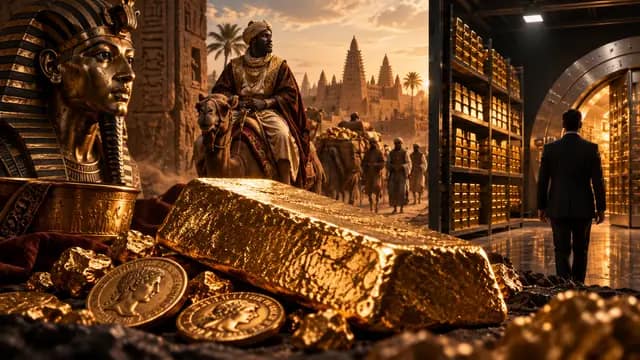
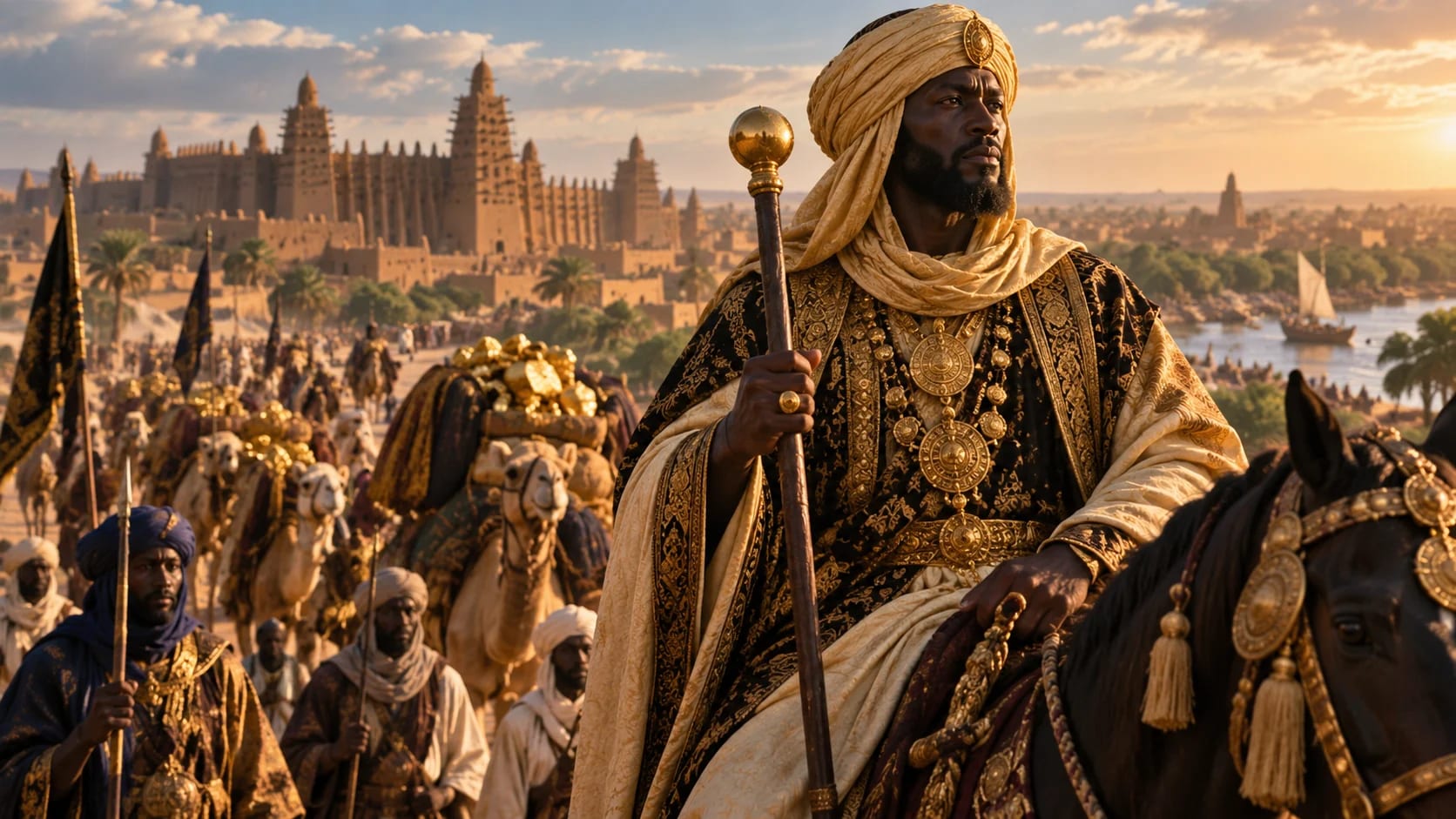
*Hero image: an editorial historical reconstruction, not a literal portrait of Mansa Musa or a documented scene from his pilgrimage. Its clothing, architecture and display of gold are artistic interpretations.*
BEFORE MALI: WEST AFRICA ALREADY HAD A HISTORY
The Sahara was a formidable environment, but it was not an unbroken wall. Routes across it connected pastoral communities, oasis settlements and trading towns. South of the desert, river valleys and savannas supported societies whose histories cannot be explained simply as the result of contact with the Mediterranean.
Archaeology at Jenne-jeno, in the Inland Niger Delta, documents an urban settlement developing from the last centuries BCE, long before Mali’s imperial rise. Its inhabitants worked iron, cultivated crops and participated in regional exchange. Such evidence matters because it replaces the misleading picture of an empty landscape waiting for merchants or kings to introduce organized life. Susan and Roderick McIntosh: the Inland Niger Delta before Mali.
Farther west, the Soninke kingdom commonly called Ghana, or Wagadu, became an important power in regional and trans-Saharan commerce. Medieval Ghana was centered north and west of much of the present Republic of Mali; it was not the modern coastal country bearing the same name. Its rulers benefited from connections between gold-producing regions and northern traders.
Ghana’s loss of predominance was a process, not a neat opening scene for Mali. Political competition and changing commercial geography reshaped the region. The once-standard story that an Almoravid conquest in 1076 single-handedly destroyed Ghana has itself been challenged through close examination of written and oral evidence. Historians should not present that disputed explanation as an established fact. Conrad and Fisher: reassessing the supposed Almoravid conquest.
SUNDIATA KEITA AND THE MAKING OF AN EMPIRE
Mali emerged as a major regional power in the thirteenth century. Its founding figure, Sundiata Keita—also rendered Sunjata or Sundjata—stands at the intersection of historical documentation and a remarkable living epic tradition.
The Epic of Sundiata tells of a troubled childhood, exile, return and victory over the ruler Sumanguru. Performers known as jeliw, often called griots, have transmitted versions of this story through speech, song and music. The Battle of Kirina, or Krina, conventionally dated around 1235, represents the decisive foundation moment in that tradition.
What the epic can—and cannot—tell us
An oral epic is not a contemporary military dispatch. Its performances preserve genealogies, claims to authority, relationships among communities and ideas about legitimate leadership. They also change with audiences and circumstances. Supernatural episodes and exact dialogue should therefore be identified as narrative tradition, not reported as eyewitness fact.
That does not make Sundiata imaginary. The later medieval historian Ibn Khaldun independently records a founder named Mari Jata, associated with Mali’s rise. The written and oral records can illuminate one another without being forced into perfect agreement. Even the conventional date of Kirina is less secure than a precisely dated archival record would be. David Conrad: finding history within the Sunjata epic.
The same caution applies to the capital. Niani has often been identified as the imperial seat, but its location and chronology remain debated; the court may also have moved. A confident modern map can conceal uncertainty that the surviving evidence has not resolved. David Conrad: Dakajalan and the question of Mali’s capital.
WHAT DID MALI ACTUALLY LOOK LIKE?
Begin with a river rather than a treasure chamber. The Niger supported fishing, transport, cultivation and connections between settlements. Beyond its banks lay different landscapes and economies: grain-growing villages, grazing country, commercial towns and routes toward gold-producing areas farther south and west.
Rice in suitable riverine environments, millet in drier areas, livestock and fish mattered more to everyday survival than the royal display of precious metal. Food supported households, soldiers and courts. Craftspeople produced tools, textiles and leather goods; markets linked rural production with urban demand. Mali’s economy included obligations in goods and labor as well as exchange involving valuable commodities. UNESCO, General History of Africa IV: Mali’s society and economy.
Its cities were not miniature versions of European capitals. Archaeology of the Middle Niger reveals forms of urban life built through relationships among specialized settlements rather than a single familiar model of a walled city dominated by a palace. Recognizing different forms of organization is essential to seeing the sophistication of the region on its own terms. Roderick McIntosh: African urbanism and Jenne-jeno.
There were prosperous merchants and powerful nobles, but also dependent people and enslaved people. A history that notices only golden ornaments erases both ordinary work and coercion. The ruler’s ability to mobilize wealth was not a description of how equally that wealth was distributed.
HOW DID A MANSA GOVERN?
Mansa was a title of rulership, commonly translated as king or emperor in this context. The Mandé heartland supplied an important political and cultural center, but Mali incorporated peoples with different languages, livelihoods and local authorities.
Imperial government worked through layered relationships: royal representatives, military power, tribute, subordinate rulers and local elites. Authority could be stronger in one district than another. Controlling a town or securing payments from a ruler did not necessarily mean administering every surrounding community directly.
This is why modern national borders are a poor template. Fourteenth-century Mali’s influence reached from its upper Niger heartland toward western regions and major Sahelian trading centers, including Timbuktu and, at stages, Gao. Its reach changed over time. An exact territorial area or population presented without qualification would imply measurements the sources do not provide. Sirio Canós-Donnay: the Empire of Mali.
The practical problem was familiar to many empires: how could a distant ruler turn recognition into revenue and dependable cooperation? Mali’s answer combined force with negotiated authority. It relied on people who knew local communities, commercial routes and the obligations through which royal power became effective.
WHY WAS GOLD SO IMPORTANT TO MEDIEVAL MALI?
Gold linked West African production to demand far beyond the region. The Bambuk and Bure zones were especially important in the history of this trade. Merchants moved gold through successive exchanges toward Saharan and North African markets, where it could enter coinage, jewelry and other stores of value.
Mali benefited from access to producing regions and from the commercial corridors through which their output circulated. Royal revenue could come through tribute and taxation. That is different from claiming that Musa personally owned every mine—or every piece of gold—in West Africa. Mining communities, local authorities and merchants remained essential participants. Metropolitan Museum of Art: the trans-Saharan gold trade.
Salt mattered for a different reason: it was a necessity with an uneven geographical supply. Saharan deposits supplied communities farther south through long-distance transport. Its price depended on place, access and the cost of getting it there. The popular shorthand “gold for salt” captures an important exchange, but it should not become a universal claim that the two always traded weight for weight.
Nor were these routes limited to two commodities. Copper, cloth, foodstuffs, beads and other goods moved through overlapping networks; enslaved people were also traded. Excavated objects connect this African commercial world with distant manufacturing centers. Northwestern’s *Caravans of Gold* project brings together artifacts and texts that show how these networks helped shape the wider medieval economy. Northwestern University: Caravans of Gold.
The underlying lesson is economic rather than magical. Valuable resources matter, but political power also depends on who can move them, protect or coerce the people moving them, and collect a share of the exchange.
ISLAM AND OLDER TRADITIONS
Islam linked Mali’s rulers, merchants and scholars to a wider religious and intellectual world. It brought shared practices, scholarly languages and connections extending through North Africa toward the eastern Mediterranean and Arabia. Yet its spread was neither instantaneous nor uniform.
The traveler Ibn Battuta, who visited Mali in 1352–1353 during the reign of Musa’s successor Sulayman, described devotion to prayer and religious learning alongside practices he considered improper. His praise and disapproval reveal an observer judging what he saw through his own expectations. They also demonstrate that Islamic observance and local social customs could coexist. He was not an eyewitness to Musa’s reign. Ibn Battuta’s account of travel in West Africa.
It is misleading to imagine conversion as a switch that erased earlier beliefs, ceremonies or political ideas. Rulers could seek legitimacy in more than one tradition; communities could adopt some practices while retaining others. Mali’s religious history was a continuing negotiation among people, not a single decree transforming an entire landscape.
MANSA MUSA: A RULER INHERITS A SYSTEM
Musa’s accession is commonly placed around 1312. Medieval regnal chronologies are not perfectly secure, and scholars have proposed different reconstructions. His reign belongs firmly to the early fourteenth century; its most securely famous event is the pilgrimage of 1324–1325.
Three major written perspectives require careful separation. Al-Umari compiled information about Musa after the Cairo visit, using testimony from people familiar with it. Ibn Battuta visited Mali later, under Sulayman. Ibn Khaldun wrote later in the fourteenth century and supplied crucial dynastic information. They are not three interchangeable eyewitnesses to the same moment. Nehemia Levtzion: the thirteenth- and fourteenth-century kings of Mali.
Musa inherited an already substantial political structure. His ability to undertake a spectacular journey depended on that inheritance: revenues, officials, escorts, provisions and the cooperation—or subordination—of many people. Even the most personal-looking demonstration of royal magnificence was a collective undertaking.
He is consequently best understood as a ruler who amplified Mali’s influence and visibility, not as a solitary entrepreneur who discovered gold and built a kingdom from nothing.
THE PILGRIMAGE THAT MADE MALI FAMOUS
The hajj took Musa across the Sahara and through Egypt toward Mecca. It was an act of Islamic devotion, but a royal pilgrimage also created opportunities for diplomacy, exchange and public recognition.
Accounts describe a very large entourage and exceptional quantities of gold. Modern retellings often convert those descriptions into an exact caravan census or a precise tonnage. The evidence does not warrant that confidence. Reported numbers belong to texts celebrating or describing extraordinary scale; they are not surviving transport manifests. People within the entourage included servants and enslaved attendants, a reality that should remain visible beneath the pageantry.
Cairo and the Mamluk court
Al-Umari’s account preserves testimony about Musa’s dealings with the court of the Mamluk sultan al-Nasir Muhammad. In one episode, Musa resisted ceremonial expectations before an accommodation allowed him to express submission to God rather than to another sovereign. The account describes gifts and hospitality, including assistance for the onward journey.
This is a valuable report of diplomatic negotiation, not permission to invent a private conversation. Al-Umari did not personally witness every scene he related. His testimony reaches us through informants, literary composition and translation. Al-Umari excerpts in the UC Davis Mali primary-source collection.
Musa continued to Mecca and completed the pilgrimage. Research drawing on Arabian sources has added detail to a journey too often told only through Cairo, while also emphasizing the limits of reconstructing its itinerary and encounters. The hajj placed Mali within a shared world of Muslim rulers and pilgrims, not outside history until Europeans noticed it. Hadrien Collet: Arabian evidence for Musa’s 1324–1325 pilgrimage.
The journey’s enduring impact was reputational. People who had never visited Mali could now associate it with a recognizable ruler, spectacular resources and direct contact with prominent centers of the Islamic world.
DID MANSA MUSA REALLY CRASH THE PRICE OF GOLD?
There is a historical basis for the story, but “he crashed Egypt’s economy” is a much larger claim than the evidence supports.
Al-Umari reported that Musa’s distribution of gold lowered its value in Cairo and described the lower price as having persisted for about twelve years. This is important near-contemporary testimony, gathered after the visit. It is not a continuous statistical series that isolates one cause from every other change in the market. Al-Umari’s account of Cairo’s gold prices, translated in the Corpus of Early Arabic Sources.
Gold’s price was relational: how much silver or other purchasing power could it command? A large additional supply could reduce its relative value. But the price also depended on the availability of silver, demand for money, minting arrangements and trade across several regions.
Economic historian David Jacoby places Musa’s visit within these wider movements of precious metals. His research discusses possible shortages before the visit, a further gold shortage in Egypt in 1335, and shifting silver demand across Mediterranean markets. That evidence makes a simple, uninterrupted tale of Egyptian financial collapse inadequate. David Jacoby: precious metals and the early Mamluk economy.
The defensible conclusion is narrower: Musa distributed conspicuous amounts of gold, and a medieval source attributed a sustained fall in its local value to his generosity. How large the effect was, how long his contribution remained decisive, and how it interacted with other market forces cannot be calculated confidently from that account alone.
A lower gold price is also not synonymous with the destruction of an entire economy. Different people would have experienced changing prices differently. Modern claims assigning an exact dollar loss to Egypt—or saying Musa permanently ruined it—turn an uncertain historical episode into an invented balance sheet.
WAS MANSA MUSA THE RICHEST PERSON IN HISTORY?
He was extraordinarily wealthy and commanded resources impressive enough to astonish observers abroad. That conclusion does not require a fabricated net worth.
The widely repeated figure of $400 billion is not a valuation derived from audited medieval assets. Historians do not possess a complete account of Musa’s income, liabilities, personal possessions or the share of production under his effective control. Nor can the commercial value of a modern company be equated straightforwardly with a ruler’s power to demand tribute, command labor or influence access to resources.
Converting a quantity of medieval gold at today’s market price would answer only a narrow question about the metal. It would not measure the purchasing power of a court, the political meaning of land, or the relationship between a sovereign and the resources of his subjects. Using a share of an estimated economy introduces different uncertainties rather than eliminating them.
“Richest person in history” is therefore an unprovable ranking across incompatible systems. “One of the most famously wealthy rulers of the medieval world” is a powerful description that the evidence can sustain. The British Museum places Musa within the history of West African gold and its wider circulation; that historical setting is more informative than a billionaire leaderboard. British Museum: West African gold and Mansa Musa.
RETURN TO MALI: CITIES, MOSQUES AND PATRONAGE
Musa’s reign is associated with Mali’s authority at important commercial centers, including Timbuktu and Gao, and with patronage that strengthened links to the wider Islamic world. These were already places with their own histories. Neither city should be treated as a blank space suddenly created by his return.
Timbuktu occupied an advantageous position near the Niger and the southern approaches to the Sahara. Trade could bring people, books and religious learning into the same urban setting. Patronage mattered because buildings and scholarly activity required material support; merchants and local families also helped sustain them.
Djinguereber and the al-Sahili story
UNESCO associates the initial construction of Timbuktu’s Djinguereber Mosque, also spelled Djingareyber, with Musa’s return from pilgrimage. The monument was subsequently rebuilt and enlarged. What stands today therefore carries the work of many generations rather than preserving one untouched fourteenth-century construction campaign. UNESCO: Timbuktu’s mosques and urban heritage.
Abu Ishaq al-Sahili, an Andalusian poet who joined Musa’s world, is frequently credited with major building projects. The broader claim that he introduced monumental architecture or the essential techniques of earthen construction to West Africa is not supported. Architectural historian Suzan Aradeon examined how that sweeping attribution developed and obscured African building traditions.
It is reasonable to discuss traditions of his participation in royal construction; it is not reasonable to make one foreign visitor the inventor of a region’s architecture. Local builders, materials, maintenance and inherited expertise belong at the center of the story. Suzan Aradeon: al-Sahili and the myth of imported architectural change.
TIMBUKTU’S KNOWLEDGE WAS A LONG HISTORY
Musa’s patronage forms part of Timbuktu’s development, but the city’s celebrated intellectual and commercial high point extended into the fifteenth and sixteenth centuries, including the period of Songhai power. Compressing all of that achievement into his reign removes the scholars, teachers, copyists and patrons who came later.
Books were written, copied, taught, purchased and inherited. The manuscripts displayed in the Library of Congress’s exhibition range across religious and intellectual subjects and demonstrate a substantial written tradition. Crucially, the exhibited items date from the sixteenth to eighteenth centuries; they are not a collection of books proven to have sat on Musa’s shelves. Library of Congress: manuscripts from Timbuktu’s libraries.
Nor should every manuscript now associated with Timbuktu automatically be labeled medieval. Texts can survive through much later copies. Modern scholarship surveying private collections distinguishes the date of a work from the date of its surviving manuscript and examines what these collections actually contain. Their importance is not diminished by careful dating. History in Africa: a survey of 31 Timbuktu manuscript libraries.
Family ownership and custodianship are also central. The libraries are part of a continuing social history of teaching and preservation, not simply treasures waiting to be “discovered” by outsiders. University of Cape Town: Timbuktu manuscript libraries.
For a wider comparison, PRESDA’s history of Abbasid Baghdad examines another setting where scholarship grew through patronage, commerce and the movement of people. The parallel is connection, not the claim that every intellectual center followed an identical model.
AFTER MUSA: CONTINUITY, COMPETITION AND DECLINE
Musa died in the 1330s in commonly used chronologies, often around 1337, although the precise dating remains debated. His son Maghan and subsequently his brother Sulayman belong to the succession that followed. Ibn Battuta’s visit under Sulayman is itself decisive evidence against the idea that Mali vanished with its most famous ruler.
Over the following generations, political struggles and regional competition weakened imperial control. Tuareg pressure reduced Mali’s hold on northern commercial centers; Songhai, based around Gao, developed into a major rival. Loss of a trading town mattered because it could redirect revenue and undermine the relationships connecting distant regions to the court.
The empire’s contraction was uneven. Western connections and changing opportunities in Atlantic commerce mattered alongside trans-Saharan routes. Mali’s rulers continued to appear in later accounts even as the earlier imperial reach diminished. The history is therefore one of prolonged reconfiguration, not an empire switching off on a single date. UNESCO General History of Africa IV, chapter on Mali’s fifteenth- and sixteenth-century decline.
Mandé languages, political traditions, commercial networks and the performance of historical memory outlived the empire’s supremacy. Sundiata’s story continued to be told. The disappearance of a hegemonic state did not mean the disappearance of the societies that had made it possible.
Later, the 1591 Moroccan invasion transformed Songhai’s political world; it was not an invasion of Musa’s fourteenth-century empire. PRESDA’s history of Morocco follows that later episode within a different chronology of trans-Saharan power.
MALI EMPIRE: MYTH VS REALITY
“Mansa Musa was worth exactly $400 billion”
No reliable accounting supports that number. Imperial authority, tribute and access to gold cannot be converted into a precise modern personal net worth.
“Mali owned all the world’s gold”
West African gold was exceptionally important to long-distance commerce. That does not establish a monopoly on global production, and Mali’s influence over producing regions was not identical to ownership of every mine.
“His pilgrimage permanently destroyed Egypt’s economy”
A medieval account links his gifts to a lower gold price. The scale and duration of his individual effect remain uncertain, and the wider monetary evidence is more complicated than the popular collapse story.
“Timbuktu was a city made entirely of gold”
It was a real commercial and scholarly city, famous for earthen architecture and connected to farming, herding and trade. Gold’s role in its reputation should not be mistaken for its building material.
“Medieval West Africa was isolated”
Archaeology, Arabic accounts, commercial goods and the pilgrimage itself show regional and interregional connections. Distance made exchange demanding; it did not make it nonexistent.
“Islam erased all earlier traditions”
Religious change was diverse and gradual. Muslim observance coexisted with local customs and political practices, sometimes producing the tensions described by outside observers.
“Mali disappeared as soon as Musa died”
Later rulers, travelers’ accounts and shifting patterns of regional power demonstrate a much longer history. Declining imperial control should not be confused with the extinction of a people or culture.
WHY IS THE MALI EMPIRE OFTEN MISSING FROM POPULAR WORLD HISTORY?
It is not missing from African historical scholarship. Generations of historians, archaeologists, linguists and custodians of oral traditions have studied it. The gap lies partly between that scholarship and the narrower selection of civilizations that became familiar in many schoolbooks, films and popular histories.
The sources also demand different methods. Arabic texts provide indispensable information but often foreground rulers, merchants and the interests of Muslim observers. Oral traditions preserve other kinds of knowledge while requiring attention to performance and change. Archaeology can recover settlement, production and exchange where written accounts say little. None of these should be forced to do the work of all the others.
Older Eurocentric narratives frequently treated African societies as peripheral to a history centered elsewhere, or discounted histories that were not organized around familiar written archives. UNESCO’s General History of Africa was developed in part to challenge such distortions and place African perspectives at the center of historical interpretation. UNESCO: the General History of Africa project.
The correction is not to replace dismissal with exaggerated claims. Calling every uncertain number exact, every building Musa’s invention or every manuscript fourteenth-century creates another distortion. Mali does not need imaginary superlatives to deserve a central place in world history.
THE KING HOLDING GOLD
In the Catalan Atlas of around 1375, Mansa Musa appears holding gold. The image was created far from the Mandé heartland, after his lifetime. It shows how widely the association between Mali, kingship and extraordinary resources had traveled.
The atlas mixes geographical information with political imagery and inherited stories. Musa’s figure is therefore evidence of reputation, not a photographic likeness, a precise territorial survey or proof of a calculable fortune. Bibliothèque nationale de France: the Catalan Atlas.
It is an unforgettable ending to the story, provided we look beyond the object in the king’s hand. Behind that gold stood miners and traders, river communities and grain fields, rulers and officials, craftspeople and scholars, free people and people denied their freedom.
Mansa Musa’s gold made Mali famous abroad. Gold alone did not build the empire. Its deeper achievement was joining resources, communities and routes into a political and commercial world powerful enough to leave its image on a map made thousands of miles away.
FAQ
Frequently Asked Questions
What is this PRESDA article about?
Mansa Musa’s gold astonished Cairo, but it did not build Mali alone. Discover the rivers, farms, trade routes and political traditions behind one of medieval Africa’s great empires.
Which category does this story belong to?
This story is part of PRESDA's History coverage.
Who published this article?
MALI EMPIRE: HOW MANSA MUSA BUILT ONE OF AFRICA’S RICHEST KINGDOMS was published by PRESDA Editorial on PRESDA.
PRESDA Dispatch
Stay Informed. Stay Aware.
A sharp briefing across AI, gaming, sport, business, world affairs, paparazzi, and lifestyle.