ANCIENT GREECE: THE CIVILIZATION THAT CHANGED HOW WE THINK
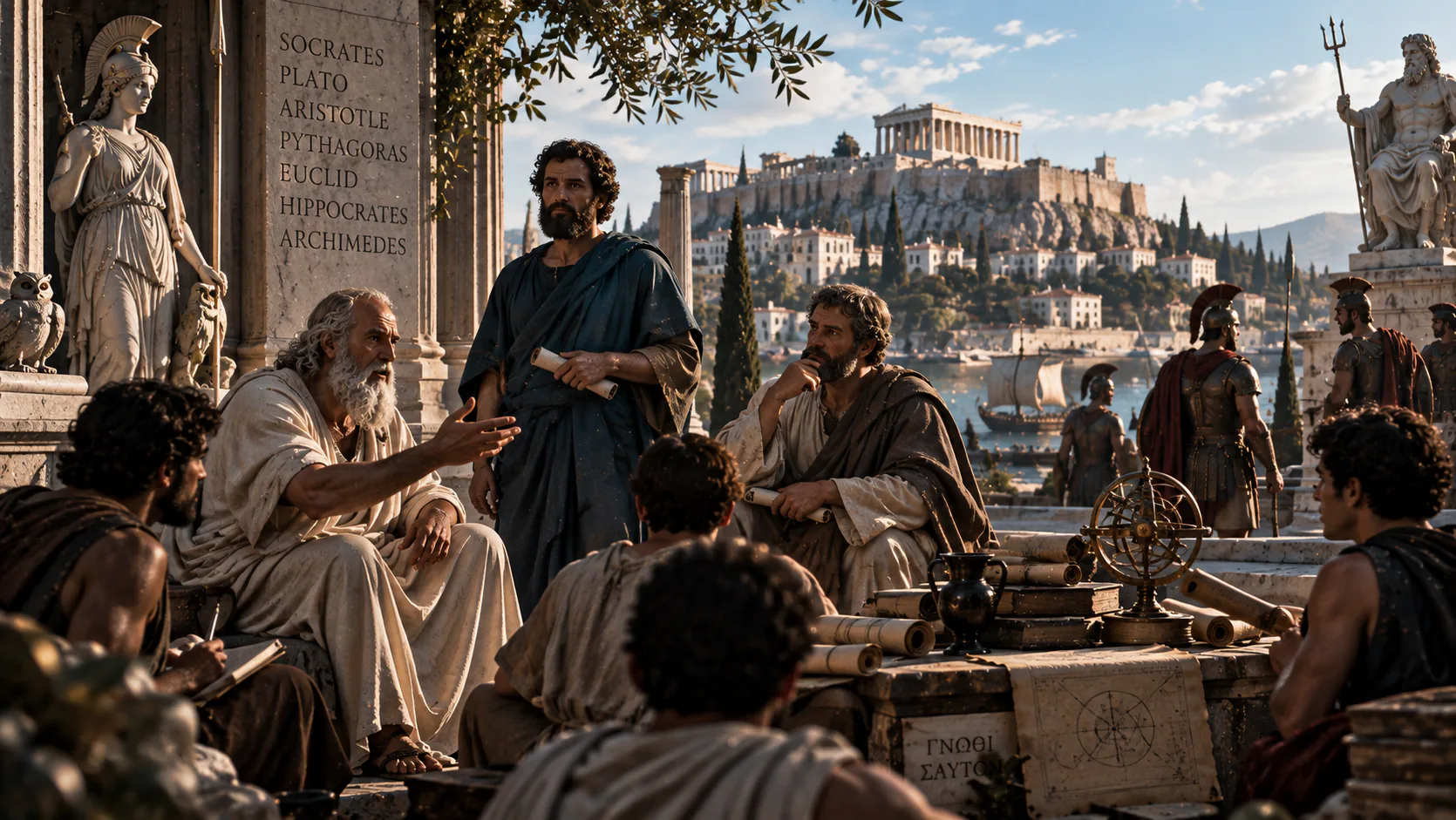
Ancient Greece shaped philosophy, science, politics, theatre, art and the language of democracy, but its story also includes war, slavery, exclusion and empire.
Ancient Greece was never a single country in the modern sense.
It was a world of city-states, islands, colonies, sanctuaries, rival armies, sea routes, languages, myths, festivals, slaves, citizens, philosophers, poets and engineers.
Yet the influence of Ancient Greece became enormous. Greek ideas shaped philosophy, mathematics, medicine, theatre, architecture, political language and the way later civilizations imagined reason itself.
That legacy should not be romanticized.
Athens discussed democracy while excluding women, enslaved people and many foreign residents from political power. Sparta built discipline and military reputation on the labor of an oppressed helot population. Greek cities created art and philosophy, but they also fought devastating wars and practiced slavery.
The history of Ancient Greece is powerful because it is human: brilliant, unequal, inventive, violent, curious and unfinished.
For more PRESDA history context, read the history of the Egyptian pyramids, the Ottoman Empire and the history of slavery.
Before Classical Greece
The famous age of Athens, Sparta, Socrates and the Parthenon did not appear suddenly.
Greek civilization grew out of earlier Bronze Age and Iron Age worlds around the Aegean.
On Crete, the Minoan civilization built palaces such as Knossos, traded across the eastern Mediterranean and developed distinctive art and administrative systems. On the Greek mainland, the Mycenaean world produced fortified palace centers, warrior elites and early forms of Greek writing known today as Linear B.
The Mycenaean palaces collapsed around the end of the Bronze Age, during a period of wider disruption across the eastern Mediterranean. Population patterns, trade networks and political structures changed dramatically.
Later Greeks remembered parts of the heroic past through epic traditions such as the stories associated with Troy.
But memory, poetry and archaeology are not the same thing.
By the Archaic period, beginning roughly in the eighth century BCE, Greek communities were again expanding, founding settlements around the Mediterranean and Black Sea, developing the polis, or city-state, and experimenting with new political forms.
The Polis: A Greek Way of Organizing Life
The polis was more than a town.
It was a political community with citizens, laws, cults, public spaces, temples, assemblies, magistrates and shared identity.
Each polis had its own character. Some were oligarchies ruled by narrow elites. Some experienced tyrannies. Some developed broader citizen participation.
This fragmentation made Greece creative and unstable.
City-states competed in war, trade, religion, athletics, colonization and prestige. They borrowed from one another, feared one another and sometimes united against external threats.
The Greek world therefore produced no single Ancient Greek civilization in the way a centralized empire might. It produced a network of communities whose rivalries became part of their energy.
Two of those communities became the most famous contrast in Greek history.
Athens and Sparta.
Athens and Sparta
Athens and Sparta were not simply opposites, but they represented very different models of Greek life.
Athens became known for naval power, drama, philosophy, public debate, empire and democracy. Its wealth grew through trade, tribute and maritime influence. Its public spaces became associated with argument, persuasion and civic identity.
Sparta became known for land power, discipline, military training and a social order designed around control of the helots, an unfree population tied to agricultural labor.
Spartan citizens were a small elite. Their military system depended on the labor and subordination of others. Spartan women could have more property and public visibility than women in many other Greek societies, but that did not make Sparta an equal society.
Athens and Sparta later became leaders of rival alliances, and their conflict helped tear the Greek world apart.
The Birth and Limits of Athenian Democracy
Athenian democracy is one of the most influential political experiments in history.
During the late sixth and fifth centuries BCE, Athens developed institutions that allowed male citizens to participate directly in government. Citizens could attend the Assembly, serve on juries, vote on policy and hold certain offices, often by lot.
This was not representative democracy in the modern sense. Citizens themselves made many decisions directly.
It was also not universal democracy.
Women could not vote. Enslaved people could not vote. Many foreign residents, known as metics, could not vote. Citizenship was restricted, and the political community represented only a portion of the people who lived and worked in Athens.
That contradiction matters.
Athenian democracy helped create enduring political language about citizenship, law, debate and public accountability. It also existed inside a society built on gender exclusion, slavery and imperial power.
The achievement and the limitation belong in the same sentence.
The Persian Wars
In the early fifth century BCE, Greek city-states faced the power of the Persian Empire.
The conflict grew out of Persian imperial rule in western Anatolia, Greek involvement in the Ionian Revolt and later Persian attempts to punish and control parts of mainland Greece.
At Marathon in 490 BCE, an Athenian-led force defeated a Persian expeditionary army.
A decade later, King Xerxes led a much larger invasion. In 480 BCE, the Spartans and their allies fought a famous delaying action at Thermopylae. Athens was evacuated and later burned. At Salamis, the Greek fleet defeated the Persian navy in a major naval battle. In 479 BCE, Greek forces defeated the Persians at Plataea.
The Persian Wars became central to later Greek memory.
But they should not be reduced to a simple story of freedom against tyranny. Greek city-states themselves practiced domination, slavery and exclusion. Persia was an imperial power, but so too would Athens become one in the Aegean.
History is rarely as clean as later propaganda wants it to be.
Athens Becomes an Empire
After the Persian Wars, Athens led the Delian League, an alliance originally formed to continue resistance against Persia.
Over time, the league became an Athenian empire.
Member states paid tribute. Athens used that wealth to maintain naval power, fund public building and strengthen its position. The Parthenon and other monuments of the Acropolis belong to this world of artistic achievement and imperial resources.
This is one reason Athens remains difficult to simplify.
The same city produced tragedy, philosophy, democratic participation and architecture of extraordinary beauty.
It also coerced allies, punished rebellion and benefited from enslaved labor.
The brilliance was real.
So was the power.
The Peloponnesian War
The Peloponnesian War, fought from 431 to 404 BCE, was the great internal catastrophe of the Classical Greek world.
Athens and its empire faced Sparta and the Peloponnesian League.
The war lasted for decades, interrupted by uneasy truces and shaped by plague, failed expeditions, shifting alliances, naval strategy, land warfare and Persian involvement.
Thucydides, the Athenian historian, described the conflict with unusual attention to power, fear, rhetoric and human behavior under pressure.
Athens eventually lost. Sparta emerged victorious, helped in part by Persian financial support for a fleet.
But victory did not bring stability.
The war weakened the Greek city-state system, deepened mistrust and opened space for new powers to rise.
Macedonia and the End of City-State Independence
North of the traditional city-state heartland, Macedonia grew stronger under Philip II.
Philip reformed the army, used diplomacy skillfully and defeated a coalition of Greek forces at Chaeronea in 338 BCE.
That battle marked a turning point.
Greek city-states did not disappear, but their independence was now constrained by Macedonian power.
Philip planned a campaign against Persia but was assassinated in 336 BCE. His son inherited the kingdom, the army and the ambition.
His name was Alexander.
Alexander the Great
Alexander III of Macedon became king in 336 BCE and launched one of history's most dramatic military campaigns.
He crossed into Asia, defeated Persian armies at major battles including Issus and Gaugamela, took Egypt, entered Babylon and pushed eastward as far as regions near modern Pakistan.
His conquests destroyed the Achaemenid Persian Empire and spread Greek language, institutions, military settlements and elite culture across a vast territory.
Alexander died in Babylon in 323 BCE at the age of 32.
He left no stable imperial succession.
His generals divided the empire into Hellenistic kingdoms, including the Ptolemies in Egypt and the Seleucids in parts of Asia.
Alexander's career was not simply heroic adventure. It involved siege warfare, massacre, political calculation and imperial conquest. But it also changed the map of culture, trade and knowledge across the eastern Mediterranean and western Asia.
The Hellenistic World
The Hellenistic period after Alexander was not a decline into afterglow.
It was a major age of cities, kingdoms, science, scholarship, art and cultural exchange.
Alexandria in Egypt became one of the great intellectual centers of the ancient world. Greek became a language of administration and elite culture across wide regions. Philosophical schools, medical research, mathematical work and scientific speculation flourished in new settings.
Hellenistic art often became more dramatic, emotional and cosmopolitan than earlier Classical styles.
The Greek world had expanded beyond the old polis.
It was now connected to royal courts, libraries, trade routes and multicultural cities.
Socrates
Socrates left no writings of his own.
What we know comes mainly through later authors, especially Plato and Xenophon, with comedy and hostile sources also shaping the picture.
That means the historical Socrates must be handled carefully.
He became famous in Athens for questioning people about virtue, knowledge, justice and the examined life. His method exposed contradictions and forced people to ask whether they truly understood the concepts they claimed to know.
In 399 BCE, after Athens had lost the Peloponnesian War and endured political turmoil, Socrates was tried and executed on charges traditionally associated with impiety and corrupting the youth.
His death became one of the founding scenes of Western philosophy: a city famous for debate condemning one of its most relentless questioners.
Plato
Plato, a student of Socrates, transformed philosophy into a written and institutional tradition.
His dialogues explored ethics, politics, knowledge, education, language, metaphysics and the soul. He founded the Academy in Athens, often described as one of the most important intellectual institutions of antiquity.
Plato's works are not simple transcripts of Socrates speaking. They are literary and philosophical texts in which Socrates often appears as a central character.
That distinction matters because Plato preserves Socrates and also creates a philosophy of his own.
Ideas such as the theory of Forms, the philosopher-ruler and the critique of democracy became deeply influential, debated and disputed for centuries.
Aristotle
Aristotle studied at Plato's Academy and later founded his own school, the Lyceum.
He wrote about logic, biology, ethics, politics, poetry, rhetoric, metaphysics, animals, causation and knowledge. He also tutored the young Alexander for a period, though Alexander's empire should not be treated as a simple application of Aristotle's philosophy.
Aristotle's range was extraordinary.
Some of his scientific claims were later overturned. Others helped structure inquiry for many centuries. His logical works, biological observations and ethical vocabulary became part of the intellectual inheritance of the Mediterranean, Islamic and European worlds.
Ancient Greek philosophy did not give humanity final answers.
It gave later thinkers durable questions.
Mathematics: Pythagoras and Euclid
Greek mathematics developed through a long tradition of proof, geometry, number theory and astronomical speculation.
Pythagoras is associated with a school that linked mathematics, music, number and philosophy. The theorem bearing his name was known in other cultures before Greek proof traditions, so the history should not be reduced to one inventor. What matters is the Greek development of deductive mathematical argument.
Euclid, working in Hellenistic Alexandria around 300 BCE, compiled and organized geometry in the Elements.
The Elements became one of the most influential mathematics texts ever written because it presented mathematical knowledge through definitions, axioms, propositions and proofs.
For centuries, learning geometry meant entering a world shaped by Euclid.
Medicine: Hippocrates and the Human Body
Hippocrates of Kos became the symbolic father of Greek medicine, though the texts known as the Hippocratic Corpus were written by multiple authors over time.
Their importance lies partly in method.
Some Greek medical writers tried to understand illness through observation, environment, diet and bodily processes rather than treating every disease as direct divine punishment.
Ancient Greek medicine was not modern medicine. It included theories, such as humoral ideas, that later science rejected or transformed.
But the movement toward clinical observation, case histories and natural explanation became historically important.
The Hippocratic tradition represents a step toward asking what can be observed in the patient, not only what can be imagined in myth.
Science: Archimedes and Ancient Inquiry
Archimedes of Syracuse lived in the Hellenistic period and became one of the greatest mathematicians and engineers of antiquity.
He worked on geometry, measurement, levers, centers of gravity, hydrostatics and mechanical problems. Later stories about him are often embellished, but his surviving mathematical and scientific work shows genuine brilliance.
Ancient Greek science was not science in the modern institutional sense. It had no modern laboratories, peer-reviewed journals or industrial research system.
Yet Greek thinkers helped develop habits that mattered: logical argument, mathematical proof, natural explanation, classification and debate.
Those habits would later travel through Roman, Byzantine, Islamic and European scholarly worlds before becoming part of modern science.
Theatre, Art and Architecture
Greek theatre grew out of religious festivals and became one of the great artistic forms of world culture.
Athenian tragedy explored war, family, pride, suffering, justice and the limits of human knowledge. Comedy mocked politicians, intellectuals and social habits with sharp public energy.
Greek art and architecture also shaped visual culture for centuries.
Temples such as the Parthenon combined religious function, civic display and mathematical proportion. Sculptors explored idealized bodies, movement, balance and later emotional drama. Pottery preserved scenes of myth, sport, war, domestic life and ritual.
None of this art was separate from society.
It was funded, viewed, used and argued over by communities that were themselves unequal and political.
The Olympic Games
The ancient Olympic Games were held at Olympia in honor of Zeus.
Tradition dates the first Olympic Games to 776 BCE, though early history is partly wrapped in later memory.
The games were religious as well as athletic. Greek male athletes competed in events such as running, wrestling, boxing, pankration, pentathlon and equestrian contests.
The Olympics did not represent modern universal sportsmanship. Participation was restricted, and the festival belonged to a specific religious and cultural world.
Even so, the games show how Greeks connected competition, honor, the body, religion and public identity.
Greek Religion and Mythology
Greek religion was polytheistic, ritual-centered and deeply local.
Gods such as Zeus, Athena, Poseidon and Hades were not just characters in stories. They were honored through temples, sacrifices, festivals, vows and civic cults.
Zeus was associated with kingship, sky and divine authority. Athena was linked with wisdom, craft and the city of Athens. Poseidon ruled the sea and earthquakes. Hades was connected with the underworld and the dead.
Greek mythology gave narrative form to divine power, human ambition, suffering and cosmic order.
But mythology is not the same as history.
A myth can reveal how people imagined the world without proving that the events happened as told.
Responsible history keeps that distinction alive.
The Trojan War: Myth, Memory and Archaeology
The Trojan War is known mainly through epic tradition, especially the Iliad and later Greek and Roman literature.
The story of Achilles, Hector, Helen, Paris and the wooden horse became one of the most famous mythic cycles in the world.
Archaeology has identified ancient Troy at Hisarlik in modern Turkiye, and the site shows long occupation, destruction layers and importance in the Bronze Age Aegean-Anatolian world.
That does not mean Homer's poems are straightforward historical reports.
There may have been conflicts involving a city remembered as Troy. There may have been historical memories behind parts of the tradition. But the gods, speeches, heroes and dramatic structure of the epics belong to poetry and later storytelling.
Troy sits between archaeology and myth.
That is exactly why it remains fascinating.
Slavery, Women and Everyday Society
Ancient Greece cannot be understood only through philosophers and temples.
Most people were not philosophers.
They farmed, traded, served, cooked, wove, fought, raised children, carried water, managed households, worked in workshops, rowed ships or lived in slavery.
Slavery was widespread in many Greek communities. Enslaved people worked in homes, mines, agriculture, workshops and public roles. Their experiences varied, but they lacked basic freedom and legal equality.
Women's lives also differed by city, class and status. Athenian citizen women were excluded from formal political life and were expected to operate largely within household structures, though they played important roles in religion, family and property transmission. Spartan citizen women had unusual prominence in property and public life compared with many Greek women, but they were not political equals to male citizens.
Foreign residents, poor citizens, rural laborers and enslaved people made Greek society function.
Any history that remembers only elite men misunderstands the civilization it claims to admire.
Rome and the End of Greek Political Independence
After Alexander, Hellenistic kingdoms competed for power across the eastern Mediterranean.
Rome gradually intervened in Greek affairs and defeated Macedonian power.
The Roman victory at Pydna in 168 BCE weakened the Antigonid kingdom of Macedonia decisively. In 146 BCE, after the Achaean War, Rome destroyed Corinth and brought Greece under firmer Roman domination.
This did not end Greek culture.
Greek language, philosophy, art, literature and education deeply influenced Rome. Elite Romans studied Greek texts, collected Greek art and absorbed Greek intellectual traditions.
Politically, independent Greek city-state power had faded.
Culturally, Greece conquered many of its conquerors.
What Ancient Greece Gave the World
Ancient Greece's lasting influence is real, but it should be described carefully.
Modern democracy is not a direct copy of Athens. It passed through Roman law, medieval institutions, Enlightenment thought, revolutions, constitutional struggles and modern movements for citizenship and civil rights.
Modern science is not simply Greek science. It developed through many civilizations, including major Islamic, Indian, Chinese, African and European contributions.
Modern philosophy is not only Greek philosophy. But Greek thinkers gave later traditions a vocabulary of argument, ethics, logic, metaphysics and political analysis that remains powerful.
The Greek legacy is therefore not ownership of civilization.
It is one vast chapter in the human attempt to ask better questions.
What is justice?
What is knowledge?
What makes a city legitimate?
How should people live?
What is nature made of?
What can reason know?
Those questions outlived the city-states that first debated them.
The Civilization That Changed How We Think
Ancient Greece changed history because it turned argument into a public art.
Its people debated laws, staged tragedies about moral disaster, built temples to gods, measured geometry, speculated about nature, told myths of heroes, questioned teachers, fought wars, enslaved others, founded colonies, wrote histories and imagined politics as something human beings could discuss.
That does not make Ancient Greece perfect.
It makes it important.
The civilization's greatness is not found in pretending it had no contradictions.
It is found in seeing how much later humanity inherited from a world that was itself unfinished.
Athens and Sparta are gone.
The Parthenon is damaged.
The independent city-states fell.
Alexander's empire fractured.
But the questions continued.
Every time people argue about democracy, evidence, ethics, drama, beauty, mathematics, medicine or the limits of power, they are still living with part of the Greek inheritance.
Ancient Greece did not teach the world how to think once and for all.
It helped teach the world that thinking itself could become a civilization.
FAQ
Frequently Asked Questions
What was Ancient Greece?
Ancient Greece was a wider Greek-speaking world of city-states, islands, colonies and kingdoms rather than one modern nation-state.
Was Athens the first democracy?
Athens developed one of history's most influential direct democracies, but it excluded women, enslaved people and many non-citizens from political participation.
How were Athens and Sparta different?
Athens became known for naval power, democracy, theatre and philosophy, while Sparta was organized around land power, military discipline and control of the helot labor population.
Did the Trojan War really happen?
Archaeology confirms an important ancient city at Troy, but Homer's Trojan War stories combine possible historical memory, myth, poetry and later tradition.
Who were the major Greek philosophers?
Socrates, Plato and Aristotle are among the most influential Greek philosophers, although Ancient Greek thought also included many other schools and thinkers.
What ended independent Greek city-state power?
Macedonian dominance after Philip II and Alexander reduced city-state independence, and Roman victories later brought Greece under Roman rule.
Why does Ancient Greece still matter?
Ancient Greece influenced philosophy, political language, theatre, mathematics, medicine, architecture, historical writing and later debates about reason, evidence and citizenship.
PRESDA Dispatch
Stay Informed. Stay Aware.
A sharp briefing across AI, gaming, sport, business, world affairs, paparazzi, and lifestyle.