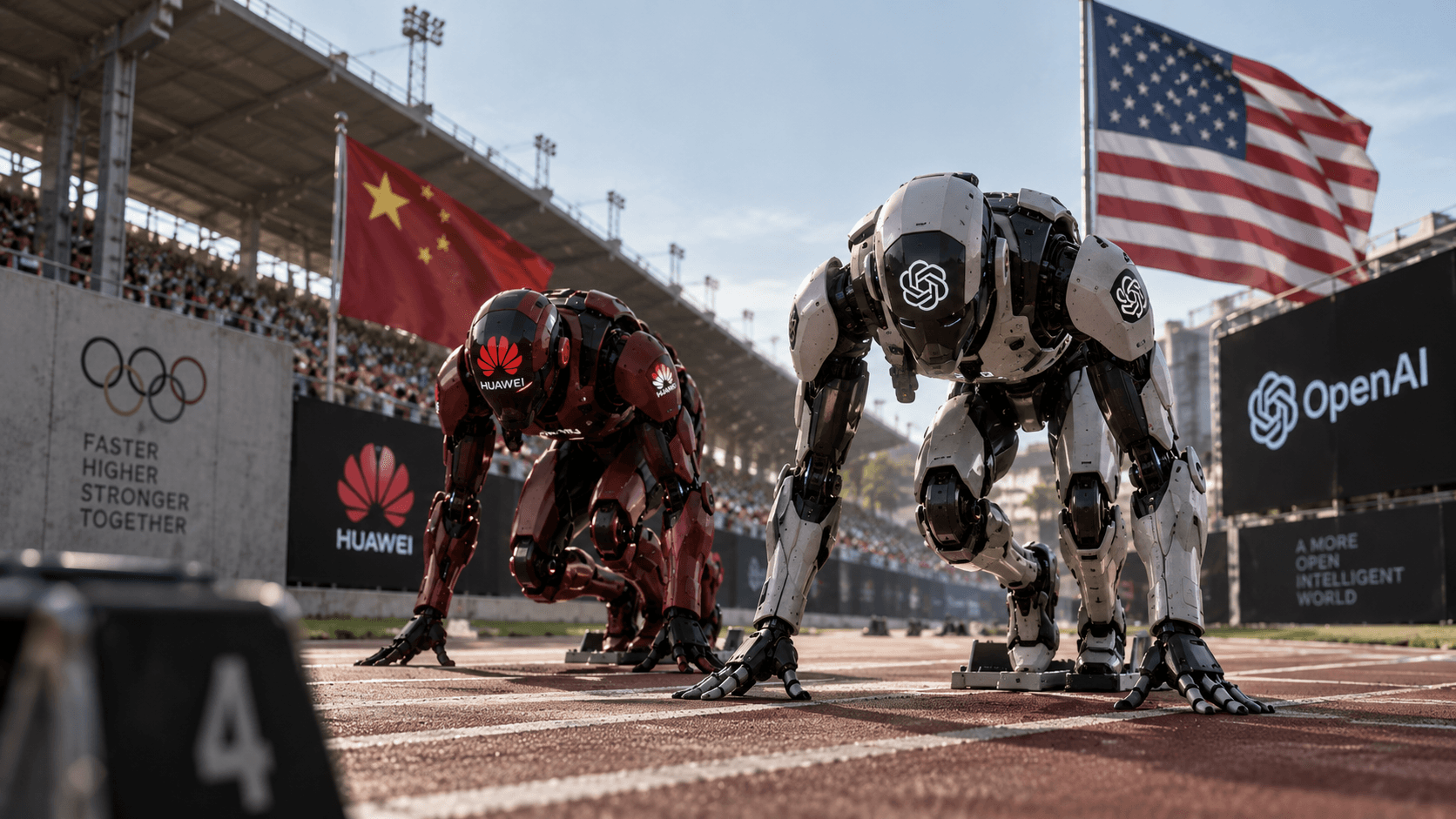
AI RACE: CHINA VS AMERICA FOR CONTROL OF THE WORLD'S MOST POWERFUL TECHNOLOGY
The US-China AI race is not only about chatbots. It is a strategic contest over chips, models, data centers, talent, robotics, cloud platforms, national security and economic power.
The US-China AI race is often described as a battle for the future. That phrase sounds dramatic because the stakes really are large.
Artificial intelligence now touches software, chips, weapons, robotics, finance, education, medicine, propaganda, cybersecurity, manufacturing and scientific research. It can write code, interpret images, operate agents, accelerate discovery, automate offices and guide machines in the physical world.
That is why Washington and Beijing no longer treat AI as an ordinary technology market. They treat it as strategic infrastructure.
But the race is not one clean contest between two governments. OpenAI is not the United States government. NVIDIA is not the Pentagon. Huawei is not simply a synonym for Beijing. SMIC is a company operating inside China's industrial-policy system. Private firms, state agencies, universities, cloud providers and chipmakers all matter, and they do not always move in perfect coordination.
The central question is therefore more precise: who leads the US China AI race in 2026, and in which part of the stack?
For more PRESDA context, read OpenAI's next model plans, AI agents and jobs and AI becoming a friend, not just a tool.
Why AI Became A US-China Strategic Competition
AI became a strategic competition because it is a general-purpose technology. Like electricity, computing or the internet, it can improve many other industries at once.
For the United States, AI leadership supports cloud platforms, software companies, chip design, military systems, scientific research, finance and productivity growth. For China, AI is tied to industrial upgrading, surveillance capabilities, robotics, manufacturing, consumer platforms and the goal of reducing dependence on foreign technology.
Both governments see the same thing: advanced AI can turn compute, data, talent and capital into economic and military advantage.
That does not mean every AI product is a weapon or every model lab is an arm of the state. It means frontier AI has dual-use potential. A model that writes code can help a business, a scientist or a cyber operator. A vision system can guide a factory robot, a self-driving car or a drone.
The American AI Stack
America's strength begins with the private technology ecosystem. OpenAI helped define the modern generative-AI wave. Microsoft turned AI into a cloud and productivity platform. Google and DeepMind remain central to model research, search, chips and scientific AI. Meta has pushed open-weight models into global developer culture. NVIDIA supplies the accelerator hardware that made the boom possible.
The American stack is powerful because model labs, cloud providers, venture capital, universities and chip designers reinforce one another. A new model can be trained on cloud infrastructure, deployed through enterprise software, funded by private capital and improved by a deep research labor market.
This ecosystem is not frictionless. Training costs are immense. Electricity and data-center capacity are bottlenecks. Copyright, safety, privacy, labor and antitrust questions are unresolved. Even so, the United States currently has the broadest concentration of frontier AI companies and infrastructure.
The Chinese AI Stack
China's AI ecosystem is different. It includes giant platform companies such as Alibaba, Tencent, Baidu and ByteDance, model developers including DeepSeek and Zhipu AI, hardware players such as Huawei, and foundry capacity led domestically by SMIC.
Alibaba's Qwen models have become important in open-weight and enterprise AI. DeepSeek became globally significant by showing that Chinese labs could produce highly capable models under compute constraints. Huawei's Ascend chips represent China's most important domestic alternative to NVIDIA accelerators. SMIC matters because domestic semiconductor manufacturing is central to any long-term Chinese AI strategy.
China also has strengths beyond foundation models. It has enormous manufacturing capacity, fast product iteration, strong robotics supply chains, large domestic markets and a state willing to direct capital toward strategic sectors.
Its weaknesses are also clear: access to the most advanced chips and manufacturing equipment is constrained, software ecosystems around AI accelerators remain harder to build than hardware headlines suggest, and frontier training at the largest scale still depends heavily on compute availability.
AI Models And Agents
The first stage of the AI boom was dominated by chatbots. The next stage is increasingly about agents: systems that can use tools, write and run code, search information, plan tasks, control software and act across workflows.
OpenAI, Google, Microsoft, Meta and Chinese labs are all pushing models toward more useful reasoning, multimodal understanding and tool use. The commercial prize is not simply a smarter chat window. It is software that can perform work.
Agents change the geopolitical stakes because they can affect productivity, cybersecurity, research and business operations. An AI assistant that writes emails is useful. An AI agent that can analyze codebases, operate enterprise systems or coordinate robots is much more powerful.
No country has solved reliability. Agents still make mistakes, misunderstand goals and require oversight. The winner in deployment may be the side that combines capability with trust, safety, integration and cost.
NVIDIA GPUs Vs China's Domestic Chip Push
NVIDIA remains central to frontier AI because its GPUs, networking hardware and CUDA software ecosystem created the default platform for large-scale AI training and inference.
The advantage is not only the chip. It is the full stack: hardware, software libraries, developer familiarity, interconnects, systems engineering, supply chains and cloud availability.
China's domestic chip push is a direct response to that dependence. Huawei's Ascend line is the most visible challenger, and Chinese companies are working to adapt models and software to domestic accelerators.
The gap is not static. Chinese hardware, packaging, software and model-efficiency work can improve. But replacing NVIDIA at the frontier is difficult because AI chips are not interchangeable commodities. A weaker software ecosystem can make a theoretically capable chip harder to use at scale.
Export Restrictions And Their Real Impact
US semiconductor export restrictions aim to slow China's access to the most advanced AI chips, chipmaking tools and manufacturing know-how.
The impact is real but not absolute. Restrictions can raise costs, delay training runs, complicate procurement and force Chinese firms toward domestic substitutes. They can also create incentives for workarounds, stockpiling, model efficiency and faster domestic investment.
Export controls are most effective when they target chokepoints that are genuinely hard to replace: extreme-ultraviolet lithography, advanced packaging, high-bandwidth memory, cutting-edge GPUs, design tools and specialized manufacturing equipment.
But controls also carry trade-offs. They can reduce sales for US companies, encourage China to accelerate self-sufficiency and push global customers to diversify away from American suppliers over time.
Huawei, SMIC And The Limits Of Catch-Up
Huawei and SMIC show both China's progress and its constraints.
Huawei has become the symbol of China's domestic AI hardware ambition. Its Ascend chips are important because they give Chinese AI firms a non-NVIDIA path, especially when paired with Huawei's cloud and software work.
SMIC is China's leading domestic foundry. Its progress matters because chip sovereignty requires manufacturing, not only design. Yet the most advanced semiconductor production is among the hardest industrial tasks on earth. It requires tools, materials, yield management, packaging, process knowledge and enormous capital.
China can narrow gaps in some areas while still facing bottlenecks at the bleeding edge. Catch-up is not a single moment. It is a long fight across dozens of technical layers.
TSMC And Why Taiwan Matters
Taiwan matters because TSMC manufactures many of the world's most advanced chips, including chips used by leading AI companies.
This makes Taiwan a central point in the AI race even though the competition is often described as simply China versus America.
Advanced AI depends on semiconductor supply chains that cross borders: US chip design, Taiwanese manufacturing, Dutch lithography tools, Japanese materials, South Korean memory, cloud data centers and global electronics assembly.
Any serious disruption around Taiwan would affect AI far beyond one company or one country. It would shake the foundation of the modern computing economy.
Data Centers, Electricity And Compute
AI leadership increasingly depends on physical infrastructure. Models need data centers. Data centers need chips, land, cooling, electricity, fiber networks, transformers and grid connections.
The United States has massive cloud platforms and private investment, but it faces power constraints, permitting delays and local opposition in some regions. China can mobilize infrastructure quickly, but it also faces energy, efficiency and regional allocation challenges.
Compute is now a strategic resource. Countries once counted steel mills and oil reserves. In the AI age, they also count accelerator clusters, megawatts and data-center capacity.
The race is therefore not only intellectual. It is electrical.
Talent, Research And Universities
The United States remains a magnet for global AI talent because of its universities, labs, startups, capital markets and immigration history.
China has also become a major AI research power. Chinese researchers publish heavily, Chinese universities train large numbers of engineers, and Chinese firms can move quickly from research to product deployment.
The talent picture is complicated because many researchers are internationally mobile. A Chinese-born scientist may work at a US lab. An American-trained researcher may return to China. Papers can be global even when policy becomes national.
Restrictions on visas, collaboration or research exchange can protect sensitive technologies in some cases, but they can also damage the openness that made AI research advance quickly.
Investment And Funding
US AI investment is driven heavily by private capital, cloud giants and venture markets. Massive spending by Microsoft, Google, Meta, Amazon, Oracle and AI startups has made the American AI ecosystem extraordinarily well funded.
China's investment combines private companies, local governments, state guidance funds and national industrial priorities. It can direct resources toward chips, robotics, cloud services and strategic AI applications.
The difference is not private versus public in a pure sense. Both countries mix state and market forces. The United States funds defense research and industrial policy. China has private giants and competitive startups.
The question is which system allocates capital better: America's market-led scale and risk appetite, or China's strategic coordination and manufacturing depth.
Open-Source And Open-Weight AI
Open-source and open-weight AI complicate the race.
Meta's Llama models helped make open-weight AI a serious force. Chinese models such as Qwen and DeepSeek have shown that open or downloadable model weights can spread influence quickly, especially among developers and companies that want lower costs or more control.
Open models can accelerate innovation because researchers and builders can adapt them. They can also make safety and security harder because powerful capabilities spread beyond a few controlled labs.
For China, strong open-weight models are a way to compete globally even when access to top-tier chips is constrained. For the United States, open models can spread American technical standards and developer ecosystems, but they also reduce the advantage of closed frontier labs.
Robotics And Autonomous Systems
AI becomes geopolitically more serious when it leaves the screen.
Robotics, drones, autonomous vehicles, warehouse automation, industrial vision and humanoid robots all depend on the marriage of AI software with physical manufacturing.
China has a major advantage in manufacturing scale, electronics supply chains, batteries, drones and factory automation. The United States has strengths in frontier models, robotics research, software, defense technology and high-value autonomy.
The future may not be decided by the best chatbot. It may be decided by who can connect AI models to millions of machines safely, cheaply and reliably.
Economic And National-Security Implications
Economically, AI could increase productivity, change labor markets, concentrate corporate power, reshape education and accelerate scientific discovery.
Nationally, it raises questions about cyber operations, intelligence analysis, autonomous systems, disinformation, military planning and the security of critical infrastructure.
That is why both governments worry about dependence. Washington does not want a rival power controlling critical AI hardware or software. Beijing does not want foreign controls deciding whether Chinese firms can train advanced models.
The security dilemma is obvious: one country's defensive move can look offensive to the other.
Who Leads In 2026?
The most accurate answer is by domain, not by slogan.
The United States appears to lead in frontier model labs, advanced AI chips through NVIDIA, hyperscale cloud platforms, venture-backed AI startups and global enterprise software deployment.
China appears strongest in manufacturing depth, fast consumer and industrial deployment, open-weight model efficiency, robotics supply chains and state-directed infrastructure mobilization.
Taiwan, through TSMC, remains indispensable to the most advanced AI chips. That means neither Washington nor Beijing fully controls the hardware future alone.
In short: America leads much of the frontier AI stack today, but China has enough scale, talent, manufacturing and policy focus that the race is not settled.
Could China Catch Or Surpass The United States?
Yes, China could catch or surpass the United States in some AI domains. It may already be closer in applied deployment, open-weight efficiency, robotics manufacturing or cost-optimized models than headline comparisons suggest.
But surpassing the United States across the full frontier stack is harder. China would need not only strong models, but advanced chips, manufacturing tools, software ecosystems, data-center infrastructure, global trust, developer adoption and sustained research talent.
Export controls can slow China, but they cannot guarantee permanent US leadership. A determined rival can adapt, invest and innovate around constraints.
The real question is whether China's domestic stack can improve faster than US companies can extend their lead.
Can The United States Maintain Its Advantage?
The United States can maintain an advantage if it keeps leading in chips, cloud infrastructure, frontier research, talent attraction, energy buildout and responsible deployment.
But leadership can be wasted. If power shortages slow data centers, immigration policy drives away researchers, regulation becomes confused, or frontier labs lose public trust, the lead narrows.
US strength comes from an ecosystem, not one company. OpenAI, NVIDIA, Microsoft, Google, Meta, universities, startups and investors all matter. So do public institutions, standards bodies and national-security agencies.
Keeping an advantage requires coordination without smothering the openness and competition that made the ecosystem strong.
Could China And America Ever Work Together On AI?
Cooperation is possible, but it is likely to be narrow, cautious and issue-specific rather than a full technological partnership.
The United States and China have shared interests in preventing catastrophic misuse, reducing accidental escalation, setting international safety standards, limiting dangerous autonomous weapons behavior, managing biosecurity risks and keeping AI-enabled cyber conflict from spiraling.
Scientific research could remain an area of limited cooperation, especially on safety evaluations, interpretability, model testing, climate science, medicine and global standards. International organizations, academic conferences and technical standards bodies may provide channels even when strategic trust is low.
But deep cooperation on frontier models, advanced chips or military applications is unlikely while both countries see AI as a strategic advantage. Neither side wants to make the other more powerful in technologies that could shape economic and security dominance.
The realistic future is competitive coexistence: rivalry in chips, models and deployment, combined with selective cooperation where both sides fear the consequences of failure.
US China AI Race: Myth Vs Reality
MYTH: The AI race has one clear winner.
REALITY: Leadership differs by domain. Models, chips, infrastructure, deployment, manufacturing and governance do not all have the same leader.
MYTH: OpenAI and NVIDIA are the US government.
REALITY: They are private companies operating inside an American strategic environment. Their incentives overlap with Washington's in some areas and differ in others.
MYTH: Huawei and SMIC are interchangeable with the Chinese government.
REALITY: They are Chinese companies operating inside China's political and industrial-policy system, but company capability, state strategy and government authority are not identical things.
MYTH: Export controls can permanently stop China's AI progress.
REALITY: Controls can slow and reshape progress, but they also create incentives for domestic substitution and technical workarounds.
MYTH: The best chatbot decides the future.
REALITY: AI power also depends on chips, electricity, data centers, talent, deployment, robotics, safety and public trust.
The Race Is Bigger Than A Finish Line
The AI race between China and America is not a sprint with one medal ceremony at the end.
It is a long contest over the layers of technological power: research, chips, energy, models, standards, cloud platforms, robots, factories, capital and trust.
The United States currently holds major advantages in frontier models, AI accelerators, cloud ecosystems and private investment. China holds major advantages in manufacturing scale, state-directed mobilization, applied deployment and the determination to reduce foreign dependence.
Neither side can simply declare victory. AI is too broad, too fast-moving and too embedded in the physical economy for that.
The country that leads the next decade of AI may not be the one with the loudest model announcement. It may be the one that turns intelligence into reliable infrastructure without losing control of the risks that come with it.
FAQ
Frequently Asked Questions
Who leads the US China AI race in 2026?
The United States appears to lead in frontier models, advanced AI chips, cloud platforms and private investment, while China is highly competitive in manufacturing scale, applied deployment, open-weight model efficiency and robotics supply chains.
Why do AI chips matter so much?
Advanced AI models require enormous compute. Chips such as NVIDIA GPUs, along with networking, memory, software and data-center infrastructure, determine how fast and cheaply models can be trained and deployed.
Can China build AI without NVIDIA chips?
China can and does build AI systems using domestic and alternative hardware, including Huawei accelerators, but replacing NVIDIA's full hardware and software ecosystem at the frontier remains difficult.
Why does Taiwan matter in the AI race?
Taiwan matters because TSMC manufactures many of the world's most advanced chips. AI supply chains depend on Taiwanese fabrication alongside US design, Dutch lithography tools, memory suppliers and global assembly.
Could China and America cooperate on AI?
Limited cooperation is possible around AI safety, standards, scientific research and preventing catastrophic misuse, but deep cooperation on frontier models, chips or military applications is unlikely while both countries treat AI as strategic power.
PRESDA Dispatch
Stay Informed. Stay Aware.
A sharp briefing across AI, gaming, sport, business, world affairs, paparazzi, and lifestyle.