SELF-DRIVING TRUCKS: WILL THE MACHINES REPLACE THE PEOPLE WHO MOVE THE WORLD?
Driverless trucks are moving from experiments to real roads. They promise cheaper, safer and nearly continuous freight, but what happens to the people whose livelihoods depend on driving?
On September 14, 2026, Pony.ai used IAA Transportation in Hanover to unveil a new Level 4 electric robotruck developed with GAC. The company said mass production was planned for 2026, that it already operated hundreds of autonomous trucks in China including some without human drivers, and that Europe and the Middle East were future target markets.
That announcement matters because it captures the moment self-driving trucks are leaving the realm of futuristic trade-show fantasy and entering the uncomfortable world of labor, law, insurance, logistics and public roads.
A driverless truck is not just another AI demo. It is a machine weighing tens of thousands of kilograms, moving at highway speed, making decisions in weather, traffic, darkness and emergencies.
The promise is enormous: cheaper freight, fewer fatigue-related crashes, trucks that can operate for longer hours, and supply chains that move with less friction. The anxiety is just as real: what happens to the people who have spent their lives moving the world?
For more context on the global competition behind autonomy, read PRESDA's AI Race: China vs America for Control of the World's Most Powerful Technology.
What Are Self-Driving Trucks?
Self-driving trucks are heavy commercial vehicles equipped with automated driving systems that can perform some or all driving tasks under defined conditions.
The clearest way to understand them is through the SAE levels of driving automation. Level 0 means no driving automation. Level 1 includes limited assistance such as steering or speed support. Level 2 can combine steering and speed assistance, but a human driver remains responsible. Level 3 allows the system to drive in limited situations but may ask a human to take over. Level 4 can drive without human intervention inside a defined operational design domain. Level 5 would mean full automation anywhere a human could reasonably drive.
Most serious autonomous-truck programs are aimed at Level 4, not Level 5.
That distinction is crucial. Level 4 does not mean a truck can drive anywhere on Earth in any weather on any road. It means the system is designed to operate without a human driver only within specified conditions: certain roads, routes, speeds, maps, weather ranges, traffic environments and operational procedures.
What Is A Level 4 Autonomous Truck?
A Level 4 autonomous truck is a vehicle that can handle the driving task by itself inside its approved operating domain.
For long-haul freight, that often means mapped highway corridors, hub-to-hub routes, favorable weather windows and carefully monitored operations. The truck may not be expected to navigate every city street, loading dock, mountain pass, blizzard or construction zone without limits.
This is why a Level 4 truck can be genuinely driverless in one setting while still unsuitable for another.
The public often imagines autonomy as a binary switch: human driver or robot driver. The real world is more layered. Autonomous trucking may arrive first as a corridor-by-corridor system, not as a nationwide overnight replacement for all drivers.
How Do Autonomous Trucks Work?
A driverless truck must perceive the world, understand where it is, predict what other road users may do, plan a safe path and control steering, braking and acceleration.
Systems can use cameras, radar, lidar where deployed, GPS, inertial measurement, high-definition maps, onboard computing and AI models for perception and planning. Some also rely on remote operations centers for monitoring, assistance or exception handling.
The important point is not the specific sensor mix. It is redundancy. A truck cannot simply hope one sensor sees the road correctly. Heavy autonomous vehicles require overlapping ways to detect lanes, vehicles, pedestrians, obstacles, weather, construction and unusual events.
Even then, the hardest part is not a sunny highway lane. It is the strange edge case: debris in the road, a police officer directing traffic, a tire failure, a sudden storm, temporary cones, an emergency vehicle or a crash ahead.
The Truck With No One Behind The Wheel
In a fully driverless highway-freight model, a human may load the trailer at a terminal, inspect the vehicle, and dispatch it onto a mapped route. The autonomous system then drives the highway portion without a person in the cab.
At the other end, humans may take over for yard movement, city streets, final delivery, unloading or customer interaction.
This is the hub-to-hub model: automate the predictable middle of the journey while leaving the complex edges to people.
A truck may therefore drive itself for hundreds of highway miles and still depend on workers for loading, maintenance, fueling or charging, dispatch, inspection, remote support and final-mile delivery.
Driverless does not mean humanless.
Why Trucks May Automate Before Cars
Long-haul trucking is attractive to automation companies because many routes are repetitive, commercially valuable and easier to define than general urban driving.
A truck that runs between logistics hubs on known highways can operate inside a narrower domain than a consumer car expected to handle every neighborhood, school zone, driveway, parking lot and surprise urban interaction.
Freight also has strong economic incentives. Trucks are expensive assets. If autonomy eventually lets them operate more hours per day, carriers may move more freight with fewer idle hours. Driver wages, benefits, rest limits and shortages in some markets add to the business case.
But trucks are also extremely difficult. They are heavy, need long stopping distances, behave differently when loaded or empty, face crosswinds and weather, and create huge consequences when something goes wrong.
A bad autonomous-car decision can be tragic. A bad autonomous-truck decision can involve a moving industrial machine.
Who Is Building Driverless Trucks?
The autonomous-trucking field is crowded but uneven. Companies are not all at the same stage.
Aurora has become one of the most closely watched US players because it has moved into driverless commercial freight operations on limited Texas routes, after years of testing with safety drivers and partners. Its deployment is important, but it is not the same as nationwide autonomous trucking.
Kodiak has focused on autonomous freight corridors and has emphasized modular hardware, military applications and commercial testing. Waabi is developing AI-first autonomous trucking with simulation-heavy training and industry partnerships. Torc Robotics, owned by Daimler Truck, is working toward autonomous trucks tied to major truck-manufacturing expertise.
Pony.ai brings a China-centered robotaxi and robotruck background, with its 2026 GAC electric robotruck announcement aimed at showing that Chinese autonomy companies want to compete beyond domestic pilots.
Plus has worked on automated-trucking systems and driver-assistance technology. Einride has pursued electric and autonomous freight concepts, including remote-operation ideas. Volvo Autonomous Solutions and Daimler Truck bring the credibility of major truck manufacturers. Gatik focuses more on middle-mile box trucks and shorter logistics routes rather than classic long-haul tractor-trailers.
The key is to separate testing, commercial operation, safety-driver operation, remote assistance and fully driverless service. They are not the same milestone.
Are Driverless Trucks Already On The Road?
Yes, but only in limited ways.
Some autonomous trucks have operated with safety drivers. Some programs have run freight commercially while a trained operator remained in the cab. A smaller number of deployments have removed the human driver on specific routes under defined conditions.
Aurora's limited driverless freight operations in Texas are a major US example. Pony.ai says it has operated hundreds of autonomous trucks in China, including some without human drivers. Other companies are progressing through pilots, partnerships, depot operations, or pre-commercial testing.
What does not exist is a world where driverless trucks can freely haul any load anywhere across every road network. The technology is real, but the rollout remains constrained.
China's Robotruck Push
China could become one of the world's most important autonomous-freight markets.
The country has enormous logistics demand, huge ports, dense industrial corridors, major domestic truck manufacturers, strong electric-vehicle supply chains and cities that have already experimented with robotaxis and delivery automation.
Pony.ai's robotruck program fits into that larger system. Chinese companies can combine AI, EV manufacturing, mapping, logistics platforms and state-backed industrial priorities in ways that may accelerate testing and deployment.
But China also faces the same hard problems as everyone else: safety, reliability, weather, liability, public trust, freight economics and regulatory boundaries.
Autonomous freight is another front in the broader US-China AI competition: chips, models, robotics, vehicles, infrastructure and manufacturing capacity all matter.
America's Driverless Highways
The United States is a natural proving ground for autonomous trucking because it has long highway corridors, massive freight volume and a large for-hire trucking market.
Texas, the Sun Belt and interstate freight lanes have attracted particular attention because weather can be more manageable than in heavy snow regions, and freight corridors are commercially valuable.
US regulators have been adapting to a technology that challenges rules written around human drivers. FMCSA rules historically assume a person exists to inspect the vehicle, place warning devices, comply with hours-of-service limits and respond to emergencies.
That creates a regulatory puzzle: if there is no human driver, who performs the tasks the law assigns to the driver?
The answer is still evolving through exemptions, state rules, federal discussion and company safety cases. There is no responsible basis for claiming nationwide driverless trucking already exists.
Europe: The Next Battleground?
Pony.ai's Hanover announcement pointed directly at Europe. That makes sense: Europe has high labor costs, major ports, dense logistics corridors, sophisticated truck manufacturers and persistent concern about driver availability.
But Europe is not an easy market.
Cross-border trucking means national rules, EU frameworks, language, liability, insurance, road complexity, city access rules and public acceptance all matter. A route that works in one regulatory environment may not be instantly transferable across borders.
European roads can also be narrower, older and more complex than some US interstate corridors. Weather and urban density create additional difficulty.
Europe may become a major autonomous-freight market, but it is unlikely to be a single switch.
Why Companies Want The Driver Out
The economic dream is straightforward: a truck that moves more hours in a day can generate more revenue from the same asset.
Human drivers need rest. They have working-hour limits. They need wages, benefits, training, parking, comfort, recruitment and retention. They can become unavailable. Long-haul trucking can be lonely and physically demanding.
An autonomous system could, in theory, reduce labor constraints and increase utilization.
But removing the driver does not remove cost. Autonomous trucks require sensors, compute, redundant systems, maintenance, software, cybersecurity, mapping, insurance, remote operations, data infrastructure, validation and specialized support.
The question is not whether a robot driver is free. It is whether the total system becomes cheaper, safer and reliable enough at scale.
The 24-Hour Truck
The most powerful business case for autonomous trucking is the nearly continuous truck.
If a truck can move for far more hours with fewer stops, freight can arrive faster. Warehouses may schedule differently. Inventory could move with less buffer. Some supply chains could shift from waiting for a driver to waiting for the road.
That would change freight economics. But several obstacles remain: vehicle charging or fueling, maintenance, inspections, loading delays, weather restrictions, route approvals, remote support, insurance and regulations.
The 24-hour truck is a vision. Today's deployments are still much narrower.
The Human Cost
Trucking is not an abstraction. It is work.
In the United States, the Bureau of Labor Statistics counts millions of people in driving occupations, including heavy and tractor-trailer truck drivers. In Europe, road freight also supports a large workforce of drivers, dispatchers, mechanics, warehouse workers and roadside services.
Many drivers earn middle-income wages without needing a four-year degree. Some are immigrants. Some are older workers. Some own or lease equipment. Some spend long stretches away from home. Some carry specialized cargo, manage difficult customers, inspect loads and solve problems no software demo ever shows.
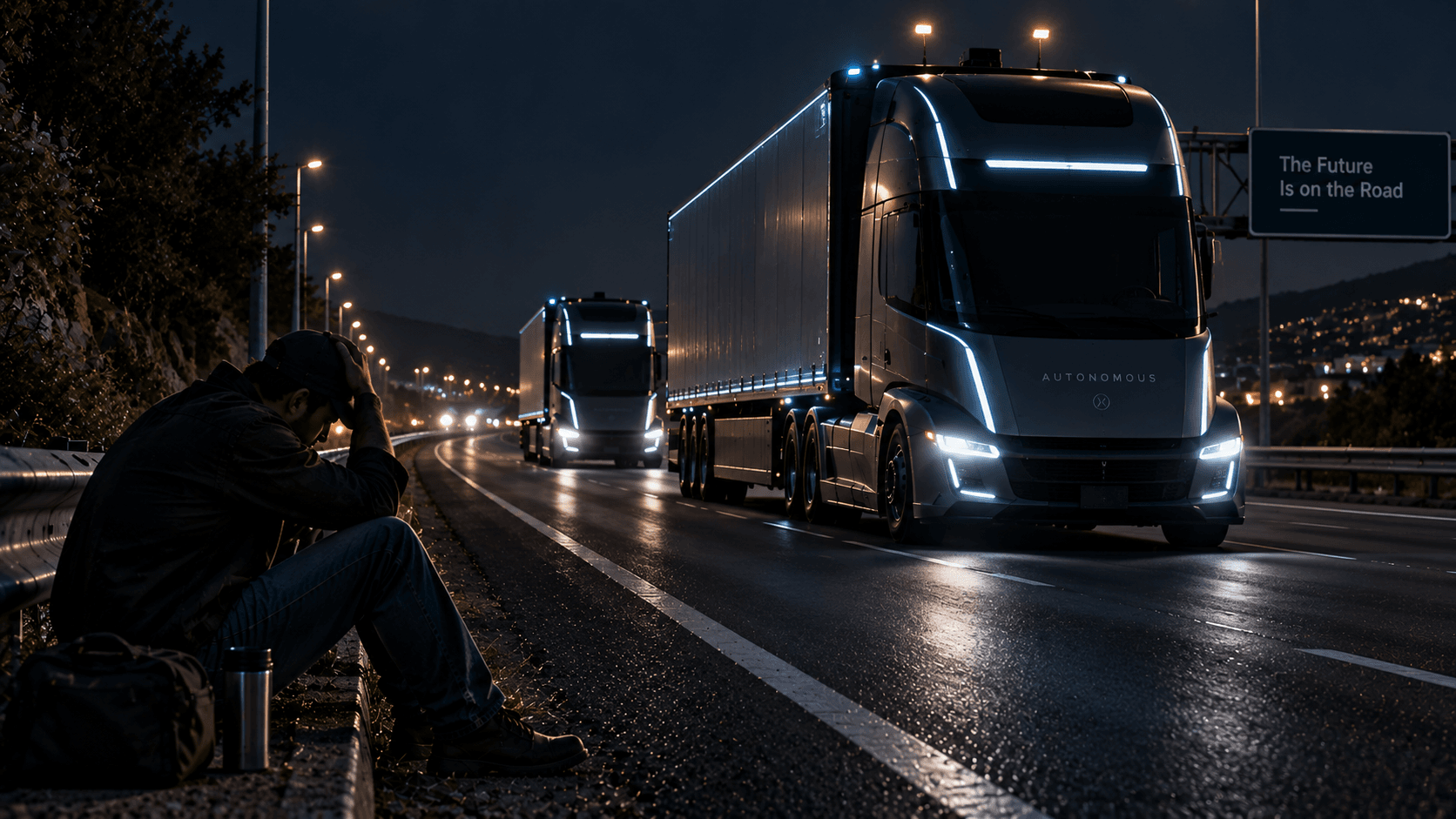
That is the emotional center of the autonomous-truck debate: the machine may keep moving while the human wonders whether his occupation moves with it.
Will Self-Driving Trucks Replace Truck Drivers?
Nobody can responsibly give an exact number today.
Viral claims that automation will wipe out millions of truck-driving jobs on a fixed timetable are too simplistic. At the same time, it would be dishonest to pretend the risk is imaginary.
The strongest near-term exposure is likely in repetitive long-haul highway freight and fixed corridors. The harder jobs are urban delivery, construction hauling, oversized loads, hazardous materials, complex customer-facing work, unpredictable routes and tasks involving loading or on-site judgment.
The US Bureau of Labor Statistics still projects continued heavy-truck-driver employment growth and large annual openings, partly because freight demand and replacement needs remain high.
That means automation can grow while driver demand also remains strong during a long transition. Both can be true.
Jobs May Change Before They Disappear
The first major labor shift may not be from driver to no worker. It may be from one kind of driving to another kind of logistics work.
Long-haul highway automation could leave humans handling first-mile and last-mile driving, yard operations, vehicle inspections, maintenance, dispatch, remote fleet supervision, customer delivery, specialized cargo and exception management.
Some drivers could move toward local routes and terminal-based work. Others may need retraining. Some smaller carriers and independent operators may face pressure if large fleets can afford technology earlier.
The transition may be economically rational for companies and still painful for individual workers.
Which Driving Jobs Are Most Exposed?
The most exposed routes are repetitive, high-volume, highway-heavy and predictable.
That includes some hub-to-hub freight corridors, port drayage links, industrial routes, mining or private-road operations and yard movement where the environment can be controlled.
Harder jobs include dense urban delivery, construction sites, rural routes with poor mapping, hazardous materials, oversized loads, snow-heavy regions, customer-facing delivery and work requiring frequent manual intervention.
The more a job involves judgment outside the lane, the harder it is to automate completely.
Are Autonomous Trucks Safer?
Safety is the industry's biggest promise.
The argument is powerful: machines do not get tired, text while driving, drive drunk or become distracted after long hours on the road. Fatigue and distraction are real human risks in trucking.
But autonomous systems introduce different risks. Software can fail. Sensors can be blinded or degraded. Maps can be outdated. Hardware can break. Weather can confuse perception. Rare events can expose gaps in training data.
The correct position is evidence-based caution. Autonomous trucks may reduce some human-caused crashes, but their safety must be proven through transparent data, independent review, regulatory oversight and real-world performance.
The 3 A.M. Problem
Imagine a driverless truck at 3 a.m.
A tire fails. Debris blocks a lane. Police unexpectedly close the highway. Snow covers lane markings. A crash happens ahead. A confused driver waves from the shoulder. Construction cones do not match the map.
What does a truck with no human inside do?
Autonomous systems are designed with fallback behavior: slow down, pull over, stop in a safe place, request remote assistance or execute a predefined minimal-risk maneuver. But the world does not always provide a perfect safe place.
The 3 a.m. problem is why autonomy is not only about normal driving. It is about abnormal driving.
Who Is Responsible When A Driverless Truck Crashes?
Liability is one of the hardest questions.
Possible responsible parties could include the vehicle owner, carrier, manufacturer, autonomous-driving-system developer, maintenance provider, cargo operator, remote operations provider or another road user.
The answer may depend on whether the crash involved software, sensors, maintenance, dispatch, road design, another vehicle, cargo loading or human oversight.
This is why law matters. Insurance and liability rules will shape adoption as much as sensors and AI models.
This is not legal advice. It is the practical reality of moving risk from an individual driver toward a technical system and the companies behind it.
Regulation Is Chasing The Technology
Commercial-vehicle regulation was built around human drivers.
Rules assume someone can inspect equipment, respond to roadside emergencies, manage warning devices, secure cargo, obey hours-of-service limits and communicate with enforcement officers.
Driverless trucks challenge those assumptions.
US FMCSA discussions and exemptions have therefore focused on how automated commercial vehicles can satisfy rules written for humans. Similar questions appear in Europe and other markets: type approval, roadworthiness, liability, data access, cybersecurity, remote support and cross-border operation.
Regulation is not just bureaucracy. It is how society decides what level of proof is required before a heavy autonomous vehicle operates near everyone else.
Hours Of Service: What If There Is No Driver?
Hours-of-service rules exist because tired humans are dangerous.
If no human is driving, the truck may gain an economic advantage by operating far longer than a human-driven vehicle. That is one reason carriers are interested.
But the vehicle still needs maintenance, inspection, charging or fueling, cleaning, loading, unloading and monitoring. Remote supervisors may also need labor rules of their own.
Autonomy does not eliminate time. It changes where the bottlenecks are.
Cybersecurity
A connected autonomous heavy vehicle must be protected against unauthorized access, communications failures, software compromise and data integrity problems.
The stakes are high because the vehicle is physical. It shares public roads with families, workers and emergency services.
Cybersecurity for autonomous trucks is therefore not an optional IT feature. It is part of vehicle safety.
The Weather Problem
Weather remains one of the hardest realities for autonomy.
Snow can cover lane markings. Heavy rain can reduce visibility. Fog can hide objects. Dust can interfere with perception. Ice changes braking. Glare can affect cameras.
Some autonomous systems may operate well in defined weather and pause in others. That is not failure. It is operational design.
But it does mean adoption will likely be uneven. Sunny freight corridors may come earlier than mountainous winter routes.
The Road Itself May Have To Change
Autonomous freight could encourage changes around roads and logistics networks.
Dedicated freight lanes, smart infrastructure, specialized transfer hubs, high-definition mapping, connected terminals and automated inspection systems could all support driverless trucks.
Some of this exists as pilots or proposals. Some may never be worth the cost.
The more society wants heavy vehicles to operate without people inside, the more the surrounding infrastructure may need to adapt.
Truck Stops Without Truckers?
Long-haul trucking supports a roadside economy: truck stops, restaurants, motels, parking lots, repair shops, showers, fueling stations and small businesses built around drivers.
If some long-haul routes become driverless, those businesses may feel the change. But the impact would not be uniform.
Autonomous trucks still need energy, maintenance, inspections and logistics support. Human drivers will still exist on many routes for a long time. The roadside economy may shrink in some places and transform in others.
The social geography of trucking matters because jobs are not only found inside the cab.
Autonomous And Electric Are Not The Same Thing
Autonomy and electrification are separate transitions.
A truck can be diesel and autonomous. It can be electric and human-driven. It can be electric and autonomous.
Pony.ai's new electric robotruck combines both ideas, which is why it is visually powerful. But the technologies solve different problems. Electric powertrains address emissions, fuel and maintenance. Autonomy addresses the driving task.
Confusing the two makes the debate less clear.
What About Tesla Semi?
Tesla Semi is primarily an electric-truck story.
Tesla has advanced driver-assistance ambitions, but the Semi should not be described as a fully autonomous driverless truck unless current evidence supports that specific claim.
An electric tractor-trailer with driver-assistance features is not the same as a Level 4 truck operating without a human driver in a defined domain.
The distinction matters because electrification may spread faster than fully driverless freight.
Self-Driving Trucks: Myth Vs Reality
MYTH: All self-driving trucks have no driver.
REALITY: Many programs still use safety operators or operate only under constrained conditions.
MYTH: Level 4 means a truck can drive itself anywhere.
REALITY: Level 4 autonomy can be limited to defined operating conditions.
MYTH: Truck drivers will disappear next year.
REALITY: Automation is progressing, but labor-market transition is far more complicated.
MYTH: A driverless truck never needs humans.
REALITY: Fleet operations can still require maintenance, loading, supervision, remote support and logistics workers.
MYTH: Autonomous trucks are automatically safer.
REALITY: They may remove some human risks while introducing different technical and system risks; evidence must be evaluated.
MYTH: Electric trucks and self-driving trucks are the same technology.
REALITY: They are separate transformations that can overlap.
Who Benefits?
The likely beneficiaries include large carriers, logistics platforms, retailers, manufacturers, ports, technology suppliers and consumers if freight costs fall.
Benefits could include faster delivery, better asset utilization, fewer fatigue-related risks, more predictable logistics and lower cost per mile.
But benefits depend on whether the technology works reliably, safely and economically outside controlled demonstrations.
Who Could Lose?
The people most exposed are some long-haul drivers, independent operators, training schools, roadside businesses and small carriers that cannot afford expensive autonomous systems.
The losses may not arrive everywhere at once. They may arrive corridor by corridor.
That makes the transition harder to see from far away and harder to manage for people whose income depends on a specific route or kind of freight.
Will Small Trucking Companies Survive?
Autonomous trucking could favor large fleets because the technology requires capital, data, maintenance systems, insurance relationships and technical support.
If only major carriers can afford driverless fleets, market power may concentrate.
But another outcome is possible. Autonomy could eventually become a service that smaller carriers lease, buy or access through platforms, much as many companies use software or logistics services today.
Both futures are plausible. The result will depend on cost, regulation, financing and whether the technology becomes standardized or remains proprietary.
The Bigger Story: AI Is Leaving The Screen
For many people, AI still means chatbots, image generators, search tools or software assistants.
Autonomous trucks show a different future: AI embedded in physical infrastructure.
A chatbot mistake may produce a wrong sentence. A truck mistake may put a machine weighing tens of thousands of kilograms into the wrong place at the wrong time.
That is why autonomous freight feels different. It turns AI from information into motion.
China Vs America: Another AI Race
Autonomous trucking is another arena in the US-China AI race.
The United States has world-leading AI companies, chip design, venture capital, logistics demand and highway freight corridors. China has manufacturing scale, EV supply chains, domestic logistics demand, fast-moving autonomy firms and industrial policy support.
Neither side should be reduced to one company. OpenAI is not the US government. Pony.ai is not all of China. Aurora, Daimler, Volvo, Gatik, Kodiak, Waabi, Plus, Torc and many others operate within different commercial and regulatory systems.
The race is not only about who writes better code. It is about who can connect AI, vehicles, roads, insurance, energy, regulation and public trust.
When Will Driverless Trucks Become Common?
No responsible analyst should give one global date.
Adoption will likely be uneven. Specific freight corridors, ports, hub-to-hub routes and favorable-weather regions may come first. Complex city delivery, harsh-weather routes and specialized work may take much longer.
Driverless trucking may become normal in some places while remaining rare in others.
That is how many technologies arrive: not as a wave that covers everything, but as islands that gradually connect.
What Happens To The Driver?
The future may not be a simple line from human driver to no human.
It may be messier: one type of driving declines, another remains, new technical jobs emerge, humans move toward the difficult edges of logistics, and some workers are left carrying the cost of transition.
That is why the debate cannot be settled only by engineers or corporate spreadsheets.
Efficiency is measurable. Cost per mile is measurable. Delivery time is measurable. But society must decide how productivity gains should be balanced against disruption to workers and communities.
The Truck Keeps Moving
For more than a century, the truck driver represented something machines could not easily replace: judgment, endurance, adaptability and responsibility for a machine moving enormous weight across unpredictable roads.
Now that assumption is being tested.
Self-driving trucks are no longer purely science fiction. But neither is the human driver already obsolete.
The transition will be decided route by route, law by law, company by company and accident by accident.
The most important question may not be whether a truck can drive without a person. It is what happens to the person when it finally can.
FAQ
Frequently Asked Questions
Will self-driving trucks replace truck drivers?
Some long-haul highway jobs may be exposed over time, but nobody can responsibly give an exact number today. Many trucking jobs involve complex routes, loading, local delivery, customer work and specialized judgment that are harder to automate.
What is a Level 4 autonomous truck?
A Level 4 autonomous truck can drive without human intervention inside a defined operational design domain, such as specific mapped routes, roads, speeds, weather conditions or freight corridors.
Are driverless trucks already on the road?
Yes, but in limited deployments and pilots. Some operations still use safety drivers, while a smaller number have removed the driver on specific approved routes under defined conditions.
Are autonomous trucks safer than human drivers?
They may reduce risks such as fatigue and distraction, but they also introduce technical risks involving software, sensors, weather, remote operations and rare edge cases. Safety must be judged by evidence.
Are electric trucks and self-driving trucks the same thing?
No. Electrification and autonomy are separate technologies. A truck can be diesel and autonomous, electric and human-driven, or both electric and autonomous.
PRESDA Dispatch
Stay Informed. Stay Aware.
A sharp briefing across AI, gaming, sport, business, world affairs, paparazzi, and lifestyle.