THE QR CODE: HOW A SIMPLE SQUARE CHANGED THE DIGITAL WORLD
Discover how DENSO’s team created the QR code in 1994, why its square patterns scan so quickly and how industrial design became an everyday digital interface.
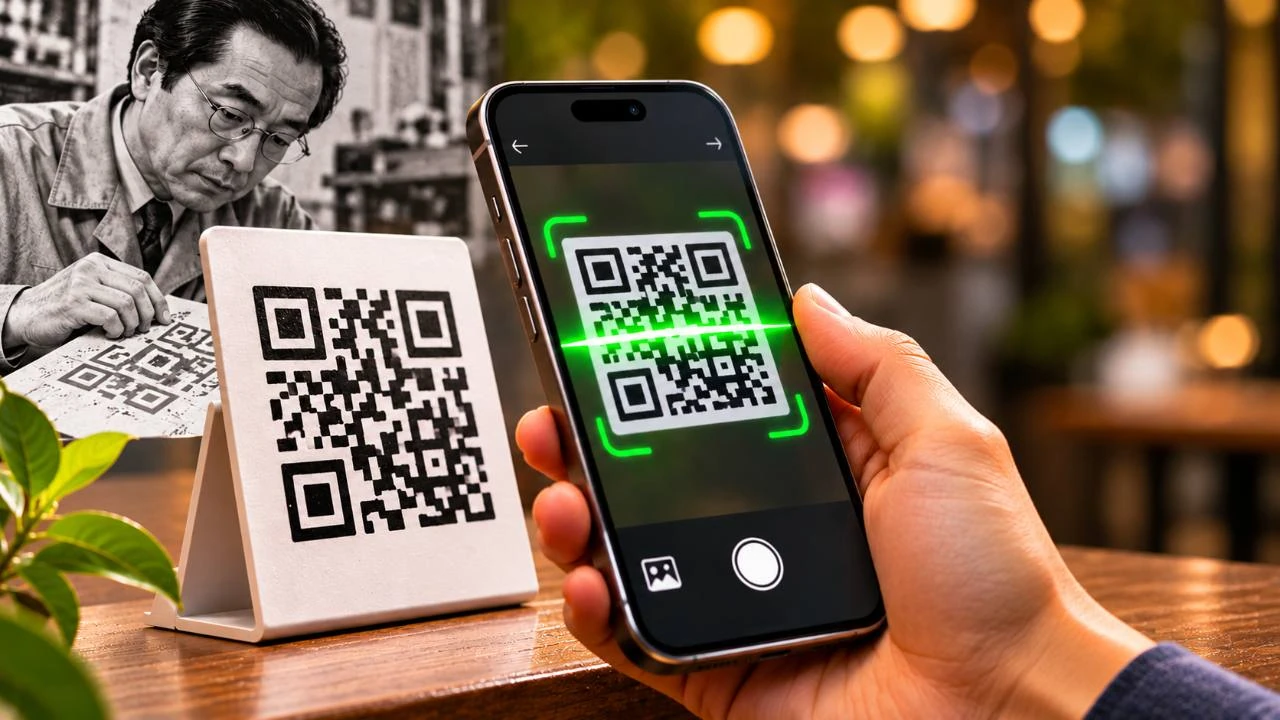
Conceptual editorial composite. The portrait is not an authenticated image of Masahiro Hara or his team. The illustrated patterns are not verified working QR codes or approved destinations. Editorial image supplied for PRESDA. Original creator and reuse licence not provided.
A camera meets a square, and a physical object becomes a digital doorway. A menu, a ticket or a component on a production line can carry the same basic invitation: read this pattern to retrieve information. The QR code feels native to the smartphone age. Its origins are elsewhere, in the unglamorous but consequential problem of moving information efficiently through industrial work.
The factory problem behind the square
DENSO dates the invention to 1994, in response to the need to handle product information more efficiently in factories. Ordinary linear barcodes were useful, but the team wanted more capacity and faster reading. The new format belonged to a practical search for a better production tool, not to a plan for restaurant menus or pandemic-era check-ins. Those later uses explain its visibility, not its invention. DENSO WAVE: QR Code 25th anniversary and development account
Masahiro Hara and a team achievement
DENSO WAVE’s history identifies Masahiro Hara as the leader of the development team. QR stands for Quick Response. Unlike a one-dimensional barcode, the design stores information in two directions. Its prominent finder patterns help a reader locate and orient the symbol. That combination of capacity and recognisability matters: information has little practical value if a busy reader cannot locate and decode it reliably. DENSO WAVE: history of QR Code
Why a little damage need not break it
QR codes add Reed-Solomon error correction to their data. Different correction levels balance recoverability against the amount of information that can fit in a symbol of a given size. This is not permission to cover any part of a code without consequence: the amount and location of damage, print quality and remaining structural patterns all matter. Error correction is engineered resilience, not a guarantee that every altered square will scan. DENSO WAVE: error correction
A format that could travel
DENSO WAVE says it retained patent rights while declaring that it would not exercise them for standardised QR codes. That distinction is more precise than saying there was never a patent. The format’s availability helped other organisations adopt it. Its history is therefore about distribution as well as invention: a useful tool becomes infrastructure when many unrelated people can build compatible practices around it. DENSO WAVE: history of QR Code
A final distinction helps explain everyday use. A QR code can contain a web address; it does not contain the whole website behind that address. The destination can change while the printed square remains identical. Nor does the square certify who operates the destination. Its achievement is simpler and more durable: it reduces the effort of moving between a physical surface and digital information, often to a single camera gesture.
Related reading: Electronic skin and the interfaces of the future.
FAQ
Frequently Asked Questions
Who invented the QR code, and when?
A development team led by Masahiro Hara at DENSO, now associated with DENSO WAVE, created the QR code released in 1994.
Does a QR code need artificial intelligence?
No. QR encoding and decoding follow a defined technical format; AI is not required for the basic function.
Can a printed QR code change?
Its encoded data stays the same. If it contains a URL, the website or redirect behind that URL may change.
PRESDA Dispatch
Stay Informed. Stay Aware.
A sharp briefing across AI, gaming, sport, business, world affairs, paparazzi, and lifestyle.