CAN AI TRANSFORM CITY TRAFFIC LIGHTS?
AI can help cities improve traffic signals, but pilot results need context. Explore adaptive timing, safety, emissions estimates and the role of human engineers.
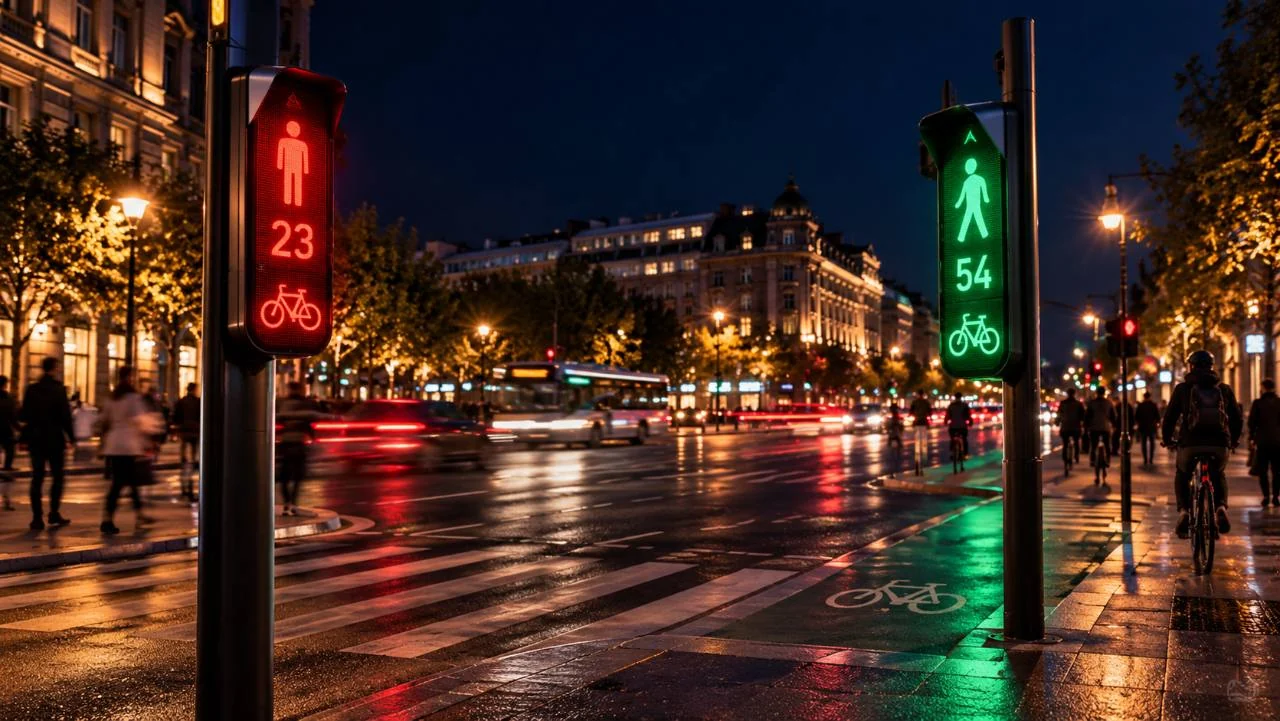
Conceptual city scene, not documentation of an installed traffic system. AI-generated editorial illustration supplied for PRESDA. Original creator and reuse licence not provided.
An empty junction holds you at red while the queue behind grows. It feels like a small failure of common sense, repeated across an entire city. Artificial intelligence offers a tempting promise: signals that respond to what is happening now. The useful answer is yes, AI can help, but the evidence is more conditional than a universal cure for congestion.
Adaptive signals existed before today’s AI boom
Adaptive control gathers traffic data, evaluates conditions and changes timing in response. The US Federal Highway Administration describes this as an established transport technology. “Adaptive” does not automatically mean machine learning: a signal can react through rules or optimisation. Reliable detection and communications are prerequisites, whatever label is on the software. FHWA, adaptive signal control FAQ
AI can add forecasts or help search for better timing plans. But a junction is not an isolated puzzle. Releasing one queue may send vehicles into a blocked downstream street. A useful system has to consider neighbouring signals and changing demand, while engineers define which objectives and constraints actually matter.
What the Pittsburgh pilot actually showed
The original SURTRAC pilot covered nine intersections in Pittsburgh’s East Liberty district. A 2013 Carnegie Mellon paper reported weighted reductions of about 25% in travel time and 40% in waiting time, comparing drive-through surveys before and after installation. Its roughly 21% emissions reduction was a modelled estimate, not direct citywide pollution measurement. Smith et al., SURTRAC pilot paper (2013)
Those are encouraging results, with a specific boundary: a small before-and-after deployment is not a randomised guarantee for every street network. Demand, roadworks and the quality of previous timings can change the comparison. Cities should ask for the baseline and evaluation method before treating a percentage as a procurement promise.
Green Light illustrates a different route
Google’s Green Light uses AI and driving trends from Google Maps to recommend signal changes for engineers to review and implement. Google describes early potential for up to 30% fewer stops and up to 10% lower greenhouse-gas emissions, with emissions assessed through models. These are provider-reported potentials, not guaranteed averages or independent safety findings. Google Research, Green Light
The distinction matters. Software advising a traffic engineer is a different deployment from software directly controlling every phase in real time. Both can be useful, but they require different integration, monitoring and accountability. “AI traffic lights” is too broad a phrase to describe a purchase without those details.
A better journey for whom?
A sensible trial should measure people, not only cars: bus passengers, pedestrians, cyclists and emergency access belong in the objectives. Crossing clearance and accessibility must remain hard engineering constraints. Fewer vehicle stops alone cannot demonstrate a safer junction. Privacy requirements should also specify what data are collected, retained and shared, rather than assuming that cameras are compulsory.
FHWA guidance notes that adaptive systems sometimes show little improvement over well-tuned existing controls. That makes maintenance, a credible baseline and a reversible trial essential. AI can improve the coordination of limited street space; it cannot by itself remove every bottleneck or decide a city’s transport priorities. The best signal upgrade begins with a public goal, then tests whether the technology serves it. FHWA, Traffic Signal Timing Manual, chapter 9
Related reading: The robotaxi revolution.
FAQ
Frequently Asked Questions
Are all adaptive traffic signals AI?
No. Adaptive signals can use rules and conventional optimisation. Machine learning is one possible component, not the definition of adaptive control.
Will AI guarantee 30% less congestion?
No. Reported figures concern particular metrics and deployments. Fewer stops is not the same as a 30% reduction in total congestion.
Who should approve signal changes?
Accountable transport engineers should define safety constraints, review changes and monitor outcomes for all road users.
PRESDA Dispatch
Stay Informed. Stay Aware.
A sharp briefing across AI, gaming, sport, business, world affairs, paparazzi, and lifestyle.