THE ROBOTAXI REVOLUTION: WHO WILL DOMINATE AUTONOMOUS DRIVING?
Compare Tesla Cybercab, Waymo, Zoox and Baidu robotaxis: verified services, cities, autonomy, safety, ride volumes and economics through October 10, 2026.
The robotaxi race has crossed a threshold: the question is no longer whether a car can carry passengers without a driver, but how widely, reliably and economically it can do so. As of October 10, 2026, Waymo has the broadest verified U.S. commercial rider footprint among these four companies, Baidu has a substantial driverless business in China and Dubai, and Tesla and Amazon-owned Zoox have moved purpose-built vehicles into fare-charging service. No single metric establishes a global winner.
This investigation compares available services with dated company disclosures and regulatory records. A service-area listing is not proof of citywide coverage, a test permit is not a commercial launch, and a production target is not a delivered fleet. The comparison below deliberately keeps those categories separate.
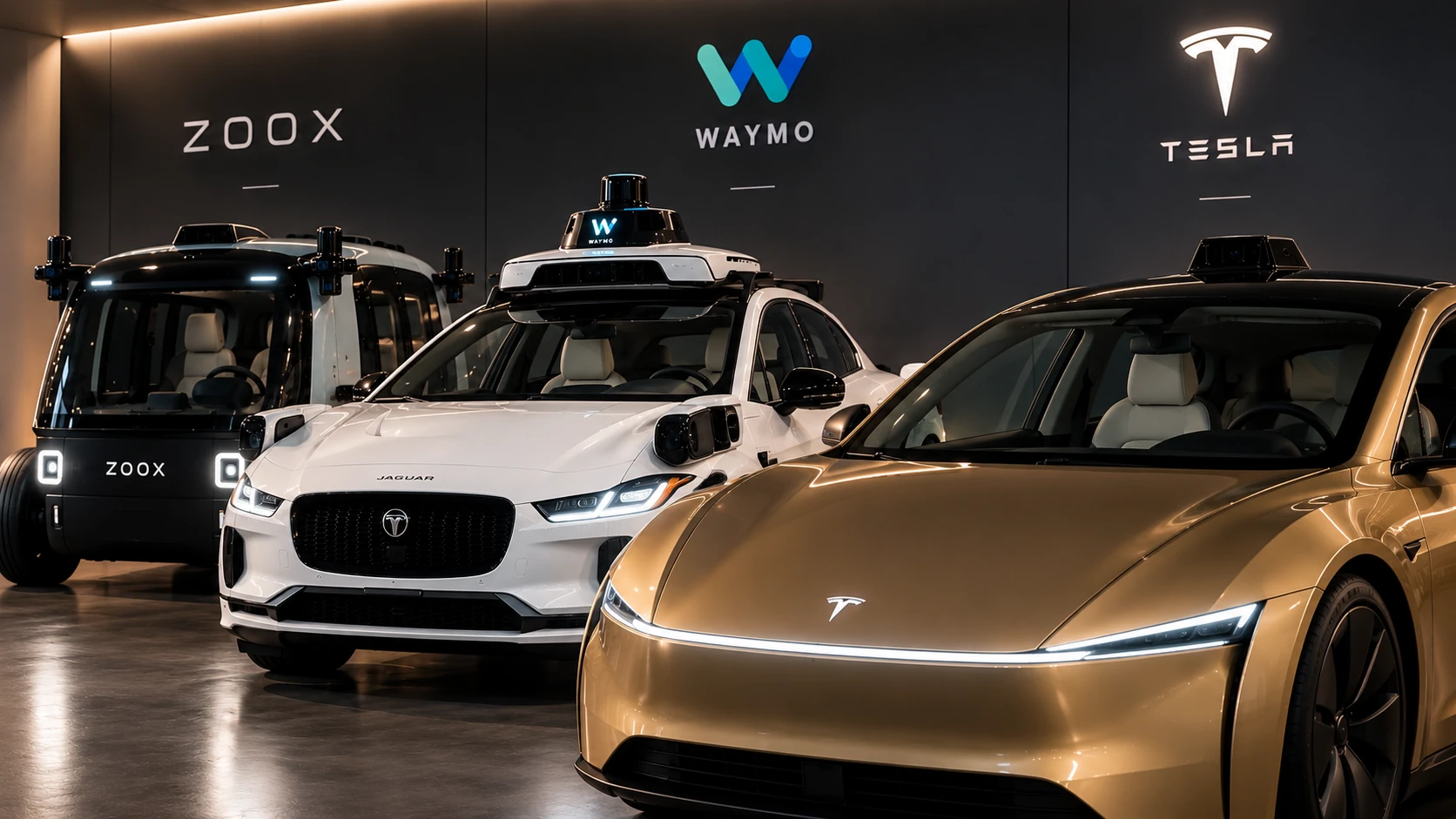
Illustration note: the showroom hero is an AI-generated editorial concept. It is not a photograph of a joint Tesla, Waymo and Zoox exhibition, a verified vehicle specification or evidence of deployment. Last verified: October 10, 2026. Service areas and regulatory decisions can change.
Tesla vs Waymo vs Zoox vs Baidu: what is operating?
The sourced comparison combines vehicle architecture, commercial status, sensing and disclosed scale. It is a snapshot, not a ranking of artificial intelligence. Fleet registration, passenger trips, paid miles and testing-city counts measure different things. Blank financial comparisons are more honest than unsupported estimates.
PRESDA Data Graphics
Verified October 10, 2026. Disclosures have different reporting periods.
Company-reported measures. Trips, operational rides, production and permits are not comparable units. No global safety or profitability ranking is implied. Scroll the table horizontally on smaller screens.
| Operator / vehicle | Sensing approach | Service status | Disclosed scale | Important limit |
|---|---|---|---|---|
| Tesla / Model Y, Cybercab | Camera-based driving perception | Robotaxi service; Cybercab launched in Austin September 3 | Production started, Q2; no comparable weekly ride count in reviewed disclosures | Consumer FSD is supervised. Cybercab certification audit is unresolved in reviewed records. |
| Waymo / Jaguar I-Pace, Ojai | Cameras + lidar + radar | Fully autonomous passenger service in 15 listed U.S. markets | More than 500,000 weekly trips, company sustainability disclosure | Admission and coverage vary; one million weekly rides is a year-end target. |
| Zoox / purpose-built robotaxi | Cameras + lidar + radar + infrared | Paid Las Vegas service since August; SF free preview is separate | Up to 2,500 vehicles annually permitted for two years | Permit ceiling is not delivered vehicles. No comparable weekly ride count established. |
| Baidu / Apollo Go, RT6 | Multisensor; original RT6 specifies cameras + lidar | Driverless mainland operations and commercial Dubai service | 3.2 million driverless operational rides, Q1 2026 | 28-city footprint includes testing. Operational rides are not necessarily all paid. |
Tesla: Cybercab is a service milestone, not universal autonomy
Tesla announced Cybercab’s Austin launch on September 3, 2026. Its two-seat vehicle has no conventional steering wheel or pedals. The Q2 shareholder update says production had begun; the September launch means it should no longer be described solely as an unveiled prototype. The same update charts cumulative paid Robotaxi miles, not passenger trips or an exclusively driverless mileage series. Those miles cannot be converted into a weekly ride count without additional data.
Tesla’s passenger support page lists limited service areas in Austin, Dallas, Houston, Miami, Orlando and Tampa. Operating hours, access and fares are app-dependent; the app shows a price estimate before booking. This listing does not mean Cybercab is available in every listed city. Tesla’s longer-term expansion ambitions remain distinct from locally available rides. Most importantly, consumer Full Self-Driving (Supervised) still requires an attentive driver. A private Tesla with that software is not automatically a driverless taxi. The Q2 update separately identifies Bay Area ride-hailing as using supervised FSD, so it must not be counted as another driverless market.
Waymo: commercial reach and a measurable ride business
Waymo’s current rider directory lists 15 U.S. markets, including the San Francisco Bay Area, Phoenix, Los Angeles and its newer Texas and Florida services. Austin and Atlanta bookings use Uber. Las Vegas welcomed its first public riders on September 14, initially through an interest-list rollout. Availability still depends on the service boundary and admission phase, not merely a city name. London and Tokyo expansion announcements should not be counted as equivalent open U.S. services.
Waymo’s sustainability disclosure reports more than 500,000 fully autonomous EV trips per week. That is a company-reported operating measure, not an audited October 10 daily counter. Its goal of more than one million weekly rides by year-end 2026 remains a target unless a later disclosure establishes achievement. The relevant advantage is repeatable passenger service across multiple urban environments, rather than the visual drama of a demonstration.
Zoox: a vehicle designed around the passenger
Amazon announced its acquisition of Zoox in 2020. Zoox’s purpose-built robotaxi uses four inward-facing seats and a bidirectional design, rather than adapting a conventional driver’s cabin. Its sensor package combines cameras, lidar, radar and long-wave infrared. The design can support a different passenger experience, but it also requires its own manufacturing, maintenance and regulatory pathway. A more unusual vehicle is not, by itself, evidence of better autonomy.
NHTSA announced a temporary commercial exemption on July 30, 2026, allowing up to 2,500 Zoox vehicles annually for two years with oversight conditions. That is an authorised ceiling, not a delivered fleet count. Local reporting confirmed paid Las Vegas service in August, following the August 10 start. AP documented free Las Vegas and San Francisco rides before that approval. Free previews and testing elsewhere must not be counted as additional established fare-charging markets.
Baidu and the Chinese challengers
Baidu reported 3.2 million fully driverless operational rides in Q1 2026, with weekly rides peaking above 350,000 in March. A peak is not a weekly average, and operational rides are not explicitly identical to paid rides. Its mainland operating cities include Beijing, Shanghai, Shenzhen, Wuhan, Chengdu, Chongqing, Haikou and Sanya. Company disclosures say mainland operations have been fully driverless since February 2025. This is a company account of designated operations, not proof that every road in those cities is covered.
Baidu’s August 18 Q2 release confirms fully driverless commercial operations in Dubai and open-road testing in London and Switzerland. Hong Kong’s Airport Island operation is classified as testing. Its 28-city global footprint therefore mixes development stages. WeRide and Uber announced paid driverless Dubai operations on April 2. Pony.ai’s Q2 results report $12.1 million of Robotaxi services revenue and a $59.8 million attributable net loss. These are serious competitors, but segment revenue and group losses do not measure the same thing.
Level 2 is not Level 4
NHTSA’s automation framework distinguishes assistance from responsibility for the driving task. At Level 2, the system can control steering and speed together, but the human must supervise and intervene. At Level 4, the system drives and handles fallback within its defined operating conditions. That domain can restrict geography, road types, speed or weather. Level 4 does not mean the vehicle can drive everywhere; Level 5 would remove those domain restrictions. A remote assistance team can support a driverless fleet without making every trip remotely driven. Its role must be disclosed rather than assumed.
PRESDA Data Graphics
Verified October 10, 2026. Disclosures have different reporting periods.
Level 0
Human drives; warnings or momentary interventions only.
Level 1
System assists either steering or speed; human drives.
Level 2
System assists steering and speed; human continuously supervises.
Level 3
System drives in its domain; human must respond to a takeover request.
Level 4
System drives and handles fallback within its defined domain; no human driver required there.
Level 5
System can drive in all conditions a human driver can handle; no restricted operating domain.
Cameras, lidar and radar: competing engineering choices
Tesla’s camera-based approach seeks to infer the driving environment from images and learned models. Waymo combines cameras with lidar and radar; lidar measures range with laser light, while radar helps measure distance and motion. Zoox adds long-wave infrared to its multisensor package. Baidu’s original RT6 specification also documents cameras and lidar. More sensors can add complementary evidence, but also cost, cleaning and calibration work. Camera-only systems avoid some hardware complexity while placing greater demands on visual inference. Sensor choice alone cannot settle safety or generalisation.
Safety: evidence matters more than a league table
NHTSA opened a Cybercab self-certification audit on September 4, following the Austin deployment. Reuters independently reported the investigation. The issue is compliance with federal vehicle standards, not a final finding that every Cybercab is unsafe. A state operating authorisation does not resolve federal certification. Conversely, an investigation should not be rewritten as a ban or a concluded defect determination. The audit makes regulatory execution part of Tesla’s commercial challenge.
Waymo publishes crash comparisons against matched human benchmarks, with methodology and exposure data. These are valuable but company-produced, geographically bounded results, not a universal guarantee. The NTSB is investigating a January 12, 2026 Austin incident in which a Waymo passed a school bus loading children; its record also describes the preceding software recall. NHTSA warns that crash-reporting datasets have collection and exposure limitations. Raw crash totals cannot fairly rank fleets with different mileage, operating domains and reporting practices. Recall repairs and the outcome of investigations belong alongside aggregate safety claims. Zoox’s July recall filing describes an unoccupied vehicle entering a smoke-obscured emergency scene on June 20. It covers 105 vehicles and says no injuries were identified; updated software was released July 15. This recall population is not a current fleet estimate.
Fares are visible; full economics remain harder to compare
Removing the onboard driver does not remove labour. Fleets still need vehicle cleaning, charging, maintenance, customer support, remote assistance, incident response and depot operations. Profitability depends on paid utilisation, empty repositioning miles, vehicle depreciation, insurance and the cost of the autonomy system. This is an analytical cost framework, not a disclosed cost statement for any one operator. A cheap introductory fare can attract demand while leaving the business subsidised.
Tesla displays trip estimates in its app; fares across operators depend on route, time, local terms and availability. The reviewed disclosures do not provide comparable audited robotaxi profit accounts for all four companies. Hardware-price targets are not passenger fares, and city-level break-even claims are not group profitability. Waymo announced $16 billion of equity financing in February at a $126 billion post-money valuation. Its October 8 announcement added a $5 billion term loan. Debt is financing to repay, not revenue; a private valuation is not listed market capitalisation. These announcements demonstrate access to capital, not proven profits.
Expansion is a sequence, not a press-release map
The progression is usually local testing, permission, restricted access, passenger service and wider coverage. Weather and roadworks can expose weaknesses that a controlled demonstration never encounters. Heavy rain, snow, glare, obscured sensors, emergency vehicles and unusual human gestures all demand robust handling. The right question is what conditions the operator allows and what the vehicle does when it reaches a limit. A successful sunny-city launch is not evidence of unrestricted winter operation.
AP’s September reporting on Uber and Wayve in London describes a service with human safety drivers, and similarly distinguishes supervised operations in Zagreb. Baidu’s London and Swiss disclosures describe open-road testing. These examples show why the word robotaxi cannot substitute for a precise operating classification. Partnerships with ride-hailing platforms can bring customers and fleet support, but do not automatically supply driverless authorisation. Cities can also differ in airports, freeway access and who may book.
PRESDA Data Graphics
Verified October 10, 2026. Disclosures have different reporting periods.
Company directories and dated reporting. Listed markets cover designated zones and may require invitations. Testing and announcements are excluded from operating lists. Free access is separated from paid service.
- Tesla: Austin, Dallas, Houston, Miami, Orlando, Tampa. Limited areas. Cybercab availability specifically verified in Austin.
- Waymo: Atlanta, Austin, Dallas, Denver, Houston, Las Vegas, Los Angeles, Miami, Nashville, Orlando, Phoenix, San Antonio, San Diego, San Francisco Bay Area, Tampa. Access varies; Austin and Atlanta use Uber.
- Zoox: paid Las Vegas service verified. San Francisco’s free preview is a separate status, not an additional confirmed paid city.
- Baidu: mainland operating cities include Beijing, Shanghai, Shenzhen, Wuhan, Chengdu, Chongqing, Haikou and Sanya; Dubai commercial service confirmed. London, Switzerland and Hong Kong Airport Island are testing, not equivalent commercial markets.Baidu Q2 2026
Public trust, jobs and the race to lead
For passengers, trust means reliable pickups, a clear way to request help, accessible cabins, understandable incident handling and protection of trip and camera data. For cities, it includes emergency access, congestion and accountability. Driverless fleets could reduce demand for some taxi and ride-hailing work, while creating maintenance and operations roles. The scale and timing of displacement depend on local adoption, costs and policy; the available evidence does not justify a precise global jobs-loss forecast. New roles are not necessarily equivalent in pay, location or accessibility to the jobs displaced.
The evidence supports a qualified answer: Waymo leads this comparison in verified U.S. commercial reach and disclosed weekly passenger scale. Baidu is a major driverless operator with a different geographic and reporting base. Tesla offers a manufacturing-led, camera-based challenge with Cybercab now carrying paying passengers and certification under scrutiny. Zoox has translated its purpose-built design into paid Las Vegas operations but has a smaller verified paid footprint. A global technology or profitability champion cannot be declared from incomparable public disclosures. The next decisive evidence will be repeatable safe service, broader authorised coverage and transparent economics.
PRESDA Data Graphics
Verified October 10, 2026. Disclosures have different reporting periods.
Chronological event list. Spacing does not represent elapsed time; financing and permission do not measure fleet deployment.
February: Waymo announces Dallas, Houston, San Antonio and Orlando rider service.
July 30: NHTSA announces Zoox commercial exemption, with limits and oversight.
August 10: Zoox starts paid Las Vegas service, confirmed by local reporting.
September 3–4: Cybercab Austin launch followed by NHTSA certification audit.
September 14: Waymo welcomes first public riders in Las Vegas.
October 8: Waymo announces $5 billion term loan; financing, not revenue.
Explore the broader contest for physical AI in PRESDA’s Tesla Optimus vs Unitree investigation and the questions of control and oversight in our AI development and safety feature. Both races demand the same discipline: distinguish a capability shown once from a service that works dependably at scale.
FAQ
Frequently Asked Questions
Who leads the robotaxi race in 2026?
Waymo leads this comparison in verified U.S. commercial reach and disclosed weekly trips. Baidu has a substantial driverless business. Incomparable disclosures do not establish a global technology or profitability winner.
Is Tesla Cybercab carrying passengers?
Tesla announced its Austin launch on September 3, 2026. NHTSA opened a certification audit the following day. Consumer FSD (Supervised) remains a separate driver-assistance product.
Is Zoox charging for rides?
Paid service began in Las Vegas in August 2026. Free previews and testing in other cities are different stages and should not be counted as established paid markets.
Does Level 4 mean a car can drive anywhere?
No. It drives without a human driver within a defined operating domain, which can limit geography, roads, weather and speed.
Are robotaxis profitable?
The reviewed public disclosures do not provide comparable audited robotaxi profit accounts for all four operators. Funding, low fares and local break-even claims do not prove group profitability.
PRESDA Dispatch
Stay Informed. Stay Aware.
A sharp briefing across AI, gaming, sport, business, world affairs, paparazzi, and lifestyle.