TESLA 'OPTIMUS' VS UNITREE: THE FUTURE OF HUMANOID ROBOTS
Optimus ambitions meet Unitree’s commercial robots. Compare verified models, prices, shipments, industrial pilots and the limits of humanoid autonomy.
The humanoid robot race has two clocks. One measures what manufacturers hope to build; the other measures what customers can buy and use. In October 2026, comparing Tesla’s Optimus with Unitree means separating those clocks before declaring a winner.
Our assessment: Unitree has the clearer commercial hardware position in this pairing. Tesla is pursuing a much larger production vision. Neither shipment volume nor an impressive demonstration establishes leadership in safe, general-purpose autonomy. AgiBot, Figure and UBTECH also make this far more than a two-company contest.
OPTIMUS: A PRODUCTION VISION, NOT A RETAIL PRODUCT
Tesla’s Q4 2025 disclosure names Gen 3 as its first Optimus design intended for mass production, succeeding version 2.5 with a new hand design. This is a verified development roadmap, not evidence of an available consumer product. A planned unveiling date should not be treated as a completed launch. Tesla Q4 2025 update
The later Q2 2026 update says Tesla removed the Model S and X lines in Fremont and began installing Optimus lines. It labels California and Texas robotics facilities as construction. Initial builds are intended for the Optimus Academy’s training-data collection and functionality development. This review found no verified retail availability or separately disclosed customer-delivery total. Tesla Q2 2026 update
Tesla’s attraction is the possibility of combining AI development, manufacturing and eventually useful manipulation at scale. But a robot generation name, video or factory line does not provide a standardized task-success benchmark. Current verified disclosures do not support a like-for-like Optimus retail price, battery-runtime or dexterity comparison with purchased Unitree configurations. Tesla Q1 2026 manufacturing plans
UNITREE: A FAMILY OF PRODUCTS WITH DIFFERENT PURPOSES
Unitree’s confirmed catalogue includes G1, H1, H1-2 and H2. The compact G1 differs from the larger H-series machines. Standard and EDU versions also differ: developer access, hands and computing options must be checked for the precise configuration. A model-family name alone does not describe the robot a customer receives. Unitree G1 specifications Unitree H1 and H1-2 specifications Unitree H2 specifications
R1 adds a lower-priced range, starting with R1 AIR. The store supports ordering but also shows variant-specific backorders. Separately, H2 Plus was announced in June 2026 as an NVIDIA Isaac GR00T academic reference platform. It should not be conflated with a standard H2 or assumed delivered merely because it was announced. Unitree R1 specifications Unitree R1 store and delivery conditions Unitree H2 Plus announcement, June 2026
USD, tax and shipping excluded. Base configurations differ. No verified Optimus retail price.
- R1 AIR$4,900
- G1$13,500
- H2$29,900
Optimus: not verified
Sources: Unitree R1; Unitree G1; Unitree H2
PRESDA Data Graphics
TESLA VS UNITREE: THE SOURCED COMPARISON
The table uses manufacturer disclosures checked on October 9. Prices are advertised hardware prices in US dollars, not total deployment costs. Specifications are supplier claims with configuration and workload caveats, not an independent common benchmark. An undisclosed value is not zero. Tesla Q4 2025 update Tesla Q2 2026 update Unitree G1 specifications Unitree H1 and H1-2 specifications Unitree H2 specifications Unitree R1 specifications
| Measure | Tesla Optimus | Unitree commercial platforms |
|---|---|---|
| Verified status | Gen 3 production roadmap; Q2 facilities under construction | G1, H1/H1-2, H2 and R1 listed; configuration-specific orders |
| Current retail price | Not verified | G1 $13,500; H2 $29,900; R1 AIR $4,900; R1 $5,900 |
| Height / mass | Comparable current retail specifications not verified | G1 1.32 m / about 35 kg; H2 1.82 m / about 70 kg |
| Mobility | Demonstrations do not establish common benchmark | H1 supplier moving-speed claim 3.3 m/s; H1-2 under 2 m/s |
| Mechanical flexibility | Gen 3 hand upgrade named; no common dexterity score | G1 23 joints, EDU 23–43; H2 31 joints |
| Battery | Comparable current runtime not verified | G1 about 2 h; H2 about 3 h; R1 about 1 h, supplier claims |
| Battery energy | Comparable current retail value not verified | H1/H1-2 864 Wh; H2 972 Wh |
| Developer access | No verified retail developer offering | G1/H2 EDU and R1 EDU differ from base models |
| 2025 delivery evidence | No verified comparable customer-sales total | Company reports more than 5,500 pure humanoids delivered |
| H1 2026 shipment evidence | No verified comparable customer-sales total | Counterpoint estimates more than 7,000 |
| Autonomous productivity | No public common independent test | Hardware sale does not establish autonomous task readiness |
| Production vs availability | Initial builds for internal training; capacity plans are targets | Commercial catalogue; stock, options and delivery terms vary |
SALES, SHIPMENTS AND PRODUCTION ARE DIFFERENT NUMBERS
Unitree’s January clarification reports more than 5,500 pure humanoids sold and delivered to end customers in 2025, versus more than 6,500 manufactured. It excludes wheeled dual-arm and other robots. These are company-reported figures. Orders, production and deliveries must not be added together as sales. Unitree 2025 shipments clarification, January 2026
Unitree company disclosure: pure humanoids, not wheeled or quadruped robots. Values are lower bounds, not exact totals.
- Delivered to end customers> 5,500
- Manufactured> 6,500
Bars begin at zero. Greater-than values show the stated minimum, not exact quantities.
Tesla Q1 2026 capacity designs, not achieved production
- Fremont: 1 million/year
- Texas long term: 10 million/year
Sources: Unitree / EQS; Tesla Q1 2026
PRESDA Data Graphics
For H1 2026, Counterpoint estimates global humanoid shipments above 22,000, with AgiBot at 9,700 and Unitree above 7,000. That places AgiBot first and Unitree second in this tracker. These estimates measure shipments, not verified paid autonomous work. They are half-year figures, not final 2026 totals. Counterpoint H1 2026 humanoid shipments
Counterpoint estimates. Unitree is a lower bound; no comparable Tesla customer-sales figure verified. Shipments do not equal autonomous deployments.
- AgiBot9,700
- Unitree> 7,000
Bars begin at zero. Greater-than values show the stated minimum, not exact quantities.
Sources: Counterpoint
PRESDA Data Graphics
AgiBot’s January announcement cites Omdia’s 2025 ranking, with 5,168 shipments and roughly 13,000 worldwide. That ranking and Unitree’s later company disclosure cannot be combined into one reconciled league table without resolving definitions and revisions. No robust, comparable Tesla customer-sales figure was verified for either period; we therefore do not invent a Tesla bar. AGIBOT: Omdia 2025 ranking
AI, MOBILITY AND DEXTERITY: WHAT A DEMO CANNOT TELL YOU
Autonomy means completing a defined task without continuous human control. Teleoperation means a person directs the robot. Scripted demonstrations, learned locomotion and language interaction can coexist with limited task autonomy. The H2 Plus research programme illustrates the work still needed to connect training, perception and manipulation into useful behaviour. Unitree H2 Plus announcement, June 2026
Joint count indicates mechanical flexibility, not intelligence. Hands, tactile feedback, grasp planning and recovery after errors matter as much as balance. The G1 and H2 pages make some features configuration-dependent and warn that sample functions remain under development. A base-price robot must not inherit every capability shown in an EDU demonstration. Unitree G1 specifications Unitree H2 specifications
Battery capacity and runtime are different measurements. An H1’s quoted energy capacity cannot be converted into a guaranteed shift length without its power demand. Walking, carrying, computation and rest produce different duty cycles. The H2 runtime claim is not a promise of uninterrupted heavy work or a standardized endurance advantage over Optimus. Unitree H1 and H1-2 specifications Unitree H2 specifications
FACTORIES, WAREHOUSES AND HOMES
There is evidence beyond promotional choreography. BMW reports that its Figure 02 pilot supported production of more than 30,000 X3 vehicles through a specific sheet-metal handling task. It did not independently assemble those cars. A bounded industrial workflow is meaningful progress, but remains distinct from replacing a whole factory workforce. BMW: Figure 02 industrial pilot
Figure announced Figure 03’s arrival at Spartanburg on June 30, 2026, explicitly describing a first logistics-workflow demonstration. Its Helix 02 system coordinates movement and manipulation. The event does not establish plant-wide rollout, a disclosed commercial fleet size or proven profitability. Figure 03 arrives at BMW, June 2026
UBTECH’s filed 2025 results describe Walker S2, autonomous battery swapping and manufacturing capacity exceeding 6,000 full-size humanoids annually. That is capacity, not a claim that 6,000 were delivered. Its industrial focus offers another route to commercialization, with applications and operating conditions that differ from research-platform sales. UBTECH 2025 results, March 2026
Warehouses and households demand different economics. Repeated industrial tasks can be defined and measured; homes introduce children, pets, clutter and unfamiliar objects. Buyers should compare humanoids with wheeled systems, conveyors and fixed arms for the actual job. A human-shaped body is useful only when its flexibility justifies its complexity. OSHA: industrial robot safety and risk assessment
MANUFACTURING STRATEGY AND THE CHINA-US RACE
Tesla’s Q1 plan describes a Fremont line designed eventually for one million robots annually and a much longer-term Texas design for ten million. These are capacity ambitions, not completed output. Unitree offers priced configurations and developer platforms now. The business comparison is between prospective integrated scale and an existing hardware ecosystem. Tesla Q1 2026 manufacturing plans Unitree R1 store and delivery conditions
AP’s reporting describes China’s dense manufacturing base and state support, while highlighting the harder question of finding customers. Lower hardware prices can widen experimentation, but exports also depend on market rules, support and trust. Chinese shipment leadership does not settle who can deliver the most reliable autonomous application. AP: China’s humanoid manufacturing and demand
MARKET GROWTH, INVESTMENT AND THE COST OF USEFUL WORK
Goldman Sachs’s February 2024 scenario projected a $38 billion addressable market and 1.4 million shipments in 2035. It is a dated forecast, not measured 2026 revenue or a guarantee. Long-range projections should be evaluated against reliability, buyer demand and the costs of integration, maintenance and supervision. Goldman Sachs 2035 forecast, published February 2024
Goldman Sachs scenario published February 2024 for 2035. Different units are shown separately; no annual growth path is invented.
- 2035 addressable market forecast
- $38 billion
- 2035 annual shipments forecast
- 1,400,000
Sources: Goldman Sachs (2024)
PRESDA Data Graphics
Figure announced more than $1 billion in committed Series C capital at a $39 billion post-money valuation in September 2025. Financing reflects investor expectations, not robot revenue, shipments or customer returns. The opportunity includes components, robot software, training tools and integration services as well as whole machines. Figure Series C funding, September 2025
WORKERS, SAFETY AND THE REMAINING TECHNICAL LIMITS
OSHA’s industrial-robot guidance stresses application-specific risk assessment, safeguards and safe maintenance. A robot working near people needs more than a polished movement demo. Falls, unexpected motion, tools and stored energy must be considered for the entire system. Emergency stopping and trained supervision remain important to deployment design. OSHA: industrial robot safety and risk assessment
The employment question is task-specific. Automating repetitive handling can change staffing and create integration or maintenance work, but it does not establish a net job forecast. The practical test is cost per reliably completed task, including human interventions. Speed on a stage and low purchase price are insufficient measures of productivity.
WHO IS ACTUALLY LEADING?
For purchasable humanoid hardware, Unitree leads Tesla on the evidence reviewed. For H1 2026 shipments, Counterpoint ranks AgiBot ahead of Unitree. For documented industrial work, BMW’s Figure pilot supplies a concrete example, not a universal technology ranking. Tesla’s scale ambitions remain substantial but prospective. No public, independent, common test establishes an overall winner in general-purpose autonomy.
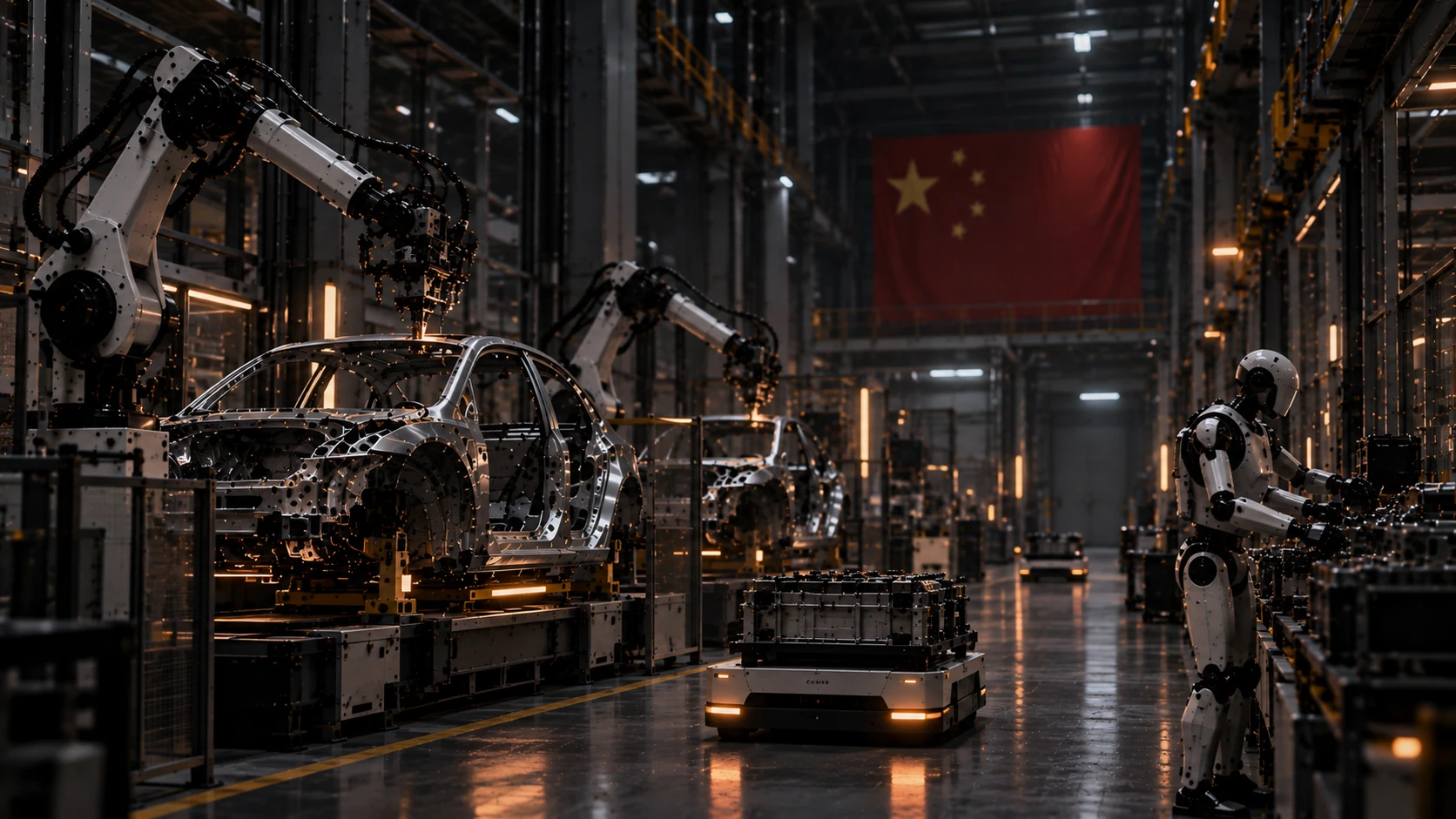
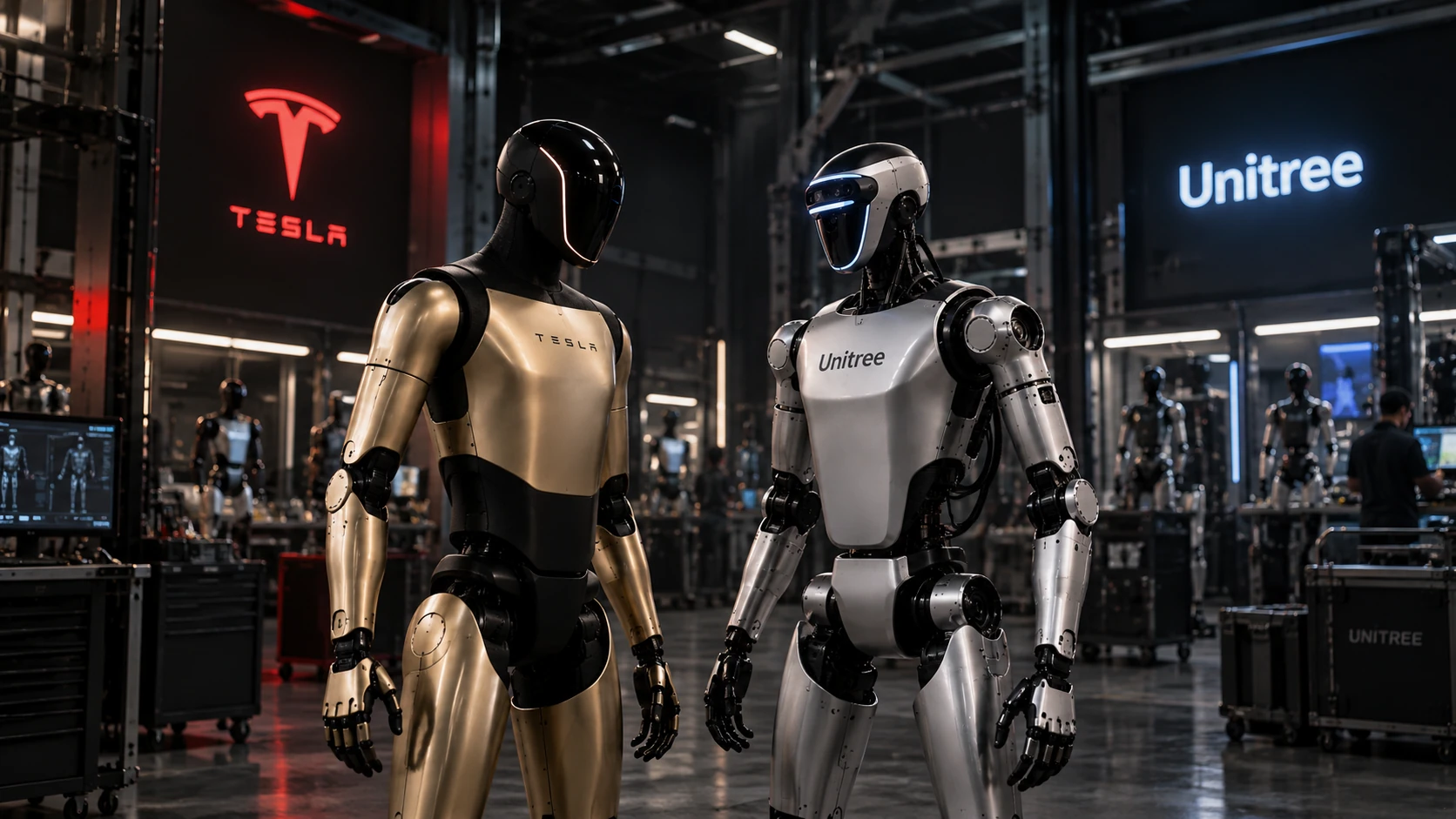
This feature was verified on October 9, 2026. The hero is an AI-generated conceptual illustration, not an authentic product photograph. Continue with PRESDA’s reporting on China’s robotics strategy and BYD’s industrial rise.
FAQ
Frequently Asked Questions
Can you buy Tesla Optimus in October 2026?
No retail availability was verified in the sources reviewed. Tesla’s Q2 update describes factory construction and initial robots for internal training, not confirmed customer sales.
Does Unitree’s shipment lead prove better autonomy?
No. Shipments measure hardware delivered, not autonomous productivity. Models and configurations differ, and no common independent test establishes overall technology leadership.
What are Unitree’s advertised starting prices?
As checked on October 9, R1 AIR starts at $4,900, R1 at $5,900, G1 at $13,500 and H2 at $29,900, excluding tax and shipping. Options and availability vary.
PRESDA Dispatch
Stay Informed. Stay Aware.
A sharp briefing across AI, gaming, sport, business, world affairs, paparazzi, and lifestyle.