ANDREA PIRLO: THE FOOTBALL LEGEND BEHIND PRATUM COLLER
Andrea Pirlo’s family wine venture began in 2007, during his playing career. Discover Pratum Coller’s Lombardy roots and the business behind the name.
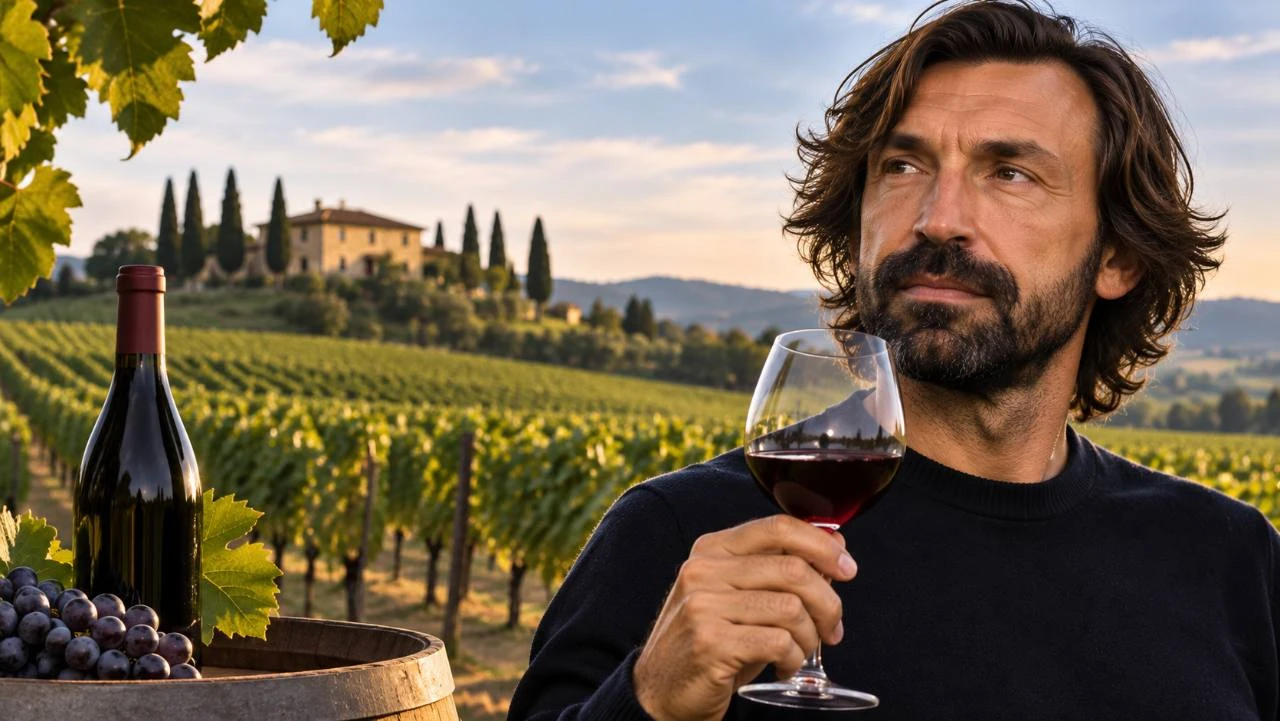
Supplied editorial illustration of Andrea Pirlo with wine and vines. The landscape is not verified as Pratum Coller; the documented estate is in Lombardy, not Tuscany.
Andrea Pirlo’s wine story did not begin when he stopped playing football. Pratum Coller grew out of a family project launched in 2007, a decade before his retirement as a player. That chronology gives the venture a different meaning: it was an interest developed alongside an elite sporting career, rather than a ready-made occupation adopted after the final whistle.
The setting also needs correcting. The estate is associated with the Brescia area of Lombardy, around Flero and Monte Netto, not Tuscany. Pirlo described its beginnings in direct interviews in 2013 and 2020, linking the enterprise to his family and his father’s influence. The supplied hero is an editorial illustration, not an authenticated photograph of that estate. Mixer: direct Pirlo interview, September 2013 VINUM: direct Pirlo interview, June 2020
| Date | Milestone |
|---|---|
| 2006 | World Cup victory with Italy |
| 2007 | Family wine venture begins during playing career |
| November 6, 2017 | Playing retirement announced after New York City FC |
| June 2020 | VINUM interview describes family support and specialist input |
A family enterprise before a retirement project
In his 2013 interview with Mixer, Pirlo traced the family’s acquisition of the property to 2007. The connection was personal as well as agricultural: he discussed his father Luigi’s appreciation of wine and the area around his family’s roots. This is stronger evidence for the venture’s origin than the familiar celebrity-business narrative of a star suddenly discovering a new passion.
The timing matters because football limited how much attention he could give it. His later VINUM interview described relying on family support while still playing and pursuing a more professional organisation of the winery afterward. The business therefore developed through overlapping phases, rather than a single dramatic change of career. VINUM: direct Pirlo interview, June 2020
Family participation is not a decorative detail. It helps explain how a project could continue while its most recognisable participant was occupied with training, travel and matches. The evidence supports a family venture associated with Pirlo, not the idea that he personally performed every vineyard, cellar, distribution and management task.
Lombardy is part of the story
Pratum Coller’s producer presentation places the enterprise in Lombardy. The geographical distinction deserves space because Italian wine is often reduced in international celebrity coverage to a generic landscape of vineyards and villas. A bottle’s regional identity should come from the producer and its documentation, not from the scenery chosen for an illustration. Apritaly: Pratum Coller producer presentation
Location is commercially meaningful as well as picturesque. A wine enterprise must communicate where its grapes and production belong, which products it offers and what makes them identifiable. A famous surname may attract the first look; the producer’s actual identity gives customers a more concrete basis for understanding what is in the bottle.
This article does not turn an undated producer profile into a current audit of vineyard area or output. Older interviews contain snapshots of the estate and its range at particular times. They cannot establish today’s acreage, production volume or financial performance without a more recent, corresponding record.
The football career running alongside it
The sporting background is exceptional. FIFA records Pirlo as a 2006 World Cup winner with Italy, a six-time Serie A champion and a two-time Champions League winner with AC Milan. His official MLS profile places the European triumphs in 2003 and 2007. These achievements explain his public reach without telling us the winery’s balance sheet. FIFA: Pirlo’s playing retirement, November 6, 2017 MLS: Pirlo’s official career profile
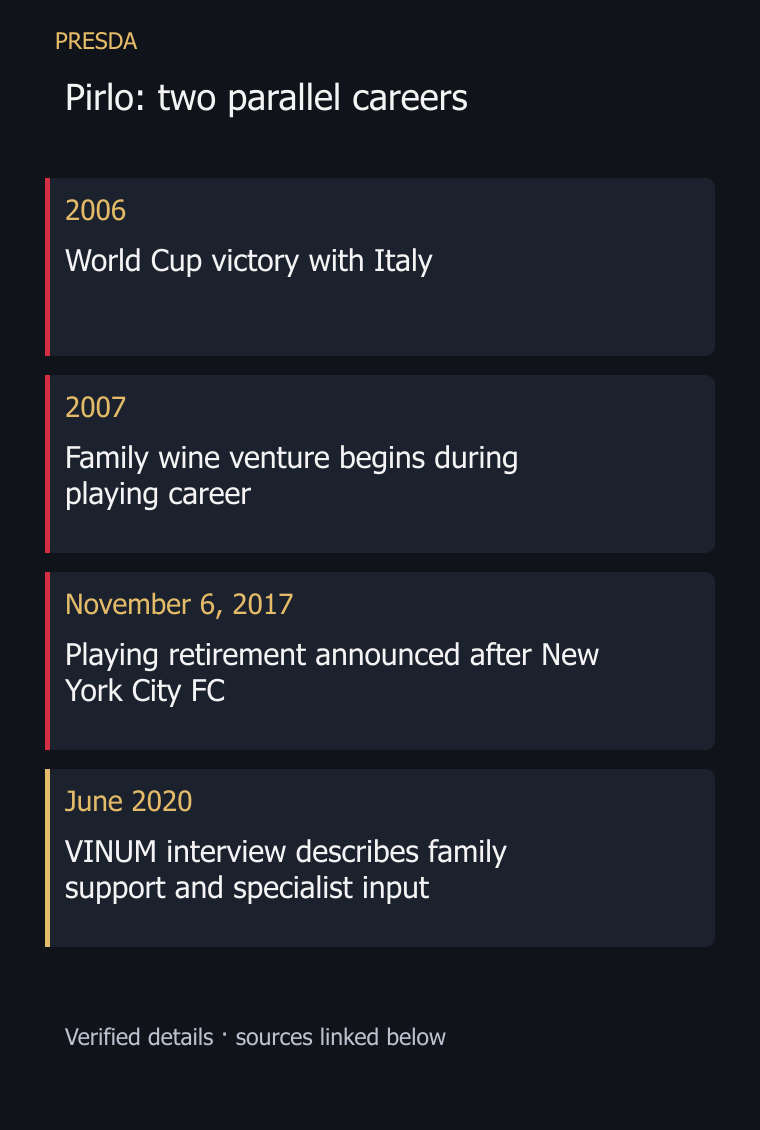
Andrea Pirlo and Pratum Coller: the documented chronology. Sources: Pirlo interviews and FIFA.
His football identity was built around the ability to organise a match: receiving possession, reading the shape of the game and choosing when to accelerate it. That makes patience and precision tempting metaphors for wine. They are useful as an introduction, but a metaphor is not evidence that football technique transfers directly to agricultural or commercial expertise.
Pirlo announced his playing retirement on November 6, 2017, after finishing at New York City FC. The word playing is important: ending a career on the field does not mean ending every relationship with football. A wine feature need not erase the distinction between a former player and someone whose subsequent work can still include the sport. FIFA: Pirlo’s playing retirement, November 6, 2017
Expertise beyond the celebrity name
In the 2020 VINUM interview, Pirlo discussed the involvement of wine consultant Carlo Ferrini. That is a dated account of the project’s professional organisation, not a claim about the consultant’s precise contractual role in 2026. It nevertheless illustrates why reporting should identify specialist input rather than attributing all technical work to the footballer. VINUM: direct Pirlo interview, June 2020
Vineyard and cellar decisions involve expertise that a label cannot supply on its own. Production and commercial roles can also be separate: making a wine, presenting it and getting it to customers are different tasks. Pratum Coller’s family history is more informative when those distinctions remain visible.
A product range has a history too
The interviews describe wines under names including Nitor, Eos and Arduo. The 2020 account also discussed a broader range, including a sparkling wine named Ventuno. These are examples from the documented history of the producer, not a guarantee that every bottle, vintage or format remains available now. Mixer: direct Pirlo interview, September 2013 VINUM: direct Pirlo interview, June 2020
That qualification prevents a feature from becoming an inaccurate shopping guide. Product portfolios change; a historical description cannot prove current stock. Nor does the presence of several wines justify a claim about sales, export revenue or the profitability of the business. No such financial figures have been established for this article.
The practical challenge is clear even without invented numbers. A producer needs an identity that can survive beyond the curiosity generated by its famous connection. For a customer, the meaningful questions concern origin, style and consistency. For the business, they concern production, relationships and the ability to keep delivering the promised product.
Two footballers, different wine-business models
PRESDA’s account of Eden Hazard’s signature-wine collaboration offers a useful comparison. Hazard’s documented association with an existing producer should not be treated as identical to Pirlo’s family-estate history. Both involve football fame and wine, but the underlying roles are different.
This distinction also improves the wider discussion of athletes in business. A partnership, an endorsement, an investment and an operating company are not interchangeable. The reporting task is to establish which relationship the evidence supports, rather than assuming that every athlete pictured with a bottle owns a winery or personally makes its contents.
The second career began during the first
Pratum Coller is most interesting when told on its own terms: a family-linked wine enterprise in Lombardy whose documented origins reach back to 2007. Pirlo’s retirement created room for greater attention, but it did not create the project from nothing. That longer timeline is the central correction to a simplified after-football story.
His medals establish what he accomplished as a player. The winery’s history establishes a separate set of relationships, choices and specialist work. Respecting both records produces a richer portrait than the suggestion that a football legend simply exchanged one field for another and instantly mastered a new industry.
FAQ
Frequently Asked Questions
Did Pirlo start his winery after retirement?
No. His direct interviews date the family venture to 2007, while he was still playing. He described giving it more attention after his playing career.
Where is Pratum Coller?
The producer is associated with the Brescia area of Lombardy, around Flero and Monte Netto. It should not be described as a Tuscan estate.
Does Pirlo personally do all the winemaking?
The documented story involves family support and professional expertise. It does not establish that Pirlo personally carries out every vineyard or cellar task.
Are current revenues and production figures known?
This article does not establish current financial results or annual output. Historical interviews and undated producer descriptions cannot substitute for a current business audit.
PRESDA Dispatch
Stay Informed. Stay Aware.
A sharp briefing across AI, gaming, sport, business, world affairs, paparazzi, and lifestyle.