EDEN HAZARD’S LIFE AFTER FOOTBALL: HIS SIGNATURE WINE COLLABORATION
Eden Hazard’s 2026 wine collaboration connects football fame with Salento. Explore the partnership, its timeline and what the evidence says about his role.
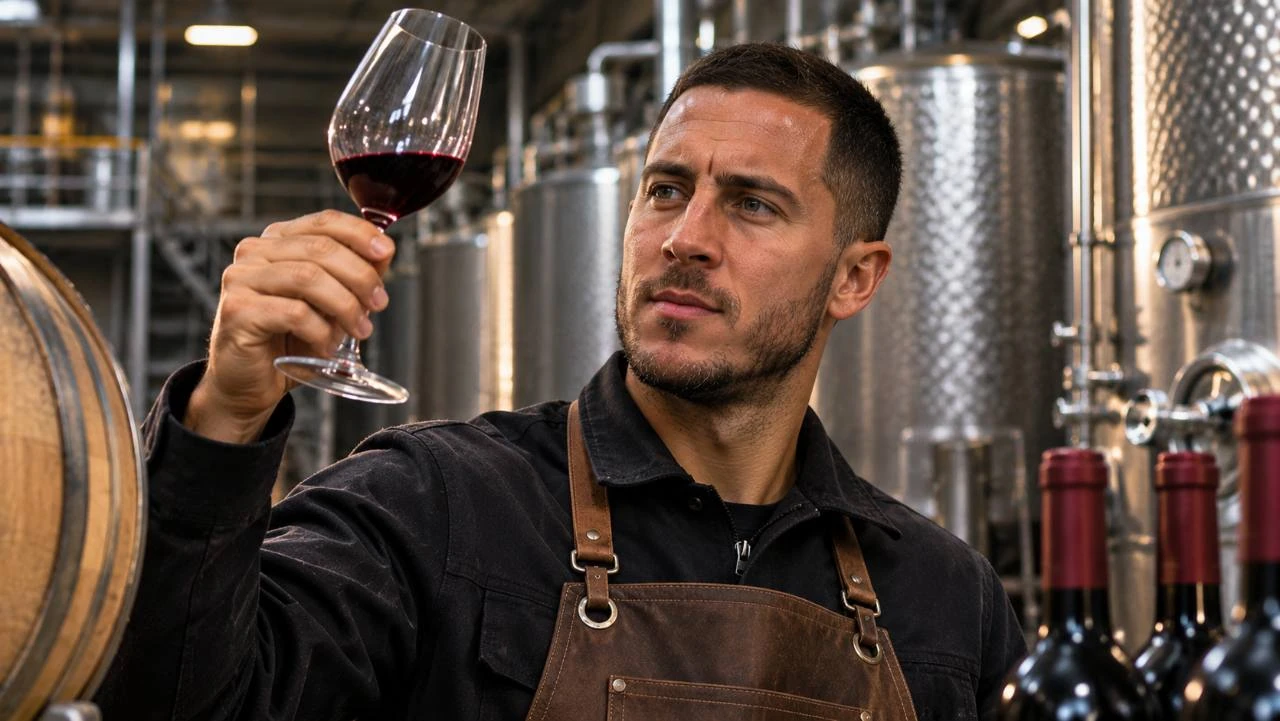
Supplied editorial illustration of Eden Hazard in a cellar. Not documentary evidence of winery ownership, a particular location or a technical winemaking role.
Eden Hazard’s life after football has acquired a new label, quite literally. The former Chelsea and Real Madrid forward is associated with a signature wine collection through Fabio Cordella’s The Wine of the Champions. The documented story is a collaboration with an existing producer, not proof that Hazard has bought an estate or become its technical winemaker.
That distinction corrects an appealing but overconfident headline. The producer’s official website lists Hazard among its participating football personalities. On-the-ground coverage in February 2026 and a subsequent public event provide a timeline for the venture. This is a feature about an established 2026 collaboration, not an invented November launch. Fabio Cordella: official Eden Hazard collection page La Gazzetta dello Sport: Hazard’s February 3 Salento visit The Grand Southampton: June 12, 2026 Hazard wine event
| Date or source | What it establishes |
|---|---|
| October 10, 2023 | Retirement from professional football at 32 |
| February 3, 2026 | Salento visit and red, rosé and white wines reported |
| June 12, 2026 | Wine-related public event in Southampton |
| Official producer website | Hazard listed within the champions collection |
What is confirmed about the wine venture?
Fabio Cordella’s website includes an Eden Hazard collection page, placing him within the wider Wine of the Champions concept. Its corporate information identifies Fabio Cordella srl. That is useful primary evidence of the association, but it does not disclose a personal ownership percentage, a winery purchase or a technical job description for Hazard. Fabio Cordella: official Eden Hazard collection page Fabio Cordella: company and champions collection
An athlete can be involved in a product in several ways: through a signature collection, promotion, creative input or investment. Those relationships have different implications. The evidence cited here supports describing Hazard as a collaborator associated with wines carrying his identity, while leaving undisclosed contractual details undisclosed.
The February visit made the story tangible
La Gazzetta dello Sport’s February 3, 2026 video report followed Hazard in the Lecce area with Cordella and described three wines: a red, a rosé and a white. It situated the project in the Salento context of southern Italy. This is more concrete than a generic story about a footballer pictured holding a glass. La Gazzetta dello Sport: Hazard’s February 3 Salento visit
The regional setting should not be confused with ownership. Visiting a producer, presenting bottles or appearing in promotional coverage does not by itself prove that the visitor owns vineyards, supervises fermentation or makes every production decision. The supplied cellar image is an editorial illustration and cannot establish any of those activities.
A public appearance in June, not a launch today
The Grand Southampton’s event page records an evening with Hazard on June 12, 2026, connected to his wine collaboration. The event is marked as having taken place. It documents another public stage in the project’s year without justifying claims about current ticket availability, sales volumes or a nationwide retail rollout. The Grand Southampton: June 12, 2026 Hazard wine event
Keeping this chronology intact matters. A wine initiative can remain interesting months after its first coverage because it reveals how an athlete uses a familiar public identity outside sport. There is no need to manufacture immediacy by moving the launch into the present or treating an old event listing as an upcoming appearance.
The sequence also offers a better way to follow future developments. A named product, a producer’s confirmation and a dated appearance are specific milestones. Claims about expansion or business success would need their own evidence, such as new official announcements or published operating results, rather than being inferred from the existence of a collaboration.
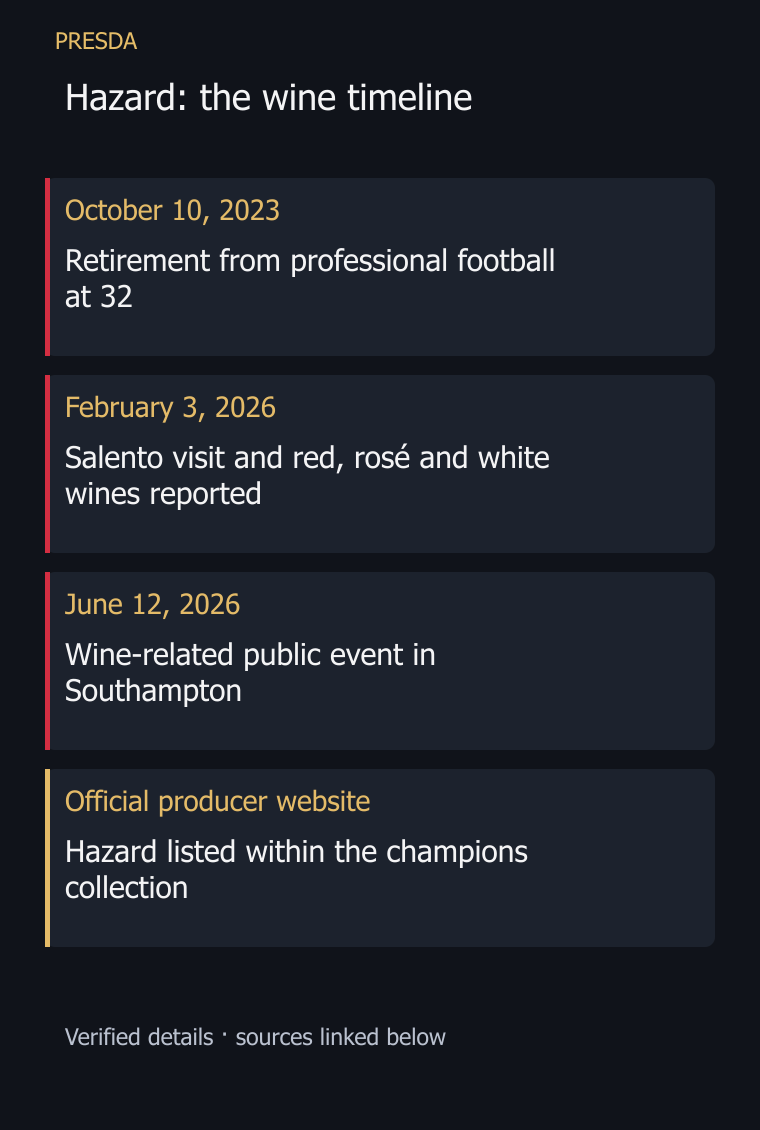
Eden Hazard’s wine collaboration: a dated timeline. Sources: Chelsea, Gazzetta, producer and event.
The football career he left behind
Hazard announced his retirement on October 10, 2023, aged 32. Chelsea’s official account records 352 appearances and 110 goals across seven years, with two Premier League titles among his honours. The Premier League separately records the retirement announcement. These are firm career facts, not a conclusion drawn from his involvement in another industry. Chelsea FC: Hazard’s retirement and career Premier League: October 10, 2023 retirement announcement
He moved from Chelsea to Real Madrid in 2019 and later ended his playing career. His Chelsea years remain central to his public identity: a player associated with balance, dribbling and the ability to disrupt a defence. That identity is the background against which supporters notice a bottle carrying his name.
The change in daily purpose is significant even without assuming that he has exchanged football for a full-time cellar job. Retirement can create room for projects with a different calendar, different collaborators and less dependence on the weekly performance cycle. The available evidence shows one such project, not an exclusive definition of his entire life after sport.
What a signature collection can offer a producer
The commercial logic is understandable: a footballer’s name can give an existing producer access to an audience that might not otherwise encounter its wines. For supporters, the appeal may include a connection with a familiar career and personality. That explains attention, but it does not establish how much wine is sold or whether the relationship is profitable.
The product still has to exist beyond its publicity. Origin, style, consistency, distribution and service remain relevant to the customer. A celebrity association can provide a reason to look, but it cannot replace the practical work of making, presenting and supplying the bottles. This is analysis of the business model, not a claim about undisclosed company performance.
The distinction is particularly useful when discussing alcohol. A famous athlete’s involvement is not a health recommendation or evidence of sporting benefit. This article reports a commercial collaboration and its context; it does not turn the player’s fitness history into a claim about consuming the product.
Hazard and Pirlo should not be given the same story
PRESDA’s profile of Andrea Pirlo and Pratum Coller describes a family wine venture whose origins date to 2007, while Pirlo was still playing. Hazard’s documented signature collection with an existing producer is a different relationship. Treating both simply as footballers who became winery owners would erase the evidence that makes each story distinctive.
This is a broader reporting lesson. A photograph can show a person with a product but cannot establish the legal and operational structure behind it. A partner’s official page can confirm an association without revealing the contract. Careful reporting combines those sources while respecting what they do and do not establish.
What remains unknown
This article does not establish Hazard’s investment amount, remuneration, ownership stake, annual bottle sales or the profitability of the collection. It also does not present a historical selection of wines as a real-time stock list. Product availability and commercial terms require current documentation of their own.
Those limits leave a clear, engaging story intact. A retired football star has attached his identity to a wine collaboration, with confirmation from the producer and dated public activity in 2026. It is a meaningful example of life beyond the pitch, told more accurately as a partnership than as an unverified transformation into a technical winemaker or estate owner.
FAQ
Frequently Asked Questions
Has Eden Hazard become a winery owner?
The cited sources confirm a signature-wine collaboration with Fabio Cordella’s brand. They do not establish an estate purchase, ownership percentage or technical winemaking role.
Where is the wine project connected to?
The reporting places the producer relationship in Salento, Puglia, in southern Italy. That geographical connection does not itself prove Hazard owns vineyards there.
When did Hazard retire from football?
He announced his retirement on October 10, 2023, at 32. Chelsea records 352 appearances and 110 goals during his seven years at the club.
Is this a new November 2026 launch?
No. The article follows documented activity earlier in 2026, including February reporting and a June event. It does not invent a new launch date.
PRESDA Dispatch
Stay Informed. Stay Aware.
A sharp briefing across AI, gaming, sport, business, world affairs, paparazzi, and lifestyle.