Bruneian Empire: The Maritime Sultanate That Ruled Northern Borneo
From a river port to a powerful maritime sultanate, Brunei linked Borneo to China and the Malay world. Its history is larger than today’s borders, but more complex than an empire map.
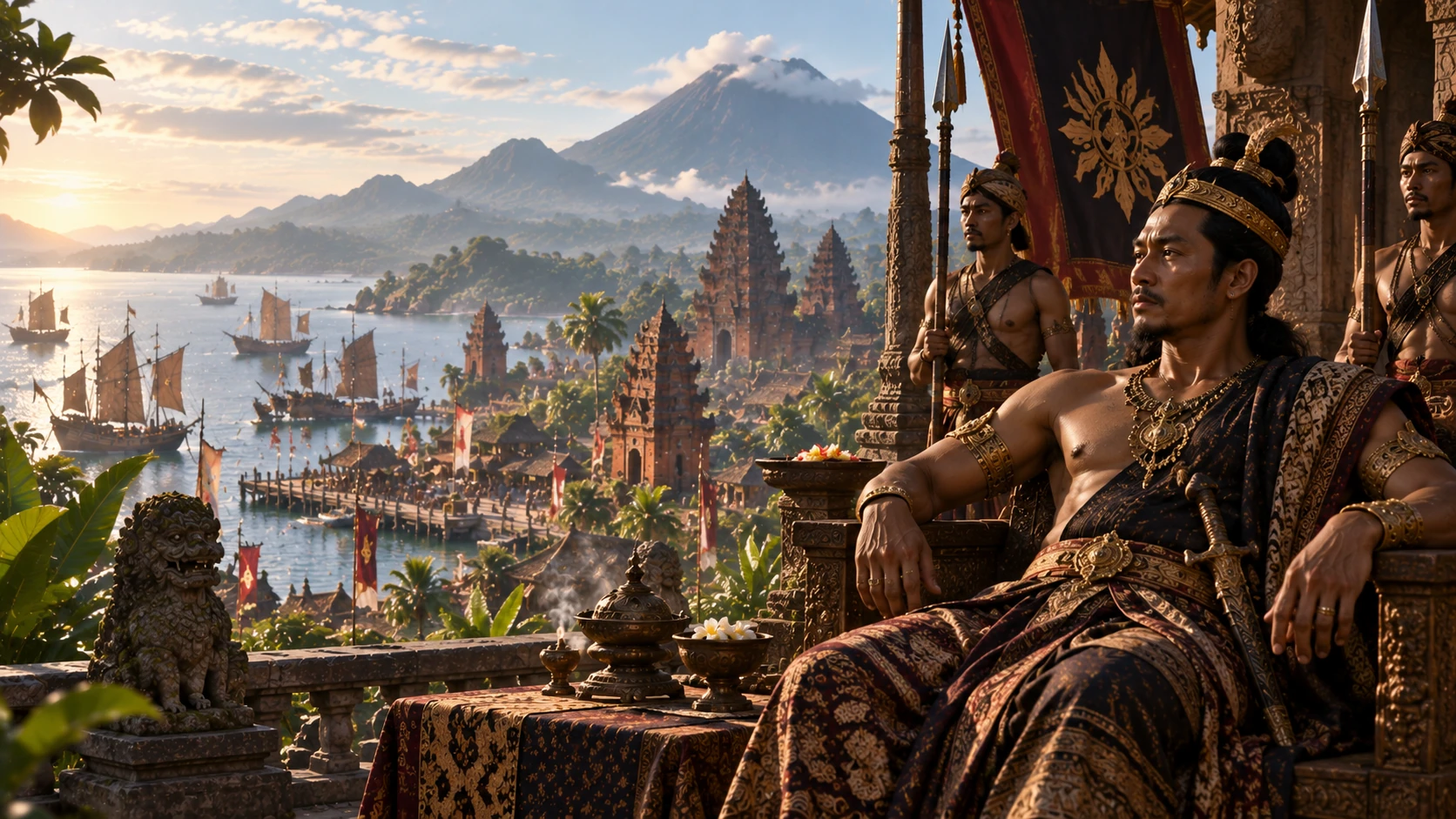
In 1521, Antonio Pigafetta reached a city where much of everyday life unfolded above the water. Boats connected houses; ceremonial elephants carried visitors toward the ruler; courtly protocol separated the sovereign from his guests. His account of Brunei reveals a wealthy Asian court already connected to distant markets when the surviving ships of Magellan’s expedition arrived. Antonio Pigafetta: 1521 account, translated in The First Voyage Round the World (1874)
The Bruneian Empire was a maritime sultanate centred on northern Borneo. Its fifteenth- and sixteenth-century expansion connected coastal settlements with the Sulu Sea and Luzon. That substantial but uneven influence did not resemble modern borders. Stephen C. Druce and Nani Suryani Haji Abu Bakar: Contextualising the History of Brunei (2022)
ORIGINS: A PORT BEFORE AN EMPIRE
Kota Batu, on the Brunei River, connected a sheltered bay to inland routes. Archaeology reveals trading connections predating its celebrated Islamic rulers. Port development, dynastic origins and conversion were distinct processes. Stephen C. Druce and Nani Suryani Haji Abu Bakar: Contextualising the History of Brunei (2022)
Brunei’s royal tradition identifies Awang Alak Betatar, subsequently Sultan Muhammad Shah, as the first Muslim ruler. The official narrative places his conversion around 1368 and associates it with a royal marriage. It also honours Sharif Ali, traditionally the third sultan, for strengthening Islamic institutions in the fifteenth century. These are important elements of Brunei’s dynastic history, but their precise chronology is debated. Pelita Brunei: the official account of Muhammad Shah and Sharif Ali, November 14, 2015
Historian Robert Nicholl showed why caution is necessary: many early manuscripts and monuments lack dates, while conventional reign lists rely on dates of uncertain origin. Comparing them with outside records produces disagreements. A ruler’s conversion should also not be treated as proof that every community adopted the same religion immediately. Robert Nicholl: Some Problems of Brunei Chronology, Journal of Southeast Asian Studies (1989)
THE TRADE THAT MADE BRUNEI POWERFUL
Brunei’s advantage lay between the forest and the sea. Peter Metcalf’s study of upriver trade describes an economy in which forest produce travelled outward while imported manufactured goods moved inland and became markers of status. Coastal wealth therefore depended on relationships with interior communities, not just ships arriving from abroad. Peter Metcalf: Premodern Upriver Trade, The Life of the Longhouse
The material evidence is tangible. The Maritime Museum’s shipwreck collection includes ceramics from China, Vietnam and Thailand. Such objects show participation in interconnected Asian markets. They demonstrate exchange; a Chinese bowl in Brunei is not, by itself, evidence of Chinese political rule or of Bruneian sovereignty over its place of manufacture. Brunei Tourism: Maritime Museum and its archaeological collections
Islam linked Brunei with wider Muslim commercial networks. Bajau seafaring communities and maritime partnerships strengthened access to routes and resources. Trade and religious connections reinforced political power. Stephen C. Druce and Nani Suryani Haji Abu Bakar: Contextualising the History of Brunei (2022)
SULTAN BOLKIAH AND THE GOLDEN AGE
Sultan Bolkiah became the best-known figure of Brunei’s expansion. Government publications identify him as the fifth sultan and conventionally date his reign to 1485–1524. Remembered as Nakhoda Ragam, he embodies the dynasty’s maritime golden age. Those conventional dates are useful signposts, but should be read alongside historians’ cautions about early royal chronology. Brunei Department of Information: Sultan Bolkiah, November–December 2008 newsletter Robert Nicholl: Some Problems of Brunei Chronology, Journal of Southeast Asian Studies (1989)
The wider setting mattered. The weakening of older regional powers and the Portuguese capture of Melaka in 1511 changed commercial opportunities. Brunei’s ascent belonged to this competitive trading world, alongside other ports and rulers, rather than to an empty sea awaiting one empire. Our history of Majapahit’s maritime power explores another part of that regional story. Marie-Sybille de Vienne: Brunei, From the Age of Commerce to the 21st Century (2015)
Pigafetta’s 1521 description records porcelain, silk, ceremonial display and an armed court. He also encountered a Luzon prince connected to Brunei’s ruler and involved in its naval affairs. This is valuable contemporary evidence of wealth and cross-sea political relationships. It is not a census, a cadastral survey or proof of every conquest later attributed to Bolkiah. Antonio Pigafetta: 1521 account, translated in The First Voyage Round the World (1874)
HOW FAR DID THE BRUNEIAN EMPIRE REACH?
Brunei’s authority combined a ruling centre, coastal dependencies and distant relationships. Across northern Borneo, the Sulu Sea and the Manila region, tribute, marriages and influence could overlap without creating uniformly administered provinces. Stephen C. Druce and Nani Suryani Haji Abu Bakar: Contextualising the History of Brunei (2022)
Royal genealogies and the Syair Awang Semaun preserve memories of origins, rulers and expansion. Scholars of Brunei historiography stress both their value and their difficulties: oral traditions were written down later, survive in different versions and blend political memory with heroic narrative. They must be compared with archaeology and contemporary external testimony. Asiyah Az-Zahra Ahmad Kumpoh, Stephen C. Druce and Nani Suryani Haji Abu Bakar: Brunei Historiography (2022)
That is why this account does not assign the empire a precise maximum land area or colour the whole of modern Borneo and the Philippines as one uninterrupted possession. A claim to overlordship, a tribute relationship, a naval expedition and direct government answer different historical questions. Evidence for one should not silently stand in for all four.
SPAIN AND THE CASTILIAN WAR OF 1578
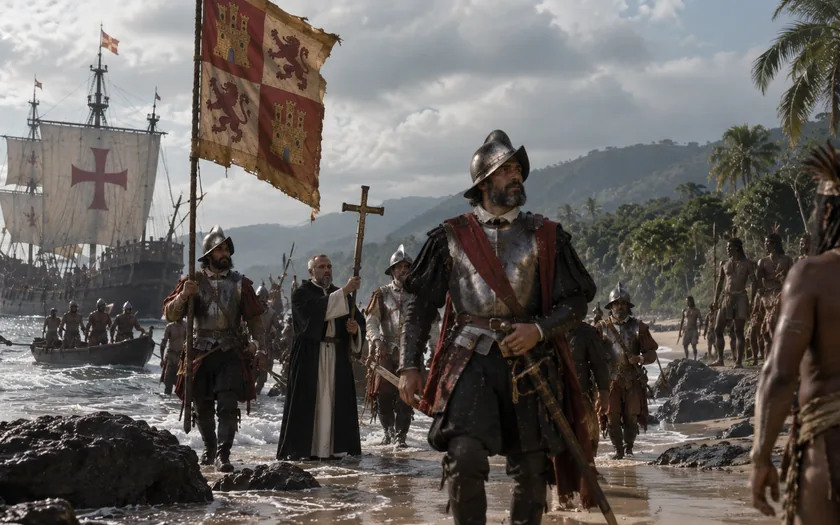
Spain’s establishment at Manila in 1571 brought an expanding colonial power into Brunei’s commercial and religious sphere. Francisco de Sande’s records show that the conflict involved political submission and missionary activity, as well as strategic rivalry. His expedition attacked Brunei in 1578 in the conflict usually called the Castilian War. Francisco de Sande and others: contemporary Spanish records, The Philippine Islands, volume IV
Spanish forces and Philippine allies occupied the capital, then withdrew. Spanish accounts emphasise sickness; later Bruneian traditions foreground resistance. Whatever the explanation, the occupation did not become lasting Spanish rule. Stephen C. Druce and Nani Suryani Haji Abu Bakar: Contextualising the History of Brunei (2022)
Colonial correspondence must also be read critically. Sande wrote to justify his actions to his king. Claims of taking possession cannot simply be accepted as evidence of durable control. The episode belongs in the wider history of Spain’s overseas empire, but it was not the moment Brunei became a permanent Spanish colony. Francisco de Sande and others: contemporary Spanish records, The Philippine Islands, volume IV
RECOVERY, RIVALRY AND SUCCESSION STRUGGLES
The war was a blow, not an instant end to Brunei’s regional life. Marie-Sybille de Vienne describes renewed institutional organisation and commercial openings after 1578, including Japanese trade in the early seventeenth century. Dutch activity brought new possibilities as well as competition. Decline was neither immediate nor a perfectly straight line. Marie-Sybille de Vienne: Brunei, From the Age of Commerce to the 21st Century (2015)
Sultan Muhammad Hasan is remembered for developing royal administration and ceremony. After his era, succession struggles and changes in the regional trading system weakened the sultanate. The problem was cumulative: competing courts and foreign powers could exploit divisions within a political network whose strength depended on continued allegiance. US Department of State: historical background on Brunei (2000 archive)
A prolonged civil war in the 1660s and early 1670s pitted Abdul Hakkul Mubin against Muhyiddin. Accounts of Sulu’s assistance and an associated grant of territory in what is now Sabah differ. The alleged transfer should not be presented as an uncontested transaction, still less used here to decide modern sovereignty claims. Historical study: competing accounts of Sulu claims to Sabah (2015)
Sulu emerged as a stronger competitor, while shifting trade routes and repeated internal conflict reduced Brunei’s room for manoeuvre. The eighteenth and nineteenth centuries brought further pressure. The surviving sultanate did not simply shrink because Europeans appeared: regional rivals, local resistance and the ruling elite’s divisions were also part of the story. Marie-Sybille de Vienne: Brunei, From the Age of Commerce to the 21st Century (2015) US Department of State: historical background on Brunei (2000 archive)
HOW THE EMPIRE CONTRACTED INTO MODERN BRUNEI
The nineteenth century turned long-term weakness into dramatic territorial losses. James Brooke obtained authority in Sarawak in 1841, laying the foundation of the Brooke state. Labuan was ceded to Britain in 1846. Expansion by the Brooke rulers and the North Borneo company subsequently narrowed Brunei’s remaining domains. B. A. Hussainmiya: Brunei Revival of 1906, a Popular History US Department of State: historical background on Brunei (2000 archive)
British protection in 1888 did not reverse those losses. Sarawak’s annexation of Limbang in 1890 divided Brunei’s remaining territory, separating Temburong from the western districts. A British Resident followed in 1906, extending British administrative influence while the sultanate continued to exist. B. A. Hussainmiya: Brunei Revival of 1906, a Popular History US Department of State: historical background on Brunei (2000 archive)
These stages must be distinguished. A protectorate was not the same as the earlier maritime empire, and dynastic survival did not mean unchanged sovereignty. Britain retained responsibility for external affairs, security and defence after Brunei’s 1959 constitution introduced internal self-government. Full independence returned on January 1, 1984. US Office of the Historian: Brunei’s protectorate and independence
WHAT SURVIVED THE EMPIRE?
The modern country preserves a sultanate whose historical reach once extended far beyond its present borders. Yet its most revealing inheritance may be the connections visible in ports, river settlements, imported ceramics and royal traditions. The story is about how a coastal court linked communities and markets, and how those relationships could be challenged or lost.
Brunei’s maritime past deserves neither dismissal as legend nor inflation into an all-encompassing map. Contemporary travellers, archaeological collections and competing historical traditions establish a consequential regional power. They also show why its exact borders, early dates and particular claims require different levels of confidence.
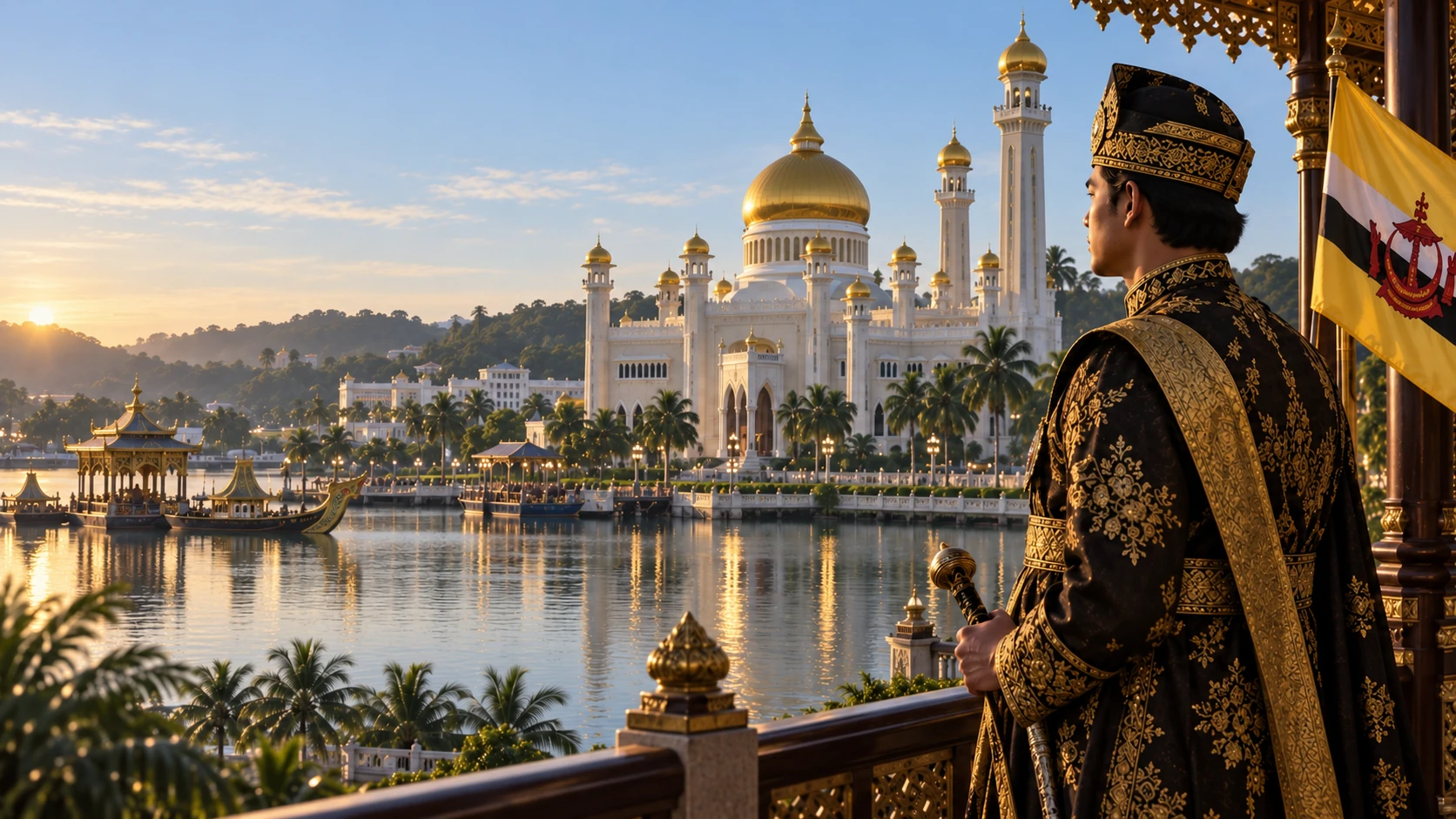
Editorial note: the supplied hero is an imaginative illustration combining a ruler figure with a modern Brunei-inspired mosque setting. It is not a documented portrait of Sultan Bolkiah or a reconstruction of fifteenth-century Kota Batu. Sources reviewed October 4, 2026.
FAQ
Frequently Asked Questions
What was the Bruneian Empire?
It was the maritime sultanate centred on Brunei in northern Borneo, whose coastal power and overseas relationships expanded especially in the fifteenth and sixteenth centuries.
Did Brunei rule all of Borneo and the Philippines?
That would overstate the evidence. Brunei had substantial coastal power and connections beyond Borneo, but tribute, alliances and trading influence were not equivalent to uniform rule over those entire islands.
Who was Sultan Bolkiah?
He was the ruler most associated with Brunei’s maritime golden age. Official accounts conventionally place his reign in 1485–1524, while scholars caution that early royal chronology is debated.
Did Spain conquer Brunei permanently in 1578?
No. Spanish forces and their Philippine allies briefly occupied the capital during the Castilian War, then withdrew. Brunei survived as a sultanate.
When did modern Brunei regain full independence?
Brunei regained full independence on January 1, 1984, after a period of British protection and later internal self-government.
PRESDA Dispatch
Stay Informed. Stay Aware.
A sharp briefing across AI, gaming, sport, business, world affairs, paparazzi, and lifestyle.