Singapore: How a Tiny Island Became One of the World’s Richest Countries
Singapore’s rise was built on more than a strategic port. Its story connects factories, homes, schools and public institutions, with lessons that travel and trade-offs that should not be ignored.
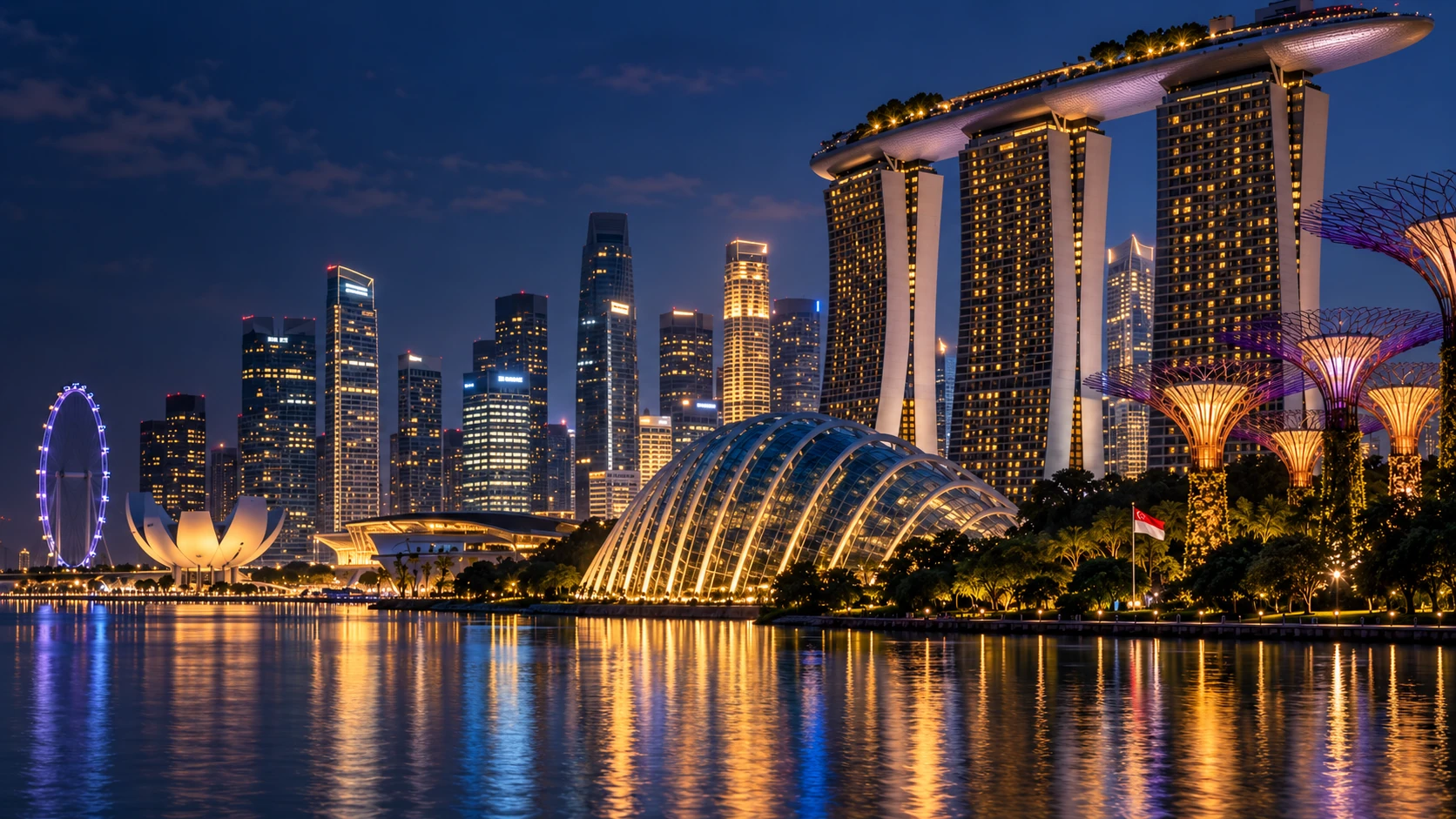
At Marina Bay, Singapore’s transformation looks almost effortless: towers, illuminated water and a skyline built to be recognised. The harder achievement is less photogenic. It lies in industrial estates, classrooms, housing blocks and the routines that allow a ship, a business or a household to plan its next move. Wealth was built through those systems long before it became a view.
Singapore became rich by making a small economy useful to much larger ones. It combined international trade and foreign investment with capable public institutions, mass housing and education. Geography helped, but the key was turning a strategic location into reliable services and progressively more valuable work. This is an account of that process, and of the compromises it involved.
1965: INDEPENDENCE WITHOUT A COMFORTABLE SAFETY NET
On 9 August 1965, Singapore became independent after separating from Malaysia. It had little land, few natural resources and a small domestic market. Yet the familiar image of a country starting from nothing is misleading: Singapore already had a trading economy and institutions inherited from its colonial past. Vulnerability and useful assets existed together. National Archives: Singapore’s independence proclamation, 1965 National Heritage Board: 50 years of economic development
The urgent question was how to create jobs and sustain a viable state without a large hinterland. A port could connect Singapore to the world, but moving other countries’ goods was not enough of a development strategy. The government sought a broader industrial base, and policies begun before independence became foundations for what followed. National Heritage Board: 50 years of economic development
LEE KUAN YEW AND THE MACHINERY OF GOVERNMENT
Lee Kuan Yew served as prime minister from 1959 to 1990, spanning self-government, merger with Malaysia and independence. His leadership mattered enormously, but reducing the story to one man hides the work of ministers, civil servants, businesses and workers. Economic institution-building was a collective project, including the industrial strategy associated with Goh Keng Swee. Prime Minister’s Office: past prime ministers National Heritage Board: 50 years of economic development
The development lesson is institutional rather than personal: a plan needs agencies able to execute it, recruit expertise and correct mistakes. Political continuity can support long projects, but continuity alone cannot make a bad investment productive. Singapore’s record should be judged by what its institutions delivered, not treated as proof that any strong leader can reproduce the same results.
WHY FOREIGN INVESTMENT WAS CENTRAL
The Economic Development Board was established in 1961, and Jurong became a focal point for industrial development. Singapore actively sought overseas investment instead of relying only on its small home market. Factories brought employment and links to international production, while public investment helped provide the places and capabilities firms needed to operate. Enterprise Singapore: 60 years of industrial innovation
The logic was a partnership between openness and preparation. An investor’s tax bill matters, but so do electricity, transport, skills and predictable administration. Industrial policy is more credible when these pieces fit together. The question for other countries is therefore not simply how much incentive to offer, but what productive activity will remain after the incentive has been spent.
FROM A TRADING PORT TO FINANCE AND TECHNOLOGY
Finance grew alongside the trade economy. The Asian currency market began in 1968, creating a base for international banking business. A regional hub gains value when firms can arrange finance, payments and commercial services near their trading operations. Those relationships help explain why a successful port economy can develop far beyond the waterfront. IMF: origins of the Asian currency market
Singapore also moved into higher-value production and technology. The IMF’s July 2026 assessment reports that AI-related exports helped drive growth in 2025. That illustrates both an opportunity and a constraint: advanced industries can generate valuable work, but their demand is global and cyclical. Becoming a technology hub does not abolish exposure to the outside world. IMF: Singapore Article IV consultation, July 2026
THE PORT: GEOGRAPHY MADE PRODUCTIVE
In 2024, Singapore handled 41.12 million twenty-foot equivalent units, or TEUs, according to its Maritime and Port Authority. TEU is a standard measure of container capacity, not a count of individual boxes. A 40-foot container represents two TEUs. The scale helps explain the importance of efficient transfers, dependable operations and maritime services. MPA: 2024 maritime performance
Tuas is the next major investment in that network. MPA targets capacity of 65 million TEUs when the port is completed in the 2040s. That is planned capacity, not today’s throughput. The project shows how a hub must keep investing to remain useful; having a favourable position on a map does not guarantee ships will keep choosing it. MPA: Tuas, the port of the future
HOUSING WAS ECONOMIC INFRASTRUCTURE
Singapore’s housing programme did more than change its skyline. HDB introduced its home-ownership scheme in 1964; from 1968, Central Provident Fund savings could be used for housing. Connecting public construction and household finance gave the housing programme a reach that isolated private developments could not have achieved. HDB: public-housing history
HDB’s July 2025 statement says close to 80% of the resident population lives in its flats. “Resident” here is not the same as every person working in Singapore. The system also needs careful description: a typical new HDB flat provides 99-year leasehold ownership, not permanent freehold ownership. HDB: housing overview, July 2025 Singapore government: understanding HDB ownership
Housing can support development by placing stable homes within reach of jobs and services. But it also creates difficult trade-offs. Rising values benefit existing owners while making entry harder for new buyers; money used for housing cannot simultaneously remain available for other needs. A successful public-housing system still requires continual choices about affordability, location and fairness.
EDUCATION CONNECTED PEOPLE TO THE ECONOMY
Singapore’s bilingual approach combines English with mother-tongue learning. It links participation in an international economy with the languages and identities of a diverse society. Education is part of the economic story because new infrastructure and investment are useful only if people can acquire the skills to work with them. Ministry of Education: language and literacy
Singapore led the participating countries and economies in mathematics, reading and science in PISA 2022. Those results measure the assessed skills of 15-year-olds, not every aspect of education. The OECD also records socioeconomic differences in performance. Excellence and unequal opportunities can coexist, which makes access and support as important as the headline ranking. OECD: Singapore, PISA 2022 results
LOW CORRUPTION, HIGH EXPECTATIONS
Singapore’s Prevention of Corruption Act covers public- and private-sector corruption, and CPIB investigates offences. The importance is practical: if a licence or contract depends on an unofficial payment, an honest firm cannot reliably calculate its costs. Enforcement helps make the written rules more credible. CPIB: anti-corruption legislation and enforcement
In the 2024 Corruption Perceptions Index, Singapore scored 84 out of 100 and ranked third among 180 countries and territories. The index concerns perceived public-sector corruption, not proof that corruption is absent. Good scores are an outcome to scrutinise, not a substitute for investigations, transparent procedures and accountability. CPIB: 2024 Corruption Perceptions Index
QUALITY OF LIFE BEYOND THE SKYLINE
Water illustrates Singapore’s approach to scarcity. PUB describes four sources: local catchments, imported water, recycled NEWater and desalination. Diversification reduces dependence on any one source, while treatment and distribution turn the resource into a dependable service. It is infrastructure that supports daily life as well as business. PUB: Singapore’s four water sources
Life expectancy at birth for Singapore residents was 83.5 years in 2024, according to SingStat. This is a population indicator based on mortality conditions, not a guarantee of an individual lifespan. It is also a reminder that judging development requires measures of life and health alongside output, buildings and financial activity. SingStat: resident life tables, 2023–2024
The World Bank’s current-dollar series puts Singapore’s 2024 GDP per person at about US$94,900, using data checked in October 2026. That is economic output divided by population, not a typical salary or household wealth. International businesses and high-value sectors can lift the average while residents still face demanding housing costs and uneven opportunities. World Bank: GDP per capita, current US dollars, 2024
STRICT GOVERNANCE HAS REAL TRADE-OFFS
Singapore’s administrative effectiveness should not be confused with unrestricted political freedom. Freedom House’s 2025 assessment classified it as partly free, citing constraints on opposition growth and freedoms of expression, assembly and association. That is the organisation’s assessment, not a neutral mathematical measure of every aspect of society. Freedom House: Singapore assessment, 2025
The analytical distinction matters. Enforcing contracts, limiting bribery and maintaining public services are not the same policy as restricting dissent. Singapore’s economic record does not establish that political restrictions caused its prosperity or that other societies must accept those restrictions to improve their institutions. Learning from a country does not require endorsing every part of its governing model.
THE NEXT TEST: AGING, COSTS AND GLOBAL SHOCKS
The National Population and Talent Division reports that 21.4% of Singapore’s citizens were aged 65 or older in 2026. This figure concerns citizens, not the total population. Aging changes the balance between employment, care and retirement, making productivity and support for older people increasingly important. National Population and Talent Division: longevity, September 2026
External risks remain substantial. The IMF’s 2026 assessment highlights trade tensions and a possible reversal of the global AI boom. A hub benefits from flows it cannot fully control. The same connections that bring investment and demand can transmit disruption, making economic diversification and room to respond more valuable than confidence in any single winning sector. IMF: Singapore Article IV consultation, July 2026
Climate adaptation adds another long-term bill. Singapore’s climate secretariat notes that around 30% of the island is less than five metres above mean sea level. Coastal protection must therefore compete for land, money and engineering capacity with other priorities. Rich countries still face physical limits; wealth changes their ability to respond, not their exposure. National Climate Change Secretariat: coastal protection
WHAT OTHER COUNTRIES CAN REALISTICALLY LEARN
The most transferable lessons are practical: make rules predictable, connect investment promotion to infrastructure and skills, treat housing as part of the economy, and maintain institutions after the launch ceremony. A country can begin with a dependable permit process or a well-connected industrial area rather than trying to reproduce Singapore’s entire model at once.
The least transferable features are its precise location, city-state scale and particular history. A large federation must coordinate more governments and regions; a landlocked country needs a different trade strategy. Policies should be adapted to those constraints and assessed against local outcomes. Copying a skyline, a tax rate or a slogan is much easier than building the competence behind them.
Singapore’s achievement is that it made limited territory perform many roles: home, factory, port, financial centre and research base. Its next challenge is ensuring that this usefulness translates into a good life across generations. For a different small-country example of institution-building, read PRESDA’s analysis of Estonia’s digital government.
Sources checked on 4 October 2026. Statistics retain their reference years and should not be read as a single-year comparison. The supplied hero is an illustrative Singapore cityscape, not evidence for an economic claim.
FAQ
Frequently Asked Questions
Why is Singapore so rich?
Singapore combines trade and foreign investment with reliable infrastructure, public administration, housing and education. Its location helped, but sustained investment and the ability to perform valuable services turned that advantage into high economic output.
When did Singapore become independent?
Singapore became independent on 9 August 1965 after separating from Malaysia. Lee Kuan Yew was prime minister from 1959 to 1990.
Does Singapore’s GDP per capita mean everyone is wealthy?
No. GDP per capita measures economic output per person, not median pay, household income or personal wealth. High output can coexist with expensive housing and differences in living standards.
Can other countries copy Singapore’s model?
They can adapt its focus on competent institutions, skills and coordinated infrastructure. They cannot simply reproduce its location, city-state scale or historical circumstances, and political restrictions are not an established prerequisite for prosperity.
PRESDA Dispatch
Stay Informed. Stay Aware.
A sharp briefing across AI, gaming, sport, business, world affairs, paparazzi, and lifestyle.