South Korea’s Viral Shark Draws 600,000 Visitors to a Busan Canal
Bukang-i, a 3.5-metre shark, became Busan’s unlikely celebrity. Behind the crowds and honorary ambassador title, rescuers are still trying to secure its safe return to open water.
A shark swimming through a narrow city canal has turned Busan’s North Port into an unlikely gathering place. Bukang-i, an approximately 3.5-metre shark first spotted on September 18, 2026, has drawn crowds to the waterfront and attention far beyond South Korea’s second-largest city. Reuters reports that experts believe it could be a bronze whaler, rather than presenting the species identification as certain. Reuters: second rescue attempt ends, October 2, 2026
More than 600,000 visits had been recorded by September 28, according to Yonhap. That is the milestone in this article’s headline. The story has since moved on: an October 3 evening update put cumulative park visits above 800,000. These are reported visitor counts over time, not a verified count of distinct people. Yonhap: rescue preparations and visitor milestone, October 2, 2026 Yonhap: net removed, monitoring continues, October 3, 2026
A WILD ANIMAL IN AN UNEXPECTED SETTING
The contrast explains much of the fascination. Instead of a distant fin offshore, people could watch a large shark moving through an urban waterway near high-rise buildings and a major railway station. Its nickname combines Bukhang, meaning North Port, with the Korean ending “i”. It became a recognisable local character almost as quickly as it became a news story. Reuters: second rescue attempt ends, October 2, 2026
Yet visibility should not be confused with understanding. The shark’s movements do not tell observers why it entered the canal or why it remained. Describing it as trapped captures the rescue concern, but does not mean the waterway is a sealed enclosure with no route to the sea.
BOATS AND WATER JETS DID NOT GUIDE IT OUT
On September 29, the Coast Guard and other emergency responders tried to shepherd Bukang-i towards open water. Boats and water jets were used to encourage movement along the canal. The shark turned back, and the operation did not secure its departure. Yonhap: first rescue operation, September 29, 2026
For rescuers, the task was more delicate than simply moving a visible animal from one point to another. A confined waterway limits manoeuvring room. The aim was to guide the shark out while avoiding an intervention that could create a different problem for the animal.
THE CUSTOM NET WAS USED, BUT RESCUE WAS NOT COMPLETED
A purpose-made net provided the next approach. On October 2, crews used a net about 50 metres long and 6.8 metres high, working from boats and the banks while a drone helped track the shark. The operation moved it towards the canal’s exit, but difficulties with the net catching on the bottom prevented completion. Yonhap: custom-net operation, October 2, 2026
Reuters reported that the attempt ended after about two hours, with the net left in place in the hope that Bukang-i would continue out by itself. Preparing the net was therefore not the end of the story: a second rescue had been attempted, without a confirmed release into open sea. Reuters: second rescue attempt ends, October 2, 2026
OCTOBER 3: THE SHARK RETURNS AND THE NET IS REMOVED
Around noon on October 3, Bukang-i crossed the barrier and returned farther into the canal. Yonhap reported that higher water at high tide was thought to have opened a gap above the net. Authorities removed it that afternoon to leave the route to the sea open. Yonhap: net removed, monitoring continues, October 3, 2026
The same report said officials would observe its movements without another immediate intervention. The National Institute of Fisheries Science would continue checking movement and health, with further action to be discussed if unusual behaviour or other concerns appeared. This was the latest confirmed operational update reviewed for publication on October 4. Yonhap: net removed, monitoring continues, October 3, 2026
FROM SOCIAL MEDIA SENSATION TO HONORARY AMBASSADOR
Bukang-i’s appeal spread through social media and news coverage, turning a local wildlife incident into a national talking point. Busan embraced that attention: on September 29, the city announced the shark as an honorary promotional ambassador. A social-media poll supporting the idea attracted about 8,200 participants, with roughly 91% in favour, according to ChosunBiz. ChosunBiz: Busan honorary ambassador announcement, September 29, 2026
The city’s mascot, Boogi, stood in for the shark at the certificate presentation. The playful gesture helped give the story a civic identity, but the honorary title did not change the practical priority of getting a wild animal safely back to open water. ChosunBiz: Busan honorary ambassador announcement, September 29, 2026
WHAT ABOUT BUKANG-I’S HEALTH?
Authorities’ concern is that a prolonged stay could weaken the shark. Yonhap’s reporting on the rescue preparations described worries about stamina and the suitability of an extended stay in the canal. It is a reason to monitor the animal carefully, not evidence by itself that a medical crisis has already occurred. Yonhap: concerns over a prolonged stay, September 28, 2026
An October 2 Yonhap report also said feeding had not been observed. That wording matters: an absence of observed feeding does not establish that the shark has eaten nothing. Likewise, being visible and active is not enough to rule out a developing welfare problem. Yonhap: rescue preparations and visitor milestone, October 2, 2026
THE OUTCOME THAT MATTERS
Bukang-i has given Busan an extraordinary shared spectacle, but popularity and a successful rescue are different measures. A large audience, a nickname and an honorary title cannot answer the question that matters most: whether the shark can return safely to suitable open water.
As of the latest verified update above, no successful return to open sea had been confirmed. The responsible ending remains an observed outcome, not an assumption based on a boat, a net or a promising movement towards the exit.
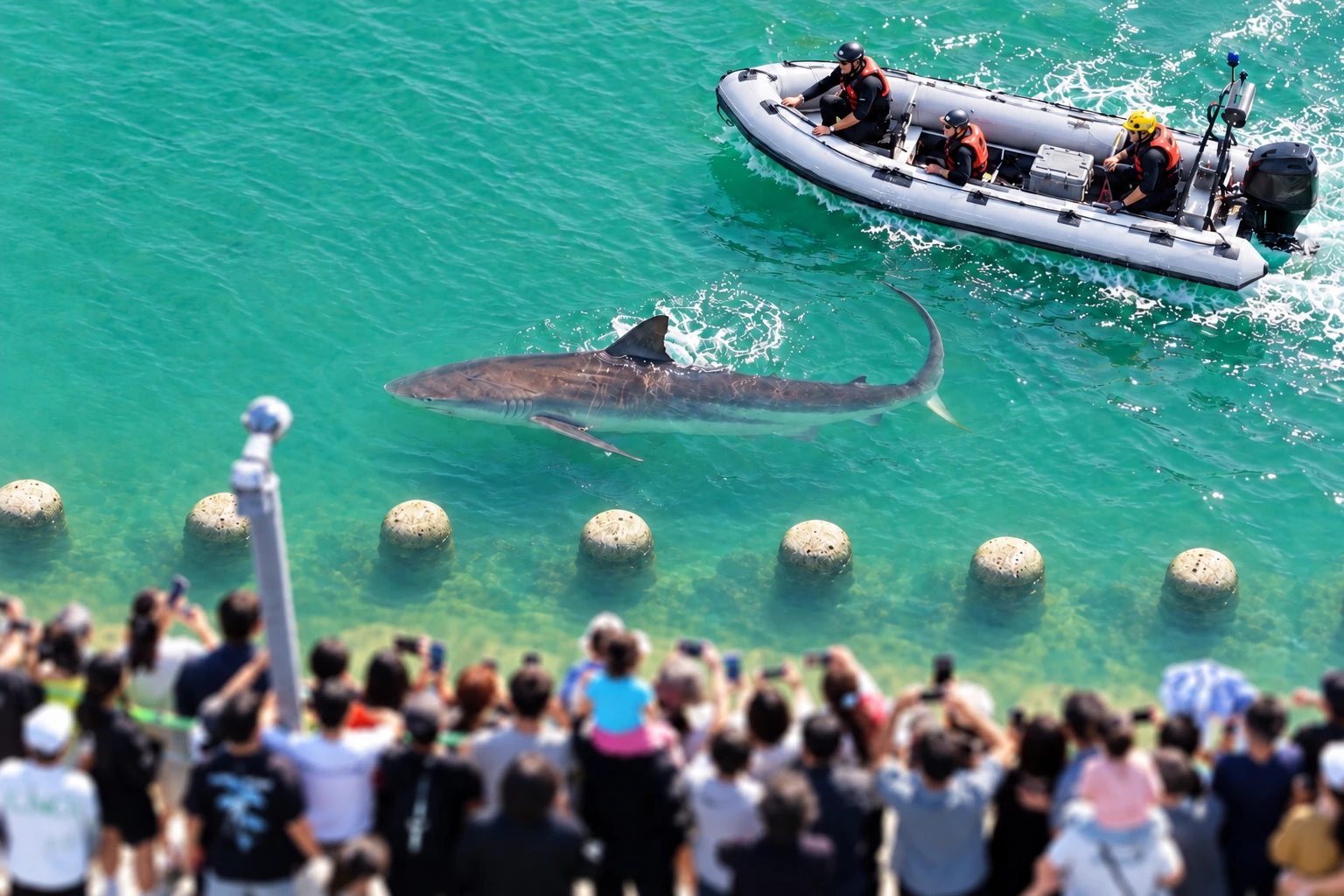
Image note: The hero image is an edited editorial illustration supplied to PRESDA. It depicts a shark, waterfront spectators and a white rescue boat; it is not presented as an authenticated photograph of the rescue operation.
FAQ
Frequently Asked Questions
What is Bukang-i?
Bukang-i is the nickname of an approximately 3.5-metre shark first spotted in Busan’s North Port canal on September 18, 2026. Experts cited by Reuters believe it could be a bronze whaler.
How many people visited to see the Busan shark?
Yonhap reported more than 600,000 visits by September 28 and over 800,000 cumulative park visits in its October 3 evening update. These are cumulative visitor figures, not verified unique individuals.
Has Bukang-i been rescued?
The latest verified update reviewed for publication, from October 3, did not confirm a return to open sea. A September 29 boat operation and an October 2 net operation failed to complete the rescue.
Why was the net removed?
After Bukang-i crossed the barrier back into the canal on October 3, authorities removed the net to keep the route to the sea open and continued monitoring the shark.
PRESDA Dispatch
Stay Informed. Stay Aware.
A sharp briefing across AI, gaming, sport, business, world affairs, paparazzi, and lifestyle.