TRUMP, XI AND PUTIN HOLD HISTORIC THREE-WAY SUMMIT IN CHINA
Trump, Xi and Putin meet in China on November 19. The confirmed summit, its APEC setting and the distinction between talks and agreed outcomes.
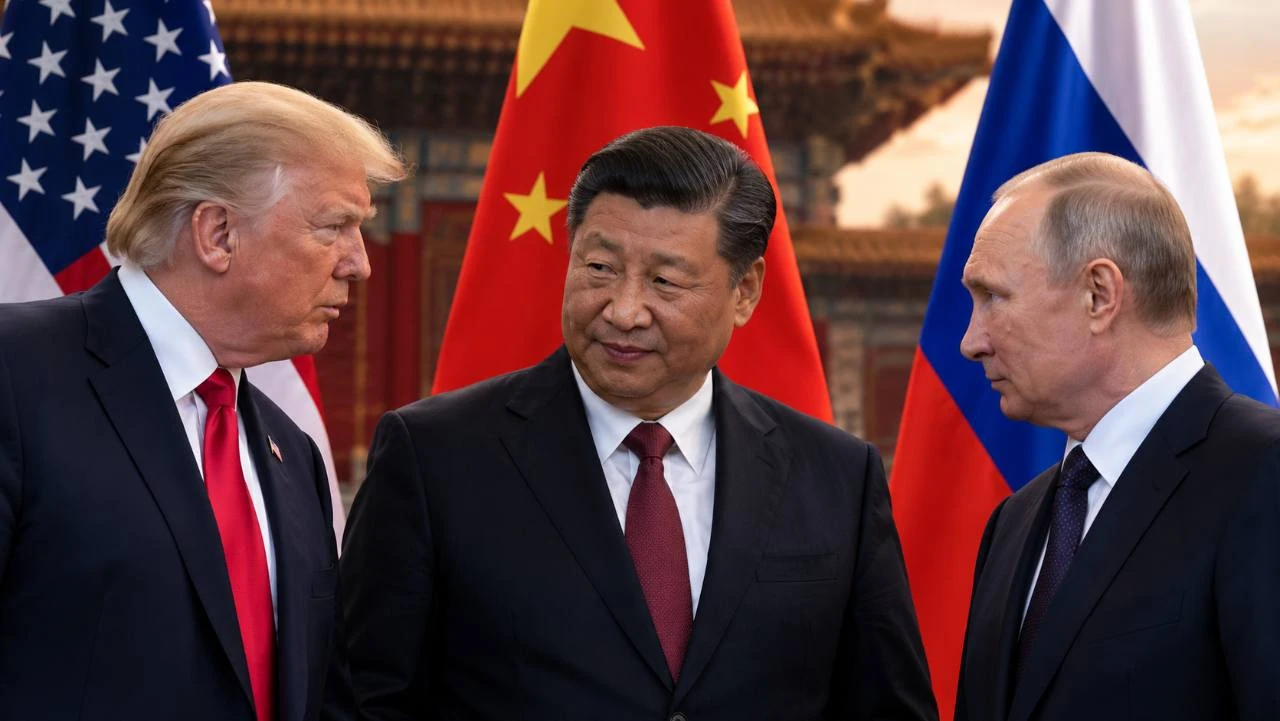
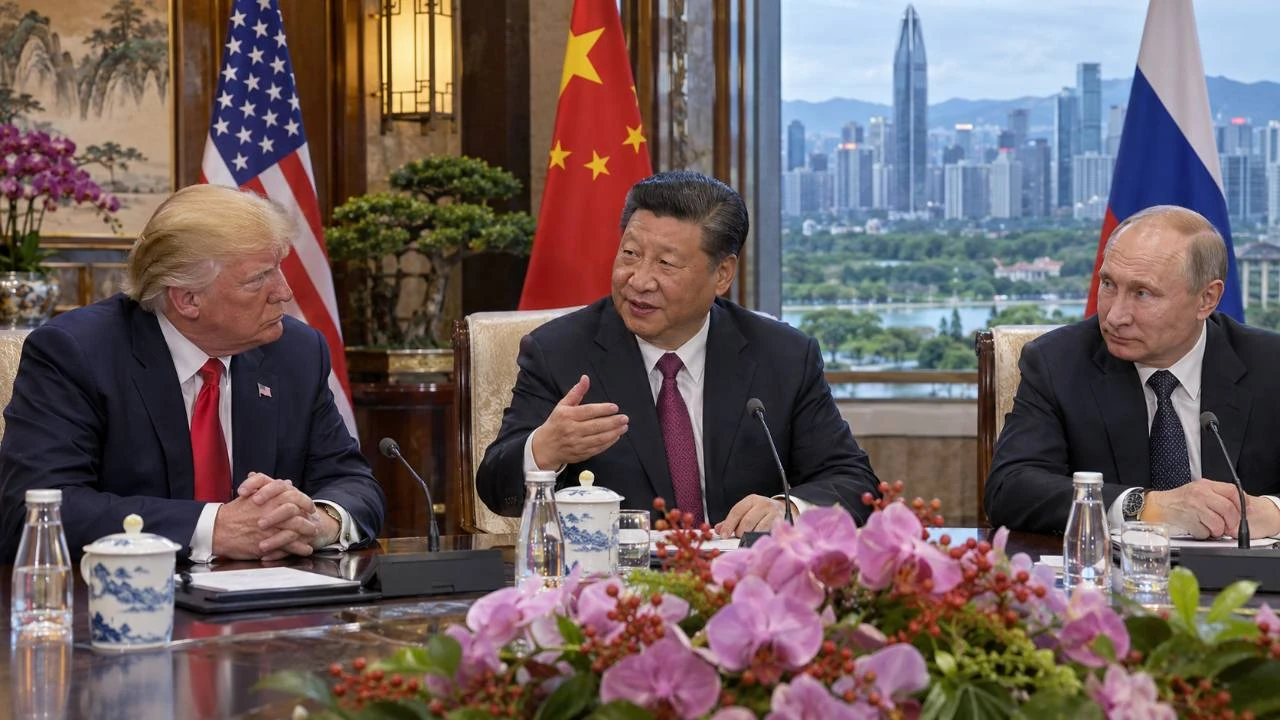
Supplied editorial illustration. Not verified as a photograph of the November 19 summit.
Donald Trump, Xi Jinping and Vladimir Putin met in Shenzhen on November 19, 2026, bringing the leaders of the United States, China and Russia into the same room during the APEC gathering. The Associated Press reported that the three-way talks had begun, following China’s official announcement of the meeting on November 16. The encounter is a diplomatic milestone, not evidence by itself that the three governments have settled their disputes. AP: live reporting of the November 19 three-way meeting China foreign ministry: official three-way summit announcement Chinese government portal: November 19 confirmation of the summit
The image of the three presidents together carries obvious weight. Their countries shape international security, trade and the strategic choices of many other states. But the substance of a summit lies in what the participants agree, how precisely they define it and whether they follow through. A historic meeting and a historic agreement are different news events.
| Date | Verified development |
|---|---|
| November 13, 2026 | China announced Xi’s APEC participation and related meetings. |
| November 16, 2026 | China announced the November 19 three-way summit. |
| November 18–19, 2026 | APEC leaders’ meeting scheduled in Shenzhen. |
| November 19, 2026 | AP reported Trump, Xi and Putin had met. |
What is confirmed about the meeting?
China’s foreign ministry announced that Xi would hold a China-Russia-US summit with Putin and Trump in Shenzhen on November 19. The announcement identified the participants, place and date, without publishing a negotiated agenda or a package of agreed outcomes. It therefore provides a primary source for the planned format, rather than proof of a settlement. China foreign ministry: official three-way summit announcement
AP’s live reporting subsequently confirmed that the leaders had met and described nuclear arms control and the wars in Ukraine and Iran among the subjects Trump wanted to address. Those reported ambitions must remain distinct from verified commitments by all three governments. This article does not report a new arms treaty or ceasefire agreement. AP: live reporting of the November 19 three-way meeting
Why Shenzhen matters
The talks took place alongside a broader Asia-Pacific gathering, not in isolation. APEC brings together 21 member economies and focuses on economic cooperation. Its 2026 leaders’ meeting was scheduled for November 18–19 in Shenzhen, creating opportunities for bilateral and smaller-format discussions alongside the collective programme. APEC: 2026 leaders’ week and 21-economy context
The setting allows different diplomatic tracks to overlap. A leader can attend an economic forum, meet another president separately and then join a three-way discussion. Those events do not automatically share an agenda or produce a single joint outcome. Reports should identify which format supports each claim.
The summit and APEC are not the same institution
APEC’s regional agenda includes trade, connectivity and economic cooperation. A three-president meeting on its sidelines is a separate diplomatic format. An APEC statement represents a wider process among member economies; it should not be described as an agreement negotiated only by Trump, Xi and Putin. APEC: 2026 leaders’ week and 21-economy context
China’s foreign ministry also published an account of a separate Xi-Trump meeting on November 19. That readout described Beijing’s presentation of the bilateral relationship and the importance of implementing leaders’ understandings. It is evidence of China’s official account of that meeting, rather than an independently verified description of every private exchange. China foreign ministry: separate Xi-Trump bilateral readout
For readers, the practical lesson is to keep the documents separate. A bilateral readout may explain one relationship, a trilateral statement may describe shared positions and an APEC declaration may address regional priorities. Similar language about stability or cooperation does not make the texts interchangeable.
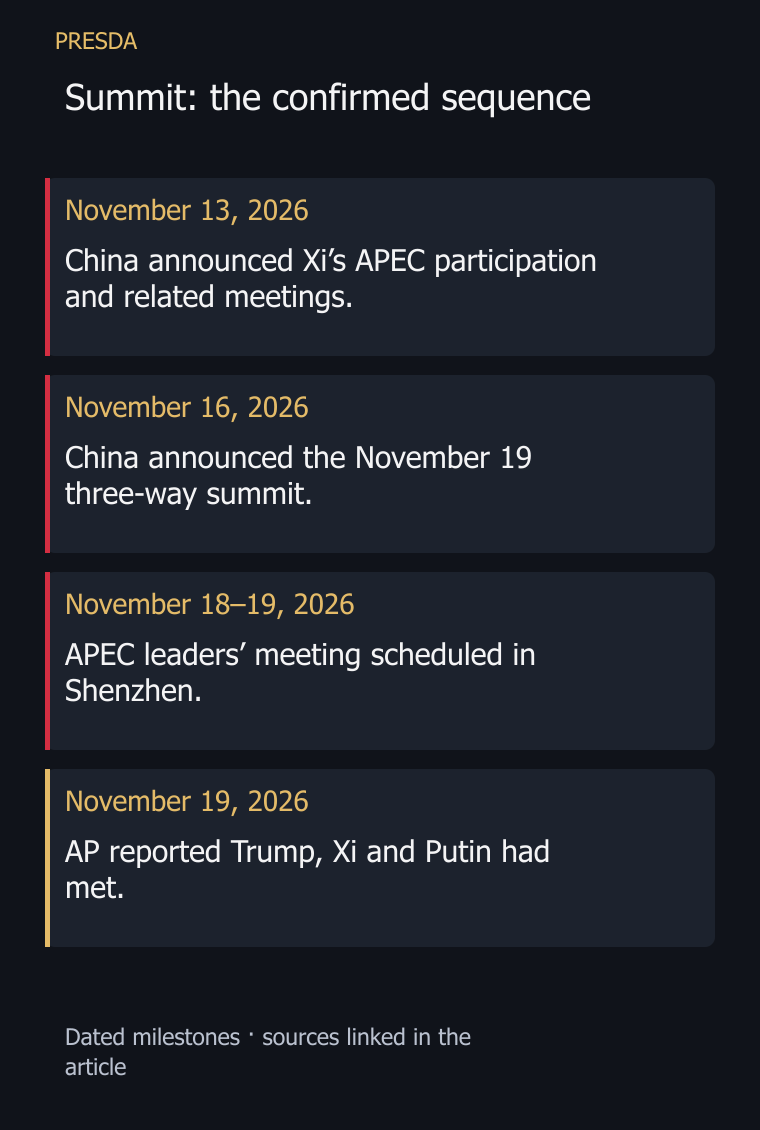
PRESDA timeline distinguishing the summit announcement, APEC’s scheduled gathering and AP’s report of the three leaders’ meeting. It does not depict an agreed treaty or settlement.
Why the three-way format draws attention
Diplomacy often proceeds through pairs: Washington and Beijing, Washington and Moscow, or Beijing and Moscow. Bringing all three leaders together creates a chance to hear positions directly within the same conversation. It can reduce the distance between public messages and the explanations delivered face to face.
It can also expose differences. Sharing a table does not erase competing interests, alliances or disagreements about security. A useful assessment asks whether the meeting establishes a workable process, clarifies a position or produces a specific commitment. The absence of a sweeping agreement would not make the act of communication meaningless.
PRESDA’s earlier report on the planned Shenzhen talks covered the preparatory stage. The development now is the meeting itself. The change in tense matters: expectations announced before an event should not be recycled afterwards as though they were the event’s conclusions.
Nuclear diplomacy: process before promises
Arms-control discussions are particularly vulnerable to oversized headlines. A proposal to talk is not a negotiated treaty. A political assurance is not the same as an agreed verification mechanism. Even a signed text needs scrutiny of its scope, obligations, timetable and the steps required for implementation.
In a three-way setting, readers should ask which countries would be covered and what kinds of weapons or activities any proposal concerns. Without those details, a broad statement about reducing danger is a diplomatic signal, not a measurable disarmament programme. This report does not infer new limits or inspection arrangements that have not been published.
What would count as a concrete development?
A named follow-up meeting, an agreed negotiating mandate or a published joint text would each be more specific than a general expression of goodwill. They would still need to be assessed on their own terms. The question is not whether a statement sounds ambitious, but whether it identifies an action that can later be checked.
The same discipline applies to claims about conflicts. Discussion of a war does not establish agreement among the people and governments directly affected by it. A summit involving three powerful states cannot, through a photograph alone, demonstrate that fighting has stopped or that a political settlement has been accepted.
Trade, technology and the economic backdrop
APEC’s preparatory work highlighted trade, artificial intelligence, supply-chain resilience and economic uncertainty. Those issues explain why the wider gathering matters to businesses and households, beyond the personal relationships between leaders. Changes in policy can affect investment decisions, production networks and the costs of moving goods across borders. APEC: trade, AI and economic cooperation before leaders’ week
The overlap with security makes careful attribution essential. A discussion about economic cooperation does not prove the removal of a tariff or export restriction. Such changes require a relevant official measure and an effective date. A commercial announcement should also be distinguished from a binding government policy.
Readers can explore the technological dimension in PRESDA’s account of the US-China AI competition. That context helps explain why strategic stability and economic competition can coexist in the same relationship, without assuming that this meeting has resolved either issue.
How to read the next announcements
The strongest follow-up reporting will compare the participating governments’ published accounts, identify points of convergence and note what remains unstated. Differences between readouts can be informative. One government’s emphasis on an issue does not necessarily establish that the other two adopted its interpretation.
Dates are equally important. An announcement before November 19 establishes an intention; a report from the room establishes that an encounter happened; a later joint document may establish an outcome. Those stages should remain visible in an account of a fast-moving diplomatic event.
As checked on November 19, the confirmed significance is the three leaders’ meeting in Shenzhen. It creates an opportunity for direct diplomacy at a moment of substantial international concern. Whether it becomes a turning point will depend on specific decisions and implementation, rather than the historic weight of the photograph alone.
FAQ
Frequently Asked Questions
Did Trump, Xi and Putin meet in China?
Yes. AP reported their meeting in Shenzhen on November 19, following China’s official announcement of the date and participants.
Was this the same as the full APEC summit?
No. It was a three-way meeting alongside a wider gathering of 21 APEC member economies.
Did they announce a new nuclear treaty?
This report does not establish a new treaty. Reported discussion of arms control must be distinguished from negotiated obligations and verification arrangements.
Does the meeting prove agreement on Ukraine or Iran?
No. Discussing a conflict does not establish a ceasefire or an accepted settlement. Specific outcomes need their own published evidence.
What should readers watch next?
Official readouts, any joint text, named follow-up talks and concrete implementation measures will provide stronger evidence of results than broad statements of goodwill.
PRESDA Dispatch
Stay Informed. Stay Aware.
A sharp briefing across AI, gaming, sport, business, world affairs, paparazzi, and lifestyle.