
TURKEY'S TOP COURT STRIKES DOWN 96-YEAR-OLD PROSTITUTION LAW
Turkey’s Constitutional Court annuls a 1930 provision underpinning state-supervised prostitution. What changed, when it took effect and what it does not ban.
Editorial illustration supplied for PRESDA.
Turkey’s Constitutional Court has annulled a 1930 provision underpinning the state-supervised prostitution system. The judgment, published on November 17, 2026, concerns Article 128 of the Public Health Law. It is a major constitutional intervention in the legal framework for prostitution, but it is not a ruling that makes every instance of prostitution a new criminal offence. Constitutional Court: Article 128 annulment, November 17, 2026 Official Gazette: E.2025/144, K.2026/164, published November 17, 2026
That distinction matters for anyone trying to understand the headline. A court can remove the statutory basis for an administrative system without writing a replacement criminal code. The practical questions now concern the remaining law, the response of public authorities and the protection of people whose lives and livelihoods are affected.
| Date | What happened |
|---|---|
| April 24, 1930 | Public Health Law 1593 dates from this day. |
| July 16, 2026 | The Constitutional Court decided E.2025/144, K.2026/164. |
| November 17, 2026 | Publication in Official Gazette 33433; no deferred commencement. |
| November 19, 2026 | PRESDA verified the decision and its constitutional context. |
What exactly did the court strike down?
The Constitutional Court decided case E.2025/144, K.2026/164 on July 16, 2026. It found the first sentence of Article 128’s first paragraph unconstitutional. The second sentence was also annulled because it could no longer operate after the first was removed. This was not the annulment of the entire Public Health Law. Official Gazette: E.2025/144, K.2026/164, published November 17, 2026
The first sentence empowered the health and interior ministries to set rules, through a joint regulation, governing women engaged in prostitution and brothels, including measures intended to prevent the spread of communicable diseases. Its terminology reflected the administrative and gender assumptions of an earlier period. The law dates from April 24, 1930, which explains the reference to a 96-year-old provision. Constitutional Court: Article 128 annulment, November 17, 2026
Why two dates appear in the news
July 16 is the date of the court’s decision. November 17 is its publication date in the Official Gazette, issue 33433. Under Article 153 of the Constitution, an annulled provision ceases to have effect upon Gazette publication unless the court specifies a later date. This judgment contains no deferred commencement in its operative order, making November 17 the relevant date of effect. Official Gazette: E.2025/144, K.2026/164, published November 17, 2026 Constitutional Court: Constitution of the Republic of Türkiye
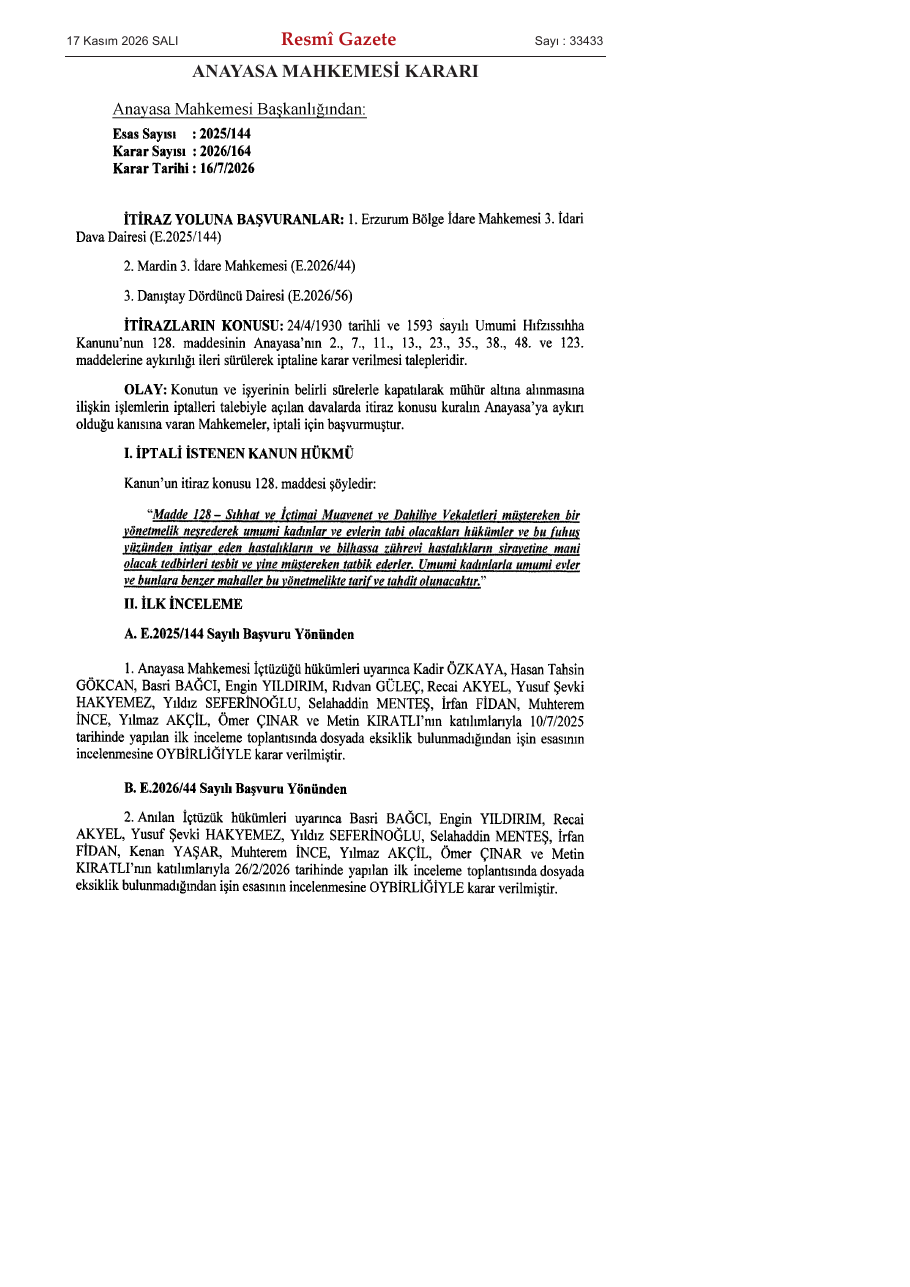
First page of judgment E.2025/144, K.2026/164, published in Türkiye’s Official Gazette on November 17, 2026. This is a reproduced legal document, separate from the supplied hero illustration.
Constitutional Court of Türkiye / Official Gazette, November 17, 2026
The Constitution also states that annulment decisions do not operate retrospectively. Readers should therefore avoid assuming that every earlier administrative decision has automatically disappeared. The consequences for a particular case require analysis of that case and the applicable law, rather than a conclusion drawn from a headline alone. Constitutional Court: Constitution of the Republic of Türkiye
How the case reached the court
The case arose through constitutional referrals in administrative litigation. The referring bodies were Erzurum Regional Administrative Court’s Third Administrative Litigation Chamber, Mardin Third Administrative Court and the Council of State’s Fourth Chamber. The underlying disputes concerned administrative measures involving the temporary closure and sealing of premises. Official Gazette: E.2025/144, K.2026/164, published November 17, 2026
The objections challenged the breadth of the delegation to the executive. They argued that the statute did not adequately define the people and premises covered, the limits of administrative power or the measures that could be imposed. That procedural background helps explain why this is a constitutional review of a statutory provision, rather than a criminal prosecution of an individual.
The reasoning: dignity and the state’s protective duties
The court examined the rule under Articles 5 and 17 of the Constitution. These concern the state’s fundamental duties and the protection and development of a person’s physical and spiritual existence. Its reasoning placed human dignity and the state’s positive protective obligations at the centre of the analysis. Constitutional Court: Article 128 annulment, November 17, 2026 Constitutional Court: Constitution of the Republic of Türkiye
In the court’s view, placing prostitution within a legal framework of state supervision, even for public health and safety purposes, did not make it compatible with human dignity. It argued that the state should address structural circumstances pushing people into prostitution and combat the people and organisations acting as intermediaries. These are the court’s findings and constitutional reasoning, not newly enacted criminal offences. Constitutional Court: Article 128 annulment, November 17, 2026
The unanimous result removed the statutory provision and its dependent sentence. It did not supply a detailed replacement system covering housing, income support, access to healthcare or administrative transition. Those questions are important precisely because the people affected do not cease to need protection when a legal provision is annulled.
What the judgment does not establish
The ruling should not be described as a complete new ban on prostitution. It does not itself create a new offence, prescribe a new punishment or announce that every person selling sexual services can now be prosecuted for doing so. The constitutional principle that offences and penalties require a legal basis is separate from the annulment of an administrative framework. Constitutional Court: Constitution of the Republic of Türkiye
Nor should it be presented as a comprehensive legalisation or deregulation. Removing one statutory foundation does not erase every other criminal, administrative or public health rule that may apply. The legality of a particular activity, premises or official action cannot be decided simply by treating Article 128 as the whole legal system.
Why existing rules and future action must be distinguished
An administrative regulation, a statute and a constitutional judgment are different legal instruments. The judgment changes the status of the provision it identifies. Any claim about a new nationwide enforcement policy, replacement licensing system or additional criminal liability needs its own legal source. The decision alone is insufficient evidence for those further claims.
This also limits what can responsibly be predicted. It is reasonable to expect attention to implementation and legislative choices. It is not responsible to announce an unverified closure timetable, automatic compensation scheme or new police power. PRESDA’s account separates the judgment’s operative effect from questions that will depend on subsequent official action.
Public health and rights remain part of the story
The old provision’s disease-control purpose explains part of its historical setting. But constitutional arguments about dignity and contemporary public health policy are different questions. Access to confidential, non-discriminatory care remains important to people affected by prostitution, whatever terminology a legal system uses. Stigma must not be mistaken for a health intervention.
UNFPA’s published work in Türkiye has included sexual health training with sex workers and organisations working with them. That dated programme provides useful context for the distinction between a legal framework and practical access to information and services; it does not establish that the same activities or arrangements are operating today. UNFPA Türkiye: dated sexual health training programme
The wider questions overlap with the history of women’s rights: who has access to protection, how economic constraints shape choices and how the state exercises power over people’s bodies. A careful news account should keep those human questions visible without assigning the same experience or motives to everyone affected.
What to watch next
The next reliable developments will be official legislative texts, published administrative measures and court decisions clarifying implementation. Readers should check their dates and scope. A ministry statement is not interchangeable with a new law, and a commentary about likely consequences is not evidence that those consequences have already occurred.
This report was checked on November 19, 2026 against the court’s announcement, the published judgment and the Constitution. The clearest conclusion is also the most precise: a 1930 statutory basis for state-supervised prostitution has been annulled. The judgment’s significance is substantial without turning it into a claim that the court has written a blanket criminal ban.
FAQ
Frequently Asked Questions
Did Turkey’s court completely ban prostitution?
No. It annulled Article 128’s first sentence and its dependent second sentence. The judgment does not itself enact a blanket criminal offence covering all prostitution.
Why is it described as a 96-year-old law?
The Public Health Law dates from April 24, 1930. The 2026 judgment concerns a provision within that law, not the whole statute.
When did the annulment take effect?
The judgment was published on November 17, 2026. Its operative order contains no postponement; Article 153 makes publication the relevant date in that situation.
Why did the court annul the provision?
It found the state-supervised framework incompatible with the protective obligations arising under Articles 5 and 17, reasoning in terms of human dignity.
Does the judgment settle every individual case?
No. Earlier actions, remaining rules and any subsequent measures require separate examination. This report explains the judgment and is not individual legal advice.
PRESDA Dispatch
Stay Informed. Stay Aware.
A sharp briefing across AI, gaming, sport, business, world affairs, paparazzi, and lifestyle.