FEMINISM: THE MOVEMENT THAT REDEFINED WOMEN'S RIGHTS
From Wollstonecraft and suffrage to African and Arab movements, intersectionality and #MeToo: the history, achievements and disagreements of feminism.
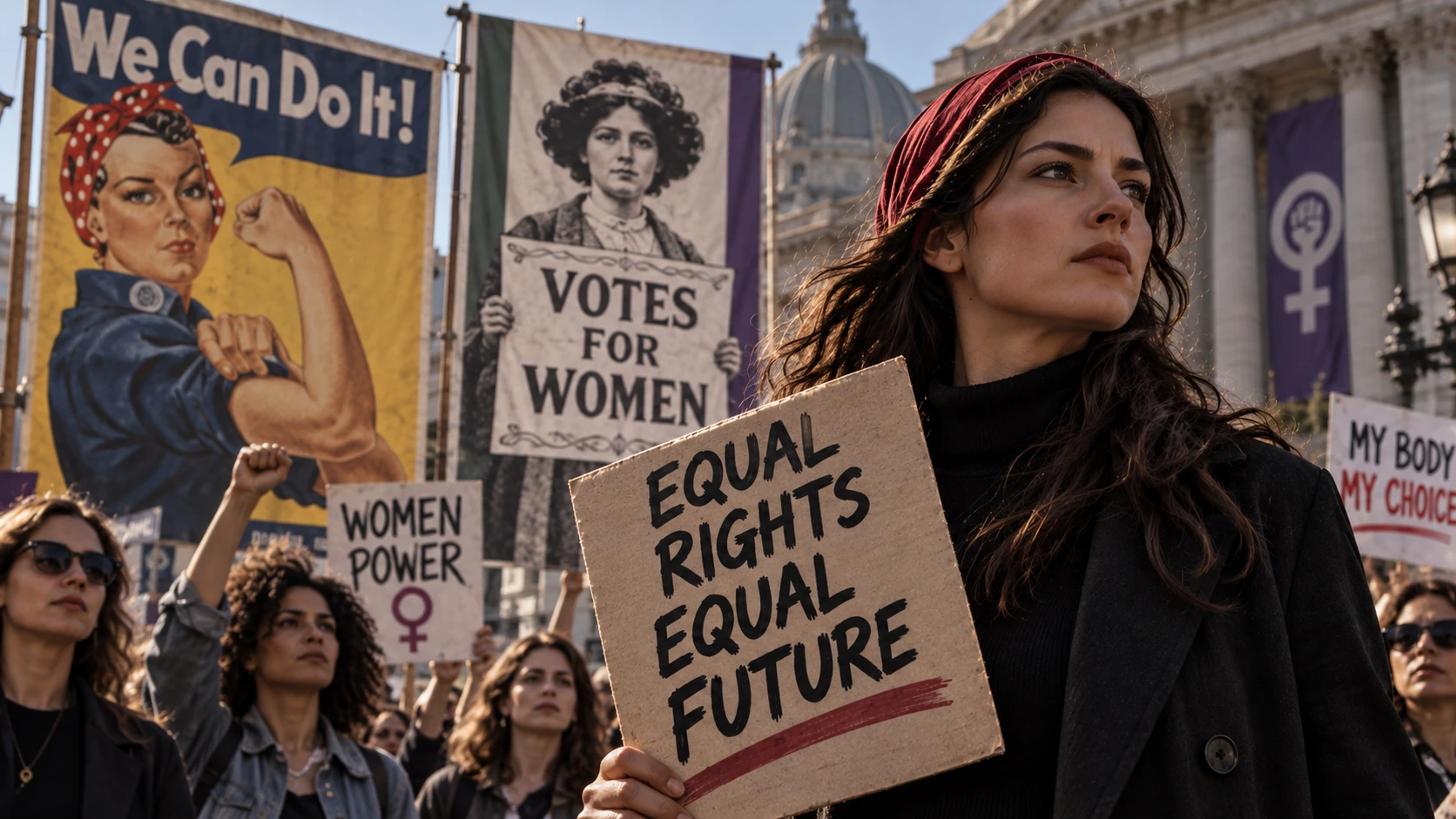
AI-generated editorial illustration combining imagined demonstrators and historical references. It is not a documentary photograph, an authentic historical event or a verified portrait of a named activist.
The promise was universal. Its application was not. As European revolutionaries debated the rights of humanity, women confronted a question that would outlive those revolutions: who counted as a person entitled to independence, education and a political voice? Feminism developed around that contradiction, turning arrangements described as natural or private into subjects of public argument.
Today, the word evokes a suffrage banner, an argument about childcare, a legal brief or a hashtag. Feminism broadly concerns women's equality and sex and gender hierarchies, but it has no single agreed programme. Its traditions dispute what equality requires, how change happens and whose experiences have been overlooked. This feature examines that history and evidence available in October 2026.
Before the movement had a familiar name
Mary Wollstonecraft's A Vindication of the Rights of Woman appeared in 1792. Education was central: women's apparent limitations could reflect opportunities denied them rather than an inability to reason. Her intervention connected dependence to institutions and upbringing. She did not anticipate every position now called feminist; she was also a thinker of her time. Stanford: Wollstonecraft
In France, Olympe de Gouges's 1791 Declaration of the Rights of Woman and of the Female Citizen exposed exclusions within revolutionary citizenship. Earlier women had already challenged authority and organised. These texts were landmarks, not the beginning of women's agency. A history of feminism must distinguish the development of a label from the longer history of struggles it helps describe. Women’s History Museum
The ballot was a beginning, not a complete settlement
The 1848 Seneca Falls convention brought Elizabeth Cady Stanton, Lucretia Mott and others into a campaign for legal, economic and political rights. The Declaration of Sentiments adapted the language of American independence to women's exclusion. Suffrage offered a practical means of influencing law. Yet alliances with abolition did not eliminate racism within the movement, and famous leaders should not obscure other organisers. NPS: Stanton and suffrage
In Britain, Emmeline Pankhurst helped establish the Women's Social and Political Union in 1903. Militant suffragettes and constitutional suffragists differed over tactics, and arrests and hunger strikes became part of the struggle. The 1918 franchise reform enfranchised women aged 30 and over meeting specified qualifications, not all adult women. Equal voting terms with men followed in 1928. Reducing this history to one heroic individual or wartime gratitude misses decades of organisation and political conflict. Parliament: Pankhurst UK Parliament
New Zealand's 1893 reform made it the first self-governing country to enfranchise women for parliamentary elections. The US Nineteenth Amendment was ratified on 18 August 1920, prohibiting denial of the vote on grounds of sex. Racial discrimination and other barriers continued. France recognised women's voting and electoral eligibility in its ordinance of 21 April 1944. These are different legal milestones, not dates when every woman in each society acquired equal power. New Zealand history US National Archives French National Assembly
Education, work and the limits of formal permission
Beyond polling stations, access to education, professions, earnings and property affected everyday independence. Changes differed by country, class and legal system. Women's employment long predated feminist movements: agricultural workers, traders, servants and factory workers were already working while arguments about respectable women's employment marginalised their experience.
One US milestone was Title IX of the Education Amendments, signed in 1972, prohibiting sex discrimination in federally funded education programmes. Legal and practical access still differ. Costs, safety, care responsibilities and enforcement shape who studies or advances at work. No single movement explains educational expansion; economics, investment and wider political coalitions also mattered. US Education Department
Four waves, with a warning about the metaphor
The first wave usually refers to nineteenth- and early twentieth-century campaigns in Europe and North America, particularly for suffrage and legal rights. The second, associated with the 1960s and 1970s, widened attention to work, sexuality, reproduction and domestic power. Simone de Beauvoir's The Second Sex, published in 1949, was an important intellectual precursor, examining how women were positioned as the Other and how social circumstances shaped their possibilities. Stanford: Beauvoir
The third-wave label, commonly associated with the 1990s, foregrounded differences among women, sexuality and challenges to a supposedly universal female experience. Black feminist writers, including bell hooks and Audre Lorde, had already contested exclusions in mainstream movements. The fourth-wave label often describes digitally connected activism from the 2010s, especially campaigns against harassment and violence. None of these categories has a universally agreed start or end, and overlapping generations continued to work together. Feminist political philosophy
The National Women's History Museum cautions that the wave metaphor compresses a more complicated history. It can make ongoing organising seem to disappear between celebrated surges, while projecting a US or European chronology onto other societies. A market women's campaign in Nigeria or a debate over family law in Egypt is not best understood simply by assigning it a Western wave number. The metaphor is an orientation tool, not a global timetable. Women’s History Museum
The arguments inside feminism
Liberal feminism emphasises equal legal standing, opportunity and autonomy, often through institutional reform. Radical feminism examines structures of patriarchal power, including sexuality and domestic relations. Radical here means addressing roots, not violence. Each tradition contains disagreements; reform and structural criticism can inform the same campaign. Neither is reducible to career ambition or hostility toward men. Feminist political philosophy
Socialist and Marxist feminisms connect gender with class, labour and economic organisation, asking who performs unpaid care and insecure work. They argue that a woman entering a boardroom does not automatically improve a domestic worker's life. Critics question whether economic explanations adequately account for sexuality, religion and agency. These are disagreements over explanation and strategy. Feminism, class and work
Intersectionality, developed by legal scholar Kimberlé Crenshaw in her 1989 work, examines how forms of disadvantage intersect. Her critique showed how analysing race and sex separately could miss discrimination affecting Black women. It is not merely a list of identities or a competition over suffering. Applied carefully, it asks whose situation a law, dataset or campaign fails to capture, and how overlapping institutions shape that exclusion. Crenshaw, 1989
A history that crosses borders without flattening them
European and American movements exchanged ideas, but their histories differed. Voting rights, workplace reform and reproductive healthcare did not arrive together or remain secure forever. Nor did every woman welcome identical reforms. Some defended family roles or protective labour rules; others feared these would preserve exclusion. This history includes negotiations, not two permanently unified camps.
In Nigeria, Funmilayo Ransome-Kuti and the Abeokuta Women's Union connected women's organisation with economic rights and opposition to colonial rule. In South Africa, women marched against apartheid pass laws in Pretoria on 9 August 1956. South African History Online records turnout estimates ranging from 10,000 to 20,000. These histories show why gender cannot be detached from colonial administration, racial hierarchy or the livelihoods of working women. They do not stand for every African movement. UNESCO: Ransome-Kuti South African History Online
In Egypt, Huda Sha'arawi founded the Egyptian Feminist Union in 1923. UNDP's historical account connects women's organising with nationalism, political participation and reform. Across the Arab world, activists have approached education, employment and family law through secular, religious and other frameworks. Countries and communities differ substantially. Religion cannot be treated as a single explanation, and women's autonomy cannot be read from clothing alone. Taking regional history seriously means recognising local disagreements and agency rather than presenting women as passive recipients of imported liberation. UNDP: Arab historical context
Transnational and decolonial scholarship questions whose priorities travel under universal rights. Campaigns can challenge inequality while reproducing class or colonial hierarchies. Conversely, cultural difference does not settle whether a practice is freely chosen or coercive. The argument requires specific institutions and voices, not a contest where one civilisation represents freedom and another its absence. Feminist political philosophy
What changed, and what the numbers actually measure
International agreements made equality an explicit subject of state accountability. The Convention on the Elimination of All Forms of Discrimination against Women was adopted in 1979. In 1995, 189 countries adopted the Beijing Declaration and Platform for Action. A treaty and a policy platform are different instruments; neither guarantees implementation. Their importance includes giving advocates and institutions standards against which to evaluate law, budgets and practice. UN legal history: CEDAW UN: Beijing 1995
The Gender Snapshot 2026, produced by UN Women and UN DESA and released in September, reports that women held 27.4% of seats in national parliaments' single or lower chambers as of January 2026, compared with 22.3% in 2015. The denominator matters: this is parliamentary representation, not a measure of all political authority or the proportion of women who identify as feminists. It documents progress and a remaining gap, not a causal estimate of feminism's effect. UN Gender Snapshot 2026
The same report puts women's share of managerial positions at 30.5% in 2025. It also reports that, by 2023, women and girls globally spent an average 2.5 times as many hours on unpaid domestic and care work as men. These indicators have different reference years. A global average does not describe each household, and a management share is not an equal-pay statistic. Care provision, employment structures and legal enforcement complicate the distance between a formal right and its exercise. UN Gender Snapshot 2026
#MeToo changed visibility, not the rules of evidence
Tarana Burke founded the me too. movement in 2006; the hashtag became globally prominent in 2017. Its official history emphasises support for survivors, including communities overlooked by celebrity coverage. Digital communication lowered barriers to finding others with similar experiences and brought harassment into public discussion. But a viral moment should not erase earlier organising or equate the number of posts with a representative prevalence survey. me too.: official history
The debates exposed difficult questions about institutions: whose complaints receive attention, what safeguards protect people reporting harm, and how allegations are investigated fairly. Public testimony can reveal patterns that organisations neglected, while an accusation is not itself a judicial finding. Privacy, proportionality and due process are compatible with taking complaints seriously. Social-media visibility cannot replace reliable reporting, independent investigation or procedures that protect both complainants and the rights of the accused.
Criticism and disagreement deserve precise descriptions
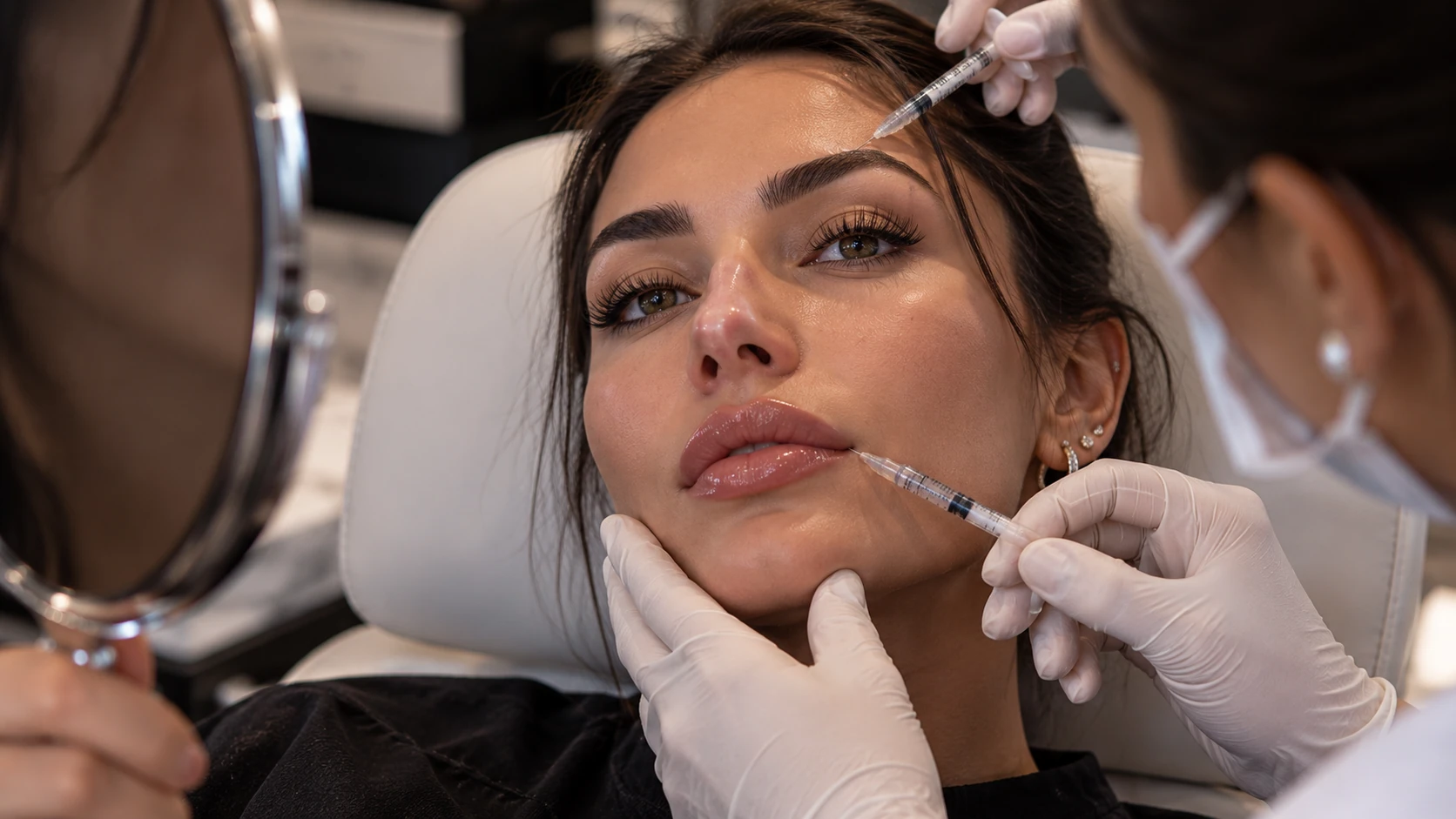
Disputes over sex work and pornography illustrate divisions inside feminism. Some approaches emphasise exploitation and unequal bargaining power; others stress workers' agency, safety and the harms of criminalisation. Neither set of concerns resolves every case. A serious comparison asks how a particular policy affects coercion, livelihoods and protection rather than assuming all participants share one experience. Similar tensions appear between personal choice and the commercial pressures surrounding beauty. Feminist philosophy of law PRESDA’s beauty investigation
Questions about sex, gender identity and inclusion also generate disagreement. Some feminists emphasise sex-based analysis and protections; trans-inclusive approaches emphasise how exclusion and gender norms affect transgender people. An academic debate about categories should not be turned into unsupported claims that a whole group is dangerous. Policies require context-specific evidence and clarity about their aims. Feminist philosophy itself contains competing accounts of what gender is and how collective rights should be framed. Sex and gender debates
Other critics question quotas, universal prescriptions or rhetoric treating men as a homogeneous adversary. Defenders argue that apparently neutral rules can preserve accumulated disadvantage. Traditionalists may prioritise family or religious obligations; feminists debate their compatibility with autonomy. Fair reporting does not make every factual claim equally supported. Assertions about discrimination or policy outcomes still require evidence. Feminist political philosophy
A revolution in ordinary relationships
Feminist debates changed questions about homes and workplaces: whose ambitions count, who provides care and whether relationships permit consent. Their influence is not reducible to women becoming like men. Some approaches challenge narrow masculinity and men's distance from caregiving. No family arrangement proves equality by itself; choice, resources, respect and freedom from coercion matter.
Commercial culture can absorb the language of empowerment while leaving institutions untouched. A campaign advertising confidence is not automatically evidence of better pay or working conditions. Our investigations of brand psychology and shopping psychology examine identity, marketing and the limits of gender stereotypes. Feminism makes those questions visible, but different feminists will disagree about whether a particular purchase expresses agency, reflects pressure or involves both.
A concise chronology of turning points
1791 and 1792: de Gouges and Wollstonecraft challenged exclusions in rights and education. 1848: Seneca Falls put a programme of women's rights before a convention. 1893: New Zealand enfranchised women for parliamentary elections. These milestones show texts becoming organisation and legal change; they are selected landmarks, not a claim that activism began or ended at those moments. Women’s History Museum Stanford: Wollstonecraft NPS: Stanton and suffrage New Zealand history
1903: the WSPU was established. 1918 and 1928: Britain's restricted franchise became equal voting terms. 1920: US amendment ratification. 1923: Egyptian Feminist Union. 1949: The Second Sex. 1979: CEDAW adopted. 1989: Crenshaw's article. 1995: Beijing platform. 2006 and 2017: me too. organising preceded viral hashtag visibility. Parliament: Pankhurst UK Parliament US National Archives UNDP: Arab historical context Stanford: Beauvoir UN legal history: CEDAW Crenshaw, 1989 UN: Beijing 1995 me too.: official history
The argument did not end with a victory photograph
Feminism changed who could claim a voice and which forms of power deserved examination. Its history also exposes exclusions, contradictory priorities and gains that can be reversed. Understanding it requires neither accepting every proposal nor dismissing a diverse tradition because its members disagree. The enduring question is more concrete than allegiance to a label: how do institutions distribute opportunity, authority and responsibility, and whose life remains absent from the answer?
FAQ
Frequently Asked Questions
What is feminism?
Feminism encompasses movements and ideas concerned with women’s equality and sex or gender hierarchies. Traditions differ over causes of inequality, policy and strategy; there is no single leadership or universally agreed programme.
What are the four feminist waves?
The labels generally describe suffrage and legal rights, broader liberation campaigns, attention to diversity and identity, and digitally connected activism. Their boundaries are disputed and primarily reflect Western histories, not a worldwide timetable.
How do liberal and radical feminism differ?
Liberal approaches emphasise equal rights, autonomy and institutional reform. Radical approaches examine underlying structures of patriarchal power. Both contain internal differences, and radical does not inherently mean violent.
What does intersectionality mean?
Intersectionality examines how systems such as race and gender discrimination interact. Crenshaw’s 1989 analysis showed how treating these separately could overlook Black women’s experiences. It is an analytical approach, not simply a list of identities.
Did feminism achieve full equality?
Significant legal and social gains coexist with remaining inequalities and uneven implementation. The UN’s 2026 report records specific gaps in representation, management and unpaid care. Indicators differ by country and reference year and cannot establish one movement’s causal contribution.
PRESDA Dispatch
Stay Informed. Stay Aware.
A sharp briefing across AI, gaming, sport, business, world affairs, paparazzi, and lifestyle.