CATATUMBO LIGHTNING: THE PLACE WHERE STORMS KEEP RETURNING
Why Catatumbo lightning keeps returning to Venezuela’s Lake Maracaibo, what satellite measurements show and why it is not one endless storm.
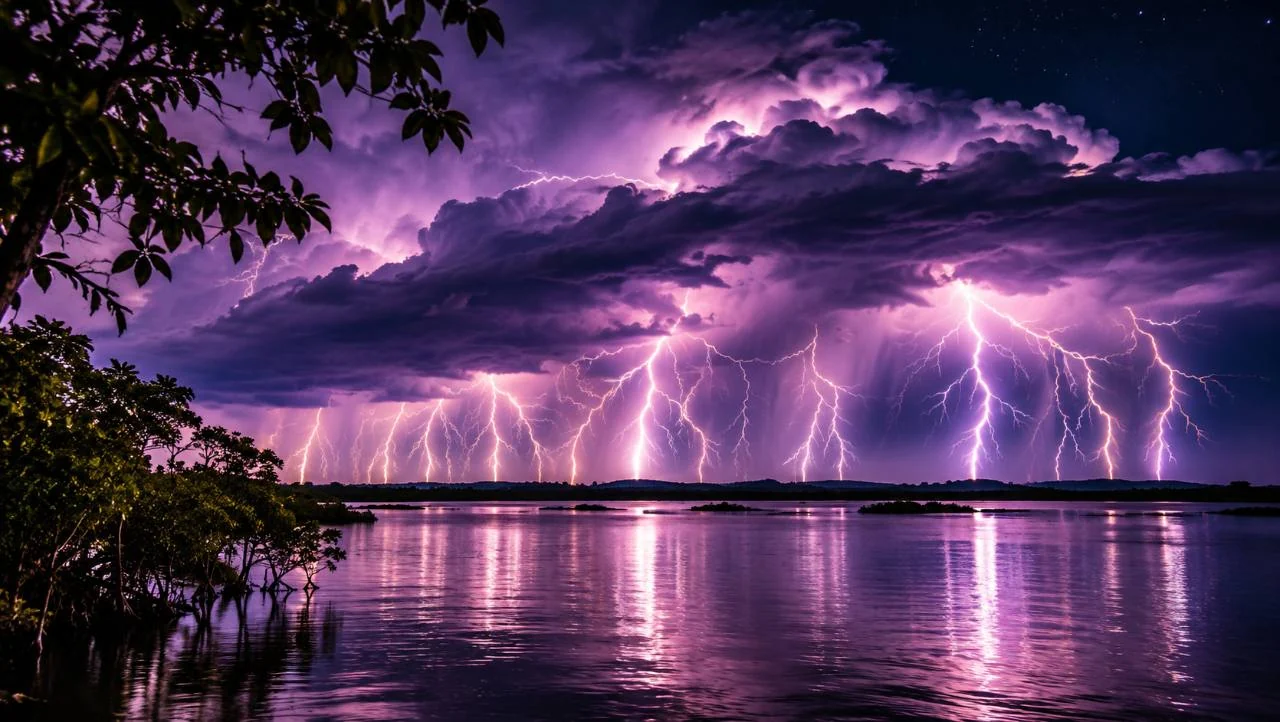
Editorial depiction, not a calibrated flash count, a live forecast or an authenticated dated observation at Catatumbo. Colour and the number of visible bolts are not scientific measurements. Editorial image supplied for PRESDA. Original creator and reuse licence not provided.
Some landscapes are known for what stays still. The Lake Maracaibo basin in northwestern Venezuela is famous for what repeatedly breaks the darkness. Catatumbo lightning names the region’s remarkable thunderstorm activity, especially around the southern lake and the Catatumbo River area. The essential point is recurrence: conditions favour new storms again and again. It is not a single storm that has remained alive for centuries.
What the famous number actually measures
NASA’s account of a 2016 study reports a hotspot averaging about 233 lightning flashes per square kilometre per year. The ranking drew on 16 years of observations from the Lightning Imaging Sensor aboard the Tropical Rainfall Measuring Mission. This is a long-term flash-density estimate for a hotspot, not a count of ground strikes on every square kilometre of the entire lake today. A flash and an individual lightning stroke are also not interchangeable units. NASA, satellite lightning hotspot study (2016)
Why the basin repeatedly builds storms
The American Meteorological Society describes a setting where coastal and mountain wind flows help trigger thunderstorms. Warm, moist air, surrounding terrain and winds changing through the day create an environment favourable to deep convection. Rising air builds storm clouds, while the wider atmosphere controls whether that local opportunity develops into a particular storm. Geography is a recurring ingredient, not an automatic switch that guarantees lightning every night. American Meteorological Society, hotspot research summary (2016)
Lightning itself belongs to thunderstorm physics. The interaction of particles inside a storm helps separate electric charge; sufficiently strong electric fields allow a discharge. Catatumbo is extraordinary because storms recur so frequently in this setting, not because its electricity follows a different set of physical laws. The spectacle is a weather system at work, with variability rather than perfect repetition. NOAA National Severe Storms Laboratory, lightning basics
New observations, and the limits of a yearly average
A 2025 study examined activity from 2014 to 2024. It found relationships between hourly lightning distributions and deep convection, and between seasonal lightning variations and mean lake-water temperature. The authors suggest that the lake supplies water vapour for developing storm systems. Correlation supports that interpretation without proving a single cause. The work also makes an important practical point: a familiar daily or seasonal pattern does not make every individual night predictable. Baissac and colleagues, JGR Atmospheres (2025)
What a spectacular image cannot tell you
A frame full of branching bolts cannot establish the flash rate, the length of the observation or whether several moments were combined. The approved hero is an editorial depiction, not a calibrated scientific record or a live forecast. Its purple palette is not a diagnostic measurement of Catatumbo lightning. Research depends on instrument coverage, detection methods and time series rather than the drama of a single image.
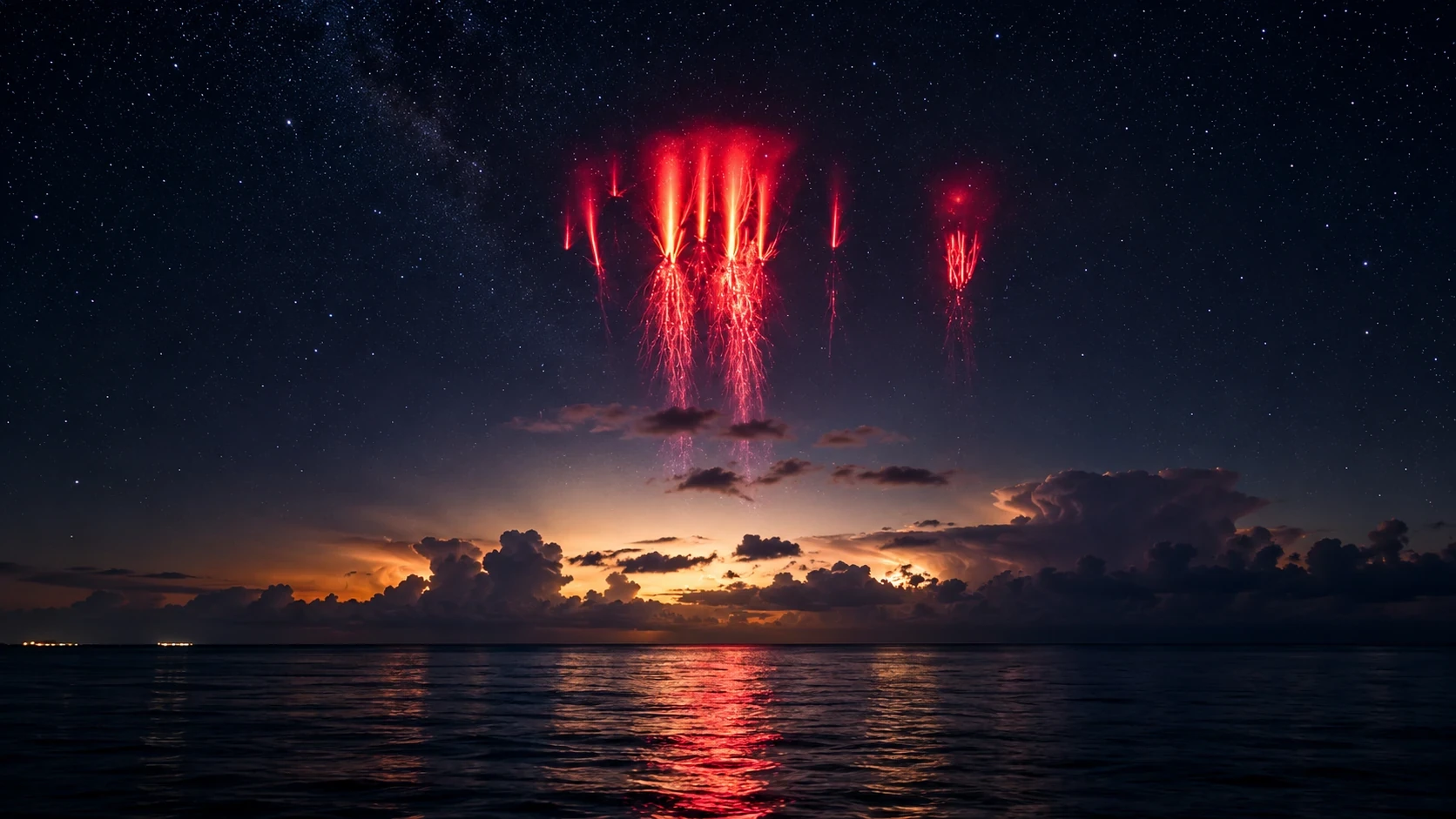
The result is more interesting than the myth of an endless storm: a place where landscape and atmospheric circulation repeatedly cooperate. For a different electrical display, our red-sprite explainer explores brief luminous events high above thunderstorms. The phenomena share an electrical context, but occupy different parts of the atmosphere.
Related reading: Red sprites above thunderstorms.
FAQ
Frequently Asked Questions
Is Catatumbo one continuous storm?
No. It is a region of unusually frequent thunderstorms, with daily, seasonal and year-to-year variation.
What does the figure of 233 flashes mean?
It is an approximate annual flash density per square kilometre reported for a hotspot in a satellite-based study, not a current ground-strike count everywhere on the lake.
Where does Catatumbo lightning occur?
In the Lake Maracaibo basin of northwestern Venezuela, notably around the southern lake and Catatumbo River region.
PRESDA Dispatch
Stay Informed. Stay Aware.
A sharp briefing across AI, gaming, sport, business, world affairs, paparazzi, and lifestyle.