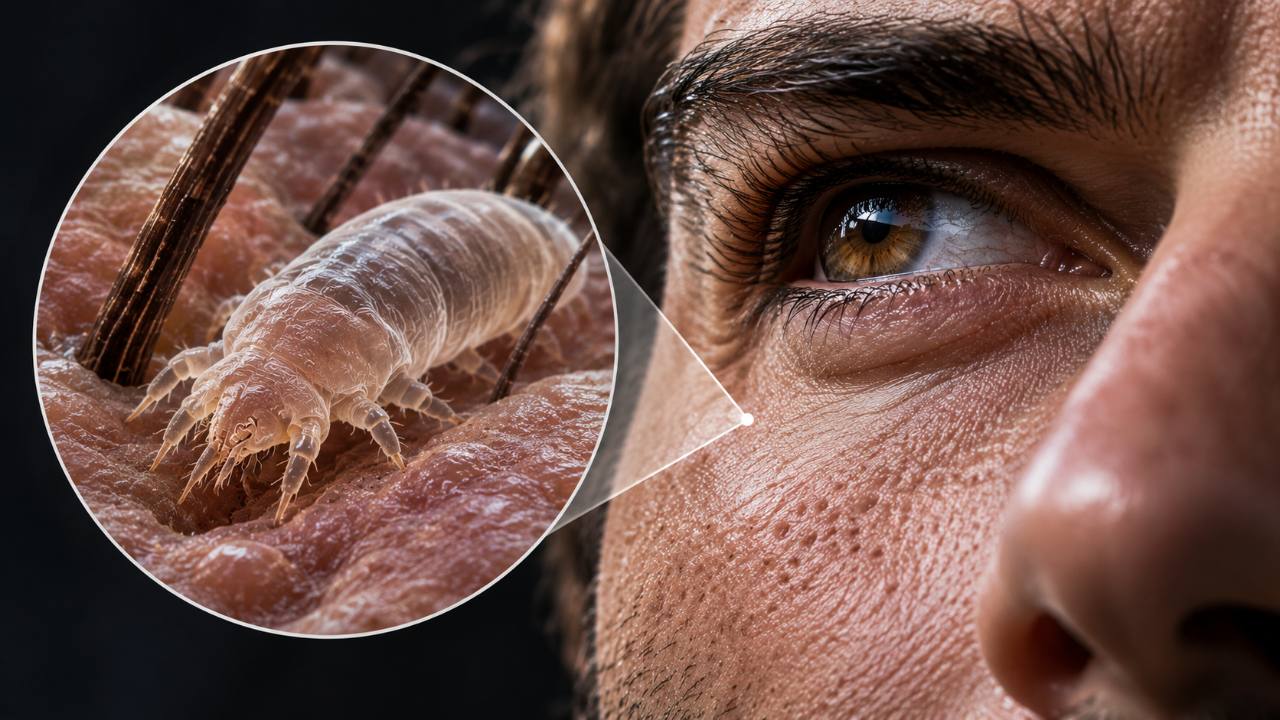
Demodex: The Microscopic Mites Living on Your Face
Demodex mites commonly inhabit human skin. Explore their biology, what studies actually show and when their presence becomes a clinical concern.
AI-generated editorial illustration supplied for PRESDA. The enlarged mite is an artistic reconstruction, not a microscope image or a diagnostic depiction; scale and anatomy are illustrative.
Demodex mites are microscopic inhabitants of human hair follicles and oil glands. Finding them on adult skin is common and usually unremarkable. Their presence alone is not a diagnosis, an explanation for every rash or evidence that a person is unclean. The science is more interesting than the frightening close-ups suggest. DermNet: Demodex, biology and clinical assessment
The face is a habitat rather than a sterile surface. Alongside bacteria and other organisms, these small arachnids occupy places that ordinary vision cannot inspect. Understanding that ecosystem means separating three questions: are mites present, are they unusually abundant, and are they contributing to symptoms?
Two species share the human face
Demodex folliculorum is associated with small hair follicles, including those around eyelashes. Demodex brevis lives deeper in sebaceous glands connected to follicles. Adult lengths vary by species: DermNet gives approximately 0.3 to 0.4 millimetres for D. folliculorum and 0.15 to 0.2 millimetres for D. brevis. They are arachnids, not insects. DermNet: Demodex, biology and clinical assessment
| Finding | What it means |
|---|---|
| D. folliculorum | Usually associated with hair follicles |
| D. brevis | Associated with sebaceous glands |
| Adult length | About 0.15 to 0.4 mm across the two species |
| DNA detection, 2014 | 19 of 19 adults over 18 in one small subgroup |
| Clinical concern | Symptoms, examination and mite burden considered together |
| US-approved medicine | Lotilaner eye drops for Demodex blepharitis, not routine facial cleansing |
Adults have eight short legs near an elongated body’s front. The anatomy suits a narrow follicular environment. Activity is mainly nocturnal, but an illustrated animal crawling across a huge landscape of pores should not be confused with what a person can actually see in a mirror. The supplied hero is a conceptual reconstruction.
What does the often-quoted 100% statistic mean?
A 2014 PLOS ONE study by Megan Thoemmes and colleagues illustrates how methods change the answer. Intact mites were visually identified in 14% of adult samples in a larger group of 253. Molecular testing detected Demodex DNA in all 19 adults over 18 examined in a smaller subgroup. Those are different samples and detection methods, not interchangeable population estimates. Thoemmes and colleagues, PLOS ONE, August 2014: prevalence and molecular detection
The finding suggests visual inspection can miss mites that are present. It does not prove that exactly 100% of every population, every age group or every individual worldwide carries the same number. Detecting genetic material also does not measure symptoms or establish a need for treatment. A memorable percentage needs its denominator.
A tiny genome and a misleading myth
In June 2022, researchers publishing in Molecular Biology and Evolution described extensive genome reduction in D. folliculorum. They proposed that long dependence on a human host might represent an evolutionary transition toward symbiosis. That is an interpretation of biological evidence, not proof that every interaction benefits the host or that the mite can never participate in disease. Smith and colleagues, Molecular Biology and Evolution, June 2022: follicular mite genome
The research also challenged the familiar claim that these mites have no anus and store waste until they burst. The authors identified an anus. The dramatic bursting-waste story should not be used as an established explanation for inflamed skin. Genome research describes an organism; it does not independently diagnose a reader’s redness.
When a normal resident becomes clinically relevant
Higher mite densities are observed in demodicosis and some forms of rosacea. Redness, rough follicular scale, itching and sensitivity can occur, but such symptoms are not specific to mites. A clinician may examine skin samples or follicular material under a microscope and interpret the result alongside the presentation. DermNet: Demodex, biology and clinical assessment
Eyelid disease is a distinct clinical problem
Demodex blepharitis concerns inflammation of the eyelid margin. Reviews describe characteristic cylindrical deposits, or collarettes, around lash bases, as well as irritation and itching. Other causes of eyelid discomfort remain possible. The presence of a mite on a lash and a clinical diagnosis should not be treated as the same thing. Rhee and colleagues, 2023: comprehensive review of Demodex blepharitis
This distinction matters because a general story about harmless facial residents can otherwise obscure a treatable eye condition. It also prevents the opposite mistake: assuming that normal skin must be sterilized because a microscopic organism has an alarming appearance.
What treatment evidence actually shows
Lotilaner ophthalmic solution 0.25%, marketed in the United States as Xdemvy, received initial US approval in 2023 for Demodex blepharitis. The prescribing information describes two randomized, double-masked, vehicle-controlled six-week studies involving 833 participants in total, including 415 given the active drug. This is evidence for a defined eye indication, not permission to use any pesticide or facial product around the eyes. DailyMed: Xdemvy prescribing information and controlled trial results
The published Saturn-2 trial compared lotilaner with its vehicle in 412 patients. It evaluated specified outcomes including collarettes and mite eradication. Controlled comparisons can test a treatment more reliably than before-and-after photographs, but an approved indication still has boundaries. Study findings do not establish that symptom-free people benefit from routine mite elimination. Gaddie and colleagues, Ophthalmology, 2023: randomized Saturn-2 trial
Descriptions of older treatments on reference websites should also be read in their publication context. An early review saying no approved medicine existed can become outdated after regulatory approval. Persistent eyelid irritation or facial inflammation deserves an appropriate examination rather than a diagnosis inferred from a social-media image. Undiluted essential oils and household insecticides are not substitutes for prescribed eye medicines.
The lesson is coexistence, not disgust
The most useful story about Demodex is the distinction between ordinary colonization and disease. Microscopy, genetic methods, clinical examinations and randomized trials answer different questions. Combining them carefully reveals a long-standing relationship between humans and a remarkably specialized animal, while leaving space for targeted care when symptoms require it.
For more on how medical evidence develops, read our coverage of cranial twin separation, Neuralink’s pivotal trial and the one-year pig-kidney milestone.
FAQ
Frequently Asked Questions
Does everyone have Demodex?
They are very common in adults, but a small study detecting DNA in every adult tested does not establish a universal population rate.
Are face mites a sign of poor hygiene?
Their presence is a normal biological finding and does not by itself establish poor hygiene or disease.
Do Demodex cause every case of rosacea?
No. Higher mite densities are associated with some presentations, but rosacea is complex and association alone does not establish one universal cause.
Should everyone use a mite treatment?
No. Treatment concerns diagnosed disease, not the routine presence of mites. Persistent skin or eyelid symptoms need clinical assessment.
PRESDA Dispatch
Stay Informed. Stay Aware.
A sharp briefing across AI, gaming, sport, business, world affairs, paparazzi, and lifestyle.