
ALIREZA FIROUZJA WINS THE TOTAL CHESS PILOT IN BUDAPEST
Alireza Firouzja won the Budapest pilot on November 20, 2026. How the Armageddon draw, weighted scoring and three chess formats decided the title.
Original supplied editorial visual, preserved unchanged. Its photographic provenance has not been independently authenticated.
An ordinary draw ended an extraordinary experiment. Alireza Firouzja won the Total Chess pilot in Budapest on November 20, 2026, holding Anish Giri with the black pieces in the deciding Armageddon game. Under that tiebreak’s draw-odds rule, avoiding defeat was enough to become the tournament’s first winner. Fabiano Caruana finished third. FIDE: November 20 final report
The result deserves a precise label: Firouzja won the Budapest pilot, a test of a competition combining three speeds of chess. It was not a victory in the separate classical World Championship match. The distinction matters because Total Chess is trying to measure something different: adaptability across changing time controls, rather than mastery of just one championship format. Total Chess: Budapest format and time controlsTotal Chess: tournament overview and standings
| Question | Verified answer |
|---|---|
| Winner | Alireza Firouzja |
| Final date | November 20, 2026 |
| Deciding game | Armageddon draw with Black against Anish Giri |
| Podium | Firouzja, Giri, Caruana |
How Firouzja turned the final around
Giri had won the first day of the final, 11–9. Firouzja answered with a 12–8 second-day victory, making the match one daily win apiece and sending it into a sudden-death decider. Those daily scores were not simply added together to declare a champion. The tournament’s knockout system treated the two days as separate contests. FIDE: November 20 final report
Friday’s blitz segment ended level. Firouzja’s win with Black in the first rapid game, followed by a draw, changed the balance before the final Fast Classic game. A draw there preserved his daily advantage. The Armageddon then lasted 35 moves and ended peacefully on the board, but decisively in the standings: Black’s draw odds gave Firouzja the title. FIDE: November 20 final report
Why a draw can produce a winner
Armageddon is designed to remove the possibility of an unresolved match. Its asymmetry changes the objective: White must win, while Black can secure the match by drawing. That makes a drawn position a successful competitive outcome for one player, even though the game itself remains a draw. Calling Firouzja’s final game a conventional win would misdescribe what happened.
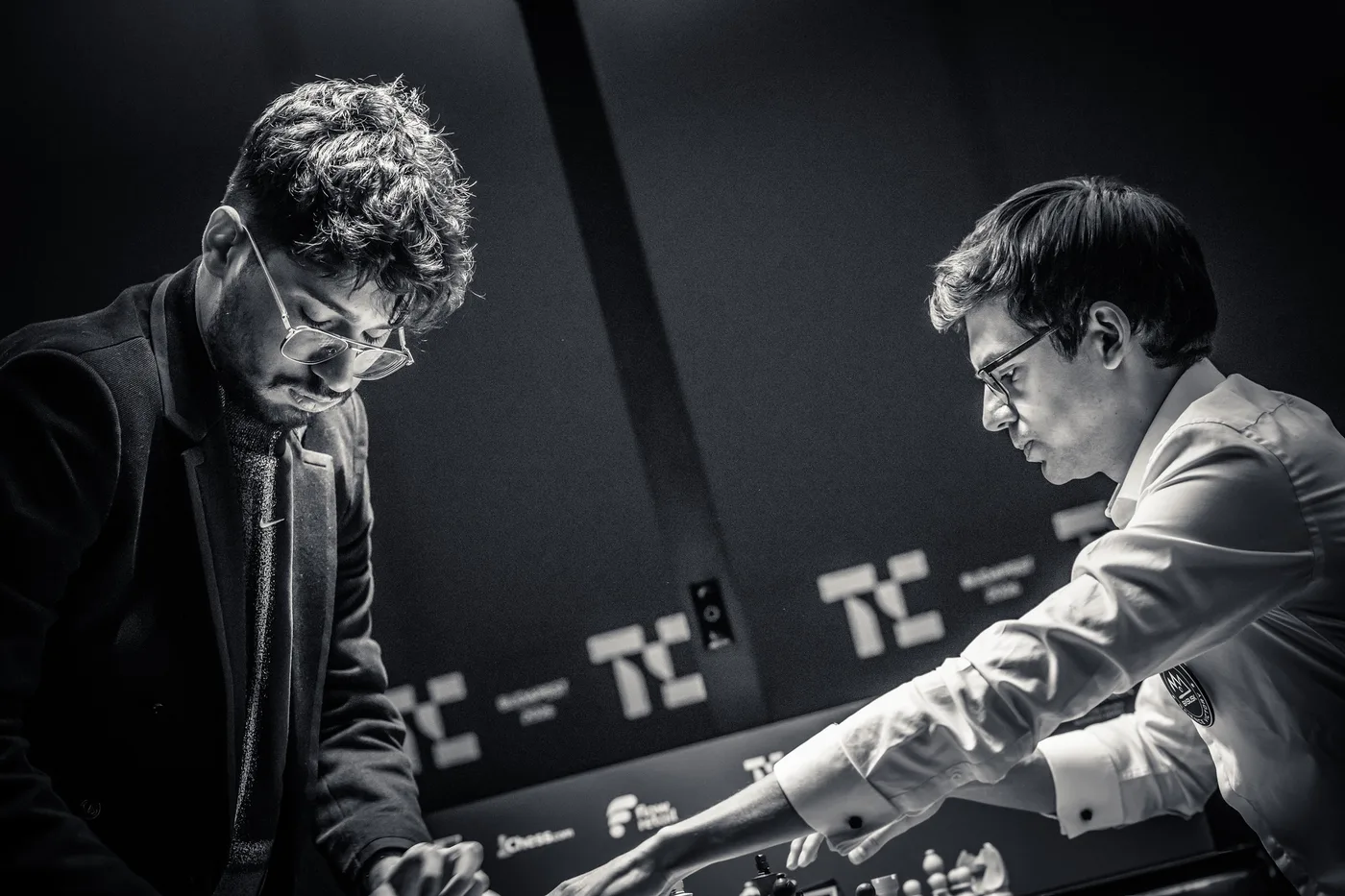
Alireza Firouzja, left, and Anish Giri during the Budapest final. Official tournament photograph published November 20, 2026.
For spectators, the easiest way to follow such a finish is to distinguish three layers: the result of an individual game, the weighted points earned during a day, and the outcome of the two-day match. Each answers a different question. Much of the drama in Budapest came from the way those layers interacted, rather than from a single decisive move.
A tournament built around three different clocks
The Budapest event ran from November 10 to 20 at the Anantara New York Palace Hotel. Twenty-four players entered a structure moving from an opening blitz competition to groups and then placement brackets. The organizer’s format guide describes a nine-round Blitz Swiss, four groups of six, and a knockout phase that continued to determine places throughout the field. Total Chess: Budapest format and time controlsTotal Chess: tournament overview and standings
The clocks explain the name. Fast Classic gives each player 45 minutes plus 30 seconds per move; rapid uses 15 minutes plus 10 seconds; blitz uses three minutes plus two seconds. These are not cosmetic changes. A player who can calculate deeply with a large reserve of time must also make sound practical decisions when the clock leaves little room to check every variation. Total Chess: Budapest format and time controls
In the knockout phase, each day featured four blitz games, two rapid games and one Fast Classic game. Their weighting was equally important: a win brought one, four and eight points respectively, with half those amounts for a draw. The longer game could therefore change a day’s result even after several faster games had been completed. FIDE: November 20 final report
The arithmetic behind the suspense
That weighting rewards range, but it also means the number of games won is not a complete guide to who is leading. Four blitz victories carry the same daily value as one rapid victory, and half the value of a Fast Classic win. A viewer counting only wins and losses can therefore reach the wrong conclusion about the match situation.
The system asks a particular sporting question: how much should a competition value consistency at speed against performance in its longest game? Budapest supplied a live test, with actual players confronting those trade-offs. It does not establish that one scoring model is universally better. It shows how a set of rules can create different incentives from a conventional round-robin.
A champion with an established elite pedigree
Firouzja arrived with a career that already extended well beyond the label of prodigy. FIDE’s December 2021 rating report recorded him at 2804 and described him as the youngest player to pass 2800. He also won the 2021 Grand Swiss and earned individual gold at that year’s European Team Championship, helping establish his place among the strongest players of his generation. FIDE: Firouzja passes 2800 in December 2021 rating list
Those achievements provide context rather than a shortcut to explaining every game in Budapest. A rating milestone is a record of performance at a particular time, not a guarantee of future results. The pilot title adds a different kind of evidence to his résumé: he survived a final in which recovery between days and adjustment between time controls were central to the contest.
The experiment also belongs to a longer history of changing competitive conventions. PRESDA’s history of chess follows the game’s development across cultures and eras. Budapest adds a contemporary example: an established board and familiar pieces can support a different sporting test when clocks, scoring and match structure change.
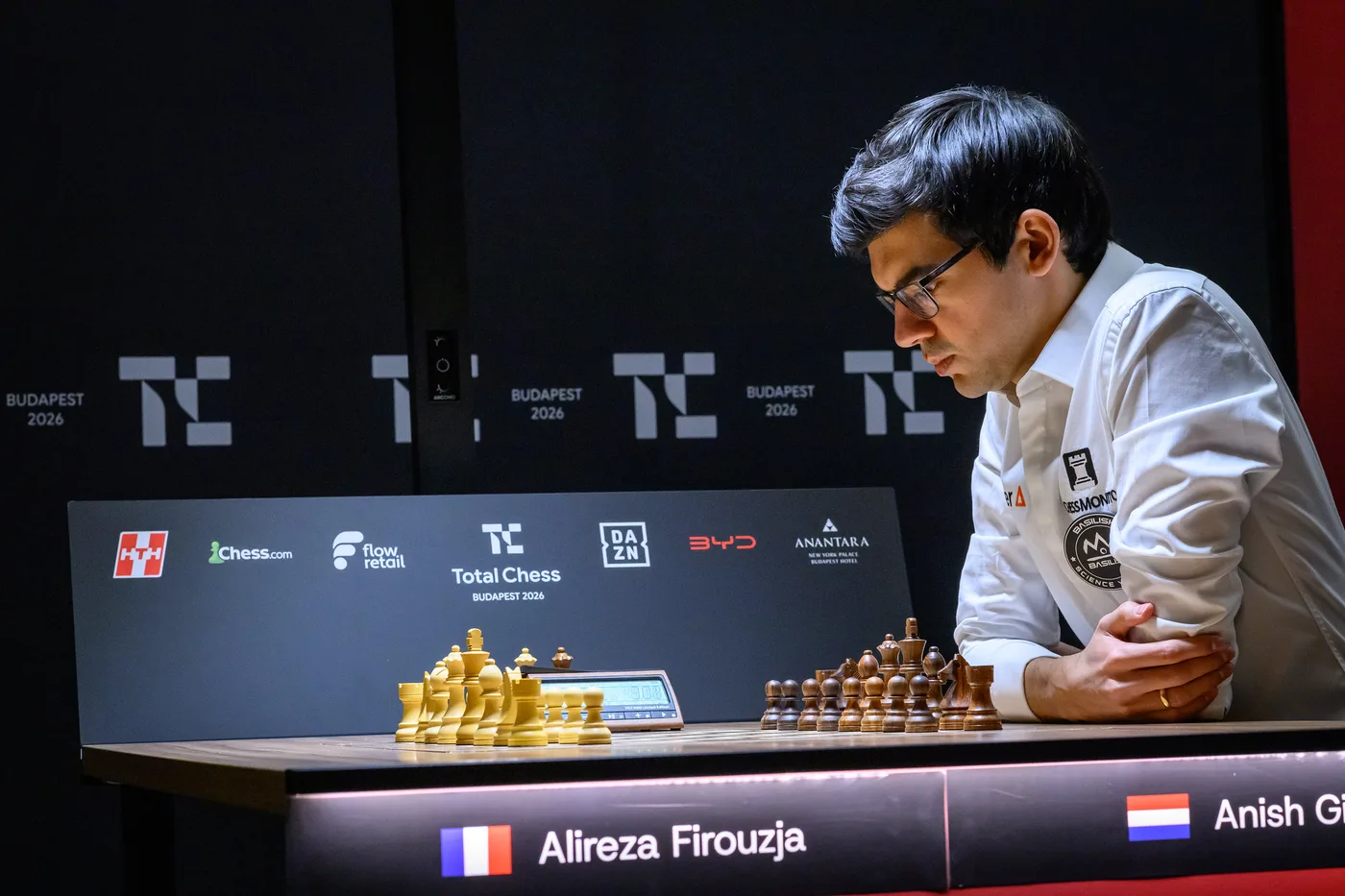
Anish Giri at the board during the Budapest final. Official tournament photograph published November 20, 2026.
What the pilot proved, and what remains to be refined
Caruana completed the podium ahead of Maxime Vachier-Lagrave. The broader experiment did not end with the trophy presentation. In a November 21 statement, FIDE congratulated the medalists while addressing Magnus Carlsen’s Fast Classic forfeit during the placement phase. The federation said it would work with Total Chess on rules governing forfeits and their consequences before the 2027 season. FIDE: November 20 final reportFIDE: November 21 statement on the pilot
That is an important part of the story rather than an incidental controversy. A format that combines several disciplines needs clear rules for what happens when a player does not complete one of them. Spectators, opponents and organizers must be able to understand how a missed game affects a match, the standings and the credibility of the overall competition.
The pilot can therefore be read on two levels. Firouzja’s victory is a completed sporting result. The longer-term success of the format remains a question for subsequent events, audience experience and the regulations that emerge from this test. Neither conclusion requires exaggerating the other: the champion is confirmed, while the experiment is still developing.
Reading the photographs and the result responsibly
The supporting photographs show genuine competition in Budapest and are credited to Michal Walusza through Total Chess’s editorial media offer. They document the setting and players; the official results and regulations establish the scores. The supplied hero is preserved separately as a user-provided editorial visual, without claiming independent authentication of its provenance. Total Chess: official tournament photographs
The lasting image of the final is not necessarily a checkmate. It is a player recognizing exactly what the rules required and securing that outcome under pressure. Firouzja’s title came through a drawn game, a recovered match and a format whose central challenge was to make several kinds of chess belong to one competition.
FAQ
Frequently Asked Questions
Who won the Total Chess Budapest pilot?
Alireza Firouzja won on November 20, 2026. Anish Giri was second and Fabiano Caruana third.
Did Firouzja win the final Armageddon game?
The game was drawn. Firouzja won the match because he had Black and the tiebreak gave Black draw odds.
What formats did Total Chess combine?
Fast Classic, rapid and blitz, with different clocks and weighted knockout scoring.
Was this the classical World Championship?
No. It was the Budapest pilot of the Total Chess format, a separate competition testing combined performance across three time controls.
PRESDA Dispatch
Stay Informed. Stay Aware.
A sharp briefing across AI, gaming, sport, business, world affairs, paparazzi, and lifestyle.