FRANCE’S STUDENT PROTESTS PUT MACRON’S GOVERNMENT UNDER PRESSURE
Why France’s students are protesting: teacher shortages, verified turnout, police investigations and government concessions, with a sourced October 2026 timeline.
A protest over missing teachers has become a national test of France’s government. After weeks of school blockades and marches, Education Minister Édouard Geffray announced assignments for roughly 3,000 qualified teachers who were not yet teaching. Student unions welcomed a first concession but promised to continue, Reuters reported on October 9, 2026. The dispute now joins arguments about educational inequality, public spending and policing.
Most demonstrations have been peaceful. Violence at some sites, serious injuries and allegations of excessive police force are also documented in the reporting. These are related developments, not grounds to portray every student as a rioter or the whole country as engulfed in violence. A nationwide political challenge is established; the fall of the government is not.
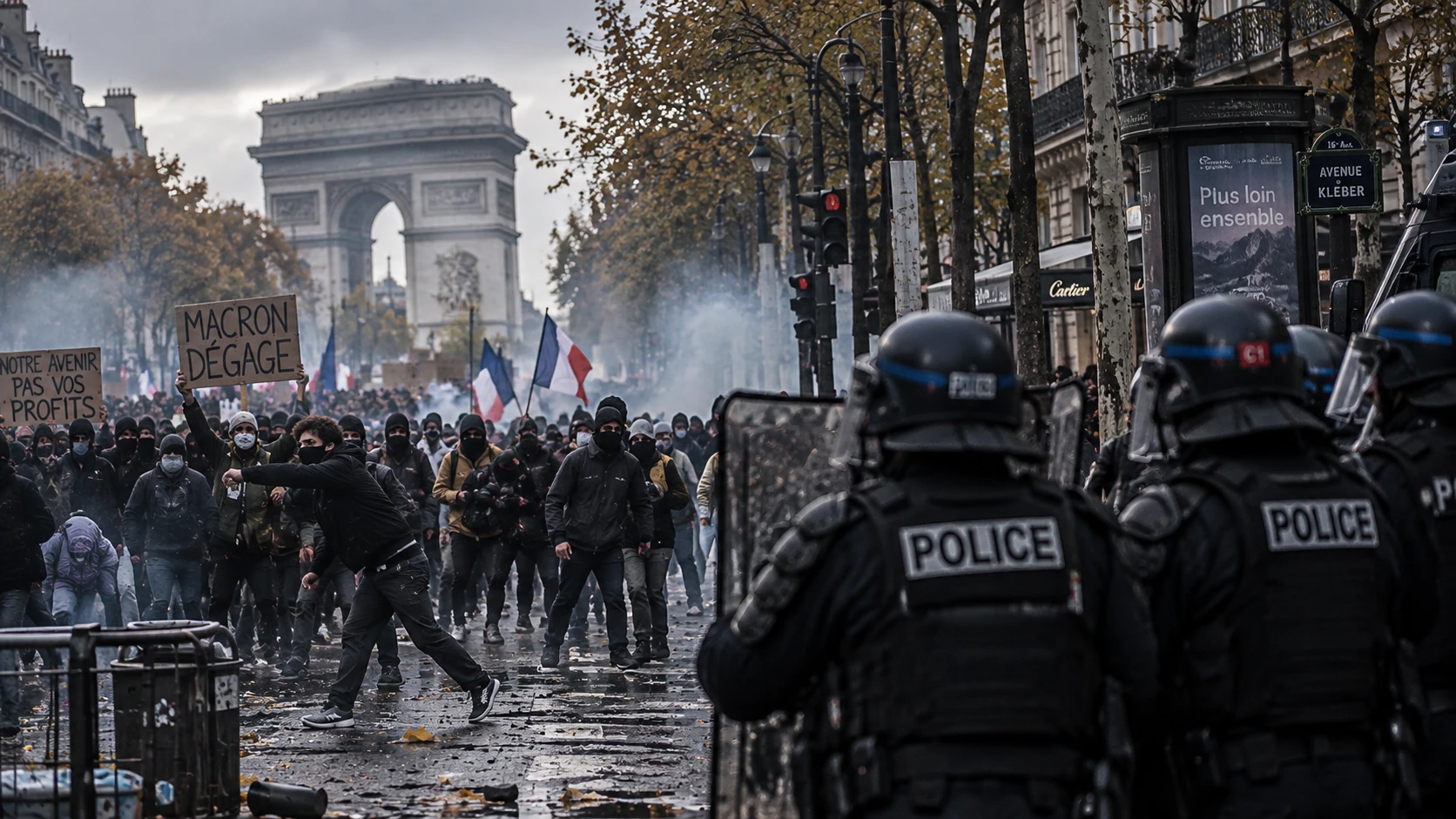
Illustration note: the Paris protest hero is an AI-generated editorial illustration, not an authentic photograph. It does not document an incident at the Arc de Triomphe, a particular crowd or any identifiable person’s conduct. This report was verified on October 10, 2026; each evolving figure retains its own reporting date.
How a local school dispute became national
AP traces the mobilization to staffing complaints in Créteil, southeast of Paris. Le Monde dates the initial protest to September 21. High school pupils, rather than a university movement opposing one newly announced reform, drove its early spread. The distinction matters: withdrawing a single policy cannot automatically resolve missing lessons, damaged facilities and fears about future opportunities.
Prime Minister Sébastien Lecornu convened a crisis meeting on October 1. The government’s October 4 roadmap then acknowledged unprovided lessons, poor buildings, long school days, anxiety about admissions and a wider feeling of not being heard. The official document is important evidence that the complaints are not merely slogans attributed by outsiders. It also insists on returning to class wherever conditions permit.
What students and teachers are demanding
The central demands concern reliable teaching, safer facilities, manageable timetables and fairer access to higher education. The government has promised greater transparency in Parcoursup, France’s admissions platform, and work with regional councils responsible for high school buildings. Its five workstreams cover lessons, premises, school-day organization, admissions and student participation. Their existence does not establish that repairs or replacements have already reached every school.
The CGT frames the movement as a defense of public education, while SNES-FSU says teachers share part of the students’ demands and supports the movement’s independence. University students have joined high school pupils. Their participation expands the coalition; it does not mean every participant has the same program or that one union controls all blockades.
A verified timeline of the escalation
The chronology below separates events that have happened from announced next steps. Dates mark the reported event or announcement, not the publication date of every source. October 13 remains a call to mobilize, not a completed demonstration or a forecast of turnout.
PRESDA Data Graphics
Reported events in 2026. Equal spacing is not elapsed time. The final entry is an announced action, not an event that has happened.
Nationwide marches bring students, teachers and unions together.
Nuñez publicly confirms provisional EF-SON suspension for school protests.
Geffray announces assignments for roughly 3,000 existing teachers.
- ANNOUNCED
Sources: AP, Le Monde, AFP, Reuters, Ministère de l’Éducation nationale, SNES-FSU. 2026.
Turnout: which figures can be compared?
For October 6, AFP reported 256,000 participants nationwide according to the Interior Ministry; the CGT claimed more than 450,000. AP independently reported the nationwide rallies. These are competing estimates of the same day, not numbers to add. A count attributed to the government or organizers is not a verified census of every individual.
For October 8, Reuters relayed the Interior Ministry’s 71,500 march and static-rally participants, including 24,500 in Paris. Le Monde reported demonstrations in Lyon and Marseille as well as the capital. Changing participation and school-closure counts suggest a movement with uneven intensity. They cannot be treated as a continuous upward curve or as proof that all French schools are closed.
PRESDA Data Graphics
Nationwide participants on October 6, 2026. Separate estimates, not an interval or a sum. Values are displayed as reported, with no averaged total.
| Source / attribution | Reported participants |
|---|---|
| Interior Ministry, reported by AFP | 256,000 |
| CGT organizer claim | More than450,000 |
Different counting methods can produce different estimates. Neither number is a verified individual census.
Sources: AFP / Ministère de l’Intérieur; CGT. 2026.
Peaceful marches and violent incidents
Le Monde’s reporting on October 8 distinguishes peaceful gatherings from clashes around dispersals, including at Paris’s Place de la Bastille. Reuters recorded police accounts of projectiles and a water cannon there, and gatherings in Marseille, Nantes and Strasbourg. Officials also reported a school fire in Poitiers. An incident’s occurrence does not establish the identity or motive of everyone nearby.
For that day, the Interior Ministry reported 504 arrests and 48 injured police officers and gendarmes, according to Le Monde. Separately, Reuters’s October 8 running report attributed cumulative totals of 215 injured pupils and 761 injured officers to Laurent Nuñez. These are dated official tallies, not independent clinical audits; they do not assign a cause or legal responsibility to every injury.
Custody is not a conviction
The Justice Ministry’s October 9 release reports 6,877 people placed in police custody since the violence began, using figures current to October 8 at 17:00. It says 86% were minors and 2,376 people were subject to prosecution at that stage. An arrest, police custody, prosecution and conviction are different procedural stages. These judicial figures should not be added to daily police arrest totals or presented as findings of guilt.
Police violence allegations and investigations
AFP learned from the Interior Ministry on October 9 that the IGPN had opened 24 investigations. This confirms oversight activity, not that every allegation is proven. Investigators must establish individual actions, context, necessity and proportionality. A recorded action can be evidence without settling all legal questions. Outcomes remain subject to the investigations and judicial process.
A 15-year-old lost a hand in Lens on October 5. Le Monde identifies the EF-SON grenade and its provisional suspension in the school-protest context, ordered October 6 and publicly confirmed by Nuñez October 7. This was a limited precaution concerning a specific model, not a ban on every grenade or all uses of force. Establishing the circumstances and lawfulness of a particular deployment remains essential.
The government emphasizes the safety of pupils, education staff and police, and condemns arson and attacks. Students and unions argue that policing can deepen grievances and that educational demands must not be reduced to public-order problems. Neither position removes the need for independent scrutiny. Peaceful assembly and accountability for unlawful violence apply together.
Government concessions: promises versus delivery
Reuters reports that around 3,000 qualified teachers awaiting assignments are to fill staffing gaps. This is an allocation of existing personnel, not evidence of 3,000 completed new recruitments. Whether schools receive suitable subject specialists, how soon lessons resume and how long vacancies remain are the practical tests. A national announcement cannot substitute for school-by-school delivery.
The official roadmap promises initial decisions, financing and timetables before the end of October and an initial staffing report by October 16. It points to a proposed €1.2 billion education-budget increase for 2027, not money already approved and delivered under the protest response. The ministry’s Agora consultation is open until October 23. Consultation is a channel for input, not a binding settlement with every protesting group.
Macron, public opinion and the political stakes
Anti-Macron sentiment is part of the movement, but education demands remain central. Reading all protesters as participants in a single campaign to remove the president would erase differences between schools, unions and political supporters. Pressure on his administration can grow without establishing an imminent resignation, a new election or a constitutional breakdown.
In remarks published by the Élysée on September 30, Macron recognized young people’s legitimate anxieties while rejecting violence and accusing some politicians of inflaming it. Those accusations remain his position, not proof of who organized particular incidents. The 2027 succession sharpens the stakes: Article 6 limits presidents to two consecutive terms, so Macron cannot seek a third consecutive term. The protests do not change that constitutional rule.
An Ifop survey for LCI interviewed 1,000 adults online on October 6–7 using quotas and geographic stratification. It found 48% supported or sympathized with the movement, 17% were indifferent and 35% opposed it. Sympathy and active support were combined in that 48%. This is one dated survey, not evidence that France unanimously backs either the protesters or the government.
Disruption, costs and the next test
The most directly established disruption is educational: missed lessons, blocked campuses and interrupted attendance. Reuters reported 141 schools still shut on October 9, citing the education ministry. The Justice Ministry describes repair costs already reaching several million euros, without an audited nationwide total. That is not a measurement of lost GDP, a general transport shutdown or the whole economy grinding to a halt.
SNES-FSU has called a strike for Tuesday, October 13. The next political test is whether staffing changes and negotiations reduce disruption, and whether further marches retain support. Future turnout, violence and government decisions remain unknown. Sustained mobilization could influence budget negotiations; that is a possibility, not an established outcome.
For longer historical context, read PRESDA’s history of France and its republics. Readers considering study and employment pathways can also consult our official work-abroad resources. Neither background guide replaces current school notices, government announcements or verified protest reporting.
FAQ
Frequently Asked Questions
Why are students protesting in France?
The movement centers on missing teachers and lessons, school conditions, long days and unequal opportunities. Policing has become an additional grievance.
How many people demonstrated on October 6?
AFP reported 256,000 nationwide according to the Interior Ministry. The CGT claimed more than 450,000. These competing estimates must not be added.
Has the government recruited 3,000 new teachers?
It announced assignments for roughly 3,000 existing qualified teachers not yet teaching. This is not evidence of 3,000 completed new recruitments.
Are police violence allegations proven?
The IGPN has opened investigations. Their existence does not establish guilt in every case; individual findings remain subject to investigation and the courts.
When is the next announced mobilization?
SNES-FSU has called a strike for October 13, 2026. It remains a planned event, with turnout and consequences unknown.
PRESDA Dispatch
Stay Informed. Stay Aware.
A sharp briefing across AI, gaming, sport, business, world affairs, paparazzi, and lifestyle.
Related