The Future of Supermarkets: AI, Robots and Cashierless Shopping
Explore Amazon, Walmart and Carrefour’s retail technology, from smart carts to AI assistants, with the costs, privacy risks and a realistic outlook for 2030.
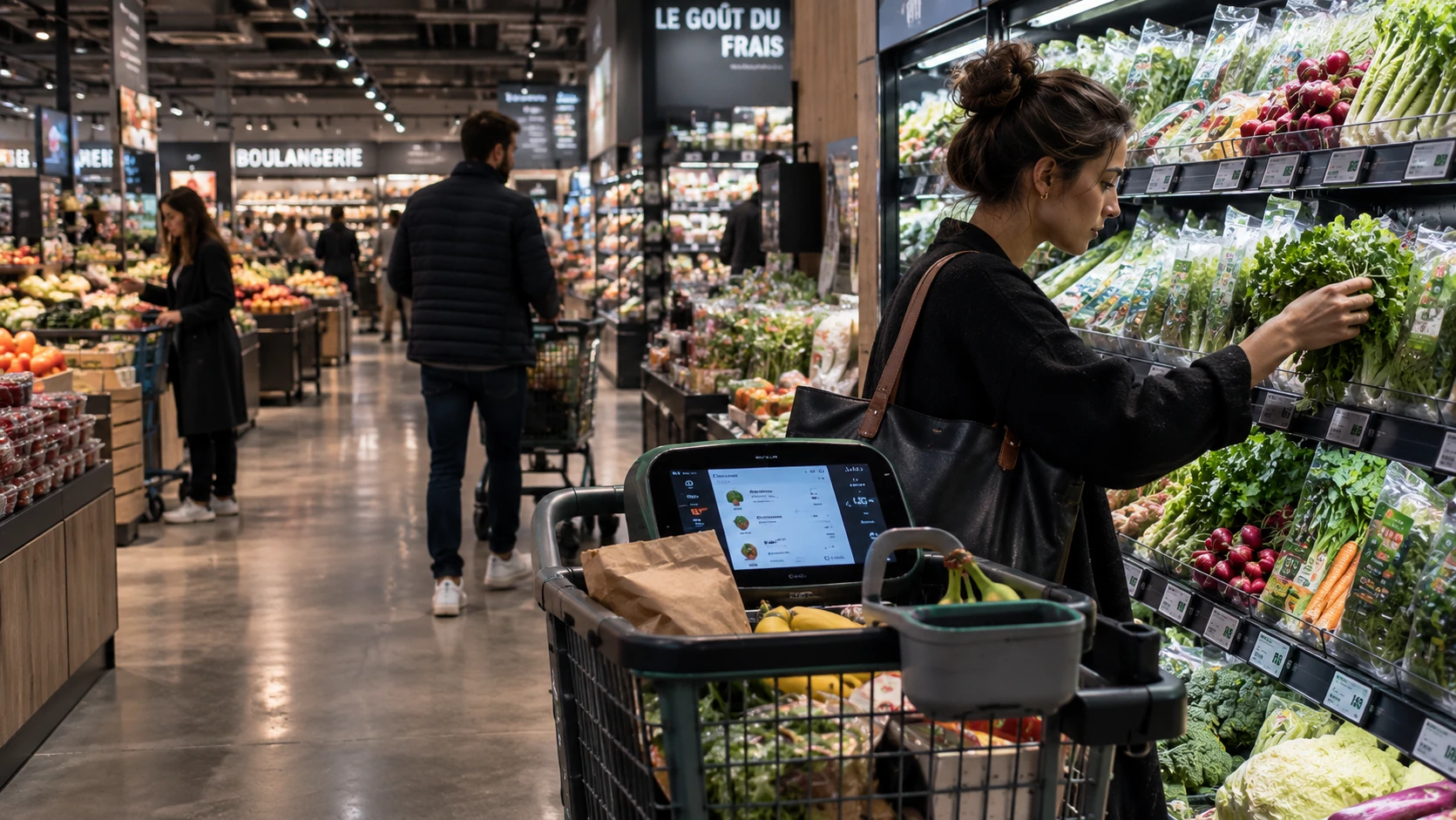
PRESDA AI-generated editorial illustration of shoppers and a smart cart in an imagined supermarket. Not a photograph of an Amazon, Walmart or Carrefour deployment.
The supermarket of the future may be most impressive when it does not look futuristic at all. A shelf has the product you came for. A cart shows what your basket costs before you reach the exit. A worker finds a missing item quickly. You leave with the right groceries and an understandable receipt. Behind those ordinary successes could sit cameras, forecasting software, connected labels and robots.
Cashierless shopping, smart carts and AI assistants already exist, but they are different technologies with different economics. None proves that supermarkets will become staffless by 2030. This feature separates documented deployments from company ambitions and PRESDA’s own conditional outlook, using information checked on October 20, 2026. The central question is whether automation makes shopping more dependable and affordable, rather than simply more spectacular.
What does cashierless shopping actually mean?
Traditional self-checkout asks the customer to scan products at a terminal. Scan-and-go moves that work to a phone or handheld scanner. A smart cart can combine scanning, weighing and product recognition with a running bill. A camera-based checkout-free store instead tries to associate selected products with a shopper’s virtual basket, then arrange payment. These approaches remove different steps. A store can automate receipt checking without automating the purchase itself.
Amazon describes Just Walk Out as combining computer vision, sensor fusion and AI to identify shopping actions. That is a system for inferring what was taken, returned and purchased, not a machine that understands shopping perfectly. Customers choosing similar products, putting something back in the wrong place or shopping together create practical challenges. A credible service needs a way to correct a mistaken charge and reach a person. Amazon’s technical explanation
Amazon: a real invention meets grocery economics
Amazon’s experience is a warning against treating an impressive demonstration as an inevitable business model. In January 2026, the company announced that it would close Amazon Go and Amazon Fresh physical stores, converting some locations to Whole Foods Market. It said its Amazon-branded grocery formats had not achieved the differentiated experience and economics needed for large-scale expansion. The decision concerned those physical formats, not the disappearance of Amazon’s online grocery business. Amazon’s updated retail strategy Associated Press on the closures
The technology and the stores must therefore be judged separately. Amazon continues to offer Just Walk Out to other operators, while developing carts for larger grocery trips. A convenience purchase at an airport and a weekly family shop have different basket sizes, layouts and customer expectations. The useful lesson is not that every cashierless system failed, nor that all supermarkets will adopt one. It is that successful checkout automation still needs a viable retail proposition.
Smart carts make the bill visible before the exit
Amazon’s redesigned Dash Cart illustrates another approach. Its published features include a running total, a scanner, a produce scale and a dedicated exit lane that processes payment. Amazon names Whole Foods locations in McKinney, Reston and Westford among the early sites for the latest generation, and describes expansion to dozens of stores by the end of 2026 as a plan. That target should not be reported as a completed rollout. Amazon’s redesigned Dash Cart
A visible bill can matter as much as saving minutes. It gives a shopper a chance to remove an unaffordable item before payment and see whether a discount applied. The trade-off is a more complicated piece of equipment: screens, sensors, charging, repairs and software all need support. Retailers should test whether customers can use it comfortably, including people with limited reach, impaired vision or little confidence with digital interfaces. The best cart is not necessarily the one with the most features.
Walmart: shopping assistance and faster exits are different projects
Walmart introduced Sparky in June 2025 as a generative-AI shopping assistant for tasks such as summarizing reviews and recommending products. Its launch announcement also described future capabilities, including automatic reordering and service booking. Those promises should not be confused with features available everywhere at launch. A conversational interface can make a large catalog easier to navigate, but answers still need to match actual products, stock, prices and delivery conditions. Walmart’s Sparky launch
At Walmart-owned Sam’s Club, a separate computer-vision project checks purchases at the exit. The company reported deployment at more than 120 locations in April 2024. This is a dated milestone, not a current store count. It reduces reliance on manual receipt inspection after payment; it should not be described as an identical version of Amazon’s whole-store tracking. Distinguishing the transaction from its verification makes the technology easier to understand and its benefits easier to evaluate. Sam’s Club exit technology
Carrefour: a test store and a conversational assistant
Carrefour’s Flash 10/10 test store opened in Paris in November 2021 with AiFi technology. The announcement described product recognition without individual scanning, followed by basket validation and contactless payment at a kiosk. It also specified a cash-payment option and four employees to operate the store. This was not a promise that every Carrefour would become an unattended shop, and the launch record alone does not establish its present operating footprint. Carrefour’s Flash launch
Carrefour took a different route online with Hopla, announced in June 2023 to help construct baskets around budgets, menu ideas and dietary constraints. Its 2026 update describes additional shopping-basket and image-analysis functions and food-choice assistance. This is software guidance, not a physical robot accompanying customers through the aisles. Personalized food suggestions should remain suggestions: product labels, allergen information and professional advice where needed cannot safely be replaced by a fluent chatbot. Hopla’s original launch Carrefour’s 2026 Hopla update
The most useful robot may be scanning shelves
The image of a humanoid grocery assistant distracts from less theatrical machinery. In January 2022, Sam’s Club announced the addition of inventory-scanning towers to its existing robotic floor scrubbers, working with Brain Corp and Tennant. The proposed dual function was practical: machines moving through the building could collect information on stock, product location, shelf-layout compliance and displayed prices while also serving a cleaning role. Sam’s Club inventory robots
Seeing an empty space is not the same as filling it. A worker may still need to locate a case in the back room, check its condition and replenish the shelf. Robots that move around shoppers also need safe paths, maintenance and procedures for blocked aisles. For the near future, narrowly defined assistance is a more grounded expectation than a machine capable of every shop-floor task. The broader distinction between specialized automation and general-purpose machines also shapes PRESDA’s robot-revolution feature.
Inventory intelligence begins before a shelf is empty
Forecasting systems try to connect demand with replenishment. A useful prediction must cope with promotions, weather, local events and changing customer habits. Sales alone can mislead: a product may appear unpopular because it was unavailable. Inventory records must therefore be reconciled with what is physically on the shelf. Walmart’s 2025 supply-chain account describes AI-supported forecasting, inventory routing and automation as parts of this larger operation. These are company descriptions, not independent proof that every store has eliminated shortages. Walmart’s supply-chain account
Fresh food makes the problem especially demanding. Ordering too little loses sales; ordering too much risks waste. An effective system has to consider shelf life, temperature, delivery reliability and what customers will accept as a substitute. Automating a bad stock record merely moves the mistake faster. Better measurement, physical checks and clear responsibility are therefore as important as a more sophisticated prediction model. The shelf is the end of a supply chain, not an isolated screen.
Digital shelf labels are not automatically personalized prices
Electronic shelf labels replace paper price tags and can make approved changes easier to distribute. In March 2026, Walmart said roughly 2,300 U.S. locations were using them and expected chain-wide coverage within the following year. It also describes lights that help workers find products for replenishment and online orders. The number is a company-reported snapshot; the wider rollout is a target. Walmart’s March 2026 update
A digital display is not itself an algorithm deciding what a particular customer should pay. Walmart says its labels show centrally set prices consistently and are not used to personalize shelf prices. That policy should be distinguished from what technology might technically enable. Retailers still need to ensure that the shelf, app, promotion and checkout agree. A faster update is only an improvement if the information is correct and understandable. Walmart’s pricing explanation
Personalization: helpful advice or a better sales pitch?
An assistant could help a family plan meals around a budget or avoid repeatedly searching for the same staples. But the retailer also wants to sell. A recommendation may reflect a promotion, advertising arrangement, available stock or commercial priorities rather than the cheapest suitable option. Customers should be able to understand sponsored placements, compare unit prices and see alternatives. A convenient answer is not necessarily a neutral one.
The risk becomes more consequential when an assistant is allowed to act. Suggesting a shopping list is different from authorizing substitutions, spending money or repeating an order. A responsible design would make budgets, exclusions, delivery fees and final approval explicit. These are editorial criteria for judging future services, not a claim that all existing tools already provide them. Automation should preserve the customer’s ability to inspect, change and cancel a decision.
Privacy belongs in the design, not the small print
Camera-based product tracking, loyalty profiles and biometric identification are distinct processes. One does not automatically imply the others. Amazon says Just Walk Out tracks shopping activity without relying on facial recognition or biometric identification. That does not settle every privacy question: customers still deserve understandable information about the data collected, its retention, access and connection to payment or account records. Amazon’s explanation of identification and tracking
The U.S. Federal Trade Commission’s January 2025 interim findings examined how pricing intermediaries can use personal information to influence prices and promotions. They establish a reason to scrutinize data-driven pricing, not proof that every named supermarket uses individualized prices. The practical questions are specific: can a customer shop without joining a loyalty scheme, decline optional profiling and dispute an inaccurate record? Clear answers build more trust than calling a system anonymous without explaining its limits. FTC surveillance-pricing findings
What does automation really cost?
There is no defensible universal price for turning a supermarket cashierless. Store size, layout, product mix, existing payment systems and the supplier contract change the calculation. A useful investment appraisal includes installation, equipment, subscriptions, networking, maintenance, training, payment processing, error handling and eventual replacement. Costs must be compared with measured improvements, not with an assumption that all checkout labor disappears on the first day.
Retailers should count the whole shopping journey. Does the system reduce abandoned baskets and waiting, or move delays to account setup and receipt disputes? Does it lower waste without increasing stockouts? Can the store continue trading during an outage? A pilot needs a comparable baseline, a realistic maintenance budget and results across busy and quiet periods. Amazon’s retreat from its own grocery formats makes these questions concrete. Technical feasibility and sustainable economics are separate tests.
Jobs change, but a staffless supermarket is not inevitable
Automation can reduce demand for particular tasks while adding work elsewhere. The U.S. Bureau of Labor Statistics projects cashier employment to fall 6 percent between 2025 and 2035, while still anticipating substantial openings as workers change occupations or leave the labor force. This is a U.S. occupational projection across retail, not a global supermarket forecast and not a measurement of jobs lost solely to AI. BLS cashier outlook
Stores still need receiving, stocking, food preparation, cleaning, customer support and judgment when something goes wrong. Whether displaced cashiers move into those roles depends on hiring decisions, paid training, scheduling and local labor conditions. A promise to free employees for better work should be tested against actual hours, pay and workload. A smaller queue is a customer benefit; it does not by itself demonstrate a fair transition for workers.
Accessibility and reliability will decide adoption
A supermarket serves people with different languages, abilities, budgets and access to banking. Requiring a recent smartphone or a particular payment account can turn convenience for one customer into exclusion for another. Large text, reachable controls, clear audio and visual cues, assistance and alternative payment routes deserve the same attention as recognition accuracy. Carrefour’s original Flash design is a useful reminder that rapid automated purchasing and a cash option need not be treated as opposites.
Reliability includes the unglamorous moments: a dead cart battery, a failed connection, a damaged barcode, an age-restricted item or a disputed charge. A shop should make the recovery path obvious. Security also extends to software updates, payment integrations and supplier access. The most persuasive technology is the one that still lets a customer finish buying dinner when its preferred route fails. That is an operational standard, not a futuristic flourish.
A realistic supermarket outlook for 2030
PRESDA’s most plausible scenario is a mixed system. More stores may combine forecasting, connected labels, digital assistants and selected automated tasks while retaining staff and several ways to pay. Smart carts and checkout-free formats could expand where basket size, customer demand and operating costs justify them. This is an inference from the contrasting examples above, not a guaranteed adoption timetable or a forecast of market share.
The less certain scenario is a widespread supermarket run by general-purpose robots with no employees and no conventional checkout alternatives. Hardware reliability, integration costs, customer acceptance and accountability remain substantial hurdles. By 2030, the meaningful scorecard should be simpler: fewer unavailable essentials, accurate bills, less avoidable waste, accessible service and decent work. The future belongs to stores that solve those problems, whether the customer notices the AI or not. For the production systems behind one familiar grocery category, read PRESDA’s history and science of chocolate.
FAQ
Frequently Asked Questions
What is this PRESDA article about?
Explore Amazon, Walmart and Carrefour’s retail technology, from smart carts to AI assistants, with the costs, privacy risks and a realistic outlook for 2030.
Which category does this story belong to?
This story is part of PRESDA's Business coverage.
Who published this article?
The Future of Supermarkets: AI, Robots and Cashierless Shopping was published by PRESDA Editorial on PRESDA.
PRESDA Dispatch
Stay Informed. Stay Aware.
A sharp briefing across AI, gaming, sport, business, world affairs, paparazzi, and lifestyle.