HBO AT 54: HOW A SMALL CABLE CHANNEL CHANGED TELEVISION
HBO turns 54 on November 8, 2026. From a small 1972 cable debut to The Sopranos, Game of Thrones and streaming, explore its television legacy.
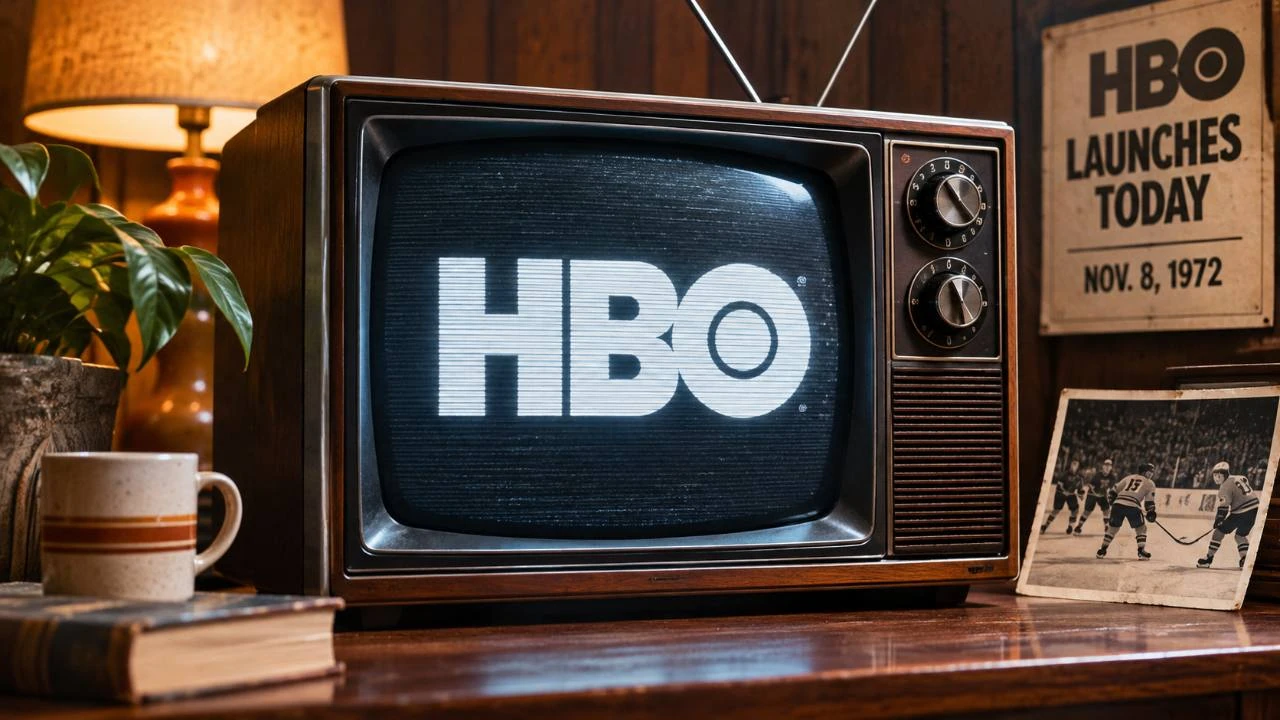
AI-generated editorial illustration supplied for PRESDA. The room, poster, television, aerial and logo treatment are imagined period imagery, not a photograph of HBO’s first broadcast or an exact reconstruction of its 1972 branding and cable equipment.
On November 8, 2026, HBO turns 54. Its first audience in 1972 was a small group of cable subscribers in Wilkes-Barre, Pennsylvania, not a global crowd waiting for a prestige-drama premiere. The distance between those beginnings and the cultural reach of The Sopranos or Game of Thrones is the story of a channel that changed both what television could make and how viewers paid to receive it. NCTA: HBO’s launch and programming history
Before the famous series, a subscription idea
Cable pioneer Charles Dolan developed the concept through his Sterling Manhattan Cable operation, with Time as an early partner. His oral history at the University of Pennsylvania describes negotiations with film studios and sports organisations, as well as technical and regulatory obstacles. The name Home Box Office expressed the proposition: entertainment worth paying for could reach the home through cable, beyond what an ordinary broadcast schedule offered. University of Pennsylvania: Charles Dolan’s HBO oral history
November 8, 1972: hockey and a movie
The opening night included a New York Rangers–Vancouver Canucks hockey game and Sometimes a Great Notion, the 1971 film starring Paul Newman and Henry Fonda. HBO was selling access to films and events before it became famous for original dramatic series. Only a few hundred households could receive that first service. Calling it an immediate nationwide launch would skip the distribution problem the young channel still had to solve. TVWeek: the first HBO transmission and early films
1975: satellites changed the scale
Satellite distribution in 1975, associated with the Muhammad Ali–Joe Frazier fight in Manila, helped HBO extend beyond a patchwork of local connections. The importance was infrastructural as much as sporting. A service that could reach distant cable systems could build a larger subscription business. A channel’s creative ambitions depended partly on something less glamorous than scripts: how its signal travelled. Television Academy: cable distribution and HBO’s satellite expansion
Why original programming mattered
A library of licensed films can attract subscribers, but other services may eventually offer those same films. Original programming makes a stronger claim on attention: a viewer must come to this particular service for this particular story. HBO’s development of specials, documentaries, comedy and scripted series gave the subscription a recognisable identity. That business logic encouraged distinction, although paying subscribers could still leave if the programmes disappointed them.
Oz, which premiered in 1997, became a landmark in HBO’s development of hour-long drama. Its prison setting and disturbing material challenged expectations about what a continuing television series could show. The point was not simply that cable could include explicit content. Longer relationships with characters and difficult institutions could support a different kind of storytelling, one that asked viewers to return without promising comfortable resolutions. Barry Levinson: Oz, 1997–2003
The series that made HBO a cultural reference
The Sopranos premiered on January 10, 1999. David Chase’s series combined organised crime with family conflict and psychological vulnerability, making Tony Soprano an unsettling centre of identification. Alongside Sex and the City and later The Wire, it helped establish that television could sustain complicated adult worlds over many episodes. HBO did not invent serious television, but these programmes widened the ambitions attached to the medium. Television Academy: The Sopranos’ January 1999 premiere
Game of Thrones, first broadcast on April 17, 2011, carried that reputation into large-scale fantasy and a global production footprint. HBO’s own retrospective figures, distributed by Bell Media, describe filming across ten countries during its eight seasons. Later shows such as Succession made corporate power and family inheritance another shared conversation. These works differed in genre; together they made the channel’s name a shorthand for a particular expectation of television. HBO via Bell Media: Game of Thrones facts and international production
From the cable schedule to streaming
Streaming changed the relationship between the programme and the channel. Viewers could choose an episode from a catalogue rather than wait for a scheduled transmission. HBO Max launched in the United States on May 27, 2020, combining HBO with a broader entertainment offer. The streaming service and the HBO television channel were related, but they were not interchangeable names for exactly the same library or product. Warner Bros. Discovery: 2022 filing, HBO Max’s 2020 launch
The wider platform became Max in 2023, then returned to the HBO Max name on July 9, 2025. The reversal revealed how much value remained in three familiar letters. Brand history, however, should not obscure the distinction between a production identity and a distribution platform. Availability, packaging and licensing can differ by country; a programme’s global influence does not mean everyone receives it through the same service. Warner Bros. Discovery: HBO Max name returns, July 9, 2025
What deserves celebrating at 54
HBO’s legacy is not that every programme succeeded or that one company transformed television alone. Writers, performers, crews, producers, competitors and viewers all helped change the medium. Its enduring contribution was to connect a subscription business with a recognisable creative promise, then carry that promise across technological changes. Fifty-four years after a local cable debut, the question remains familiar: what can a programme offer that makes an audience choose to stay?
Related reading: The first SMS and the history of changing communication.
Related reading: YouTube and a different transformation of the moving image.
FAQ
Frequently Asked Questions
When did HBO launch, and why is 2026 its 54th anniversary?
HBO launched on November 8, 1972. November 8, 2026 is 54 years after that first broadcast.
Who developed the original HBO concept?
Charles Dolan developed the concept through Sterling Manhattan Cable, with Time as an early partner.
Are HBO and HBO Max exactly the same thing?
No. HBO is the television and programming brand; HBO Max is a broader streaming service. The platform adopted Max in 2023 and restored HBO Max in July 2025.
PRESDA Dispatch
Stay Informed. Stay Aware.
A sharp briefing across AI, gaming, sport, business, world affairs, paparazzi, and lifestyle.