THE FIRST TEXT MESSAGE: TWO WORDS THAT CHANGED COMMUNICATION
Neil Papworth sent “Merry Christmas” from a computer on December 3, 1992. How the first SMS reached Richard Jarvis and changed mobile communication.
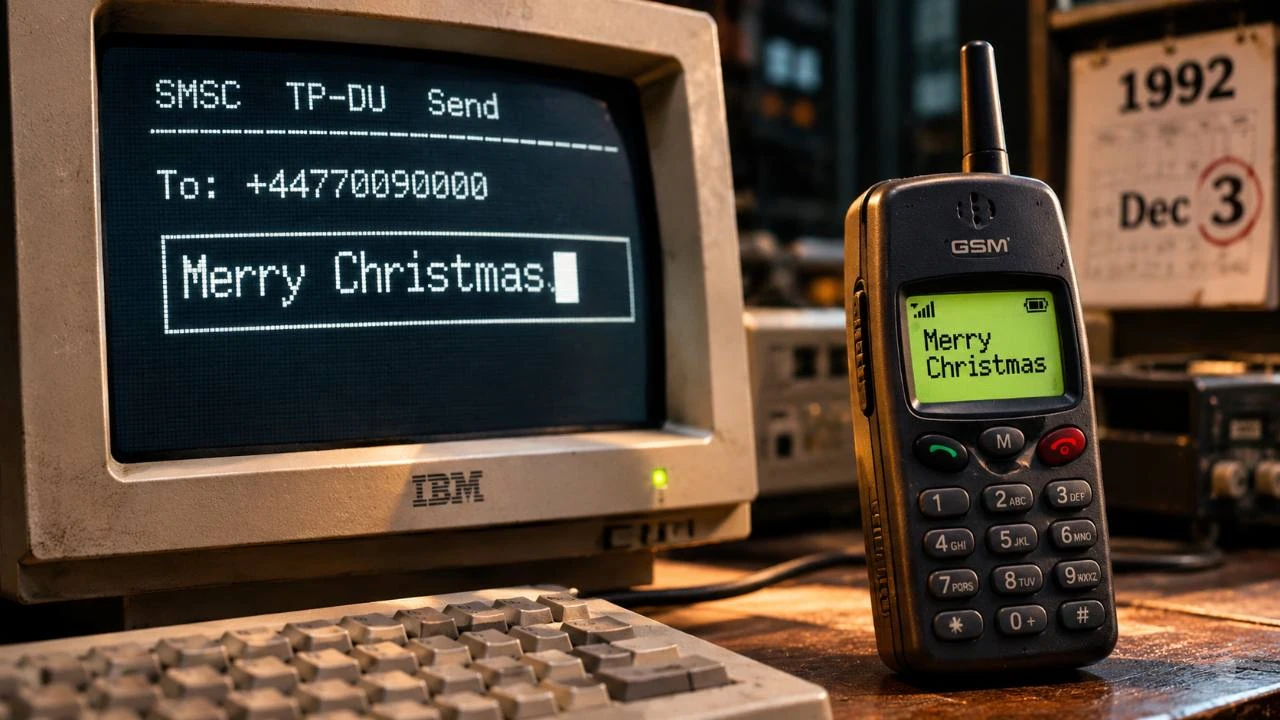
AI-generated historical reconstruction supplied for PRESDA. The devices, screen layout, calendar and displayed number are illustrative, not a photograph or exact recreation of the original equipment or recipient’s number. The historical message was “Merry Christmas”. Editorial image supplied for PRESDA.
The first SMS carried no urgent instruction and no grand prediction. It said “Merry Christmas”. On December 3, 1992, British engineer Neil Papworth typed those two words on a computer and sent them over Vodafone’s network to Richard Jarvis. What looks like a tiny seasonal greeting became a landmark in mobile communication. Crucially, it was a computer-to-phone message, not a text tapped out on another handset. Vodafone: the first SMS on December 3, 1992
What happened on December 3, 1992?
Papworth worked for Sema Group Telecoms on the messaging system. The Mobile Phone Museum identifies the receiving handset as an Orbitel 901 and describes Jarvis as engineering director at Vodafone subsidiary Vodata. This was a demonstration within an emerging mobile service, not the instant launch of today’s mass texting culture. The receiving phone belonged to an era when mobiles were still understood primarily as devices for calls. Mobile Phone Museum: the Orbitel 901 and first SMS
The exact historical greeting matters because later recreations can introduce details that were never part of the transmission. Vodafone’s own record gives “Merry Christmas”, without an added exclamation mark. The approved illustration on this page evokes the period, but its hardware, display and telephone number are not evidence of the original setup. A reconstruction can make history approachable without becoming an archival source. Vodafone: the original message and its digital replica
A first message was not a one-person invention
Papworth’s role as the sender is distinct from the development of SMS. The Computer History Museum credits Friedhelm Hillebrand and Bernard Ghillebaert with setting the basic standard within the Franco-German GSM effort. Standards work made it possible for equipment and networks to understand the same short-message format. The celebrated greeting is one clear moment in a longer history of collective engineering. Computer History Museum: the history and impact of texting
Why were texts limited to 160 characters?
The familiar limit comes from a small technical envelope. A standard SMS can carry 140 octets of user data. With the GSM seven-bit alphabet, that can fit 160 characters. Other encodings change the calculation: the RFC describes 70-character messages with UCS-2. That distinction matters for Arabic and other scripts, which cannot simply be treated as English letters occupying the same space. IETF RFC 5724: SMS length, encoding and message centres
One message can contain several segments
Longer texts can be split and reassembled through concatenation. Some of the available space is then used for the information that joins the pieces, so the per-segment allowance changes. A messaging app can hide those divisions from the reader. This is why the number of visible chat bubbles is not always the number of SMS segments a network transports. IETF RFC 5724: SMS length, encoding and message centres
How a short message travels
SMS is not simply a miniature voice call. A message centre can store a message and forward it for delivery. Sender and recipient therefore do not need to hold an uninterrupted conversation at the same moment. That flexibility does not mean delivery is infallible or instantaneous. The underlying network still determines whether and when a message can reach its destination. IETF RFC 5724: SMS length, encoding and message centres
The cultural change was larger than the greeting
The Computer History Museum places texting in a wider story of everyday communication, commerce and mobile services. Its importance was not only that phones acquired another feature. People could leave a brief written message without demanding an immediate spoken response. The result was a different social rhythm: arrangements, reassurance and quick updates could fit between other activities. Computer History Museum: the history and impact of texting
What “first” does and does not mean
The documented milestone is the first SMS, not the first written electronic communication. Telegraphy, computer messaging and pagers had already shown that words could travel electronically. SMS joined that older possibility to a standardised mobile service. The two-word greeting deserves its place in history because of the system it demonstrated, not because nobody had ever sent text through a machine before.
The lasting lesson is that an innovation can arrive looking ordinary. A seasonal greeting was enough to demonstrate a new channel; years of engineering and adoption made that channel useful. The story works best when both scales remain visible: two words on a screen, and the much larger effort that allowed people to send their own words afterward.
Related reading: The QR code and another quiet revolution in communication.
Related reading: How Android changed the mobile platform.
FAQ
Frequently Asked Questions
What did the first text message say?
It said “Merry Christmas”. Neil Papworth sent it on December 3, 1992 over Vodafone’s network.
Who received it, and on which phone?
Richard Jarvis received it on an Orbitel 901. Papworth sent it from a computer, not another handset.
Does every SMS contain 160 characters?
No. The familiar limit applies to GSM seven-bit encoding. Other encodings and concatenated messages have different per-segment limits.
PRESDA Dispatch
Stay Informed. Stay Aware.
A sharp briefing across AI, gaming, sport, business, world affairs, paparazzi, and lifestyle.