LIE DETECTORS: CAN SCIENCE REALLY DETECT DECEPTION?
What polygraphs actually measure, why nervousness is not proof of lying, and what documented cases and research reveal about AI, eye tracking and brain scans.
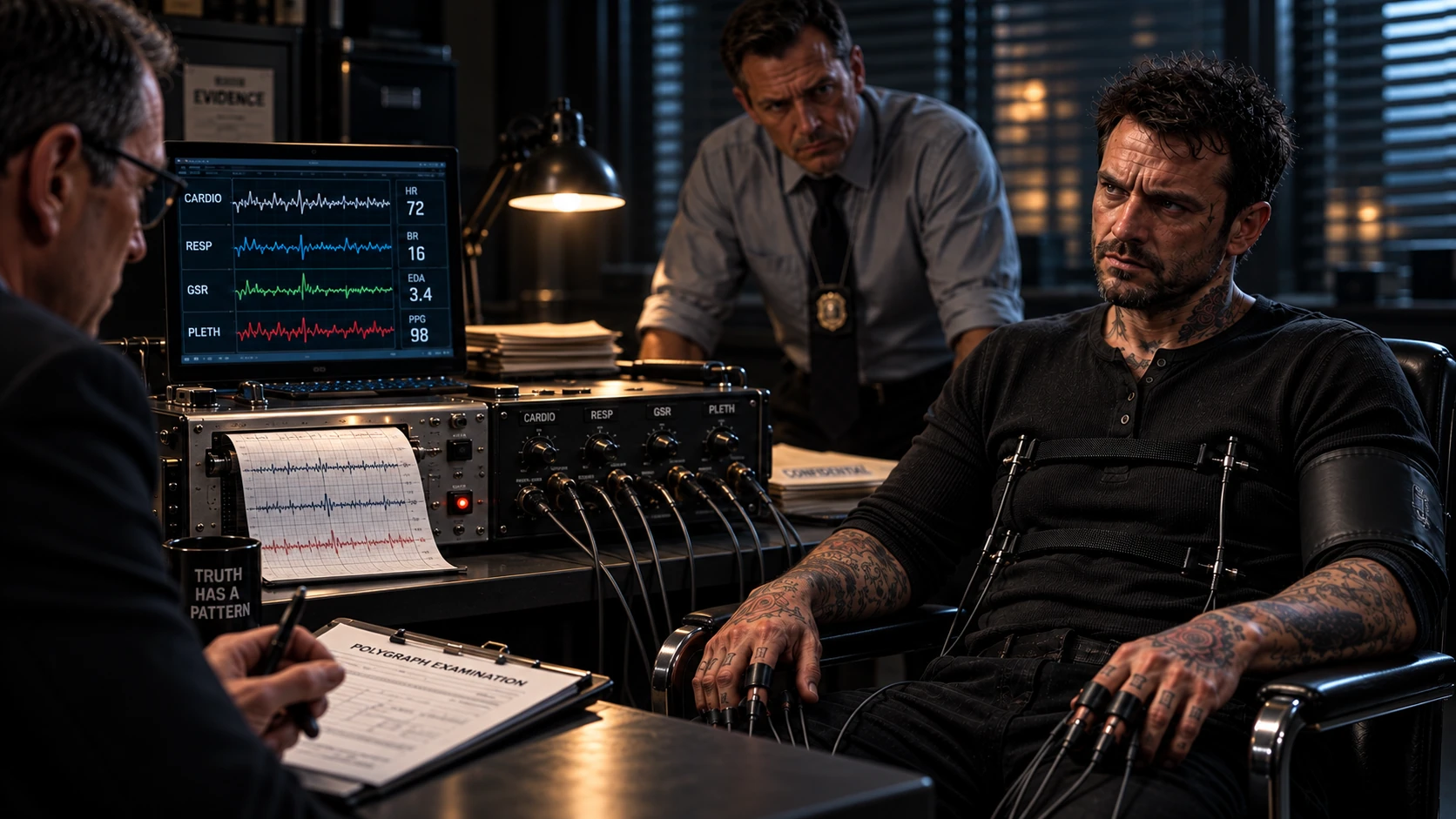
AI-generated editorial illustration of an imagined interrogation. The people, instruments and screen readings are not documentary evidence or an exact technical diagram.
Imagine sitting beside a machine that turns your breathing into a moving line. A cuff tightens around your arm. Sensors touch your fingers. An examiner asks a question, and the trace changes. You know you have answered honestly, but you also know how much depends on being believed. The machine records that moment precisely. What, exactly, has it discovered?
This imagined scene captures the central problem of lie detection: a measurable response is not automatically an explanation. Polygraphs can record physiology and, under some conditions, distinguish groups better than chance. They do not directly observe dishonesty. From early police instruments to artificial intelligence, the scientific challenge is separating deception from other reasons a body or mind reacts. Sources checked on 12 October 2026 support a nuanced account.
A century of trying to make truth visible
There was no single invention that suddenly made lying detectable. Earlier investigators explored blood pressure and other bodily reactions; William Moulton Marston developed a systolic blood-pressure approach. In 1921, John Augustus Larson, working with Berkeley police, built an instrument recording several physiological channels. Leonarde Keeler later refined equipment and techniques. The Smithsonian preserves Larson's early apparatus: an artefact of an ambitious attempt to bring measurement into interrogation, not proof that measurement established truth. Smithsonian: Larson polygraph US congressional historical report
Polygraph means multiple recordings. The name describes an instrument more accurately than lie detector does. Moving pens and paper charts eventually gave way to digital sensors and software, but a better recording system does not resolve the interpretation problem. An apparently objective line promises to settle a dispute. Yet the examiner still chooses questions, applies a procedure and interprets patterns within a human encounter.
What the sensors actually measure
A conventional examination records cardiovascular activity, respiratory movement and electrodermal activity. The latter reflects changes in skin conductance associated with sweat-gland activity. An arm cuff and breathing belts do not read a proposition from the brain; finger sensors do not identify moral intent. These channels respond to processes associated with arousal, attention and anticipation. Physiological recording may be technically reliable while its proposed interpretation as dishonesty remains uncertain. APA: polygraph science
In a comparison-question test, reactions to investigation-relevant questions are compared with reactions to broader questions about past behaviour. The assumption is that deceptive and truthful examinees will find different questions more concerning. The result depends on that comparison, not simply whether a pulse rises. Preparation, wording, the subject's understanding and scoring all matter. Inconclusive outcomes should not be silently treated as either proof of lying or proof of innocence.
The concealed-information test asks a different question: does someone recognise a detail that should not be publicly known? Recognition can produce a distinctive response without establishing who committed a crime. A witness might know the detail; an offender might not remember it; publicity might contaminate it. Investigators must therefore protect relevant information and distinguish knowledge from guilt. Calling both procedures lie detection can conceal the fact that they test different hypotheses.
Accuracy is a question, not a universal percentage
The National Research Council's 2003 review concluded that specific-incident testing in the studied populations, without countermeasure training, could distinguish truthful from deceptive responses substantially better than chance but far short of perfection. It also warned that study biases probably overstated field performance and that results could not simply be transferred to security screening. This is more nuanced than saying polygraphs never detect anything, and more cautious than assigning every examination one impressive accuracy rate. National Research Council, 2003
A 2019 review by William Iacono and Gershon Ben-Shakhar argued that the underlying research quality had changed little and that the major concerns remained. Validation is difficult because investigators need an independent answer to whether someone lied. If a confession influenced by the examination becomes the truth label used to validate that examination, reasoning can become circular. Volunteer mock-crime studies provide clearer labels but weaker parallels with the stakes of an actual investigation. Iacono and Ben-Shakhar, 2019
A false positive labels a truthful person deceptive; a false negative misses deception. Sensitivity, specificity and the treatment of inconclusive results describe different aspects of performance. Reliability asks whether measurements or judgments are consistent; validity asks whether they establish the claimed thing. Screening adds a base-rate problem: when genuine wrongdoing is rare, even a modest false-alarm rate can overwhelm the relatively few genuine detections. Overall accuracy alone cannot tell an accused individual what a result means.
Nervousness, suspicion and two documented cases
Fear of accusation, embarrassment about a comparison question or the pressure of being tested can make an honest person react strongly. A practised or untroubled liar may show a different pattern. Neither possibility means every anxious person fails or every calm person passes. It means there is no unique physiological signature that identifies a lie independently of context. Anxiety is information about a person's state, not a verdict on the statement they have made.
A US Senate investigation reported that CIA officer Aldrich Ames passed polygraph examinations in 1986 and 1991 while involved in espionage. The report identified procedural deficiencies and noted how the 1991 result reduced investigators' suspicion. It does not establish a universally successful cheating method. The documented failure involved an examination process and institutional confidence in its outcome, not just an isolated sensor. A reassuring result helped obscure a threat that required independent investigation. Senate investigation: Ames, 1994
Gary Gauger's case illustrates a different danger. Northwestern University's Center on Wrongful Convictions reports that police told him he had failed a polygraph after his parents' 1993 murders; the result was actually inconclusive. His conviction was reversed in 1996, and he received an innocence pardon in 2002 after other perpetrators were identified. This is not a verified machine-generated false positive. It is a documented misrepresentation of an uncertain result during an interrogation with devastating consequences. Northwestern: Gary Gauger
Can trained people defeat a polygraph?
Yes, some laboratory research shows that countermeasures can reduce detection. In a 1994 study by Charles Honts, David Raskin and John Kircher, 120 community participants underwent mock-crime testing. Of 100 assigned to the guilty condition, 80 received countermeasure training. The authors reported that mental and physical countermeasures each enabled roughly half of the trained participants to defeat the test and were difficult to identify. These figures concern this experiment, not everyone's chances in real examinations. Honts et al., 1994
The important point is scientific, rather than instructional: consciously altering responses can disrupt a procedure that relies on relative physiological reactions. This does not mean a trained person always succeeds, or that a suspicious chart proves deliberate interference. Field conditions, examiner procedures and subject differences complicate generalisation. A claimed detection technology needs testing against plausible attempts to manipulate it, not only against cooperative volunteers following the researcher's script.
Body language does not supply a secret code
People also try to read dishonesty without machines. Charles Bond and Bella DePaulo's 2006 meta-analysis synthesised 206 documents involving 24,483 judges. Without special aids or training, average correct truth-lie judgments were about 54%. That is statistically above chance in the pooled research but a modest discriminatory advantage. It is not a polygraph accuracy figure, nor a universal score for every professional, conversation or kind of deception. Bond and DePaulo, 2006
Looking away, fidgeting or briefly displaying an emotion cannot independently identify a lie. A 2019 review by Aldert Vrij, Maria Hartwig and Pär Anders Granhag described nonverbal deception cues as generally faint and unreliable. Microexpressions may reveal a fleeting expression; they do not establish why it occurred. Concealing embarrassment differs from fabricating an alibi. Cultural expectations and individual behaviour make confident visual stereotypes especially hazardous. Our investigation of cult psychology explores why apparent authority can nevertheless become persuasive. Vrij et al., 2019
Voices and eyes: different measurements, familiar difficulties
Voice-stress systems seek cues in speech, but stress remains an ambiguous target. An NIJ-funded jail study, published in 2007 and summarised in 2008, evaluated two systems against reports of recent drug use checked with urine testing. NIJ reported that only about 15% of the lies were identified. The study addressed particular products and circumstances, not every future speech algorithm. A machine's presence encouraging admissions is also different from its measurements accurately classifying statements. NIJ: voice-stress field study
Eye tracking examines pupil responses, fixations and reading patterns rather than merely where someone looks. Anne Cook and colleagues' 2012 experiments investigated responses to computerised statements about a mock crime. Such work explores cognitive effort and attention; it does not validate the popular claim that a particular gaze direction means lying. Tests requiring reading need independent evaluation across languages and populations. Lighting, task demands and individual characteristics must be considered rather than assuming every pupil change is deceptive. Cook et al., 2012
Artificial intelligence inherits the problem of truth labels
Machine learning can combine speech, wording, facial movement and other features in ways a person cannot easily calculate. A 2023 PLOS ONE systematic review nevertheless identified scarce, limited real-life labelled data and substantial risks of bias. Models often trained on simulated scenarios or repeatedly reused datasets. A classifier's high score within one collection of recordings does not establish dependable judgments about new people in a different setting. PLOS ONE: systematic review, 2023
Independent testing should separate people across training and evaluation sets, examine errors by relevant subgroups and include unfamiliar settings. Otherwise a system might learn features of speakers, recording conditions or experimental roles rather than deception. Those are methodological risks to test, not accusations that every model does so. Marketing a score as truth hides data uncertainty. Automation can make a doubtful judgment look more authoritative without making it better supported.
Brain scans cannot read a verdict
Functional MRI measures blood-oxygen changes associated with neural activity. A 2016 controlled comparison by Daniel Langleben and colleagues studied 28 participants concealing a number they had written down. Independent experts assessed fMRI and polygraph recordings; the study reported an advantage for fMRI in that defined task. This was a concealed-information experiment, not a scanner detecting the truth of any statement or reconstructing an unknown crime. Langleben et al., 2016
Brain activity linked to attention, conflict or response inhibition is not exclusive to lying. A cooperative participant following instructions inside a scanner differs from someone defending an account under criminal suspicion. Individual classification, countermeasures, reproducibility and independent field validation remain crucial. The colourful image can invite the same mistake as the old paper trace: confusing a sophisticated measurement with a self-interpreting answer. Our feature on hypnosis examines a similar gap between brain findings and sweeping claims about minds.
What courts and ethics must ask
Legal treatment varies by jurisdiction and purpose. In United States v. Scheffer in 1998, the US Supreme Court upheld the military rule excluding polygraph evidence against the constitutional challenge before it. That ruling is not a global ban on every investigative use. Separately, the US Employee Polygraph Protection Act generally bars most private employers from such testing, with defined exemptions and restrictions. Current local rules require checking; scientific credibility and legal admissibility are different questions. Supreme Court: Scheffer, 1998 US Department of Labor: EPPA
Consent, privacy and access to challenge a result matter even outside a courtroom. Who sees physiological or brain data, how long is it retained, and can an individual question the interpretation? A detector should not turn refusal into automatic suspicion or uncertain output into pressure to confess. Procedures that influence liberty or livelihood need transparent evidence, scrutiny of error and a way to contest decisions. The burden cannot fairly rest only on the person connected to the equipment.
The most dangerous lie may be certainty
Science can study deception, identify statistical differences under defined conditions and improve how investigators obtain checkable information. It cannot reliably turn every heartbeat, facial movement or scan into a verdict. Stronger interviewing focuses on accounts and independently verifiable evidence rather than a supposed physical mark of dishonesty. Even an inconsistent recollection requires interpretation; memory, stress and misunderstanding can complicate an honest narrative.
The polygraph's enduring fascination comes from a human wish: that truth should leave an unmistakable trace and that someone should know how to read it. The traces are real. The certainty is often not. A responsible investigation keeps the instrument's output separate from the conclusion it hopes to reach. Perhaps the most valuable scientific advance is not a machine that never doubts, but a system of evidence careful enough to doubt its own machines.
FAQ
Frequently Asked Questions
Does a polygraph measure lies directly?
No. It records physiological responses. Inferring deception requires a test procedure and interpretation; arousal is not unique to lying.
Is nervousness proof that someone is lying?
No. Fear, embarrassment and testing pressure can affect an honest person's responses. Context and independent evidence matter.
What is a polygraph's accuracy rate?
There is no universal rate. Task, population, scoring, ground truth and inconclusive results affect estimates; screening differs from specific-incident testing.
Can someone fool a lie detector?
Some trained participants have defeated tests in controlled experiments. This establishes vulnerability, not a guaranteed method or a universal success rate.
Are AI and brain scans proven replacements?
Research shows task-specific promise, but it does not establish a universal truth detector or routine proof of guilt.
PRESDA Dispatch
Stay Informed. Stay Aware.
A sharp briefing across AI, gaming, sport, business, world affairs, paparazzi, and lifestyle.