THE LONDON BEER FLOOD: WHEN A CITY STREET FILLED WITH BEER
A brewery vat burst in London on October 17, 1814, killing eight people. Discover the Beer Flood’s causes, victims and the myths that followed.
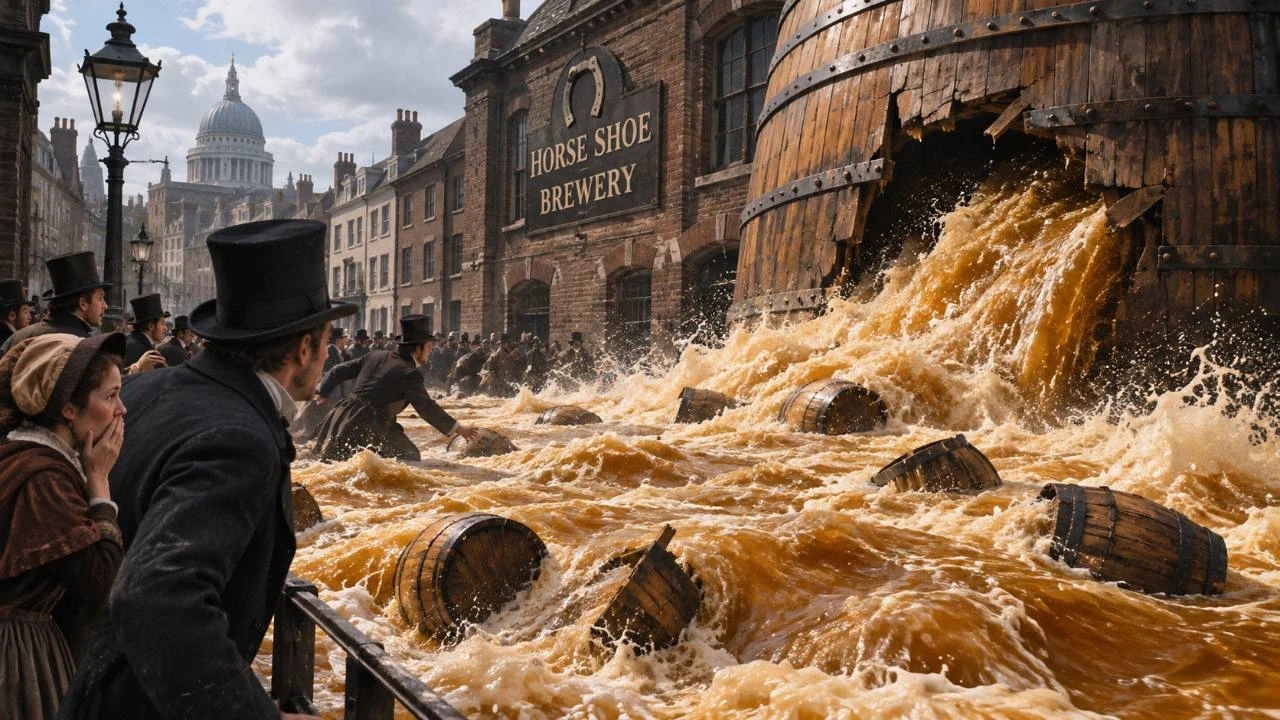
AI-generated historical illustration supplied for PRESDA. The street, crowd, skyline, exposed vat and dramatic wave are imagined. This is not a photograph, a contemporary eyewitness image or an accurate plan of the brewery and flood area.
The London Beer Flood was real, but it was not a city enjoying an unexpected free drink. On October 17, 1814, a huge wooden vat failed at Meux’s Horse Shoe Brewery near Tottenham Court Road. Beer broke out of the premises and entered nearby streets and homes. Eight people died. The British Library’s account preserves their names and the inquest’s finding of accidental death, bringing a human scale to an event too often retold as a joke. British Library: archived London Beer Flood account and inquest
How a brewery became a flood hazard
The initiating failure involved an iron hoop holding together a large vat of porter, the dark beer stored in enormous quantities at London breweries. Its collapse damaged another vessel and smaller containers, enlarging the release. This was a structural failure with cascading consequences. Calling it a beer explosion can obscure the mechanism: liquid escaping from a massive storage vessel, collapsing masonry and carrying debris into densely occupied housing. Christopher Klein, HISTORY: the London Beer Flood
How much beer escaped?
The British Newspaper Archive’s summary of contemporary reporting gives approximately 1.5 million litres for the flood. Published estimates vary, and the contents of the first vat should not be confused with the total released from damaged containers. The important physical fact is not an exact modern conversion. Enough liquid escaped suddenly to destroy houses and fill cellars, turning ordinary rooms into places from which escape could be impossible. British Newspaper Archive: contemporary reports of eight deaths
Why St Giles suffered so badly
The brewery stood beside the crowded St Giles neighbourhood, where poor families occupied vulnerable buildings and cellar rooms. The flood brought both drowning and falling masonry. A household below street level had a different chance of escape from someone able to climb upstairs. The disaster’s strange material does not make its social pattern unusual: industrial power and dense housing existed side by side, while those outside the factory bore its worst consequences. Christopher Klein, HISTORY: the London Beer Flood
The eight people behind the headline
Among the named victims was Eleanor Cooper, a 14-year-old servant at the Tavistock Arms. The British Library also records Hannah Banfield, aged four. These names resist the temptation to treat the event as harmless spectacle. Its account describes a girl who escaped because she had been allowed out to play shortly before relatives died inside a nearby house. Survival could turn on small differences of position and timing. British Library: archived London Beer Flood account and inquest
The inquest and the unequal aftermath
The inquest treated the deaths as accidental. The brewery continued operating and recovered excise duty previously paid on the lost beer. That financial outcome should not be mistaken for compensation to bereaved neighbours. An industrial business could rebuild its balance sheet; families had lost lives, homes and belongings. The comparison helps explain why the flood belongs in social and industrial history as well as in collections of extraordinary events. Londonist: flood geography and the unsupported ninth-victim story
Did a ninth person drink themselves to death?
Some later accounts add a death from alcohol poisoning; Historic England’s caption for an Edwardian brewery photograph repeats that claim. It is not the same evidence as the eight deaths recorded by the inquest. Londonist notes that the ninth-victim story lacks support in contemporary newspapers and the coroner’s report. The responsible conclusion is eight documented victims, with the extra drinking-related death identified as an unverified later claim rather than added to a settled total. Historic England: Horse Shoe Brewery archive photograph
A disaster worth remembering accurately
The brewery site is associated today with the Dominion Theatre, while the vanished lanes and damaged homes are harder to imagine. The flood remains memorable because beer seems an improbable agent of destruction. Its deeper significance lies elsewhere: the dangerous proximity of huge industrial stores and vulnerable households. Remembering the victims, separating estimates from facts and resisting the drunken-crowd legend turns an astonishing anecdote back into history.
Related reading: How destructive events reshape communities.
Related reading: The long history of beer, wine and spirits.
FAQ
Frequently Asked Questions
When did the London Beer Flood happen?
It happened on October 17, 1814, at Meux’s Horse Shoe Brewery near Tottenham Court Road in London.
How many people died?
The inquest documented eight deaths. A later claim about a ninth person dying from alcohol poisoning is unverified.
Was the flood caused by a river?
No. A large brewery vat failed, damaging other containers and releasing porter into nearby streets and homes.
Was the flood a free-beer celebration?
It was a fatal industrial accident. Stories of widespread drunkenness should not be treated as established contemporary evidence.
PRESDA Dispatch
Stay Informed. Stay Aware.
A sharp briefing across AI, gaming, sport, business, world affairs, paparazzi, and lifestyle.