NVIDIA to Invest $3 Billion in Meta to Expand Muse AI Partnership
NVIDIA announces a planned $3 billion Meta equity investment and expanded Muse AI collaboration. What is confirmed, what is proposed and what comes next.
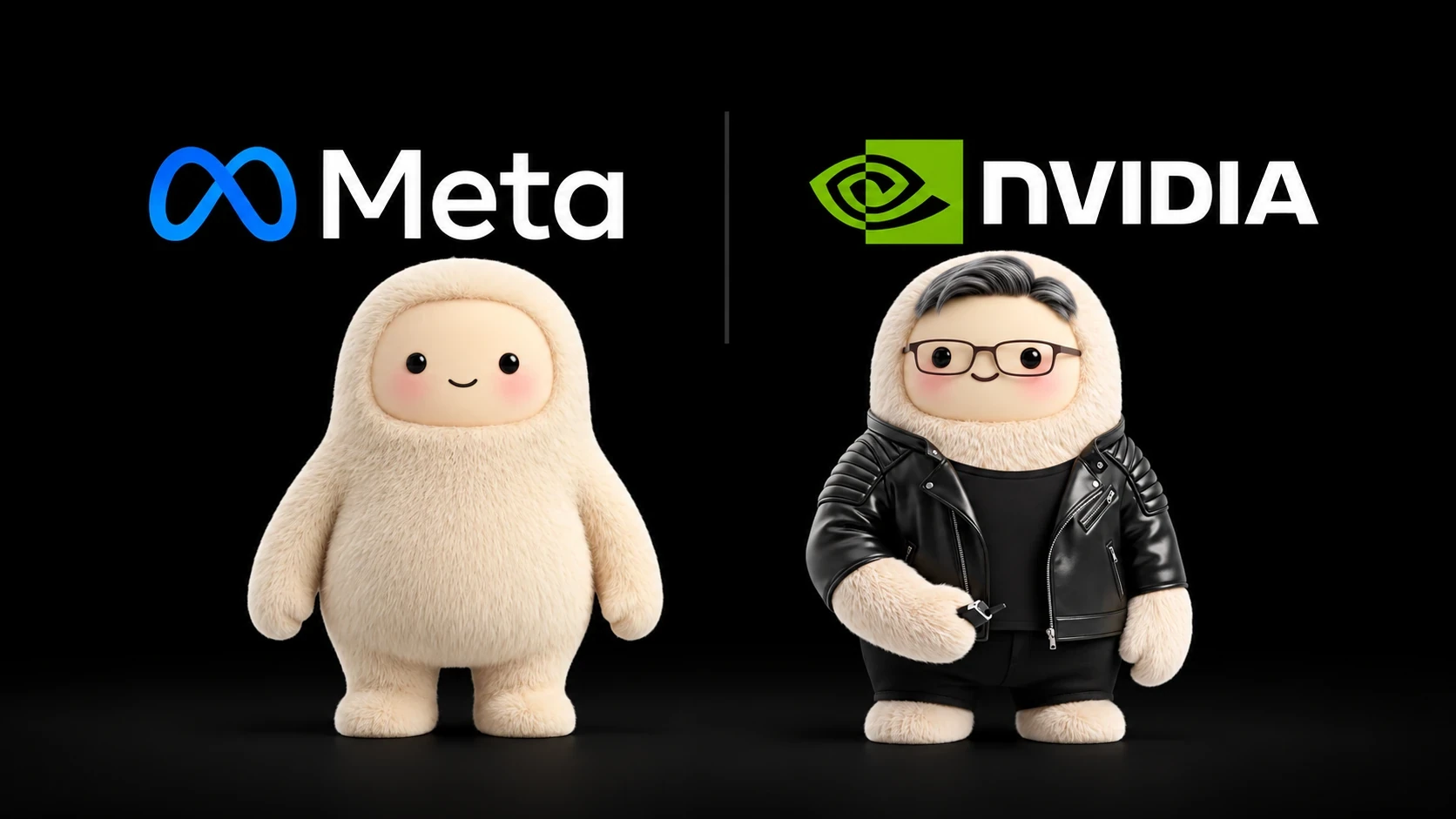
PRESDA AI-generated editorial illustration. Stylized figures and company logos illustrate the announced partnership; this is not a photograph of a meeting or signing.
NVIDIA has announced plans to invest $3 billion in Meta through an equity offering, alongside an expanded collaboration on Muse and its family of AI models. The agreement brings a capital commitment together with work on the computing systems behind Meta's AI services. It is a proposed investment, not evidence that the transaction has already closed. NVIDIA's official announcement
What has been announced
NVIDIA's October 26, 2026 statement sets out a broader relationship covering model training, inference and infrastructure. Reuters subsequently reported the planned $3 billion investment. The announcement does not specify the share price, the resulting ownership percentage or a completed closing date. Those omissions limit what can responsibly be said about the financial transaction. Reuters reporting
An equity investment and a hardware purchase are different things. The first buys an ownership interest; the second pays for equipment or related services. The announcement links investment and collaboration strategically, but it does not establish that the entire $3 billion will be spent on a particular quantity of NVIDIA chips. Nor does it describe NVIDIA acquiring control of Meta.
Announced commitments versus completed results
The companies frame improvements in cost and performance as goals. NVIDIA's release treats the investment's completion and expected benefits as forward-looking and subject to conditions and risks. “Will invest” therefore needs to remain distinct from “has invested.” Readers should also distinguish intended deployments from technology that a company is merely considering.
What is Muse?
Meta introduced Muse in September as a personal AI agent available through its own interface and WhatsApp. Its stated purpose extends beyond answering a question: it can use tools to carry out tasks. Meta describes a separate secure virtual machine with a browser as part of the system supporting those actions. Meta's Muse launch
The distinction between a conversational assistant and an agent is practical. A model can explain how to complete an activity; an agent may attempt intermediate steps using software. That introduces questions about permissions, mistakes and accountability. A fluent response is not, by itself, evidence that a booking, document or other action has been completed correctly.
Meta's product information describes free use subject to limits and paid options for additional usage. It also sets out approval controls for certain actions. These are descriptions of the service offered by its developer, rather than independent findings that every workflow is secure or reliable. Availability, features and limits should be checked against the current product page. Official Muse product information
The agent and the model family are different layers
In October, Meta introduced Muse Wonder and Wonder Full. Models provide capabilities that can support products, while the agent adds interfaces, tools and controls around those capabilities. Meta's model announcement describes distribution through developer and coding products as well as plans for the agent. Treating all of those layers as one interchangeable application obscures what the partnership is trying to improve. Meta: Muse Wonder models
Why training and inference both matter
Training is the process through which a model's parameters are learned. Inference is the use of a trained model to process new inputs and generate outputs. NVIDIA's technical glossary distinguishes these stages; they place different demands on computing systems. A partnership aimed at both is concerned with developing models and operating them once people begin using the service. NVIDIA: AI inference
For an agent, one user request may involve several model calls and tool interactions. That makes cost per successful task a useful analytical question, alongside the speed of an individual response. This is an editorial way to assess future performance, not a metric the companies have demonstrated in this announcement. A lower cost per token would not automatically prove a lower cost for a correctly completed task.
Chips, networks and the cost of a complete system
The official release names Vera Rubin and Vera CPUs in Meta's expansion plans, along with Spectrum-X Ethernet and BlueField-4 networking infrastructure. It separately says Meta is considering OpenShell reference architecture and Sentry monitoring. “Considering” should not be converted into a claim that those tools are already deployed throughout the service.
An AI system is more than its processors. Moving data between machines, keeping equipment occupied, managing memory and operating software all affect the economics. This helps explain why a collaboration can involve hardware, networking and model engineering simultaneously. The announcement alone does not quantify how much each part will contribute to any eventual savings.
A partnership within a broader computing strategy
Meta's own explanation of its infrastructure strategy describes a mix of custom silicon and external partners, including NVIDIA, AMD and AWS. That wider context matters: this agreement should not be read as proof of an exclusive supplier relationship or the abandonment of Meta's other technology projects. Meta: computing infrastructure
Large AI services also depend on systems beyond a data centre's walls. Connectivity, power and the movement of information remain part of their practical operation. PRESDA's undersea cables explainer examines the physical networks behind international digital communication, a useful counterpoint to the idea of AI as a purely intangible product.
What to watch next
The next meaningful evidence would include confirmation that the investment has closed, clearer financial terms and measured results from deployed systems. Claims of efficiency are most useful when they specify the workload, hardware, comparison baseline and quality of the output. Without those details, an aspiration to reduce total cost of ownership remains a target rather than an independently established saving.
Muse's development also raises a separate question: whether users can understand, supervise and reverse the actions an agent takes for them. Capital and computing capacity can support a product's growth, but they do not settle that question. The significance of this deal will depend on what the companies deliver after the announcement, as well as the money they propose to exchange.
FAQ
Frequently Asked Questions
What is this PRESDA article about?
NVIDIA announces a planned $3 billion Meta equity investment and expanded Muse AI collaboration. What is confirmed, what is proposed and what comes next.
Which category does this story belong to?
This story is part of PRESDA's AI coverage.
Who published this article?
NVIDIA to Invest $3 Billion in Meta to Expand Muse AI Partnership was published by PRESDA Editorial on PRESDA.
PRESDA Dispatch
Stay Informed. Stay Aware.
A sharp briefing across AI, gaming, sport, business, world affairs, paparazzi, and lifestyle.