PRINCESS DIANA: THE LIFE, TRAGEDY AND LEGACY OF THE PEOPLE'S PRINCESS
Diana’s life from childhood and royal marriage to motherhood, HIV advocacy, landmines, the Paris tragedy and the official findings behind her enduring legacy.
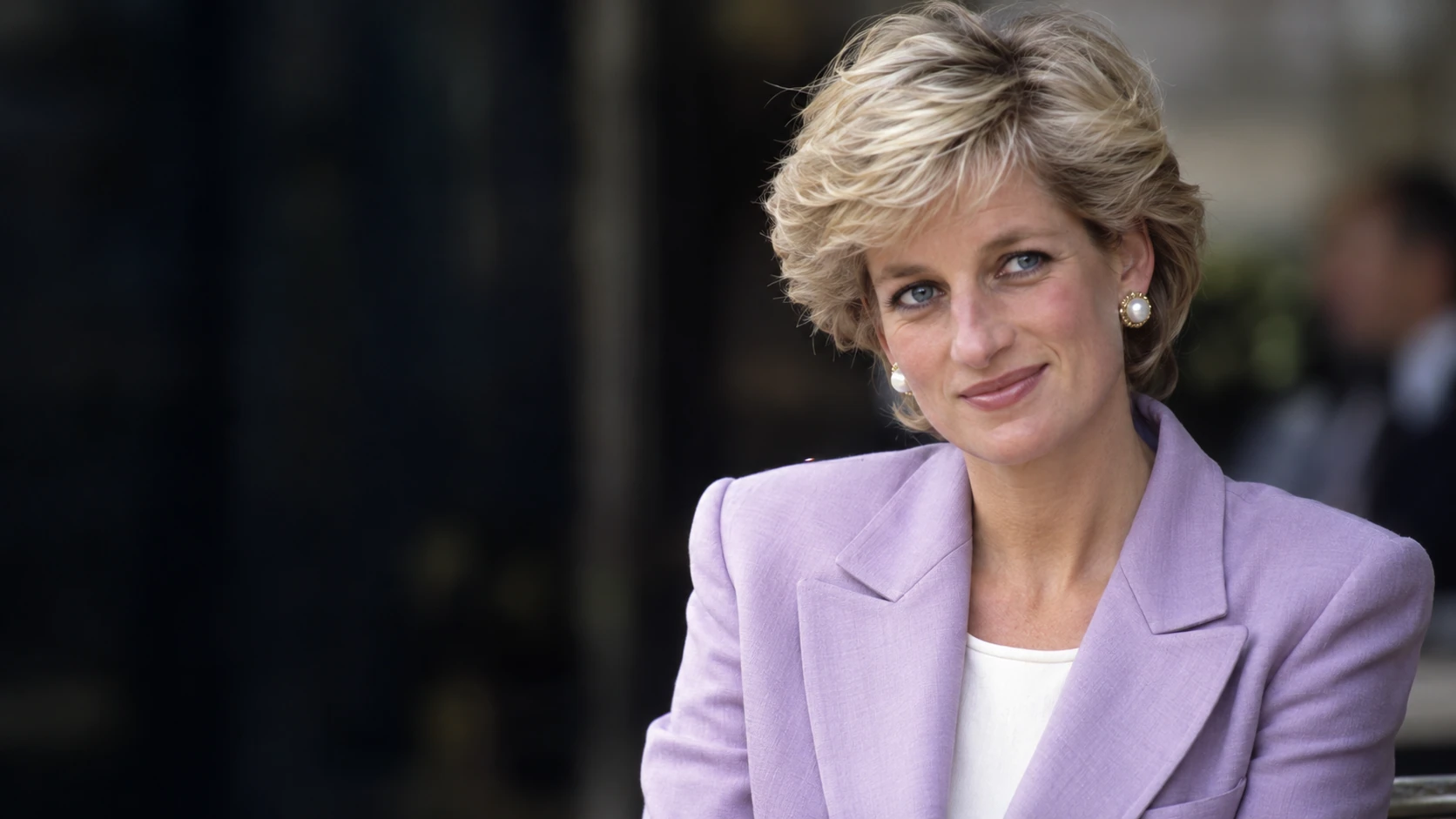
Supplied editorial portrait illustration. This opening image is not presented as an archival photograph; authentic historical photographs below carry individual source and reuse credits.
In April 1987, Diana, Princess of Wales, held the hand of a man living with HIV at London’s Middlesex Hospital. There was no protective glove between them. The encounter was brief, but the photograph challenged a prejudice that medical explanations alone had struggled to overcome: the belief that ordinary contact with someone who had HIV was dangerous. A princess whose image usually advertised glamour was making compassion visible. National AIDS Trust: Diana and HIV
That moment offers a better starting point for Diana’s biography than either the fairy-tale wedding or the wrecked car. Her life contained both extraordinary privilege and public vulnerability. She was a mother, a working royal, a celebrity pursued by photographers and an advocate who could bring attention to people otherwise overlooked. None of those identities explains her completely; together they help explain why her death became a shared memory across generations.
Diana lived from 1 July 1961 to 31 August 1997. She married Charles in 1981, became the mother of William and Harry, and divorced in 1996. The essential distinction in telling her story is between documented events, personal testimony and later interpretation. Her humanitarian influence is real. So are the failures established by investigations into the BBC interview and her death. Conspiracy theories do not acquire equal evidential weight merely by surviving online.
Before the palace: Diana Spencer
Diana Frances Spencer was born at Park House, near Sandringham in Norfolk. Her upbringing was aristocratic, not the ordinary childhood sometimes suggested by the Cinderella version of her story. Her parents separated in 1967 and divorced in 1969. When her father inherited the Spencer earldom in 1975, she became Lady Diana and the family moved to Althorp. Proximity to royalty, however, was not the same thing as preparation for becoming one of the world’s most scrutinized women. Royal Household: Diana’s biography
Her education took her through Riddlesworth Hall, West Heath and a finishing school in Switzerland. She later lived in London, cared for a child and worked at the Young England kindergarten in Pimlico. These years matter because they place a young woman before the public symbol: someone whose early adult experience involved children and practical care, rather than a long apprenticeship in constitutional duties. Her engagement was announced in February 1981, when she was nineteen.
The wedding and the image of a perfect future
On 29 July 1981, Diana married the Prince of Wales at St Paul’s Cathedral. She had turned twenty earlier that month. The ceremony, crowds and television coverage made the marriage a worldwide spectacle. Her ivory silk-taffeta gown, designed by David and Elizabeth Emanuel, had a 25-foot train. Historic Royal Palaces preserves the dress’s place in a history of royal ceremony, craftsmanship and the immense expectations attached to a bride’s appearance. Historic Royal Palaces: royal weddings
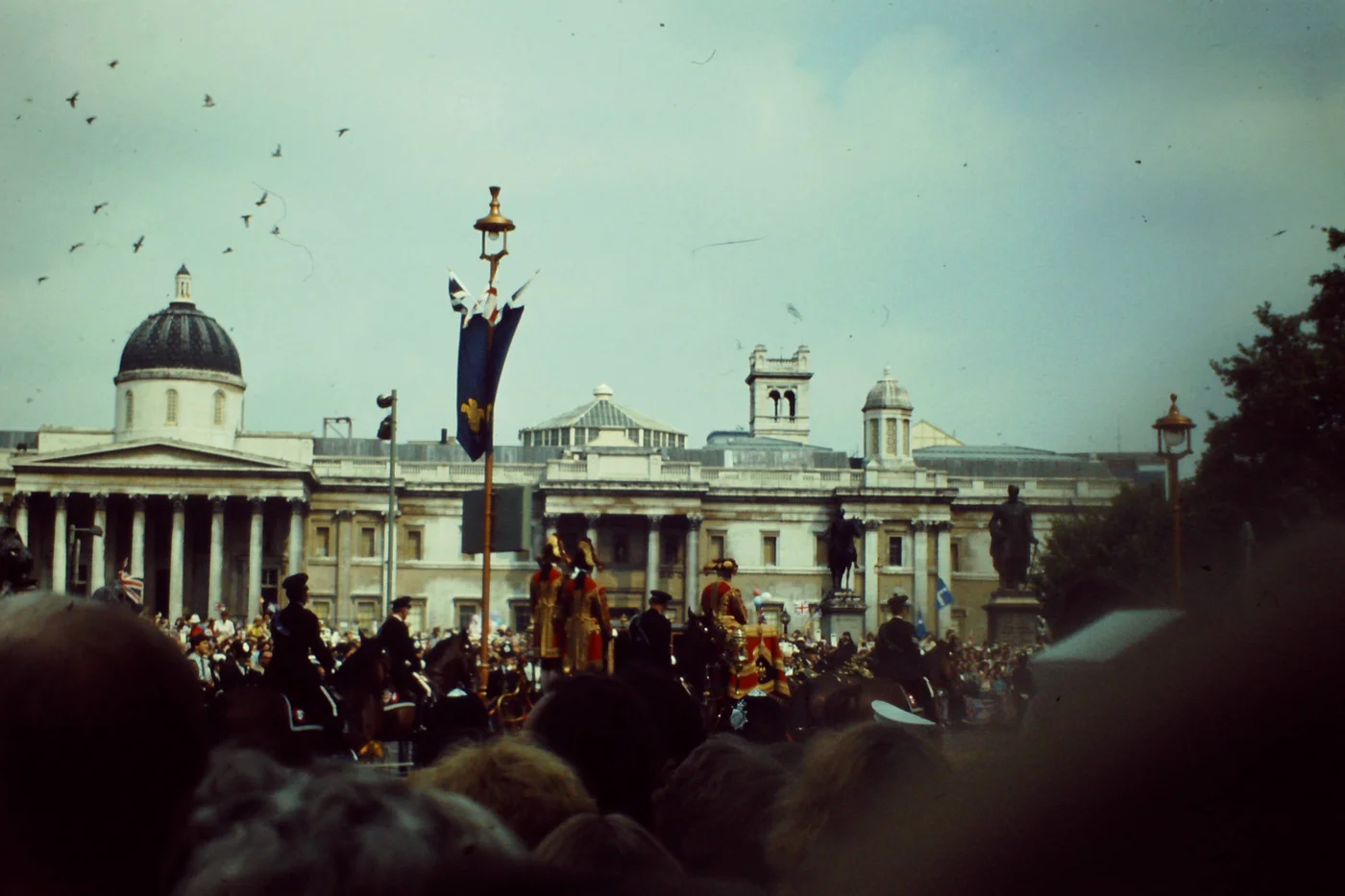
Crowds surround the coach carrying Lady Diana Spencer toward St Paul’s Cathedral for her wedding, July 1981. This is a distant procession view, not a close-up of the bride.
CC BY-SA 2.0. Resized and converted to WebP by PRESDA. Full composition preserved. Reuse follows the individual license stated here.
The visual promise was irresistible: youth, continuity, romance and a future king’s marriage presented in a single procession. Yet a wedding photograph can establish who was present and what was worn; it cannot demonstrate the emotional condition of a marriage. Looking back, it is tempting to read every expression as an omen. Responsible biography resists that temptation. The public ceremony was a documented event, while the private relationship unfolded over years.
William, Harry and the work of being a mother
William was born on 21 June 1982 and Harry on 15 September 1984. Their births made Diana central to the monarchy’s future, but motherhood also gave her public role a more intimate dimension. The boys would grow up with both the privileges of royal life and the attention directed at their parents. Those birth dates are straightforward facts; claims to know every feeling within the family are something else. Royal Household: family chronology
One documented example of her parenting reaches beyond the familiar holiday photographs. Centrepoint records that Diana took William and Harry on private visits to its homelessness services. Such visits brought them into contact with lives very different from their own. William later became the charity’s patron in 2005. The continuity is more concrete than a sweeping claim that a son inherited every aspect of his mother’s character: an introduction to an organization became a lasting commitment. Centrepoint: Diana’s visits and William’s patronage
Charles, Camilla and a marriage in public
The breakdown of the marriage cannot responsibly be reduced to a collection of anonymous anecdotes. Charles’s relationship with Camilla Parker Bowles was central to the public account of its collapse. In a 1994 television documentary, he acknowledged adultery; Diana acknowledged her relationship with James Hewitt in her 1995 interview. Contemporary reporting records those admissions. They are firmer ground than imagined private conversations or retrospective scenes written for entertainment. UPI archive: divorce and public admissions
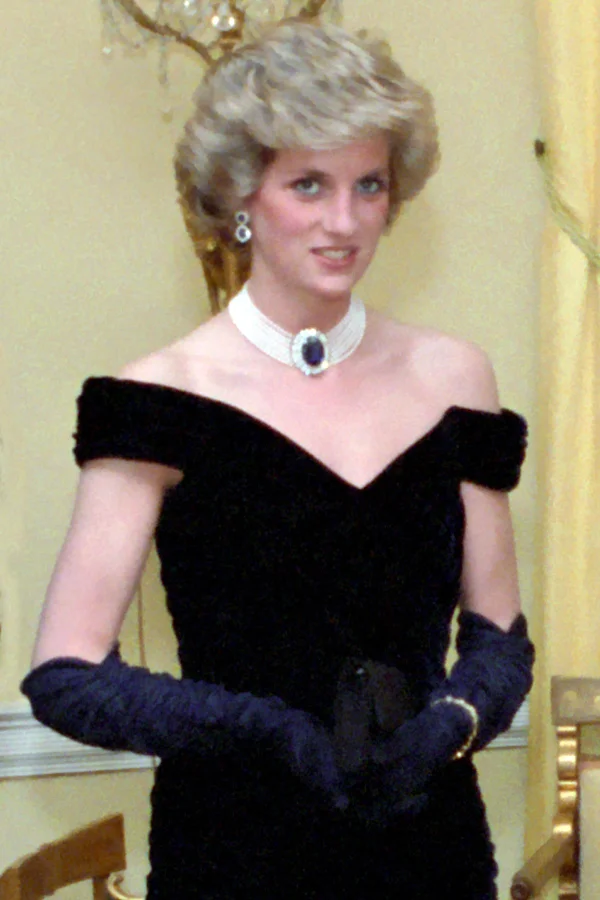
Diana at the White House on 9 November 1985, in the Yellow Oval Room. Archival crop from a White House photograph, preserved by the Ronald Reagan Presidential Library.
White House photographer / Ronald Reagan Presidential Library
Public domain. Resized and converted to WebP by PRESDA. Full composition preserved. Reuse follows the individual license stated here.
Separation was announced in December 1992, and the divorce became final on 28 August 1996. Diana retained the name Diana, Princess of Wales, but ceased to use Her Royal Highness. A legal settlement ended the marriage; it did not end her relationship with her children or the public’s interest in her. Charles and Camilla’s relationship belongs in this history, but assigning every difficulty to a single person would flatten a complicated marriage into a moral fable.
The press was not merely watching from a distance. Interviews, books and published private conversations turned family conflict into an ongoing public narrative. PBS’s chronology of the royals and the press documents that escalation. Diana sometimes used publicity to communicate her position, yet access to a microphone did not mean control over the market for her image. Cooperation with some coverage and objection to intrusion could coexist. PBS FRONTLINE: the royals and the press
Panorama: her words and the deception behind the interview
The BBC broadcast Martin Bashir’s Panorama interview with Diana on 20 November 1995. It became a defining account of her unhappiness and her relationship with the institution she had married into. But the program’s fame cannot be separated from the later finding that deceptive methods had been used to obtain access to her. In 2021, Lord Dyson’s investigation examined how the interview had been secured and how the BBC had handled concerns about it. Dyson investigation: original report
Dyson found that Bashir commissioned fake bank statements, showed them to Diana’s brother Earl Spencer and used deception to induce him to arrange a meeting. The report also found serious failures in the BBC’s internal investigations and its disclosure of what it knew. These are findings about journalistic conduct, not a license to treat every word Diana spoke as fabricated. Nor was Dyson conducting an inquiry into the Paris crash. Keeping the investigations separate protects both historical accuracy and Diana’s agency.
Reuters reported that the BBC accepted the findings and apologized. The episode changes how the interview should be presented: not as an unqualified triumph of access, and not as a complete explanation of a life. A person’s testimony may be significant while the circumstances in which it was obtained remain ethically compromised. Quoting a famous line without that context risks repeating the original imbalance between the interview’s impact and its methods. Reuters: findings and BBC response
HIV/AIDS: using visibility against stigma
Diana’s work on HIV was sustained, not confined to one photograph. The National AIDS Trust remembers her visits, public support and decision to remain its patron after reducing her charitable commitments in 1996. She met adults and children living with HIV when fear and moral condemnation often shaped the response to them. The significance lay in whom she chose to acknowledge, as well as the scale of the attention she could attract.
The medical point should be stated plainly: HIV is not transmitted by shaking hands, hugging or ordinary social contact. Diana did not change the biology of the virus. She helped challenge a social response that confused infection with untouchability. WHO’s explanation remains useful because the famous handshake should be understood as a rejection of misinformation, not as a medically dangerous act made safe by courage. WHO: HIV transmission and prevention
Her contribution should sit beside the work of patients, activists, clinicians and community organizations, rather than replace it. Celebrity could widen the audience; it could not supply treatment or dismantle discrimination alone. That distinction makes the legacy stronger. It identifies a specific achievement, using royal visibility to humanize people affected by an epidemic, without claiming that one person transformed every public attitude or solved a public-health crisis.
Angola: a cleared path through a larger danger
In January 1997, Diana visited Angola and walked along a cleared route through a minefield in Huambo, wearing protective equipment associated with The HALO Trust. The images drew international attention to weapons that continued to injure civilians after fighting had moved elsewhere. HALO’s account places her visit within the long work of clearance and recovery. The photograph was powerful, but the safer path existed because trained deminers had prepared it. The HALO Trust: Diana’s visit and legacy
Her intervention helped make the consequences of landmines visible to audiences far from affected communities. It did not create the international campaign single-handedly. The 1997 Nobel Peace Prize went to the International Campaign to Ban Landmines and its coordinator Jody Williams. Recognizing that coalition preserves the role of survivors, local workers, campaigners and diplomats. Diana’s contribution was amplification at an important moment, not personal authorship of a global disarmament movement. Nobel Committee: the 1997 Peace Prize
The treaty opened for signature in Ottawa in December 1997, after her death. The UN’s contemporary account describes a broad coalition and negotiations, not a change achieved by celebrity alone. Her landmine work also illustrates a wider transformation: the woman so often examined as a fashion image was directing cameras toward the enduring consequences of war. United Nations: the landmine treaty process
Paris, 31 August 1997
After leaving the Ritz in Paris shortly after midnight, Diana and Dodi Fayed were traveling in a Mercedes driven by Henri Paul, with bodyguard Trevor Rees-Jones in the front passenger seat. The car struck a pillar in the Alma underpass. Fayed and Paul died at the scene; Rees-Jones survived serious injuries. Diana was taken to Pitié-Salpêtrière Hospital and died after emergency treatment. She was thirty-six. The Operation Paget report provides the documented sequence. Metropolitan Police: Operation Paget report
The tragedy invited speculation partly because it seemed impossible to reconcile an intensely visible life with a sudden, chaotic death. But emotional disbelief is not evidence of a plot. The 2006 Operation Paget investigation examined allegations of conspiracy to murder and did not substantiate them. It should not be confused with the later inquest, which had a different purpose and considered how the deaths occurred. Neither process supports presenting an assassination theory as an established fact.
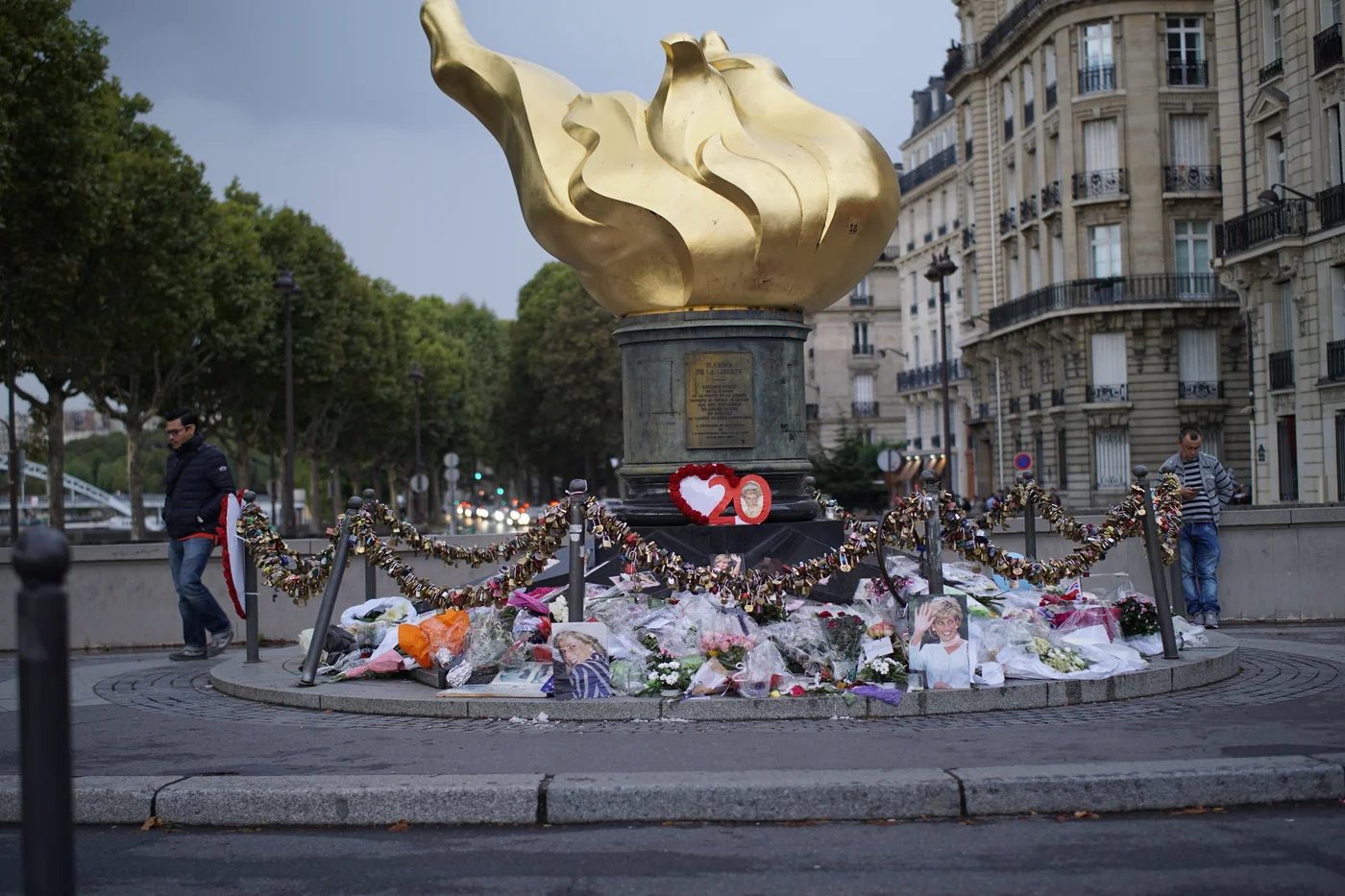
Tributes at the Flame of Liberty near the Alma underpass, photographed on 1 September 2017. This is a memorial scene twenty years after Diana’s death, not a photograph of the 1997 crash.
CC BY-SA 4.0. Resized and converted to WebP by PRESDA. Full composition preserved. Reuse follows the individual license stated here.
What the official inquest found
On 7 April 2008, the inquest jury returned verdicts of unlawful killing, attributing the deaths to grossly negligent driving by Henri Paul and the following vehicles. The jury also identified alcohol’s impairment of Paul’s judgment and the failure of Diana and Fayed to wear seat belts as contributing factors. The verdict concerned fatal negligence; it was not a finding of a premeditated royal or intelligence-service murder. Associated Press: the inquest verdict
The words “unlawful killing” can mislead when detached from that explanation. They should not be converted into a claim that a secret conspiracy was proved, or that individual photographers were convicted at the inquest. A coroner’s inquiry establishes circumstances of death; it is not the same proceeding as a criminal trial. The historical record allows serious criticism of dangerous conduct without inventing a different verdict. The LSE legal study of inquests provides useful context for that distinction. LSE: inquests and the Diana verdict
The funeral: public grief, private loss
Diana’s funeral took place at Westminster Abbey on 6 September 1997. The procession and service gave public mourning a focus, while flowers and messages made grief visible in the streets. The Abbey records the tributes left at its gates and the departure of the coffin for Althorp, where she was buried privately on an island in a lake. The public farewell and the family burial were distinct parts of the same day. Westminster Abbey: funeral and burial
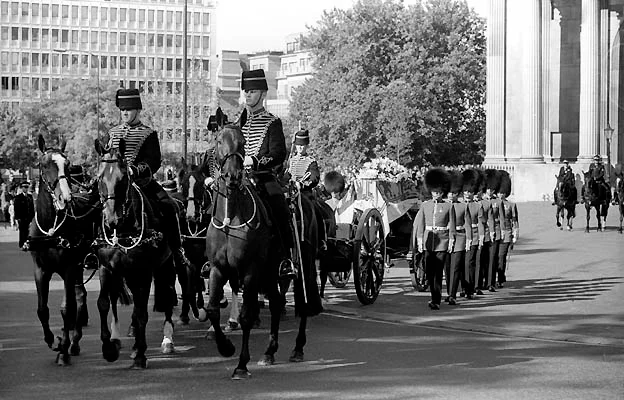
Diana’s funeral procession passes St James’s Park on 6 September 1997. Authentic archival photograph by Jialiang Gao. The small original resolution is retained without enlargement.
Jialiang Gao / peace-on-earth.org
CC BY-SA 3.0. Resized and converted to WebP by PRESDA. Full composition preserved. Reuse follows the individual license stated here.
It is possible to describe the scale of attention without repeating uncertain worldwide audience totals as audited facts. What survives in photographs is already striking: a ceremonial carriage, crowds and a city marking a death. For William and Harry, however, the woman being mourned was their mother. A biography should leave room for that difference between a public symbol and a family relationship, rather than treating grief as another performance to decode.
Beyond the icon
Diana’s fashion remains part of her cultural legacy, but even that history was about more than decoration. Historic Royal Palaces traces how her clothing adapted to public duties and the messages she wished to convey. Appearance could communicate formality, accessibility or confidence before she spoke. The archive offers evidence of those choices; it does not make an outfit a reliable diagnosis of her inner life. Historic Royal Palaces: Diana’s dress codes
Her story also asks us to look critically at images. An authentic photograph can still be cropped, selectively captioned or removed from its date and context. A convincing reconstruction is not archival evidence. The distinction is central to PRESDA’s feature on photography and visual authenticity. Here, the supplied opening portrait is labeled as an editorial illustration; the historical photographs retain their own dates, source records and reuse credits.
The lasting value of Diana’s story does not require either sainthood or a conspiracy. It lies in the coexistence of influence and vulnerability: a woman born into privilege who brought attention to exclusion, a mother inside a public institution, and a celebrity whose visibility could be both a resource and a burden. Remembering the People’s Princess responsibly means preserving her achievements, acknowledging complexity and allowing evidence to set the limits of the story.
FAQ
Frequently Asked Questions
What is this PRESDA article about?
Diana’s life from childhood and royal marriage to motherhood, HIV advocacy, landmines, the Paris tragedy and the official findings behind her enduring legacy.
Which category does this story belong to?
This story is part of PRESDA's Paparazzi coverage.
Who published this article?
PRINCESS DIANA: THE LIFE, TRAGEDY AND LEGACY OF THE PEOPLE'S PRINCESS was published by PRESDA Editorial on PRESDA.
PRESDA Dispatch
Stay Informed. Stay Aware.
A sharp briefing across AI, gaming, sport, business, world affairs, paparazzi, and lifestyle.