
SNAPCHAT LETS CREATORS BUILD AR FILTERS USING AI CODING TOOLS
Snap’s Easy Lens CLI connects AI coding assistants to AR creation. Explore the workflow, testing, publishing review and creator-payment limitations.
Supplied editorial illustration of imagined AR effects. Not a verified screenshot of Easy Lens CLI or a product-interface specification.
Snapchat creators can now build augmented-reality experiences through AI coding assistants including Claude Code, Codex and Cursor. Snap announced Easy Lens CLI on November 18, 2026, describing a free tool that connects an existing assistant to its Lens creation workflow. The important change is the route into development: creators can work through tools they already use, rather than start every project in a separate visual editor. Snap: Easy Lens CLI launch, November 18, 2026
The announcement covers camera effects, beauty experiences and Web Lens games, not just a decorative overlay on a photograph. A creator can describe an idea, ask the assistant to assemble it, generate assets and test revisions. Publication still passes through Snap’s review process.
| Stage | What Snap describes |
|---|---|
| Create | Use an existing AI coding assistant with Snap’s AR resources. |
| Test | Render previews and send versions to a phone. |
| Publish | Use the normal content checks and Lens review process. |
| Earn | Eligible approved creators may participate in Lens+ Payouts; payment is not guaranteed. |
What is Easy Lens CLI?
CLI means command-line interface. Here it provides a bridge between an AI coding assistant and Snap’s authoring tools. The assistant can carry out technical steps while the creator specifies the intended result. Snap says the tool runs on Mac, Windows and Linux and requires a Snapchat account. Snap: Easy Lens CLI launch, November 18, 2026
That does not mean the creative task has vanished. A useful instruction must still define what the experience should do: which objects appear, how they respond and what a person is meant to understand or enjoy. Describing a desired feeling is a starting point; turning it into a coherent interaction still benefits from clear decisions.
Lenses are more than static filters
A camera Lens can change how a face or environment appears. An interactive Lens can also respond to movement or support a game. The difference matters because judging a still image is not enough to test an experience that unfolds over time. A successful preview frame may conceal broken interaction, confusing instructions or an awkward restart.
Snap’s launch description includes Web Lens games with leaderboards and the adaptation of existing browser games. That broadens the announcement beyond face effects. It also gives developers with previous work a possible distribution route without establishing that every browser project will transfer unchanged. Snap: Easy Lens CLI launch, November 18, 2026
Prompt-based creation existed before this launch
In June 2025, Snap introduced experimental web and iOS authoring tools and described Easy Lens as an existing prompt-based capability. At that time it also distinguished those accessible tools from the professional desktop Lens Studio application. November 2026 therefore does not mark the first time Snap offered AI-assisted Lens creation. Snap: earlier web and iOS authoring tools, June 2025
The new element is bringing that creation flow into an outside coding assistant’s working environment. For a developer already using an assistant, this can reduce the need to repeatedly move between a conversation, asset generation, testing and another publishing interface. It is a workflow change, not evidence that all earlier tools have been replaced.
Build, test and publish are separate jobs
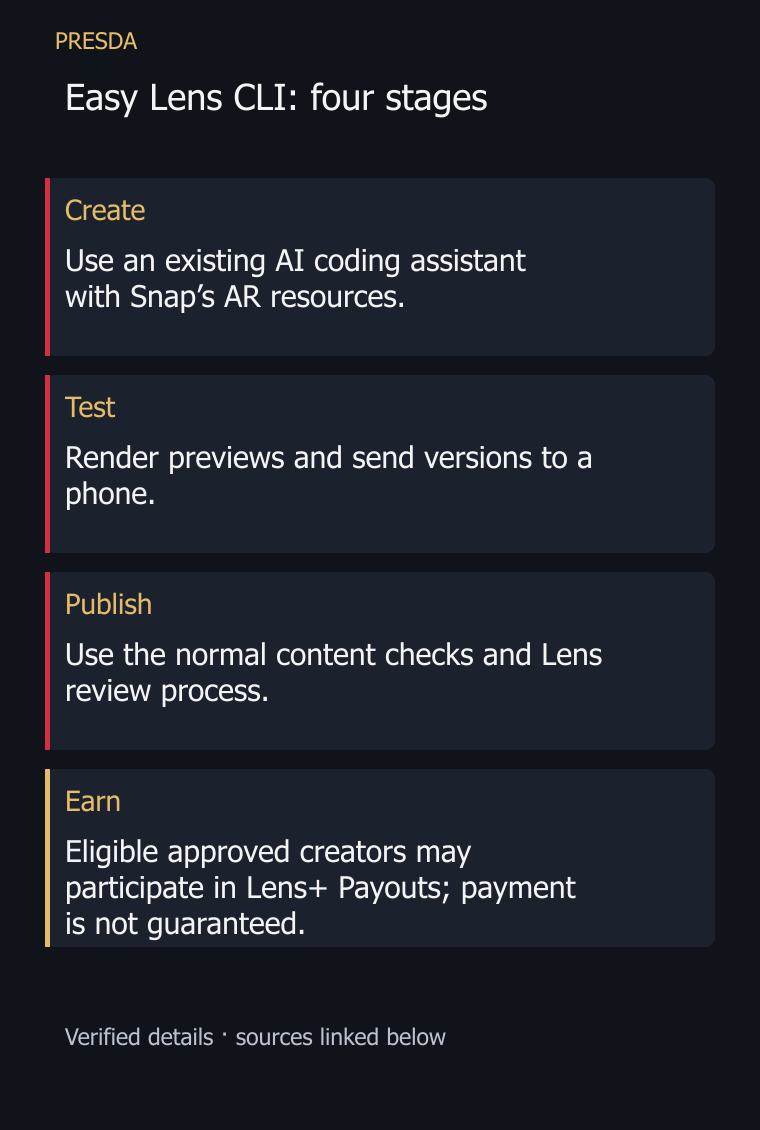
Easy Lens CLI: the workflow and its boundaries. Sources: Snap’s November 18 announcement and developer documentation. Tool access does not guarantee publication or earnings.
Snap says assistants can use more than 100 AR building blocks and more than 50 AI asset generators. Those are the company’s descriptions of available resources, not a count of complete original experiences that a creator has already made. A finished Lens still needs a purpose and a consistent visual and interactive language. Snap: Easy Lens CLI launch, November 18, 2026
Testing can involve rendered preview videos and sending a Lens to a phone. The phone step is especially important for camera-based work: the experience has to make sense in a moving person’s hands, with a real scene behind it. Generated assets that look attractive alone may not remain readable when layered over that scene.
Why iteration still matters
A sensible prototype can begin with one clear behaviour, then add complexity after that behaviour works. This is an editorial recommendation about production practice, not a claim that Snap requires a particular development method. It gives creators a way to distinguish a technical failure from an idea that needs clearer direction.
PRESDA’s feature on the robot revolution considers automation as a change in how tasks are organised. Easy Lens CLI offers a similar lesson in creative work: moving technical execution to an assistant can make judgment about the result more central, not less necessary.
Faster does not mean automatically approved
The launch announcement says CLI-created Lenses follow the same content checks, Lens review and publishing path as work made in Easy Lens apps. The assistant can prepare and submit a project, but its ability to operate the tools does not grant permission to bypass moderation. Snap: Easy Lens CLI launch, November 18, 2026
Creators also need to know what they are publishing. An effect may contain generated visuals, imported campaign material or an existing game. Reviewing that combination is part of making a deliberate release. An automated publishing command should represent an actual decision about a tested version, rather than merely the next step in a conversation.
What the payments announcement really says
Snap says the Lens+ creator community received $1.8 million in payouts in the preceding month, October 2026. That figure describes an aggregate programme payout. It is not the typical income of one creator, nor evidence that the newly released CLI itself generated that amount. Snap: Easy Lens CLI launch, November 18, 2026
Snap’s developer documentation says Lens+ Payouts are for approved creators and eligible exclusive Lenses, with payments linked to subscriber engagement. It explicitly states that enrolment does not guarantee a payout. Making a Lens available and qualifying for a particular revenue programme are different achievements. Snap developer documentation: Lens+ Payouts
Free software is not a guaranteed free production pipeline
Snap describes Easy Lens CLI as free with a Snapchat account. That statement applies to its tool. Creators should check the separate access and usage conditions of whichever AI assistant or asset service they choose; the announcement is not a universal promise about every external tool’s cost.
The practical value should therefore be assessed through an actual project: how much revision it needs, whether the final experience works and what the complete workflow costs. A claim that an idea can become a game in a day is a company capability claim, not an independently measured completion time for every kind of project.
A wider doorway into AR creation
The release puts a familiar question in a new setting: what becomes possible when describing an experience is enough to begin building it? More people may be able to make a prototype, but the quality of what reaches an audience will still depend on design, testing and review. Lowering the barrier to entry does not make every output worth publishing.
PRESDA’s discussion of whether AI can become conscious addresses a different question about intelligent systems. Here the immediate story is practical: an assistant can help operate a creation pipeline. The creator remains responsible for deciding what that pipeline should produce and whether it is ready for Snapchat.
FAQ
Frequently Asked Questions
Which AI coding assistants does Snap name?
The announcement names Claude Code, Codex and Cursor as examples of assistants creators can use.
Is Easy Lens CLI free?
Snap says its tool is free with a Snapchat account. Separate assistant or external-service costs should be checked independently.
Does AI-generated work skip Snapchat review?
No. Snap says the same content checks, Lens review and publishing path apply.
Does publishing a Lens guarantee income?
No. Lens+ participation has eligibility and approval conditions, and Snap states that enrolment does not guarantee a payout.
PRESDA Dispatch
Stay Informed. Stay Aware.
A sharp briefing across AI, gaming, sport, business, world affairs, paparazzi, and lifestyle.