UBER EATS LAUNCHES DRONE FOOD DELIVERY WITH ZIPLINE
Uber Eats’ Zipline drone service launches in Houston. What customers can access, how delivery works and why expansion targets remain future plans.
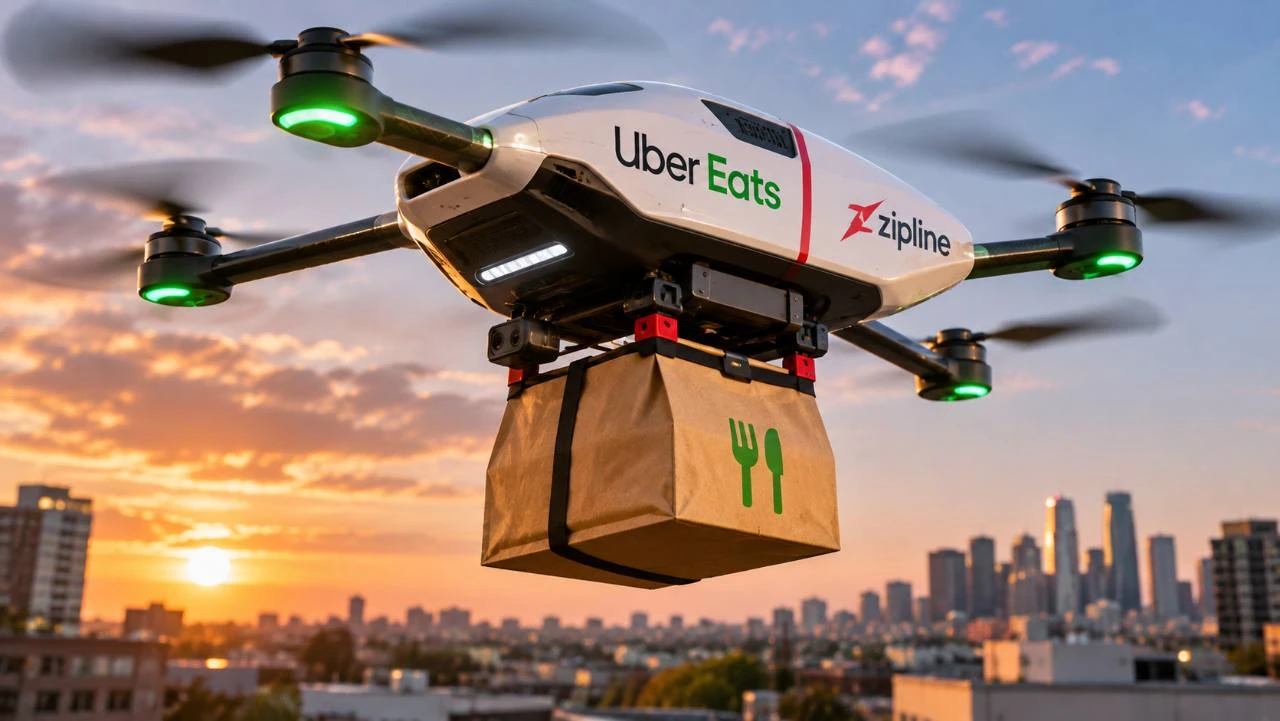
Supplied editorial illustration, not verified launch photography or an accurate specification of Zipline’s operational aircraft. Platform 2 uses a tethered delivery droid.
Uber Eats customers in the Houston area can now receive eligible orders through Zipline’s drone-delivery service. Zipline announced the launch on November 17, 2026, moving the companies’ partnership from a future deployment plan into a service customers can select in the app. Dallas is named as the next expansion market, not as a second launch already completed. Zipline: November 17 Houston launch
The change is as much about the ordering system as the aircraft. A drone can be impressive in a demonstration; a delivery business needs to connect restaurants, orders, dispatch and a customer’s actual address. Putting the service inside Uber Eats brings that connection into an app people already use.
| Milestone | Verified meaning |
|---|---|
| March 15, 2023 | Zipline presented the Platform 2 home-delivery design. |
| August 17, 2026 | Uber announced the partnership and strategic investment plan. |
| November 17, 2026 | Zipline announced Uber Eats drone service in Houston. |
| End of 2029 target | One million daily drone deliveries; a stated ambition, not launch volume. |
What has launched, and where?
Zipline’s launch notice tells Houston-area customers to open Uber Eats and select the drone option on the home screen. That describes access through the existing app, rather than a requirement to place every order through a separate Zipline marketplace. The available offer should still be checked for the customer’s location. Zipline: November 17 Houston launch
An announcement naming a metropolitan area does not establish that every address, restaurant or menu item is served. The practical test is what the app offers for a particular order. Consumers should not assume that an ordinary Uber Eats listing automatically qualifies for flight, or that availability will remain identical at every hour.
The August partnership was an earlier step
Uber announced the strategic agreement on August 17. That release said initial deployments would begin later in 2026 and that Uber would make a strategic investment in Zipline. The November launch is therefore the delivery milestone following an earlier commercial announcement, rather than the first disclosure that the two companies would work together. Uber: August 17 strategic partnership announcement
The distinction keeps the chronology useful. Agreements establish intentions and business relationships; a launch establishes that a service has begun in a defined market. Expansion to other cities remains another step, requiring its own operational confirmation.
How the aircraft gets a meal to the ground
Zipline’s Platform 2 design separates the travelling aircraft from the final placement of the package. In its engineering announcement, the company described a larger aircraft hovering overhead while a smaller delivery droid descends on a tether and manoeuvres toward the drop-off point. The main aircraft does not need to land beside the recipient. Zipline: Platform 2 engineering announcement, March 2023
That arrangement addresses a difficult part of home delivery: the last few metres. Reaching an approximate coordinate is different from placing a meal at a usable location. A yard, a front step, nearby obstacles and people moving through the space create a more demanding problem than drawing a straight line between restaurant and customer.
Why the supplied image needs a caption
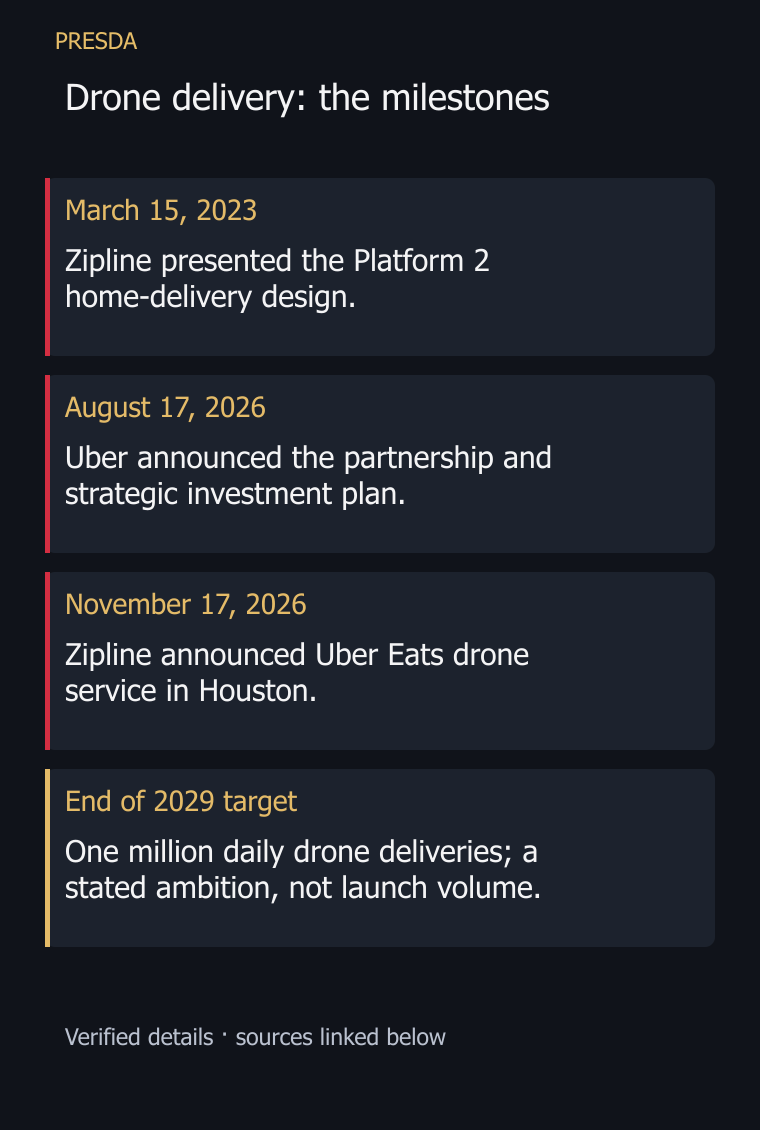
Uber Eats and Zipline: confirmed milestones and limits. Sources: Uber, Zipline and the FAA. Expansion and volume targets are not completed results.
The hero image is a supplied editorial illustration, not verified photography of Zipline’s operational aircraft. A familiar multirotor carrying a branded bag can communicate the idea of drone delivery while misrepresenting the actual hardware. The article’s technical description follows Zipline’s documentation rather than treating the illustration as a specification.
It is a distinction worth making whenever autonomous systems move from promotional images into everyday services. The appearance of a concept rendering does not tell a reader the aircraft’s payload, range, noise profile or approved operating conditions. Those require evidence about the actual system.
Speed claims need an end-to-end clock
Zipline says its delivery system can move food rapidly after preparation. That is a company claim about a particular part of the process, not proof that every order will arrive within that interval from the instant the customer pays. Kitchen preparation, dispatch and the final handoff belong to the same customer experience. Zipline: November 17 Houston launch
A useful comparison would follow equivalent orders from checkout to receipt, not compare an aircraft’s short flight with a courier’s entire journey. Customers also care about food arriving intact and at an appropriate temperature. Faster movement is valuable when the surrounding process preserves those qualities.
A million daily deliveries is a target
The August agreement set an ambition of reaching one million drone deliveries a day by the end of 2029. It also described expansion into dozens of U.S. cities. These are forward-looking goals; they are not the volume of the newly launched Houston service. Uber: August 17 strategic partnership announcement
Moving from a launch to that scale would require much more than adding aircraft. Restaurants need suitable collection arrangements, customers need reliable receiving locations and the delivery network must manage fluctuations in demand. A system that works at one site has to demonstrate that its reliability survives a much larger operating footprint.
Regulation remains part of the route
The FAA describes commercial package delivery by drone through its Part 135 certification framework and the approvals needed for operations beyond a pilot’s visual line of sight. It records Zipline’s certification history, but a carrier certificate should not be read as permission for every possible route, aircraft or operating condition everywhere. FAA: package delivery by drone
This is why an app integration and an aviation approval are different achievements. One connects the order to a delivery option; the other concerns how aircraft may operate. Neither replaces the practical need to serve a specific neighbourhood safely and dependably.
What changes for restaurants and couriers?
For a restaurant, an aerial route offers another way to reach a nearby customer. Its value depends on collection timing, packaging, handling and whether the order reaches someone who would otherwise have been difficult to serve. Drone availability alone does not establish an improvement in every restaurant’s margins or delivery economics.
PRESDA’s report on automated supermarkets explores a related shift: automation changes particular tasks inside a larger commercial system. In delivery, the existence of an autonomous option does not by itself establish how many courier jobs change or which orders remain better suited to a person.
Evidence to watch after launch
Repeated reliability, the share of orders actually eligible, successful handoffs and total delivery times will be more useful than isolated demonstration flights. None should be invented from an expansion announcement. The same applies to emissions: the environmental result depends on the complete operation and the journey being replaced, not simply on an aircraft being electric.
The Houston launch is a concrete step in the broader story covered in PRESDA’s robot revolution feature. Its significance is that customers can choose a real service inside a familiar app. Whether it becomes routine will be determined by the ordinary deliveries that follow the announcement.
FAQ
Frequently Asked Questions
Is Uber Eats drone delivery available everywhere?
No. The launch concerns the Houston area, and eligibility should be checked in the app for the particular address and order.
Has the Dallas service already launched?
The Houston announcement names Dallas as next. It does not establish a completed Dallas launch.
Does Zipline land its main aircraft at the customer’s door?
Its documented Platform 2 design uses a smaller tethered droid for the final drop-off while the larger aircraft remains overhead.
Are one million deliveries already being made daily?
No. That figure is the partnership’s target for the end of 2029, not a reported current volume.
PRESDA Dispatch
Stay Informed. Stay Aware.
A sharp briefing across AI, gaming, sport, business, world affairs, paparazzi, and lifestyle.