THE SONGHAI EMPIRE: THE GLORY AND FALL OF WEST AFRICA'S GIANT
Explore Songhai's rise, Gao's political power, Timbuktu's scholarship and the Saadian invasion of 1591, with sourced maps and historical uncertainties.
Songhai was a West African empire built around the Niger River, with Gao as its principal political capital. Its imperial expansion under Sunni Ali and Askia Muhammad joined military power to commerce and scholarship. In 1591 a Saadian Moroccan expedition defeated its army at Tondibi, opening a period of occupation, fragmentation and continued resistance. The empire fell; the civilization did not vanish.
The story is compelling because its achievements and vulnerabilities grew from the same connections. River towns needed farmers, merchants, boat crews, cavalry and scholars. Rulers depended on people whose authority did not come solely from the palace. To understand the empire's glory, and the limits of that word, we must follow both the people who benefited from imperial order and those who carried its burdens.
PRESDA DATA GRAPHICS
Songhai: a chronology with its limits
- First millennium CEGao area's early settlements and trade, documented archaeologically
- 1464–1492Sunni Ali's reign and imperial expansion
- 1468Capture of Timbuktu; University of Cape Town chronology
- 1470sDjenné brought under Songhai control; approximate date
- 1493–1528Askia Muhammad's reign
- 1495Tomb of Askia, as dated by UNESCO
- 1496–1498Askia Muhammad's pilgrimage
- 1528Askia Muhammad deposed
- 1590Saadian expedition sent under Judar Pasha
- 13 March 1591Tondibi: date given by Nobili's 2022 study
- 1591–1612Resistance period analyzed by Kaba; overlaps occupation
- 1594Exile of prominent Timbuktu scholars
Chronicle traditions and modern accounts do not agree on every detail. Approximate dates remain approximate; overlapping periods do not imply that resistance ended everywhere in 1612.
Sources and context: Singleton (2004) · University of Cape Town · Nobili (2022)
Before the empire: the rise of Gao
Gao's history reaches well before the fifteenth-century empire. Archaeological research at Gao Saney and Gao's older settlements reveals an early urban and commercial world. Work by Mamadou Cissé and colleagues documents settlement growth and exchange during the first millennium CE. Imported objects and local production provide evidence independent of later stories about kings. They do not supply a single, securely documented founding day for Songhai.
The river made this setting distinctive. A settlement at the meeting point of water transport and desert exchange could connect different economic zones. That connection was created through work and accumulated knowledge, not simply bestowed by geography. Archaeologists Shoichiro Takezawa and Mamadou Cissé have investigated buildings interpreted as an early royal palace, while emphasizing the gaps and controversies in Gao's earlier written history. An architectural interpretation is not a complete dynastic record.
Traditions about early rulers and the Za dynasty are valuable evidence of remembered authority, but must be read alongside archaeology and Arabic accounts. Gao later came within Mali's sphere before recovering political independence. The earlier Mali Empire and Mansa Musa belong to this background. Mansa Musa was a ruler of Mali, not an emperor of imperial Songhai. Sharing trade routes and cities did not make these states interchangeable.
Sunni Ali: conquest along the Niger
Sunni Ali, also called Sonni Ali, ruled from 1464 to 1492. He transformed a regional kingdom into an expansive empire through campaigns involving cavalry and river forces. Timbuktu came under his control in 1468; Djenné followed in the 1470s. The University of Cape Town's Timbuktu history supplies the former date. Different modern accounts give differing details for Djenné's siege, so its capture should not become an apparently exact reconstruction of every maneuver.
These conquests joined important markets to Gao's power. A river fleet offered advantages that cavalry alone could not: movement through a seasonal water landscape and access to towns connected by waterways. Military expansion therefore cannot be understood as an uninterrupted march across a uniformly dry region. The Niger's changing conditions were part of the strategic setting, as were communities with their own interests, leaders and capacity to resist imperial demands.
Sunni Ali's reputation is contested. Timbuktu's scholarly traditions remembered persecution and violence against learned families, whereas other traditions emphasize his effectiveness and connections with local religious practices. Such accounts tell us about conquest and also about the people who preserved its memory. The Metropolitan Museum's Sahel exhibition places his military rise within the region's longer history. Celebrating imperial achievement need not sanitize coercion or adopt every hostile anecdote uncritically.
Askia Muhammad and the golden age
After Sunni Ali's death, his son Sonni Baru faced a successful challenge from Muhammad Ture, who took power in 1493 as Askia Muhammad. He ruled until his deposition in 1528. His government developed the empire's administration and cultivated Muslim scholars. Brent Singleton's scholarly survey identifies this period as central to Songhai's political, commercial and intellectual achievement.
Askia's pilgrimage to Mecca in 1496–1498 connected his rule with a wider Islamic world. The chronology is discussed in The Cambridge History of Africa. It is a different journey from Mansa Musa's earlier pilgrimage. Describing both rulers as wealthy African pilgrims is reasonable; transferring the famous details of Musa's expedition to Askia would erase a century of historical difference.
The phrase golden age identifies particular achievements, not universal prosperity or permanent peace. Patronage, provincial government and military pressure helped sustain imperial rule, yet each depended on continuing cooperation. A ruler could appoint officials without removing the practical power of established families and local authorities. The succession troubles that followed Askia's deposition show why successful institutions and an unstable royal household could coexist. Administration was a continuing political task, not a reform completed once and for all.
PRESDA DATA GRAPHICS
The people who shaped the turning points
Scroll horizontally to read the full table.
| Person | Date / period | Role |
|---|---|---|
| Sunni Ali | 1464–1492 | Songhai ruler; military expansion |
| Askia Muhammad | 1493–1528 | Songhai ruler; administration and scholarly patronage |
| Askia Ishaq II | Tondibi, 1591 | Songhai ruler whose forces faced the expedition |
| Ahmad al-Mansur | Invasion ordered, 1590 | Saadian Moroccan sultan; did not command Tondibi |
| Judar Pasha | Expedition, 1590–1591 | Field commander, not a Songhai ruler |
Sources and context: Singleton (2004) · University of Cape Town · Nobili (2022)
Gao, Timbuktu and Djenné: three different roles
Gao was the political capital, the location from which rulers organized imperial authority. Timbuktu's fame rests especially on scholarship and commerce, not on replacing Gao as the seat of government. Historian Michael A. Gomez's 1990 study challenges claims that Timbuktu was effectively autonomous, emphasizing Gao's control and financial objectives. The distinction between urban prestige and sovereign power is essential.
That relationship remains a subject of interpretation. John Hunwick's 1996 analysis emphasizes negotiated relations between rulers and religious authorities. Scholars could receive gifts and privileges while offering legitimacy and spiritual support. These positions differ in their emphasis on influence; neither requires moving the political capital from Gao to Timbuktu. Cities could depend on imperial power while retaining distinctive sources of authority.
Djenné linked the productive inland delta with wider commerce. Its urban history also predates Songhai. UNESCO's Old Towns of Djenné entry describes this long settlement history and its earthen architectural tradition. The monumental Great Mosque visible today was reconstructed in 1906–1907. It should not be presented as an unchanged sixteenth-century Songhai building. Historical continuity often survives through rebuilding, making the construction date of a visible monument different from the age of a community.
PRESDA DATA GRAPHICS
The Niger world: three distinct urban roles
- Gao: principal political capital
- Timbuktu: scholarship and commerce
- Djenné: agriculture and regional trade
Historical schematic, not to scale. River geometry is simplified; symbols show connections, not precise borders or the empire's full extent.
Sources and context: UNESCO: Gao · UNESCO: Timbuktu · UNESCO: Djenné
Gold, salt and a working river economy
Gold moved north through trans-Saharan networks; salt and other goods moved into the Sahel. The Metropolitan Museum's history of the gold trade traces the older commercial system inherited and reshaped by successive states. Songhai's wealth was partly the wealth of connections. Controlling a route or collecting duties did not mean possessing every mine, caravan or trading community involved in the exchange.
Agriculture and local exchange sustained that network. Food production, fishing, herding, craftwork and river transport supplied needs that a dramatic story about gold can overlook. OpenStax's academic overview identifies agriculture and trade taxation as important supports of the empire. Its list of imports includes horses, cloth and luxury goods. A court's expensive possessions reveal access to resources, but not the living standards of everyone under its rule.
Reliable empire-wide annual revenues, production totals and population counts are unavailable. Modern dollar valuations of Songhai's wealth would require assumptions the sources cannot substantiate. The economic graphic therefore maps relationships and commodities instead of inventing GDP. Nor should a historical description of profitable book sales become an audited comparison of books and gold across the whole empire. Individual observations illuminate a marketplace; they do not automatically measure an entire economic system.
PRESDA DATA GRAPHICS
How the economy connected regions
Scroll horizontally to read the full table.
| Goods / activity | Connection | What the evidence does not measure |
|---|---|---|
| Gold | Northbound trans-Saharan exchange | No audited empire-wide tonnage or modern-dollar valuation |
| Salt | Saharan supply to Sahelian markets | No single fixed gold-to-salt price for all markets |
| Food, fish and livestock | Local production and river exchange | No reliable empire-wide production total |
| Cloth and horses | Imports and regional exchange | No complete annual import ledger |
| Manuscripts | Copyists, merchants, scholars and libraries | No census of all imperial books or students |
This is a network comparison, not quantified trade flows, GDP or an estimate of royal net worth. Enslavement and coerced labor are addressed in the article, not converted into commodity prices here.
Sources and context: Metropolitan Museum · University of Cape Town
Scholarship was an industry of people and books
Timbuktu's intellectual life involved scholars, teachers, students, copyists, merchants and family libraries. The University of Cape Town's manuscripts project studies texts, the circulation of ideas and the economy of manuscript production. This approach brings intellectual work into daily history. A manuscript had to be acquired, copied, read and preserved. Those activities required expertise and resources, not merely the existence of a celebrated ruler or a beautiful mosque.
UNESCO identifies Djingareyber, Sankore and Sidi Yahia as major surviving witnesses to Timbuktu's intellectual and spiritual importance. The term university is often applied to Sankore, but readers should not imagine a modern centralized campus with standardized degree administration. Mosque teaching and scholarly networks belonged to a different educational setting. Their difference from contemporary universities diminishes neither the difficulty of study nor the importance of the work produced.
The Library of Congress's introduction to Timbuktu connects its surviving manuscripts to the city's wider cultural influence. Collections contain material from different periods, so not every surviving page dates from Songhai's imperial peak. The right question is what a specific manuscript, its date and its provenance can establish. A large present-day collection should never be treated as a census of sixteenth-century students or books.
Society, religion and the costs of empire
Songhai encompassed communities with different languages, occupations, religious practices and political histories. Islam was particularly important in courtly and scholarly life, while local traditions continued. Mauro Nobili's study of Muslim roles in medieval West Africa warns against overly simple divisions between religious and secular power. Those modern categories can obscure relationships that contemporaries understood differently.
Social hierarchy included enslavement. Captivity and coerced labor belong in the history alongside libraries and royal patronage. The Library of Congress preserves a manuscript of Ahmad Baba's discussion of slavery, dated 1615, which documents legal reasoning after the conquest. It is not an empire-wide demographic survey. Questions about lawful enslavement could be argued within a society that still practiced slavery; the existence of such debate should not be confused with abolition.
Women participated in these societies but appear unevenly in records centered on kings, warfare and male scholarly lineages. The evidence does not justify a single description of every woman's freedom, wealth or influence. Nor does a court chronicle speak equally for farmers, captives or boat crews. Recognizing those silences is part of writing history, not a reason to fill them with invented biographies. Imperial order could offer opportunity to one household and coercion to another.
Earth, architecture and military power
Gao's Tomb of Askia is a particularly tangible connection with the imperial period. UNESCO dates the monument to 1495 and describes its 17-meter pyramidal tower and earthen construction. Regular maintenance is integral to this architecture. The building is an enduring historical witness, but not a preserved royal portrait or a blueprint for every palace in the empire. Its documented features are more valuable than an imagined skyline presented as archaeological fact.
Cavalry, infantry and river forces made Songhai formidable within its regional setting. Each also carried costs: animals, equipment, provisions, skilled personnel and command. A large army was not simply a number that could be summoned without preparation. The ability to project force along a river or demand tribute from a neighbor did not guarantee equivalent control everywhere. It is more accurate to describe changing cores and zones of influence than a perfectly uniform territory with modern borders.
Political decline did not happen overnight
Askia Muhammad's deposition in 1528 exposed conflict within the ruling family. Subsequent government was not one continuous collapse: later rulers could restore strength, while rivalries repeatedly endangered coordination. The late-sixteenth-century divisions highlighted in Singleton's survey matter because an empire needed decisions, revenue and command to work together. Succession struggles could turn the same elite networks that sustained government into competing centers of power.
This is not a claim that civil conflict made defeat inevitable. Historical explanations should distinguish a vulnerability from a predetermined ending. A state might survive political instability, and an invading army might fail despite favorable weapons. Songhai's position in 1591 emerged from interacting choices on both sides. To explain the invasion, we must also look north, where Morocco's ruler saw an opportunity to turn military capability into political and commercial gain.
Ahmad al-Mansur and the Saadian decision
Sultan Ahmad al-Mansur ordered the invasion. He belonged to Morocco's Saadian dynasty, not the much earlier Almoravids. PRESDA's history of Morocco places those dynasties in sequence. The distinction changes the setting: this was a late-sixteenth-century campaign shaped by gunpowder warfare and Mediterranean politics. It was not an extension of an eleventh-century Almoravid expedition, and the sultan did not personally lead the battle at Tondibi.
Historian Lansiné Kaba's 1981 study connects the campaign with Saadian commercial needs and Mediterranean concerns, particularly ambitions surrounding the gold trade. This is an interpretation of motive, not a surviving ledger proving one exact expected profit. Both states had important Muslim institutions. The confrontation cannot be reduced to a simple war between Islam and a wholly non-Muslim opponent.
Judar Pasha crosses the Sahara
The expedition dispatched in 1590 reached the Niger region in 1591 under Judar Pasha. Crossing the Sahara meant maintaining an army far from its base while transporting provisions and weapons. That logistical achievement deserves attention equal to the weapons themselves. An army's firearm advantage meant little if men, ammunition and supplies could not reach the battlefield. The campaign linked the desert and the river through a route of invasion rather than ordinary commerce.
Our route graphic is deliberately schematic. It connects Morocco, the Sahara and the Gao region without claiming an exact day-by-day itinerary. Troop totals also vary across historical accounts. Figures for the Songhai force differ even between chronicle traditions discussed in Kaba's notes. They support caution, not a precise graphic claiming that one side was exactly a particular multiple larger than the other. The broad asymmetry matters more securely than an apparently audited head count.
PRESDA DATA GRAPHICS
1590–1591: invasion across the Sahara
General direction only, not a verified daily itinerary. Troop totals and tactical details vary across accounts. The campaign was ordered by Ahmad al-Mansur and commanded by Judar Pasha.
Sources and context: Kaba (1981) · Nobili (2022)
Tondibi, 1591: what firearms changed
Tondibi was fought near Gao in March 1591 between Judar's expedition and the forces of Askia Ishaq II. Mauro Nobili's study of Moroccan manuscript archives gives 13 March as the battle date. Firearms helped the Moroccan army defeat Songhai's forces. That established result should be distinguished from disputed numerical estimates and detailed battlefield stories reconstructed from later narratives.
The military lesson concerns an encounter between specific forces. It does not demonstrate that West African armies were universally incapable of innovation, or that a single weapon always determines a war. Range, firepower, coordination and the response of opposing troops shape how a technological advantage works. For this battle, firearm superiority is central; for the empire's eventual fragmentation, the political and administrative consequences of losing its core were also essential.
We do not reproduce dramatic dialogue or cattle-stampede scenes as if independently observed. The sources permit a confident account of defeat without certainty about every moment of combat. A modern map cannot reconstruct the exact position of each unit from sparse evidence, and a cinematic hero cannot provide missing testimony. Keeping those limits visible makes the turning point more intelligible, rather than less dramatic.
Victory was not stable government
Moroccan occupation of major centers broke Songhai's imperial position, but battlefield victory did not produce effortless administration. Continuing campaigns, local opposition and the challenge of governing distant communities complicated the project. Kaba emphasizes prolonged resistance under Askia Nuhu and the limits imposed by conditions farther south. His analysis covers 1591–1612, a useful corrective to the idea that all organized opposition ended when Tondibi was lost.
Repression also affected scholars. Prominent learned men were exiled in 1594, and Ahmad Baba became an important figure in the intellectual aftermath. Hunwick's work stresses the damage to the earlier balance between rulers and religious authorities. These consequences reached beyond military command: occupation altered patronage, trust and institutions. A conqueror could occupy a commercial town without automatically securing the cooperation that had helped make its prosperity possible.
Resistance, fragmentation and a longer legacy
Songhai resistance continued downriver, notably in Dendi. The restored scale of the old empire never followed, but smaller political formations and communities survived. Later Niger politics included the Arma, descendants of the Moroccan expeditionary soldiers, whose position evolved beyond direct Moroccan control. The Cambridge History of Africa's discussion of the seventeenth and eighteenth centuries places the conquest within that longer transition.
The fall of an empire is therefore different from the disappearance of a people or the extinction of learning. Trade routes, languages, religious traditions and manuscripts continued through changing political circumstances. Songhai should be remembered both as an ambitious state and as part of a regional history larger than its dynasty. Comparisons with the Kingdom of Benin can widen that perspective without treating different African societies as identical.
How we know, and what remains uncertain
Al-Sa'di's seventeenth-century Ta'rikh al-Sudan is a major narrative source, available in John Hunwick's scholarly edition and translation. It records a remembered past from a later setting, not a neutral live transcript of Sunni Ali's court or Tondibi. Archaeology, manuscripts, oral traditions and later scholarship need to be compared, especially where chroniclers' interests influenced the reputations of rulers.
Nobili identifies a surviving copy of Ahmad al-Mansur's conquest announcement and an additional Ta'rikh al-Sudan manuscript in Moroccan collections. A royal announcement can establish how victory was represented; it cannot alone prove every triumphal claim. This is why our timeline separates secure broad events from approximate dates, and our maps show connections rather than invented borders. Songhai's history needs neither inflated wealth totals nor imaginary witnesses to reveal its grandeur.
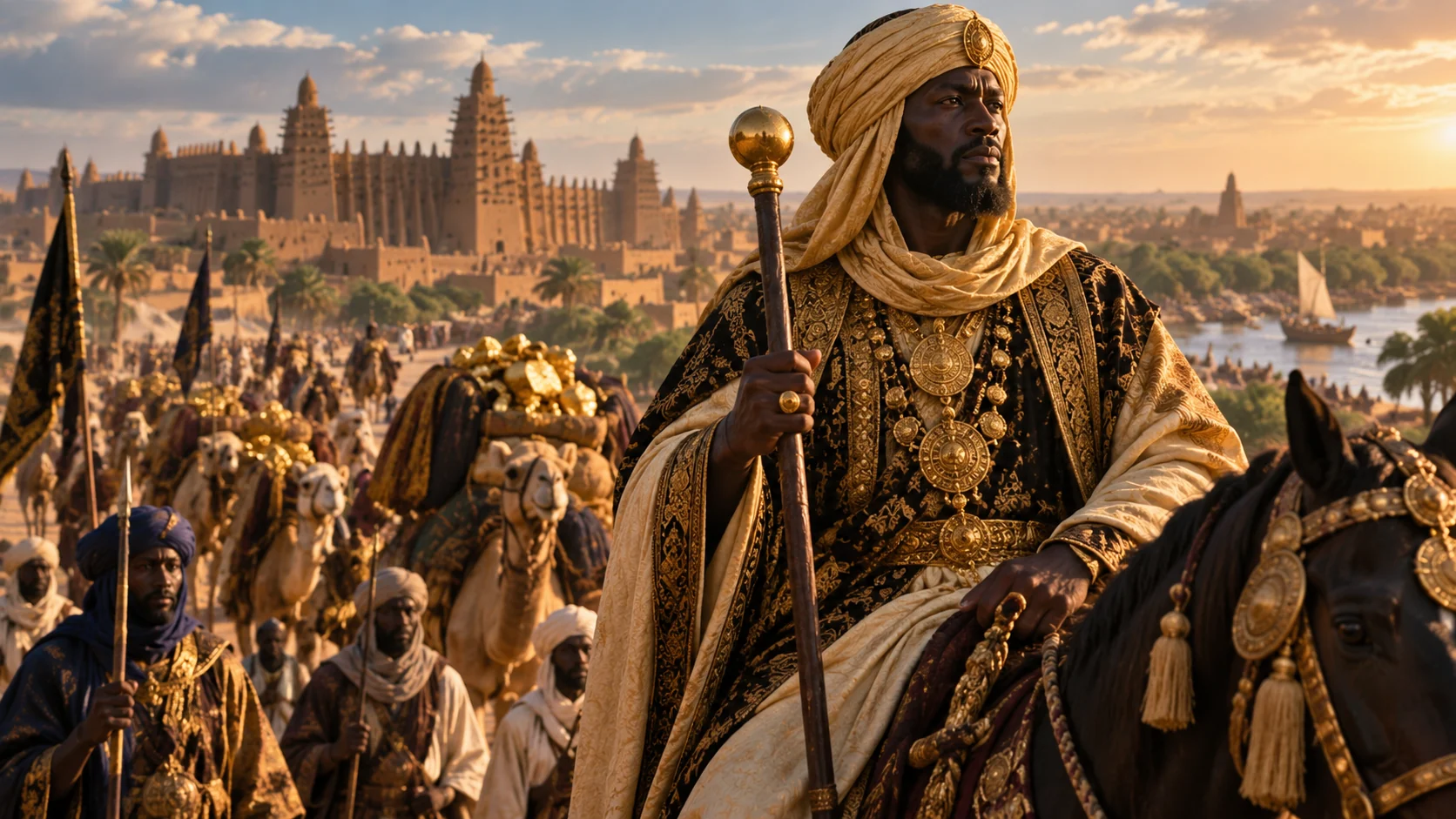
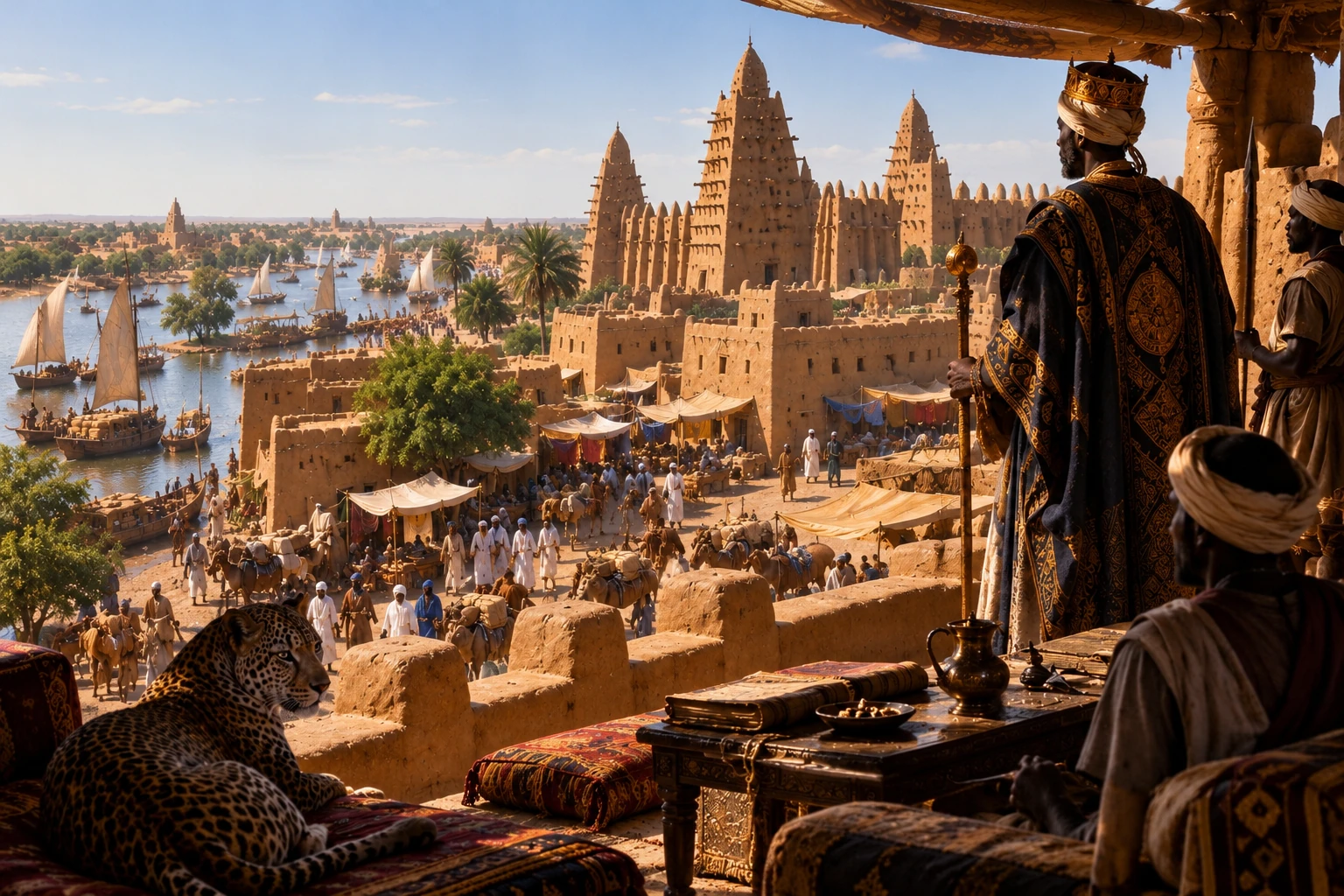
The approved hero is an AI-generated historical reconstruction. Its river city and ruler are imagined, not a documented portrait, verified palace or authentic view of sixteenth-century Gao. The evidence lies in the cited scholarship and material record. Taken together, they reveal a powerful West African state whose fall transformed the region, while leaving traditions of government, commerce and learning that outlived imperial conquest.
FAQ
Frequently Asked Questions
What was the capital of the Songhai Empire?
Gao was the principal political capital. Timbuktu was a major center of Islamic scholarship and commerce, while Djenné connected river commerce, agriculture and regional trade.
Did Mansa Musa rule Songhai?
No. Mansa Musa ruled the earlier Mali Empire in the fourteenth century. Songhai's leading imperial rulers included Sunni Ali and Askia Muhammad.
Who defeated Songhai in 1591?
A Saadian Moroccan expedition led by Judar Pasha defeated Askia Ishaq II's forces at Tondibi. Sultan Ahmad al-Mansur ordered the invasion from Morocco; he did not personally command that battle.
Did firearms alone destroy Songhai?
Firearms gave the invaders an important battlefield advantage, but political divisions, disrupted administration and subsequent campaigns also mattered. Songhai resistance continued after the loss of Gao.
How wealthy was Songhai?
Trade taxation and agricultural production supported the empire, with gold and salt especially important in long-distance exchange. Reliable empire-wide GDP, annual revenue and population totals are not available.
Did Songhai disappear after Tondibi?
The great empire fragmented, but its people, scholarship and political traditions continued. Songhai forces resisted farther down the Niger, notably in Dendi.
PRESDA Dispatch
Stay Informed. Stay Aware.
A sharp briefing across AI, gaming, sport, business, world affairs, paparazzi, and lifestyle.