TOYOTA’S NEXT BIG BET GOES BEYOND CARS: INSIDE WOVEN CITY
Inside Toyota Woven City: its 2025 launch, September 2026 progress, household robots and the business case for testing mobility beyond cars.
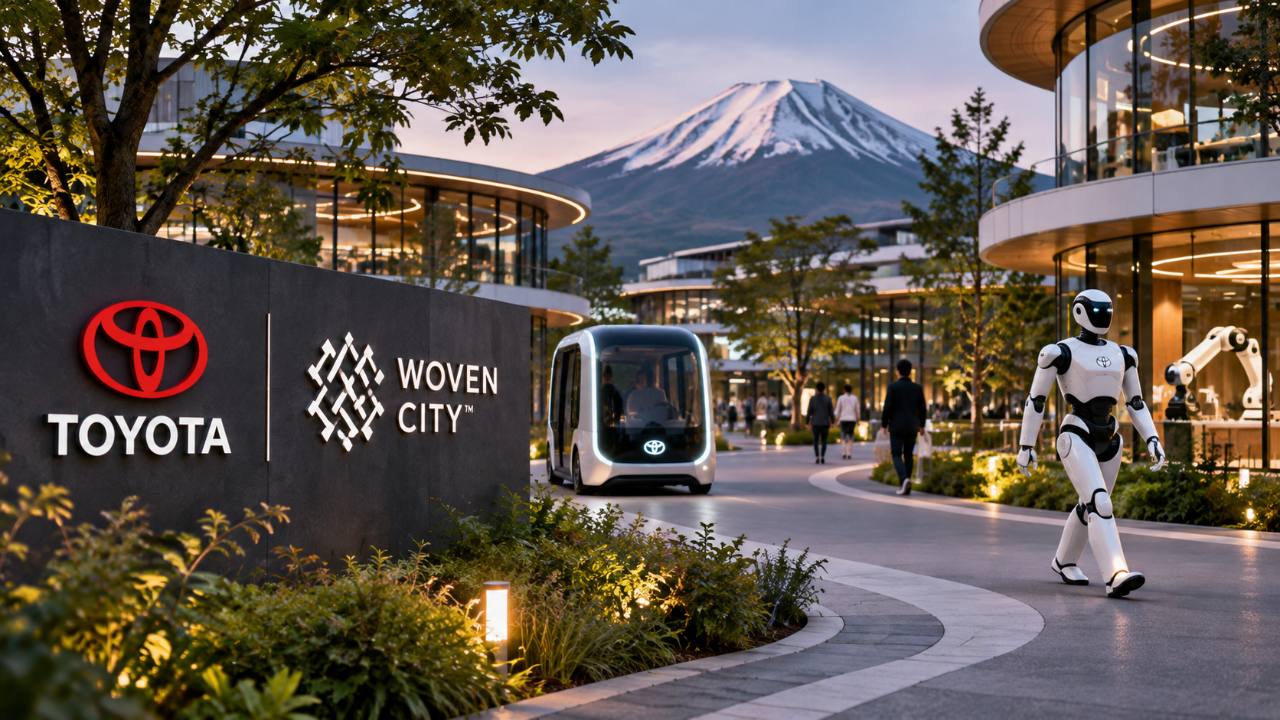
Supplied editorial illustration of Woven City, preserved unchanged. Its futuristic elements are not a verified inventory of deployed technology. Official photographs appear below.
Toyota’s experiment beyond the automobile is already inhabited. At Woven City in Susono, Japan, residents are helping test technologies that move people, objects, energy and information through daily life. The project officially launched on September 25, 2025. Its September 2026 first-year update described approximately 30 proof-of-concept projects, 31 participating Inventor companies and about 160 residents across roughly 80 households. Toyota: September 25, 2025 official launchWoven by Toyota: September 25, 2026 first-year update
Those figures describe a working test community at a particular date, rather than a finished city or a proven new profit engine. Toyota’s business question is larger than whether it can build another vehicle: can a manufacturer’s engineering methods, software and partnerships produce useful services across the places where people live? Woven City makes that question concrete enough to test.
| Question | Officially reported position |
|---|---|
| Official launch | September 25, 2025 |
| First-year update | September 25, 2026 |
| Trial activity | Approximately 30 proof-of-concept projects in September 2026 |
| Community | 31 Inventor companies; about 160 residents in roughly 80 households |
What Woven City actually is
Toyota calls Woven City a test course for mobility. Located in Shizuoka Prefecture near Mount Fuji, it is developed with Woven by Toyota. The project’s official launch announcement distinguishes the people developing ideas, called Inventors, from the resident participants, called Weavers. Those names describe roles in an experimental community, not separate categories of customers buying a completed consumer product. Toyota: September 25, 2025 official launch
The distinction matters commercially. An ordinary showroom demonstrates something ready to sell. A living laboratory gives developers a chance to discover where a prototype fails, how people actually use it and whether it fits into routines outside an engineering team’s assumptions. The purpose of a trial is to generate evidence that can improve a product or redirect an idea before wider deployment.
Why involve residents rather than only engineers?
A household contains conditions that are difficult to reproduce fully in a controlled demonstration. Objects move, schedules change, people have different preferences and a device may have to coexist with children, furniture or another service. A system that performs one impressive task on a stage still has to become dependable in that less predictable environment.
Residents can supply feedback about convenience, reliability and friction that a successful technical demonstration may miss. That makes their participation part of the development process. It also means that the number of trials is an activity measure, not proof that every tested technology has already earned widespread acceptance or become commercially viable.
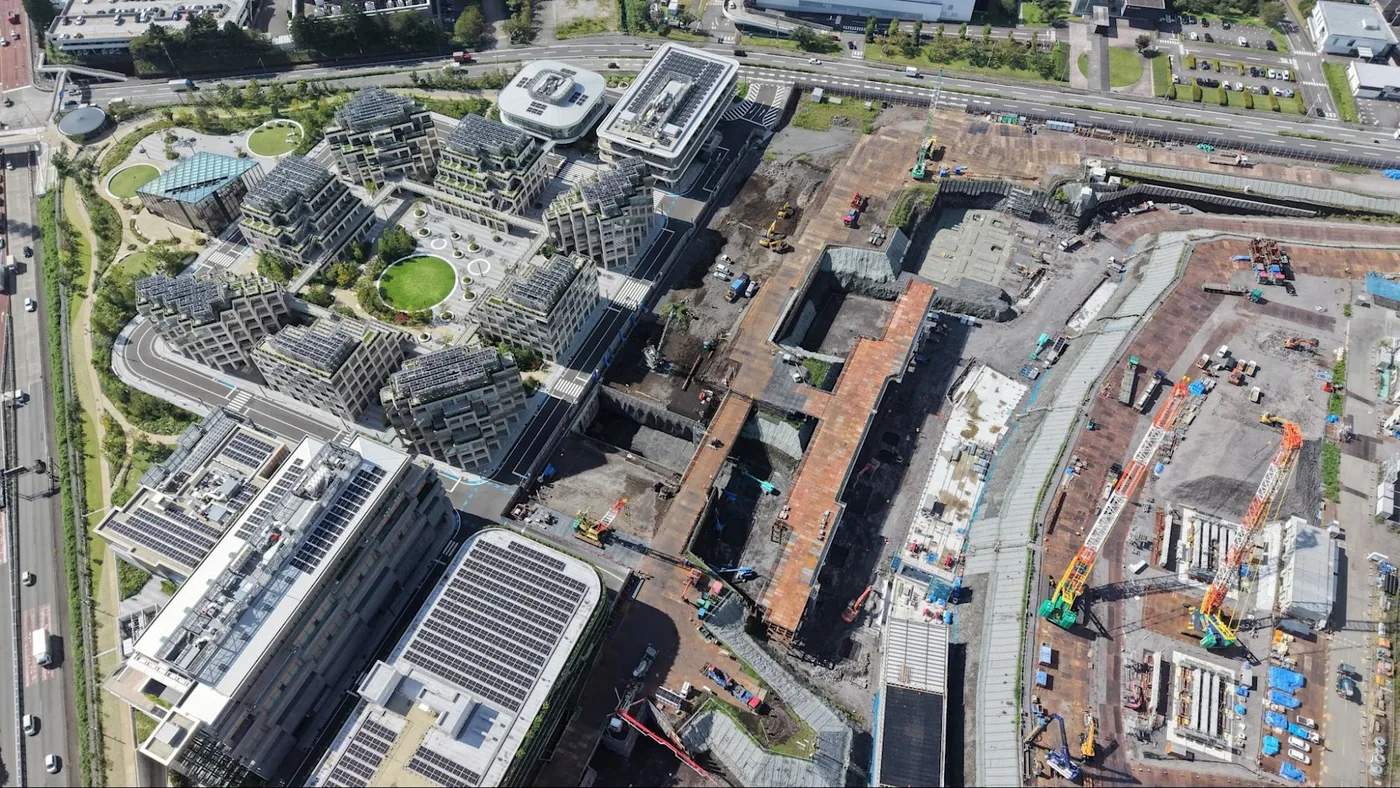
Official aerial image published September 25, 2026, for Woven City’s first year. It shows the built environment and construction areas, not the supplied hero’s futuristic illustration.
What the first-year update tells us
The September 25, 2026 announcement described household robots helping with tasks such as tidying and carrying objects. It said the AI Robot Association had introduced robots in 11 households and tested more than 1,000 tasks by September 24. These are bounded trial figures, tied to a named organization and a reporting date, rather than a claim that household robotics has been solved. Woven by Toyota: September 25, 2026 first-year update
The same update said the participating Inventor community had reached 31 companies after seven additions. Toyota’s earlier partner announcement shows how the project was designed to bring outside businesses into the test environment before launch. The network is part of the proposition: a company developing one service may encounter another firm whose technology helps it work in practice. Woven by Toyota: September 25, 2026 first-year updateToyota: new partner companies announced before launch
Kakezan and the business logic of collaboration
Woven by Toyota uses Kakezan to describe combining different strengths so that their interaction produces more value. The term is useful when it points to a concrete dependency: a robot needs navigation, a delivery service needs access to buildings, and a software system needs information about its environment. A city-like setting exposes how those dependencies meet.
That collaborative ambition also creates a management challenge. Different partners may move at different speeds or define success differently. A trial environment needs a way to turn feedback into decisions, rather than simply accumulating demonstrations. Toyota’s familiar emphasis on continuous improvement provides a development method; the quality of the resulting services still needs to be demonstrated in use. Woven by Toyota: official news and press-image terms
Software is part of the expansion beyond cars
Toyota and Woven by Toyota’s April 2026 Kakezan announcement presented AI technologies intended to support the project’s development cycle. The broader company overview positions Woven by Toyota around areas including software, automated driving and Woven City. The city is therefore one part of a wider attempt to connect digital capability with physical mobility, rather than an isolated property development. Toyota: April 22, 2026 Kakezan technology announcementsWoven by Toyota: company overview
This connection helps explain why an automaker is interested in the movement of information as well as passengers. Software can affect how a vehicle senses its surroundings, how a service is coordinated and how a developer learns from an experiment. Those activities remain connected to mobility even when the visible object is a household robot or a building service instead of a passenger car.
A useful test for every AI announcement
The practical question is what an AI component changes for a participant. Does it reduce a recurring problem, improve a system’s reliability or make an interaction easier to understand? A technology label alone cannot answer that. The strongest evidence comes from clearly defined tasks, repeated use and a comparison with what people could do before the system was introduced.
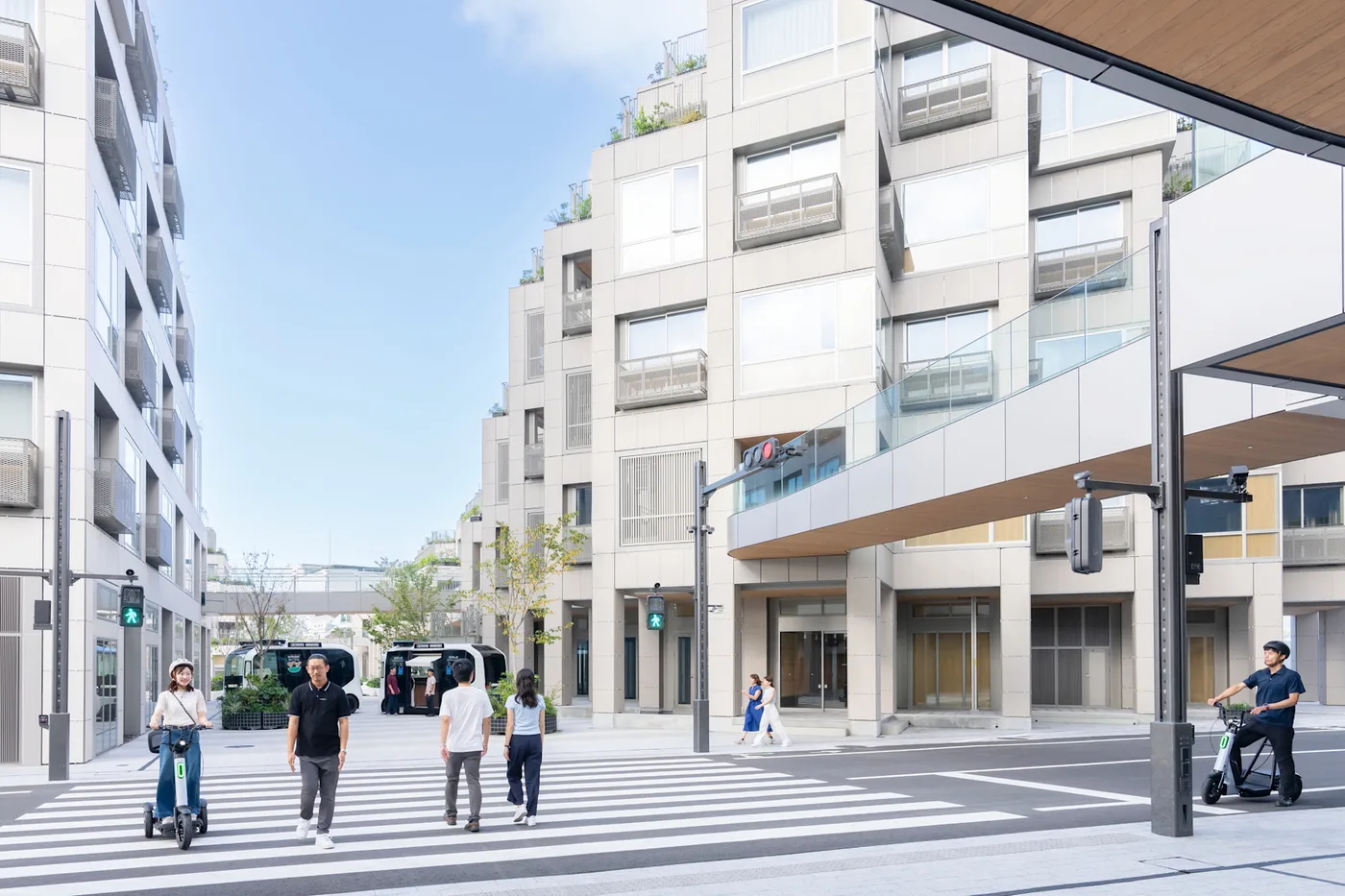
A street scene from official launch material published September 25, 2025. People and mobility equipment place the research community in its real built setting.
Woven City offers a setting in which such questions can be investigated together. The results should still be read at the scale at which they were obtained. A successful trial in a small resident community can justify further testing without establishing that the same service will work equally well across every city, household or regulatory setting.
A new direction built on an existing industrial identity
Toyota’s launch material presents Woven City as a place to extend the scope of mobility. The partner program reinforces that direction by inviting businesses whose work reaches beyond conventional automotive manufacturing. The idea is to apply engineering, iteration and coordination to an interconnected environment where a vehicle is one component of daily life rather than the sole product under examination. Toyota: September 25, 2025 official launchToyota: new partner companies announced before launch
The approach also changes what the company has to learn. Manufacturing consistency is important, but a service has to fit social habits and operating conditions. A resident may judge a delivery robot by whether it arrives at a useful time and is easy to interact with, while the developer may initially focus on whether it reaches the right location. Both perspectives matter to the business case.
PRESDA’s examination of the robotaxi competition explores a related transition from building a vehicle to operating a service. Woven City widens that frame. It allows mobility systems to be considered alongside the homes, public spaces and other services with which they have to interact.
How to judge the experiment’s commercial progress
The first useful measures are specific: what was tested, with whom, over what period and with what result? Project counts and partner numbers show that an ecosystem is active. Stronger commercial evidence would include reliable service delivery, sustained participant demand and a workable route to operating beyond the original test site. Those outcomes require observation rather than an assumed return on investment.
It is equally important to separate phases. The official September 2025 launch is a completed event. The September 2026 update is a dated account of progress and further plans. A future construction phase or software release should be described according to its announced status, rather than treated as finished merely because it appears in a corporate presentation. Toyota: September 25, 2025 official launchWoven by Toyota: September 25, 2026 first-year update
An experiment can be valuable without validating every idea
Testing can produce useful information when a concept needs substantial revision. Discovering that a device is inconvenient, that a service duplicates an existing habit or that a proposed interaction confuses users can prevent a larger deployment from repeating the same problem. A premium assessment of Woven City should therefore examine what Toyota learns, not just how futuristic a scene looks.
The official photographs accompanying this article show the project as presented by Woven by Toyota, with dates and credits. The supplied hero is preserved as an editorial illustration. Its visual combination of robots, buildings and Mount Fuji is not a verified inventory of technologies operating at the site. The distinction keeps the business analysis grounded in the project’s announcements and observed setting. Woven by Toyota: official news and press-image terms
Toyota’s bet beyond cars is ultimately a bet on integration: that expertise in building complex machines can help organize useful interactions among people, software and physical services. Woven City provides a real place to test that proposition. Whether its strongest ideas become durable businesses will depend on the evidence generated there and on what survives contact with a wider world.
FAQ
Frequently Asked Questions
What is Toyota Woven City?
It is a test course for mobility in Susono, Japan, developed by Toyota and Woven by Toyota to test products and services with resident participants.
Has Woven City already launched?
Yes. Toyota dates its official launch to September 25, 2025. The first-year update was published on September 25, 2026.
Why does it go beyond cars?
Its trials concern the movement of people, goods, energy and information, including household robotics and services that connect buildings, software and mobility.
Do the trial figures prove commercial success?
They document activity and participation at a stated date. Commercial success requires further evidence about reliability, demand and operation beyond the test setting.
PRESDA Dispatch
Stay Informed. Stay Aware.
A sharp briefing across AI, gaming, sport, business, world affairs, paparazzi, and lifestyle.