WOMEN AND GOLD: A TIMELESS LOVE STORY
A gold necklace can be adornment, inheritance, savings or a memory worn close to the skin. Its meaning changes across women, families and cultures, and across time.
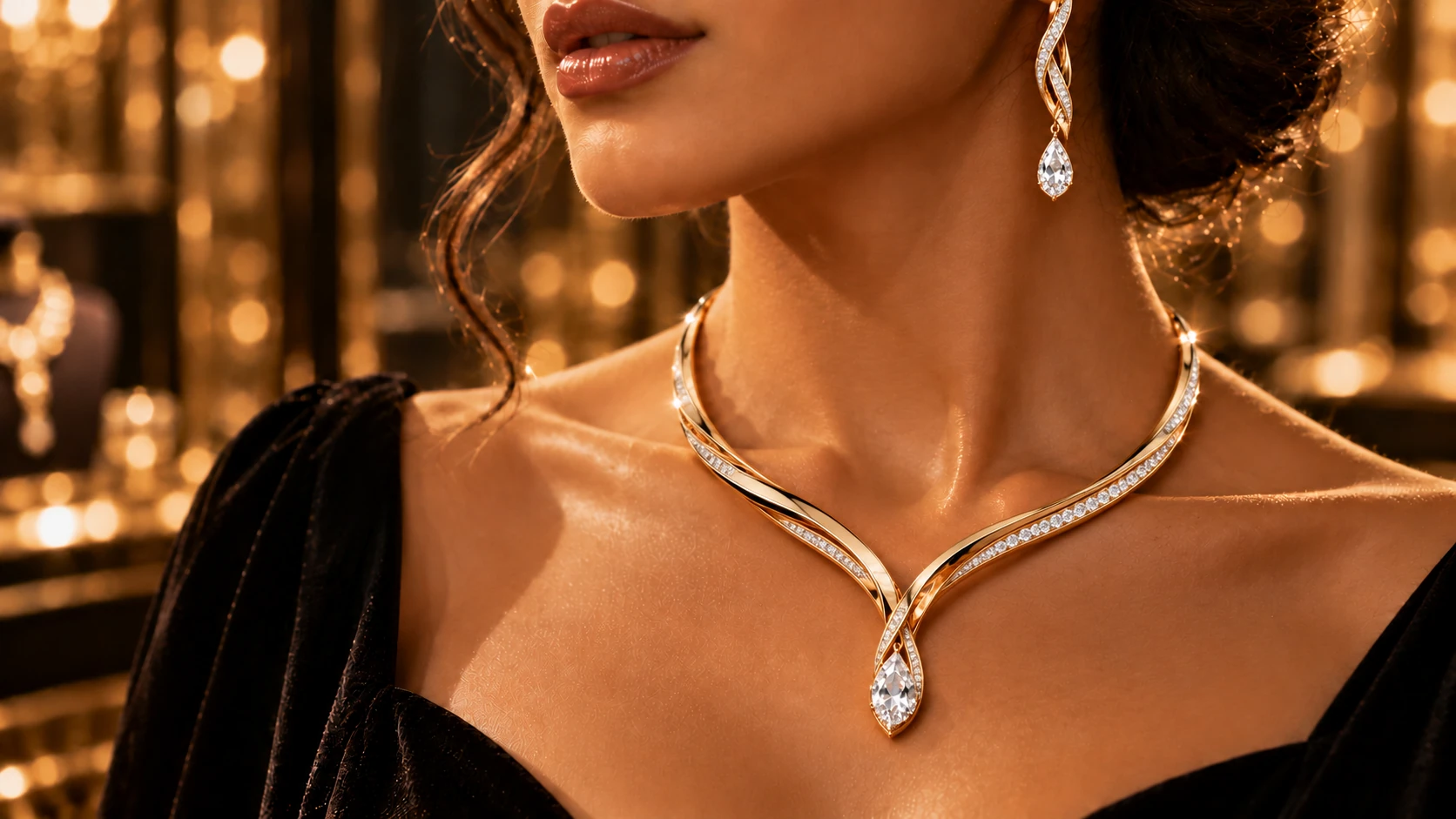
AI-generated editorial illustration of a woman wearing gold jewelry. It is not a photograph of a real person or a specific jewelry collection.
Imagine a woman fastening a gold necklace before a family celebration. The clasp is older than she is. Perhaps it was bought for a wedding, perhaps saved for from a first salary, perhaps passed down without a written story. Its value cannot be read from the metal alone. It may hold craftsmanship, a remembered voice, a promise, a measure of wealth or all of these at once. This intimate scene is imagined, but the many lives carried by jewelry are real.
There is no single female relationship with gold. Women are not a uniform market or a timeless type of consumer, and jewelry has been worn by people of every gender. Yet in many societies, rules around inheritance, marriage, work and public appearance have made gold especially consequential in women's lives. Across centuries it has been ornament, protection, rank, gift, portable property and family memory. The story is less a simple romance than an evolving negotiation over beauty, agency and belonging.
Why did gold become more than a precious metal?
Gold is visually distinctive, can be worked into fine forms, and resists corrosion. Those material qualities made it useful to skilled makers long before modern luxury houses existed. They do not explain every culture's choices, but they help explain why gold objects could survive, be repaired, remade or handed on. The metal also carries a contradiction: it can be shaped into something delicate while retaining a material value that can be weighed and exchanged. In jewelry, permanence and change sit together.
Archaeological objects show what people valued enough to bury, preserve or display, but they are not a complete record of everyday life. Some of the earliest surviving Egyptian gold artifacts date to the fourth millennium BCE, while the Met notes that gold jewelry was made for daily use, temple ritual and funerary settings across Egyptian history. Gold ownership was not restricted to royalty, although political power controlled much of the commodity. Surviving pieces therefore illuminate both personal adornment and unequal access. The Metropolitan Museum of Art, Gold in Ancient Egypt
In ancient Egypt, jewelry could be personal and protective as well as beautiful. The British Museum describes Egyptian pieces as adornment associated with wealth and status, but also as objects understood to give strength or protection to their wearer. Burial finds make those meanings visible because jewelry was placed with the dead. A necklace or amulet could therefore belong to a life and to ideas about what came after it. We should not reduce those objects to decoration for a modern display case. British Museum, Egyptian jewellery
The Hellenistic world offers another chapter, shaped by trade, conquest and cultural exchange. The Met records an expanding market for gold jewelry after Alexander's campaigns brought new wealth and contact across the Mediterranean and Near East. Greek makers combined local forms with influences from Persia and elsewhere, creating earrings, necklaces, bracelets, diadems and elaborate hair ornaments. The evidence shows a connected craft culture rather than a single unchanging style. What counted as beautiful moved with materials, mobility and the people who commissioned the work. The Met, Hellenistic Jewelry
Gold also communicated authority beyond the body. In Asante society in present-day Ghana, gold regalia included personal ornaments and symbols of office associated with the Asantehene, court officials and attendants. The British Museum describes these objects as culturally and spiritually significant, while documenting how many entered its collection through colonial seizure, indemnity and later sales. Their history asks a question that luxury advertising rarely does: who made an object, who had the right to wear it, and who controls it now? British Museum, Asante gold regalia
How did jewelry become a language of status and selfhood?
In medieval Europe, jewelry reflected a society organized by rank. The Victoria and Albert Museum describes gold, silver and precious gems as markers associated with royalty and nobility, while people of lower status more often wore base metals. Jewelry could signal who a wearer was permitted to be in public. Later fashions changed the visual code: court jewels, mourning rings, portraits and love tokens tied objects to religion, politics, grief and intimacy. A piece's meaning was shaped not only by its owner, but by the audience expected to read it. V&A, A history of jewellery
The psychology of a treasured object is not exclusive to gold. In his influential 1988 paper, consumer researcher Russell Belk proposed that possessions can contribute to an “extended self,” becoming part of how people express identity and continuity. A ring may mark a commitment; an inherited pendant may connect a person to relatives they never met. Belk's work is a theoretical account, not evidence that everyone feels attached to objects in the same way. Its value is that it makes room for meanings that a price label cannot measure. Belk, Possessions and the Extended Self
A qualitative study of women in Helsinki and Chicago explored how jewelry can become singular through family stories and links between generations. It is a small, context-specific study, not a claim about all women. Still, its focus on remembered relationships helps explain why two pieces with similar weight and design can feel incomparable to their owners. An inherited necklace may preserve a grandmother's taste, a migration story or the memory of being trusted with something precious. The emotional value is not imaginary just because it cannot be priced objectively. Ahde-Deal, “It’s From My Grandma,” The Design Journal
Gifts add another layer. Jewelry can carry a message of affection, recognition or obligation, depending on who gives it and under what conditions. A gift freely chosen may feel like an extension of a relationship; an expensive item demanded by custom may bring pressure along with beauty. The distinction matters. To romanticize every gold exchange is to miss how family expectations, class and gender can shape who pays, who receives, who keeps and who gets to decide what the object means.
Weddings, vows and traditions that are never universal
Gold appears in wedding traditions across many regions, but rituals differ by religion, locality, class and family. In some communities a bride receives gold as a personal gift; elsewhere ornaments are ceremonial, borrowed, jointly owned or not central to the wedding at all. Even the familiar ring is not a universal marriage symbol. GIA's historical overview traces changing ring customs and notes that the Roman “vein of love” explanation for the ring finger is anatomically false. A tradition can feel ancient without having one simple origin. GIA, The origin of wedding rings
In India, gold jewelry can be associated with weddings, festivals, family gifts and savings, but the word “wedding gold” covers sharply different arrangements. The World Gold Council describes Indian jewelry demand as closely tied to culture and ceremony, and notes that gold given to a woman at marriage may be treated as her property and a form of security. That is an important practice, not a guarantee of control in every household. Researchers also document the coercive and unequal dimensions of dowry, which is illegal in India. Bridal gold should never be used to romanticize financial pressure or harmful demands. World Gold Council, India’s jewellery market
Anthropologist Sarah Pinto Wright's research on Indian labor migration to the Gulf shows how gold given for marriage can operate as kinship, status and gendered obligation, not simply as an asset delivered to one woman. Her study describes families who use gold to maintain relationships and fulfill expectations, while also noting the costs and inequalities attached to dowry practices. The distinction between a woman's property, family exchange and a demand placed on her relatives is essential. The same ornament can be treasured by its wearer and embedded in a system she did not choose. Wright, Making Kin from Gold, Cultural Anthropology
In Istanbul, anthropologist B. Kalpaklioğlu's 2024 study of mehir and gold gifts draws on religious women's accounts to examine how marriage transactions intersect with intimacy, religion, family, civil law and reputation. It does not claim that all Turkish or Muslim women experience these practices alike. It shows something more useful: money and affection are not always separate spheres, and women's own interpretations can be ambivalent. Gold may feel like security, care, social expectation or a negotiation over rights, sometimes within the same marriage. Kalpaklioğlu, Anthropology of the Middle East
Can jewelry be beauty, memory and wealth at once?
The answer is often yes, but each meaning operates differently. A necklace may be chosen for its color against a particular dress, while its metal also has a market price. A ring may be emotionally irreplaceable yet costly to insure. Gold can be relatively portable and saleable compared with many household possessions, but a piece of jewelry is not equivalent to bullion or a savings account. Purity, workmanship, retailer premiums, resale terms, local rules and the market price all matter. Its value as an asset depends on ownership and access, not just possession in a photograph.
The market data underline the distance between desire and affordability. The World Gold Council reported that global jewelry demand in the second quarter of 2026 fell 17 percent year over year to 278.2 tonnes, while the value of jewelry demand in the first half rose 22 percent to US$86 billion. Higher gold prices help explain how buyers could spend more while purchasing less metal by weight. These industry figures track the market, not women's preferences alone, and the Council identifies its sources and methodology. World Gold Council, Gold Demand Trends Q2 2026
Gold's financial promise should be described carefully. Jewelry can provide a store of value for some owners, and in some settings it can be sold or pledged in a crisis. But access may be limited by family control, safety, documentation or the cost of selling. Craft labor and retail markups may not be recovered at resale, while gold prices can fall as well as rise. A necklace is not a guaranteed investment and cannot substitute for legal ownership, independent income or economic rights. A sentimental heirloom may be worth keeping even when selling it would be financially rational.
Craftsmanship turns a material into a personal object
Between a grain of gold and a finished jewel lie many decisions: alloy, proportion, setting, balance, finish and the way a clasp feels in the hand. The Met's studies of ancient Egyptian objects describe sheet-working, soldering and elaborate assembly, reminding us that fine jewelry has always depended on technical knowledge as well as raw material. Across eras, makers have hammered, cast, engraved, granulated and set stones. A finished piece can carry the skill of a workshop whose name is less visible than the luxury house that sells it.
Modern luxury brands build on this association between craft and story, but their products should be judged specifically. Design, repair services, provenance and material quality can justify a premium; branding and scarcity can add symbolic value. These elements may coexist, yet they are not interchangeable. For a parallel look at how identity, status and perceived quality influence premium purchases, see PRESDA's Psychology of Brands. The buyer's own taste remains part of the equation, not a flaw to be explained away.
Fashion keeps changing the scale of the relationship. Some women prefer a single inherited chain; others choose contemporary sculptural forms, recycled gold, colored stones, plated pieces or no jewelry. Lightweight designs can respond to higher prices and everyday comfort, while maximalist pieces may celebrate ceremony or visual abundance. A younger wearer may layer a family pendant with a new one, creating a style that neither generation would have chosen alone. These are not opposing camps. They are ways of deciding which past to carry and what to make newly visible. For more on the emotions, retail cues and social influences around purchase decisions, see PRESDA's Shopping Psychology.
What does gold mean to a woman now?
The answer depends on the woman, the piece and the moment. Gold can be chosen because it flatters a complexion, because a partner gave it, because a craftsperson made it beautifully, or because the owner wants an asset she can identify as her own. It can express confidence, faith, grief, lineage, pleasure or status. None of those meanings is guaranteed by the metal, and no woman owes anyone a performance of wealth or femininity through what she wears.
The timeless part is not a universal love story. It is gold's unusual capacity to hold several stories at once. An ornament can be beautiful in the mirror, meaningful at a wedding and measurable on a scale. It can connect generations, reveal unequal power or give an owner a degree of financial flexibility. To understand why women keep gold is to ask not only what it costs, but who chose it, who controls it, and what memory or possibility the wearer sees when she fastens the clasp.
FAQ
Frequently Asked Questions
What is this PRESDA article about?
A gold necklace can be adornment, inheritance, savings or a memory worn close to the skin. Its meaning changes across women, families and cultures, and across time.
Which category does this story belong to?
This story is part of PRESDA's Lifestyle coverage.
Who published this article?
WOMEN AND GOLD: A TIMELESS LOVE STORY was published by PRESDA Editorial on PRESDA.
PRESDA Dispatch
Stay Informed. Stay Aware.
A sharp briefing across AI, gaming, sport, business, world affairs, paparazzi, and lifestyle.