XIAOMI TARGETS EUROPE’S CAR MARKET IN 2027
Xiaomi targets Europe’s electric-car market in 2027. Examine the Germany plan, dealer preparations, latest financial context and unannounced prices.
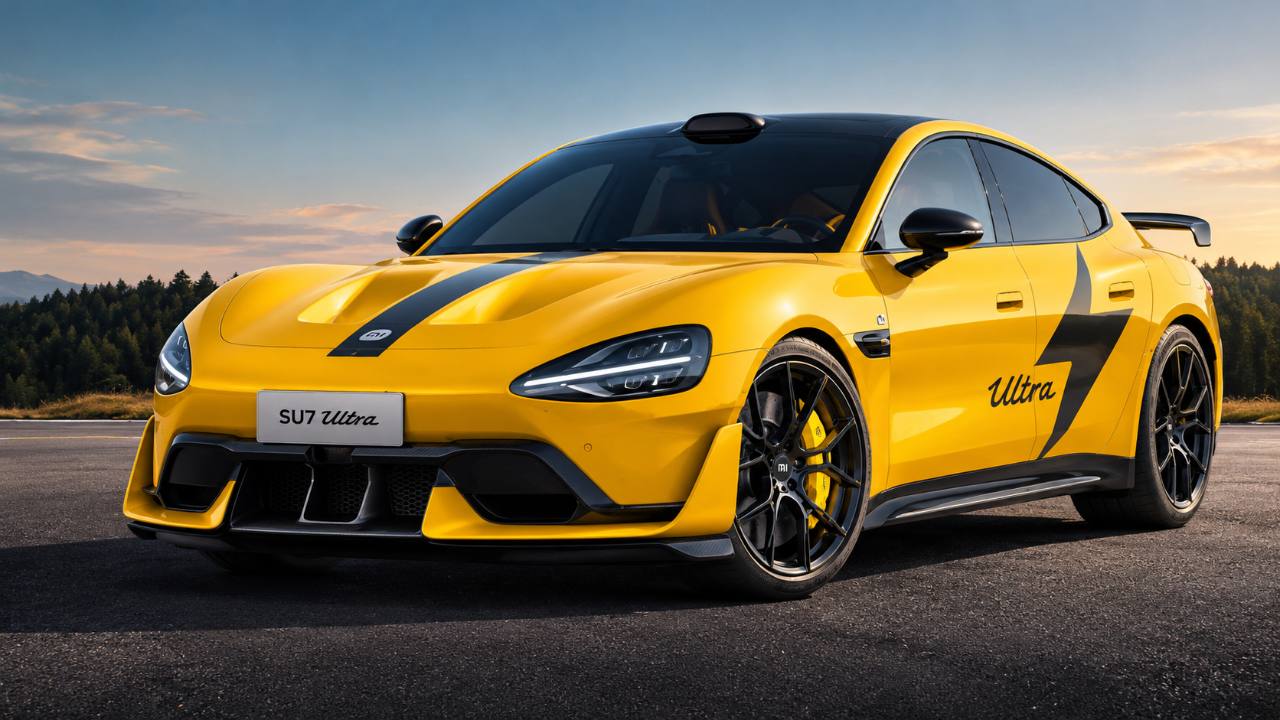
Supplied SU7 Ultra image, preserved unchanged. It does not confirm a European launch model, specification or retail price.
Xiaomi is preparing to enter Europe’s car market in 2027, with Germany planned for the second half of that year according to Reuters’ November 24, 2026 reporting. The company’s own global automotive website states the 2027 Europe target, but also warns that the SU7 and SU7 Ultra shown there are not currently for sale outside China. A market-entry plan is therefore confirmed; a finished European retail offer is not. Xiaomi Auto: official European entry target and sales disclaimer Reuters, November 24, 2026, via MarketScreener: Germany target and financial context
The business challenge extends well beyond shipping a striking electric sedan. A durable entry requires products adapted to local customers, regulatory approvals, sales partners, repairs, parts and software support. Xiaomi’s European research operation and preliminary dealer work show preparation for that broader system. They should be examined as practical steps, not treated as proof that success in China will automatically repeat overseas. Xiaomi Auto: European research and design capabilities CnEVPost, September 3, 2026: preliminary German dealer agreements
What Xiaomi has actually announced
The clearest primary reference is Xiaomi Auto’s global website. It names Europe in 2027 and provides a channel for dealer and distribution inquiries, while its product disclaimer explicitly limits current sales. Reuters adds a more specific Germany timetable. The distinction between these statements and an open configurator with local contracts, prices and delivery promises is the starting point for reading the expansion responsibly. Xiaomi Auto: official European entry target and sales disclaimer Reuters, November 24, 2026, via MarketScreener: Germany target and financial context
| Issue | Current verified position |
|---|---|
| Europe target | 2027, stated on Xiaomi Auto’s official global site |
| Germany timing | Second half of 2027, reported by Reuters on November 24, 2026 |
| Current sales status | Official site says SU7 and SU7 Ultra are not for sale outside China |
| Distribution | Eight preliminary German dealer MoUs reported in September 2026 |
| European customer offer | Local models, prices and delivery terms must be announced separately |
Why a smartphone company wants to sell cars
Xiaomi describes its core strategy as Human × Car × Home, connecting personal devices, the vehicle and domestic products. The car is not presented merely as a separate badge attached to an outsourced consumer gadget. In the company’s account, it becomes another important setting for software, user accounts and connected services. That positioning explains why an existing electronics customer base matters to the business, without proving that every phone owner will buy the brand’s car. Xiaomi Auto: company history and product positioning
The opportunity is clear in principle: a familiar interface and well-integrated devices can reduce friction in everyday use. The challenge is equally concrete. A vehicle remains a long-lived physical product that must be safe, repairable and useful even when a particular app, subscription or phone changes. European customers will judge the ecosystem not only by how easily it connects, but by what remains dependable over years of ownership.
Munich is about adaptation, not just prestige
Xiaomi’s 2026 interim report says its European research and design center was established in Munich in early 2025. The global R&D page describes work on performance, design, European user needs and collaboration with suppliers and universities. Those stated functions matter more than treating a German address as an automatic certificate of engineering superiority. The center supports preparation; it does not itself grant market approval. Xiaomi Auto: European research and design capabilities Xiaomi: 2026 interim report and Munich centre
Adaptation can involve many ordinary details that a launch photograph cannot show: the usability of navigation, language support, charging access, road behavior and the way assistance features are explained. A specification sheet is only one part of that work. Good market entry means learning which features customers actually use and ensuring that the surrounding services make them usable locally, rather than assuming that a successful domestic configuration needs no changes.
A European engineering base is not a European factory
Research, manufacturing and sales are different activities. The presence of a Munich center does not establish that the launch vehicles will be built in Germany, or that every component is European. Likewise, a test vehicle on European roads is not proof that retail deliveries have begun. A clear article should name the function of each operation rather than merge every preparatory activity into the word launch.
Dealer agreements are a beginning, not a completed network
Trade publication CnEVPost reported on September 3, 2026 that Xiaomi had signed memoranda of understanding with eight German dealer groups during IFA Berlin. Its account explicitly distinguishes these documents from definitive dealership agreements. That is an important business step toward a local retail and service network, but it does not establish the number of operating stores, sales territories or contractual obligations. CnEVPost, September 3, 2026: preliminary German dealer agreements
For an owner, the network is not an abstract corporate diagram. It determines where to obtain a diagnosis, how quickly a replacement part can arrive and who handles a warranty claim. Those questions can outweigh a dramatic acceleration claim when a car is used every day. The useful measure of progress is therefore not only how many partnerships are announced, but how clearly the eventual customer can understand the support available.
What the latest financial results do and do not show
Xiaomi’s November 24 results report RMB23.9 billion in third-quarter revenue for the combined new-energy-vehicle, AI and other new initiatives segment, and an operating loss of RMB3.4 billion for that segment. Group adjusted net profit was RMB4.9 billion. These are different scopes and measures: the group figure should not be described as profit from selling European cars, and segment revenue is not all vehicle revenue. Xiaomi, November 24, 2026: third-quarter results
The figures give context to the expansion without predicting its outcome. A company can have substantial resources and still face a costly, uncertain launch. Domestic demand, product transitions and research spending affect the starting position; European sales, support costs and customer retention will create another set of tests. An overseas target should therefore be assessed alongside operating discipline, rather than treated as a guaranteed remedy for a weaker quarter.
Regulation, software and the final price
Imported vehicles enter a market shaped by approval requirements and trade policy. The European Commission’s documentation records countervailing duties on Chinese battery-electric vehicles under the framework introduced in 2024. It would be misleading to take a headline tariff rate, assign it automatically to a future Xiaomi model and present the calculation as a settled 2027 price. Applicable treatment and commercial decisions must be checked when the actual offer exists. European Commission: countervailing duties on Chinese battery-electric vehicles
Connected-car regulation also extends beyond the battery and motor. The Vehicle Certification Agency explains separate frameworks for cybersecurity and software-update management under UN Regulations 155 and 156. For a software-centered brand, this is part of the product’s ongoing governance, not an optional smartphone-style feature. Compliance claims should be tied to approved vehicle types and management systems, rather than inferred from a polished demonstration. Vehicle Certification Agency: cybersecurity and software-update regulations
A Chinese sticker price is not a European customer quote
Currency conversion alone omits taxes, distribution, local specification, warranty coverage and other commercial choices. Equally, a concept car, a prototype record and a production model should not share one undifferentiated set of claims. Xiaomi’s site itself separates promotional display from availability. Until a localized offer is published, the responsible answer to an exact European price question is that it has not been established by the sources reviewed. Xiaomi Auto: official European entry target and sales disclaimer
A growing electric market is not a single customer
ACEA’s November 24 release reports that battery-electric cars accounted for 23.4% of new EU car registrations in January–October 2026. The underlying data are provisional. The figure describes a powertrain’s share of a specified new-car market over ten months; it is not the share of all cars already on European roads, a single-month result or Xiaomi’s own market share. It supplies evidence of a substantial addressable market without predicting how many buyers will choose a newcomer. ACEA, November 24, 2026: January–October EU registrations, provisional data
The same dataset separates battery-electric, plug-in-hybrid and hybrid-electric cars. Combining them into an undefined electric total can conceal important differences in how vehicles are powered and used. It can also make one article’s percentage appear to contradict another when the regions or categories differ. For a business entering Europe, that is more than a statistical footnote: product positioning, customer expectations and service requirements depend on the actual vehicles and countries being addressed. ACEA, November 24, 2026: January–October EU registrations, provisional data
A strong launch would connect that market research to an offer a customer can actually evaluate. The relevant comparison includes purchase or finance terms, space, daily charging, assistance features and access to repairs, not just a prototype’s headline performance. Xiaomi can use engineering and brand recognition to attract attention; earning repeat trust requires the ordinary ownership experience to support the promise. That outcome remains ahead of the company, rather than something its 2027 announcement has already demonstrated.
The practical milestones to watch next
For customers, the next meaningful announcements are the exact local models, certified specifications, usable range and charging information, complete prices, warranty terms and an operating service network. For the company, the test is whether those pieces arrive together in the markets it actually launches. Europe is not one contract, and a Germany target should not be rewritten as simultaneous sales in every European country.
PRESDA’s analysis of Toyota beyond cars considers another attempt to build a broader mobility business. Our guide to documented car auction prices examines a very different market and explains why a verified transaction is not the same as an estimate. Xiaomi’s European story currently belongs to the preparation stage: a stated 2027 target, concrete groundwork and important customer details still to come.
FAQ
Frequently Asked Questions
When does Xiaomi plan to sell cars in Europe?
Its official global site names 2027. Reuters reported on November 24, 2026 that Germany’s market entry was planned for the second half of 2027.
Can Europeans already buy an official local SU7?
Xiaomi’s global site says the SU7 and SU7 Ultra shown are not currently for sale outside China and are displayed for promotional purposes.
Has Xiaomi announced European retail prices?
The sources reviewed do not establish a complete localized customer price list. A Chinese price converted into euros is not an official European retail quote.
Does a dealer MoU mean a showroom is open?
No. A memorandum of understanding indicates preliminary cooperation. It does not by itself establish operational stores, final contracts or vehicle deliveries.
PRESDA Dispatch
Stay Informed. Stay Aware.
A sharp briefing across AI, gaming, sport, business, world affairs, paparazzi, and lifestyle.