BYD’S YANGWANG U9 XTREME BREAKS 500 KM/H SPEED BARRIER
Marc Basseng reached 503.17 km/h in Abu Dhabi on November 1, 2026. What Guinness and the FIA recognise, and why a one-way peak is not a two-way average.
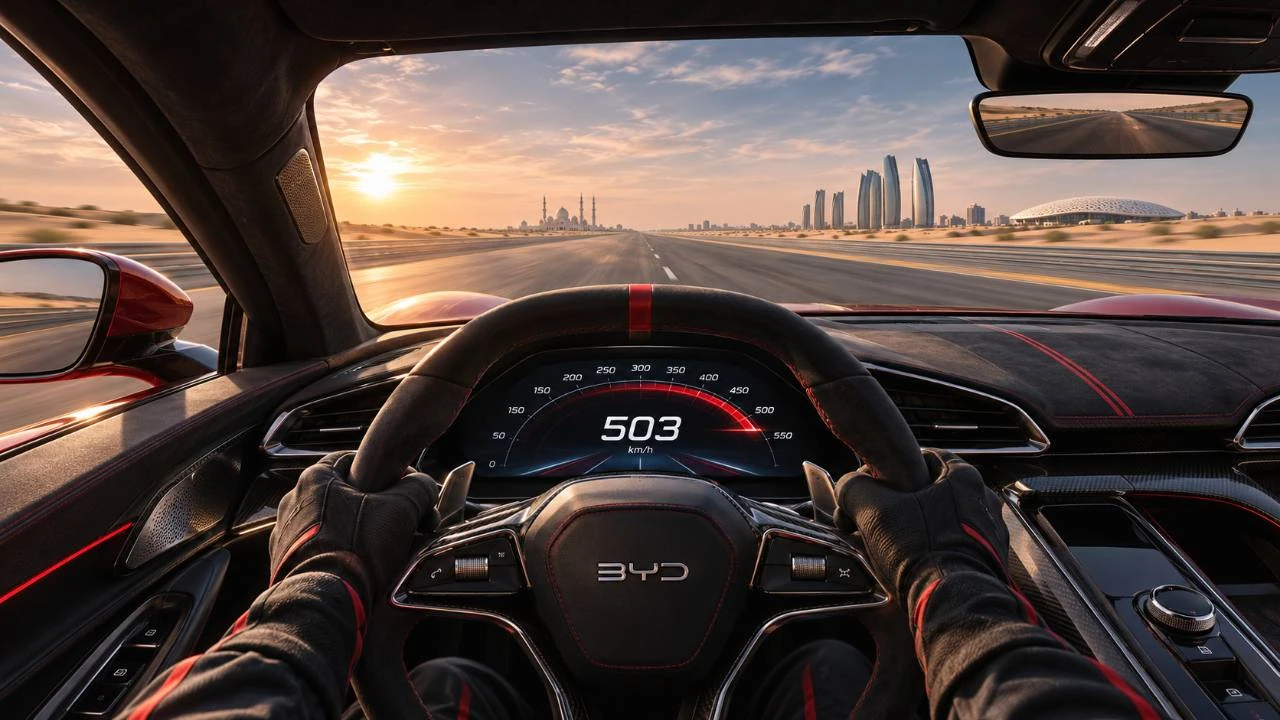
AI-generated editorial illustration supplied for PRESDA. The cockpit, cityscape and speed display are conceptual, not footage or measurement evidence from the record run. Editorial image supplied for PRESDA.
BYD’s Yangwang U9 Xtreme reached 503.17 km/h on a closed section of the E11 highway in Abu Dhabi on November 1, 2026, driven by German racer Marc Basseng. Guinness World Records lists the achievement as the highest speed by a production car in a single-direction run. That final qualification belongs beside the headline number: this is a verified one-way peak, not a published average of opposite-direction runs. Guinness World Records: production-car single-direction record
Where, when and how the run happened
The manufacturer announced the result on November 6, distinguishing the announcement date from the November 1 run. The location was Sheikh Khalifa Bin Zayed International Road in Abu Dhabi’s Al Dhafra region. BYD describes two preliminary runs on October 31, followed by adjustments to rear-wing angle, suspension software and tyre pressures. Two further runs followed on November 1, with the second producing the final figure. BYD: November 6 record announcement and technical specification
The road was closed for the attempt, and the car was driven by a professional. Neither the electric powertrain nor the high-tech setting makes this an autonomous-driving record. Basseng’s role remains central: the run required a human driver, a prepared vehicle and a controlled test environment. The approved cockpit illustration accompanying this article is a visual interpretation, not the telemetry used to establish the speed.
What the official recognition covers
The FIA’s November 6 statement recognises the 503.17 km/h achievement and identifies two Guinness categories: the highest speed achieved by a production car in a single-direction run, and the equivalent category for an electric production car. These are specific titles. They should not be expanded into an absolute land-speed record or a claim that every recognised speed-record protocol has been satisfied. FIA: recognition of the 503.17 km/h achievement
One-way peak versus two-way average
Guinness explicitly distinguishes this peak-speed category from conventional records requiring different procedures, including runs in opposite directions. A return run helps account for conditions such as wind and road gradient. A one-way maximum and a two-way average answer different questions, so comparing the biggest numbers alone can mislead. The Guinness entry also identifies a calibrated VBOX system and FIA review of the data, going beyond a dashboard photograph. Guinness World Records: production-car single-direction record
The hardware behind 503.17 km/h
BYD specifies four electric motors, each rated at 555 kW, for a combined 2,220 kW and a quoted 3,019 metric horsepower (PS). The Xtreme uses a 1,200-volt architecture, independent wheel-torque control and the DiSus-X body-control system. PS is metric horsepower, so it should not be silently relabelled as the same numerical value in mechanical horsepower. These are the Xtreme’s specifications, not those of every standard U9. BYD: November 6 record announcement and technical specification
Tyres were another specialised component. Giti identifies its GitiSport e.GTR 2 Pro as developed for the U9 Xtreme and describes reinforcement and profile changes for extreme performance. The point is not that motor power becomes unimportant. It is that delivering power at this speed also depends on the tyre-road interface, vehicle stability and the ability to manage heat. The record is a system-level achievement rather than a battery number in isolation. Giti Tire: tyres developed for the U9 Xtreme run
Production car does not mean an ordinary showroom model
Car and Driver reports that the Xtreme programme is limited to 30 cars. A small production run can still sit within a recognised production-car category, but the qualifier matters when readers compare it with a mass-market electric vehicle. The record also says nothing by itself about price, delivery dates or registration rules in every country. Those require separate evidence, not an inference from the word production. Car and Driver: the single-direction Guinness records
The milestone and its proper comparison
Crossing 500 km/h is a clear engineering milestone for the recognised category. The most informative comparison keeps four items together: the vehicle specification, the achieved speed, the measurement method and the conditions under which the attempt took place. Remove the method and the number becomes easier to promote but harder to understand. Keep it, and the U9 Xtreme’s achievement remains striking without confusing one kind of record with another.
Related reading: How autonomous driving differs from electric propulsion.
Related reading: The wider global shift to electric cars.
FAQ
Frequently Asked Questions
When and where was 503.17 km/h achieved?
On November 1, 2026, on a closed section of the E11 in Abu Dhabi’s Al Dhafra region. BYD announced it on November 6.
Who drove the car?
German racing driver Marc Basseng. This was a human-driven speed attempt.
Is it a two-way world speed record?
No. Guinness recognises a peak in a single-direction run, including production-car and electric-production-car categories. It is not a published two-way average.
How powerful is the U9 Xtreme?
BYD specifies four 555 kW motors, totalling 2,220 kW, and quotes 3,019 PS of metric horsepower.
PRESDA Dispatch
Stay Informed. Stay Aware.
A sharp briefing across AI, gaming, sport, business, world affairs, paparazzi, and lifestyle.