ADIDAS VS PUMA: THE BROTHERS WHO BUILT RIVAL SHOE EMPIRES
How Adolf and Rudolf Dassler built a shoe business, split in 1948 and created Adidas and Puma. Explore the documented history behind the famous feud.
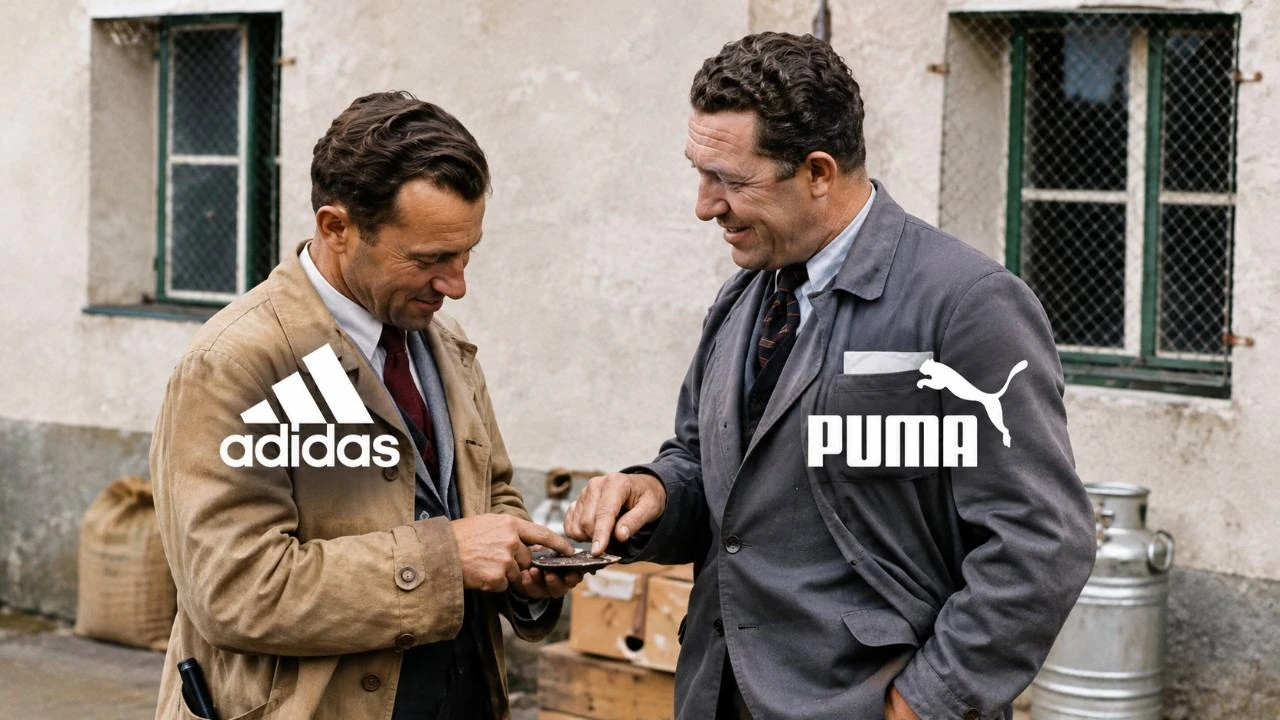
Conceptual historical reconstruction supplied for PRESDA. The figures are illustrative representations, not an authenticated photograph of the brothers. Modern logos identify the later brands and are not period evidence. Editorial image supplied for PRESDA.
Adidas and Puma began with the same family, the same German town and a shared ambition to make better sports shoes. Adolf, known as Adi, and Rudolf Dassler built a business together before their separation produced two enduring rivals. The familiar tale of a brotherly feud is true in outline. The challenge is to distinguish the business chronology, which can be checked, from stories that claim to explain an entire rupture with one insult or one moment of betrayal.
One factory before two famous names
The brothers registered their shared sports-shoe factory in Herzogenaurach in 1924. The town’s own history places the family home within that story and dates the separation to 1948. This starting point prevents a common chronological error: athletes wearing Dassler shoes before the split were not choosing between Adidas and Puma as later consumers would. The two brands had not yet emerged as independent competitors. Herzogenaurach: the Dassler family home and shared factory
Jesse Owens wore Dassler spikes at the 1936 Berlin Olympics, where he won four gold medals. Puma’s chronology identifies that moment as part of the shared company’s international breakthrough. The sporting achievement belonged to Owens; the footwear offered the manufacturers visibility. Keeping those roles separate avoids turning an athlete’s success into a story in which a shoe company alone creates victory. PUMA: company chronology
The Nazi era cannot be edited out
Both brothers joined the Nazi Party in 1933, a fact acknowledged in Adidas’s own account of Adi’s life. Their company operated within Nazi Germany and through the disruptions of the Second World War. Supplying Owens does not erase that political context. A responsible history can recognise technical skill and commercial ambition without using a famous Olympic association to absolve everything else. Corporate biographies are useful evidence, but their explanations of motives require critical reading. adidas Group: Adolf Dassler and wartime history
Why did the Dassler brothers split?
The Adi and Käthe Dassler Foundation describes escalating disagreements about company decisions and representation during wartime absence. It offers evidence of a relationship deteriorating over time, while also presenting the story from Adi’s side of the family. Popular versions add dramatic misunderstandings and suspicions. Those episodes should not be promoted into a single proven cause. The documented separation is firmer ground than any claim to know one decisive private motive. Adi and Käthe Dassler Foundation: the separation
1948 and 1949 are different milestones
Rudolf’s new enterprise began in 1948, initially associated with the name RUDA. Puma’s official chronology distinguishes business registration, the start of operations, brand registration in October 1948 and a commercial-register entry in January 1949. This explains why dates can appear to conflict without describing different companies. A business can acquire a legal registration, a working factory and a familiar brand name at different moments. PUMA: company chronology
Adi registered the company bearing the Adidas name on August 18, 1949, with 47 employees, according to Adidas’s history. The name combines his familiar first name with part of Dassler. It is not an acronym invented from an English slogan. By this stage, a shared manufacturing tradition had become the foundation for two businesses, each able to claim experience while needing to build a separate identity. adidas Group: company history
How shoes became a global business
The scholarly Deutsche Biographie account traces Adi’s connections with athletes and the expansion of sporting partnerships. That relationship helps explain the business model: products needed to perform, but they also needed to be seen performing. Competition moved beyond workshop skill into athlete relationships, distribution and recognisable design. A logo on a winning competitor could connect a specialised item to a much larger public. Deutsche Biographie: Adolf Dassler
Rivalry is an appealing explanation for growth, but it is not sufficient on its own. Anger does not organise a supply chain, finance production or guarantee that a shoe fits. The brothers’ history is better understood as a combination of shared expertise, fractured ownership and competition for credibility. The feud gave the story memorable characters. Customers, workers, athletes and later managers helped turn those characters’ companies into institutions that outlasted them.
A symbolic handshake, not a merger
In 2009 the companies announced a joint football event supporting Peace One Day. The gesture belonged to a later generation and should not be mistaken for a reconciliation personally achieved by the founders. It also did not merge the brands. Its significance was symbolic: businesses built on the same family history could acknowledge that connection without abandoning competition. The story ends less neatly than a fairy tale, but more usefully for understanding how companies remember their past. PUMA: Adidas and Puma Together for Peace (2009)
Reading the company story critically
A company timeline is strongest when it gives a dated registration, product launch or public event. It is less conclusive when it explains what a founder secretly intended. Family foundations can preserve valuable documents while also defending a reputation. Reading those sources alongside municipal and scholarly histories helps separate the archive from the anniversary narrative. That distinction matters because a brand’s origin story is itself part of what the business sells.
Further reading: Johan Cruyff and the power of an individual sporting identity.
Related reading: Samsung’s journey from trading business to technology giant.
FAQ
Frequently Asked Questions
Were the founders of Adidas and Puma brothers?
Yes. Adolf, or Adi, Dassler founded Adidas; his brother Rudolf founded the enterprise that became Puma. They previously ran a shared shoe business.
When did Adidas and Puma begin?
Rudolf’s independent enterprise began in 1948, with subsequent registration milestones. Adi registered Adidas on August 18, 1949. The shared factory dates to 1924.
What caused the Dassler feud?
The separation followed years of personal and business conflict. No single dramatic anecdote should be treated as the sole proven explanation.
Does Adidas stand for an English slogan?
No. The name comes from Adi Dassler. English phrases attached to it are later backronyms.
PRESDA Dispatch
Stay Informed. Stay Aware.
A sharp briefing across AI, gaming, sport, business, world affairs, paparazzi, and lifestyle.