JOHAN CRUYFF: THE MAN WHO CHANGED FOOTBALL FOREVER
How Johan Cruyff transformed football as a player and coach, from Ajax and the 1974 World Cup to Barcelona’s Dream Team and his lasting influence.
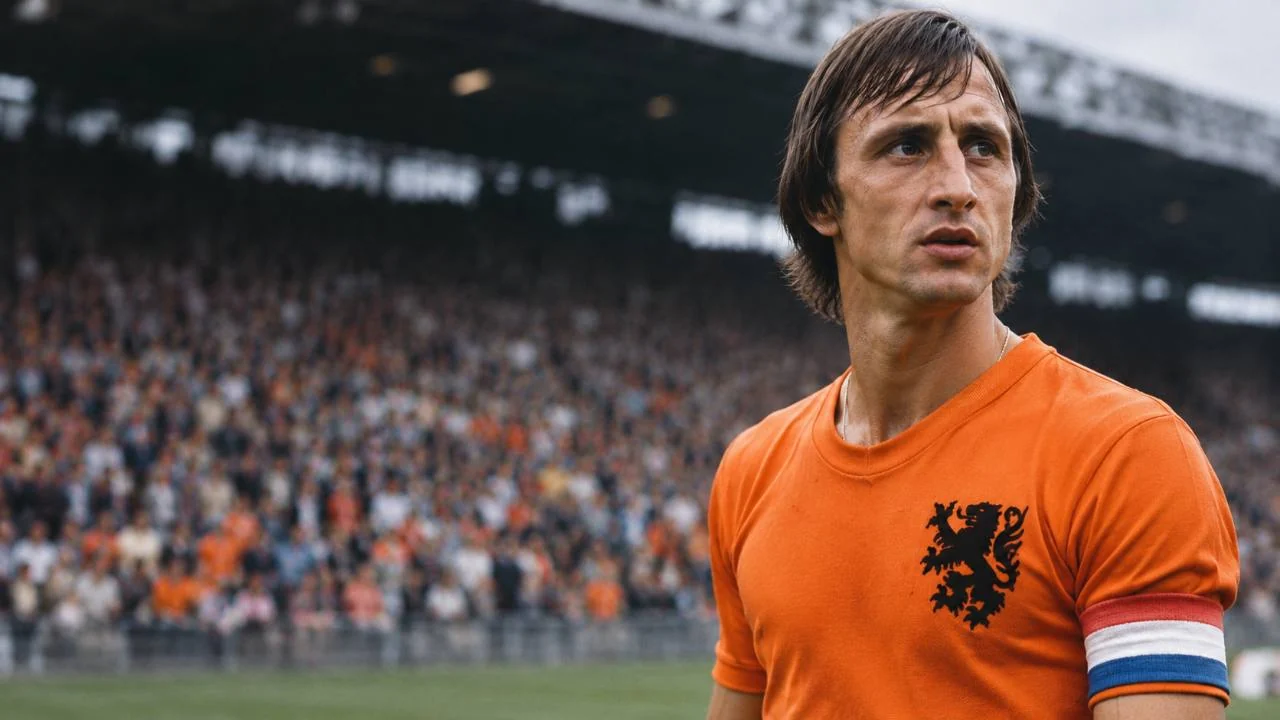
Editorial depiction of Johan Cruyff, not an authenticated archival photograph. Image supplied for PRESDA. Original creator and reuse licence not provided. WebP conversion: PRESDA.
Johan Cruyff changed football by making intelligence visible. A forward could leave the centre without abandoning the attack; a defender could move into midfield without destroying the team’s balance. The important question became what a movement did to everyone else. His career, first on the pitch and then on the touchline, turned that question into a lasting football education.
Who was Johan Cruyff?
Born in Amsterdam on 25 April 1947, Cruyff became an outstanding player and later an influential coach. He won the Ballon d’Or in 1971, 1973 and 1974. He died on 24 March 2016. Those dates frame an extraordinary career, but awards alone explain little about why coaches still return to his ideas. FC Barcelona: Cruyff
Total Football was a collective invention
Cruyff did not invent Total Football alone. FIFA’s account identifies Rinus Michels as its central coaching architect and Cruyff as its on-field organiser. At Ajax and with the Netherlands, movement, versatility and mutual understanding made positional exchanges possible. The freedom depended on coordination: when one player moved, someone else had to understand the space left behind. FIFA: Rinus Michels and Total Football
Imagine a centre-forward dropping towards the ball. If the opposing defender follows, a gap opens behind him. If he stays, the forward may receive with time to turn. The movement becomes useful only if teammates recognise those alternatives. This is a tactical illustration, rather than a reconstruction of one match, and it helps explain why the idea is richer than simply telling everyone to change positions.
Ajax made the idea impossible to ignore
Cruyff won three consecutive European Cups with Ajax, in 1971, 1972 and 1973. He later won the competition as Barcelona’s coach in 1992. That bridge between playing and teaching is unusual: he could test an attacking philosophy through the decisions of a footballer and then rebuild it through the responsibilities of a manager. UEFA: Cruyff’s playing and coaching legacy
The turn that survived a lost World Cup
Against Sweden on 19 June 1974, Cruyff pulled the ball behind his standing leg and escaped Jan Olsson. The famous Cruyff Turn offered a miniature version of his football: suggest one direction, understand an opponent’s reaction, then choose another. FIFA preserves the episode as one of the tournament’s defining moments. FIFA: the Cruyff Turn
The Netherlands lost the final 2–1 to West Germany. That result matters because influence and victory are different measurements. A team can lose the decisive match and still give the sport a vocabulary that outlives its champions. Admiration should not erase the defeat, just as the defeat should not erase the football. FIFA: the 1974 final
Barcelona turned a philosophy into an institution
Cruyff arrived at Barcelona in 1973 and helped win the 1973/74 Spanish league. Returning as coach in 1988, he led the club to four consecutive league titles and its first European Cup in 1992. The Dream Team made attacking ambition part of the club’s expectations, rather than a promise renewed with every appointment. FC Barcelona: Cruyff’s arrival and Dream Team
Why his influence still matters
Cruyff’s most useful legacy is a habit of asking better questions. Where is the spare player? What makes possession dangerous? When does freedom require more discipline? His story belongs alongside other sporting lives in PRESDA’s Sport coverage. Greatness can be counted in trophies; the deeper test is whether other people learn to see the game differently. Explore the section
Related reading: Muhammad Ali: a fighter beyond the ring.
FAQ
Frequently Asked Questions
Did Cruyff invent Total Football alone?
No. Rinus Michels was its central coaching architect; Cruyff was its influential on-field organiser and later a leading coach.
Did Cruyff win the World Cup in 1974?
No. The Netherlands lost the final 2–1 to West Germany.
PRESDA Dispatch
Stay Informed. Stay Aware.
A sharp briefing across AI, gaming, sport, business, world affairs, paparazzi, and lifestyle.