MUHAMMAD ALI: THE FIGHTER WHO BECAME BIGGER THAN BOXING
He won world championships, lost years of his prime for refusing the Vietnam draft, embraced Islam, challenged America in public and became one of the most recognizable athletes in history. Muhammad Ali’s greatest fights did not all happen inside a ring.
On July 19, 1996, Muhammad Ali stood above the Olympic stadium in Atlanta holding a flame. His hands trembled. The man whose speed had once made heavyweight boxing look weightless had to concentrate on movements that millions of spectators could see were difficult. He raised the torch and helped set the cauldron alight. The ceremony continued; the image stayed.
Ali was 54, living with Parkinson’s disease, and long retired from boxing. Yet the applause was not simply for a former champion. It carried memories of an Olympic teenager, a defiant young Muslim, an athlete threatened with prison, and an older fighter who had returned too often. Atlanta brought those lives into one frame. The Olympic record begins with a different name: Cassius Clay.
How did that boy become Muhammad Ali and a figure in arguments about America, religion, race and war? His story contains dazzling achievement and uncomfortable contradictions, including defending his own dignity while diminishing others’.
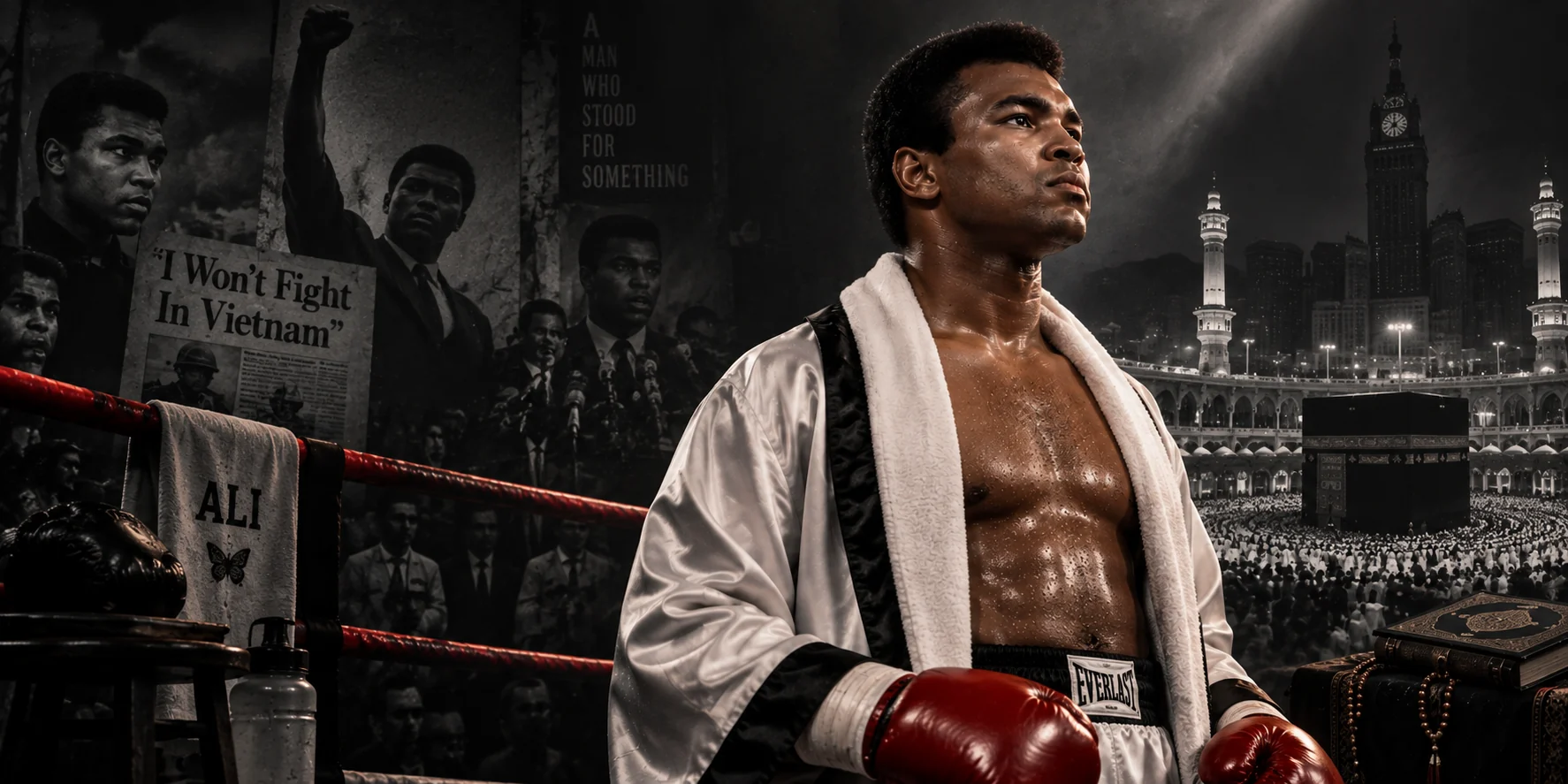
About the artwork: the hero is a conceptual editorial montage combining different periods of Muhammad Ali’s life. It is an illustration, not a single historical photograph or a documentary record of one event.
Who Was Cassius Marcellus Clay Jr.?
Cassius Marcellus Clay Jr. was born on January 17, 1942, in Louisville, Kentucky. His father, Cassius Sr., painted signs; his mother, Odessa Grady Clay, worked in domestic service. He grew up with his younger brother Rudolph, later known as Rahaman, in a household where faith, work and racial exclusion were part of ordinary life. His mother raised the boys as Baptists. The Ali Center’s account of his religious upbringing places belief well before fame.
Louisville was not an abstract lesson in segregation. A Black child encountered restrictions on where he could eat, where he could be served and how white authority expected him to behave. Sporting talent could create opportunity without dissolving those boundaries. The distinction between being applauded for America and being treated equally within it would eventually become central to his public life.
The stolen bicycle story is unusually well established among the legends surrounding him. At 12, after his bicycle disappeared, Clay sought out Joe Martin, a Louisville police officer who also coached boxing. Martin encouraged him to learn to fight before attempting revenge. This was reported while Clay was still a young contender, including in TIME’s 1963 profile, rather than first appearing in a posthumous tribute.
Gym instruction, repetition and amateur competition came between the theft and the medals. Golden Gloves and national AAU success established his promise. Published amateur totals differ; the clear progression is from a Louisville novice to an international contender before adulthood.
What Did Ali Win at the 1960 Rome Olympics?
At 18, Clay represented the United States in the light-heavyweight division in Rome. On September 5, 1960, he defeated Poland’s Zbigniew Pietrzykowski in the final, winning a unanimous decision and Olympic gold. This was an amateur light-heavyweight championship, not the professional heavyweight title he would later hold. Olympedia’s biography and results distinguish those careers.
He returned to a country capable of celebrating his medal while maintaining racial barriers. Gold identified an exceptional athlete; it did not grant Black Americans equal treatment or guarantee its owner dignity outside an arena.
Did He Really Throw His Gold Medal Into the Ohio River?
Ali told that story in his 1975 autobiography, The Greatest: My Own Story: after racist treatment, he cast the medal into the Ohio River. But biographers Thomas Hauser and David Remnick challenged the account; alternative explanations hold that the medal was simply lost. BoxRec’s discussion of the autobiography records this dispute.
His experience of racism does not depend on proving that a piece of gold landed in a river. The distinction between his autobiographical account and established fact should remain visible.
How Did “I Am the Greatest” Become a Public Challenge?
Clay turned professional in 1960. Working with trainer Angelo Dundee, he developed the movement, timing and fast combinations that would distinguish him from the familiar image of a lumbering heavyweight. He also made talking part of the contest. Predictions, rhymes, imitations and insults turned promotional appearances into performances people wanted to see.
Professional wrestler Gorgeous George helped demonstrate the commercial possibilities. The Ali Center’s boxing timeline places that influence around Clay’s 1961 Las Vegas fight with Duke Sabedong. A spectator could buy a ticket to admire an extravagant performer or to hope someone humbled him. Either reaction made the performer difficult to ignore.
For a young Black athlete, announcing his superiority challenged expectations of gratitude and deference. Some listeners heard comedy; others heard a threat to the social order. His boxing increasingly justified his theatrical confidence.
This was also collaborative theatre. “Float like a butterfly, sting like a bee” became inseparable from Ali, but his cornerman Drew “Bundini” Brown is credited with creating the phrase. UPI’s contemporary obituary of Brown explicitly records that authorship. Ali made the words famous with his voice and his body.
How Did He Beat Sonny Liston in 1964?
Sonny Liston had power, an intimidating presence and a championship won by overwhelming Floyd Patterson. Clay entered their February 25, 1964, fight in Miami Beach as a substantial underdog. The challenger’s noise could be mistaken for camouflage: perhaps the jokes were protecting a young man who knew he was about to be exposed.
Instead, his speed complicated everything Liston tried to do. Clay moved, struck quickly and made the champion reset. He endured a frightening spell of impaired vision during the fight, recovered, and continued. Liston remained on his stool after six rounds, unable to answer the bell for the seventh. At 22, Clay was heavyweight champion. The Associated Press’s original fight report captures how startling the result was.
“I shook up the world!” he declared. The words are documented in Sports Illustrated’s account of the night. They were exuberant and accurate about the sporting upset. The larger disturbance was still unfolding. Within days, the new champion would insist that the world reconsider what it called him, what he believed and who could define him.
Why Did Cassius Clay Become Muhammad Ali?
His association with the Nation of Islam developed before he won the championship. The movement offered Black pride, discipline, economic independence and an explanation of white supremacy that appealed to a young man raised under segregation. Malcolm X became a friend and mentor, helping him understand his fame as a source of public power.
After defeating Liston, Clay publicly identified himself as a Muslim. He briefly used Cassius X. On March 6, 1964, Elijah Muhammad, the Nation’s leader, announced the name Muhammad Ali. These were distinct steps, not a single ringside conversion. The Ali Center’s spiritual history documents the sequence.
Ali rejected his birth name as an inheritance of slavery. There is a historical complication: the white nineteenth-century Cassius Marcellus Clay after whom his father had been named was an abolitionist, as Yale’s account documents. Ali’s objection concerned self-definition within a society shaped by enslavement, not simply one namesake’s politics.
The Nation of Islam of Elijah Muhammad should not be treated as interchangeable with mainstream Sunni Islam. It combined religious teaching with Black nationalism and racial separatism; its distinctive claims about race and religious authority diverged from orthodox Islamic theology. Identifying this difference helps explain both Ali’s early beliefs and how substantially they later changed. PBS’s historical discussion of Ali, race and religion addresses these tensions.
What Happened Between Ali and Malcolm X?
The friendship broke during Malcolm’s rupture with Elijah Muhammad and the Nation of Islam in 1964. Ali remained loyal to Elijah Muhammad. When the men encountered one another in Ghana that year, he rejected Malcolm. The younger man whose independence inspired so many people was also susceptible to the authority of the religious community that had given him belonging.
Malcolm X was assassinated in February 1965. Ali’s later spiritual evolution did not allow him to repair their relationship in person. In The Soul of a Butterfly, his 2004 memoir with daughter Hana, he described turning his back on Malcolm as one of his greatest regrets. Contemporary reporting quoting that memoir preserves the admission.
Ali could be courageous in public and mistaken in loyalty. His later acknowledgment recognizes a lost friend as a person, rather than merely another character in the champion’s rise.
What Did Muhammad Ali Actually Believe?
Faith remained central, but its expression changed. After Elijah Muhammad died in 1975, his son, known as Warith Deen Mohammed, guided followers toward Sunni Islam. Ali followed that movement. His later religious life emphasized a wider human community rather than the racial separatism associated with his early affiliation.
There were further spiritual influences. In a 2005 interview with Beliefnet, Hana Ali described her father’s interest in the Sufi writings of Hazrat Inayat Khan. This supports describing Sufi influence; it does not require inventing a neatly dated third conversion or suggesting that Sufism and Sunni Islam are necessarily mutually exclusive categories.
Religion shaped his identity, discipline, opposition to war and responsibility toward others. It also provided a framework for mortality as his body became less dependable. Understanding that faith requires acknowledging its evolution.
Why Did Muhammad Ali Refuse the Vietnam Draft?
As the United States expanded its war in Vietnam, the draft threatened to take Ali from boxing into military service. After previously failing to qualify under the Army’s testing requirements, he was reclassified as eligible in February 1966 following a change in standards. He sought exemption as a conscientious objector on religious grounds.
“I ain’t got no quarrel with them Viet Cong” became the most enduring expression of his position. Historian Mike Marqusee discussed that formulation and its context in ABC’s historical examination of Ali. Versions of the sentence vary in contemporary accounts. It should not become a license to attach every later viral antiwar quotation to him.
His reasoning extended beyond a slogan. He questioned why a Black American denied equality at home should fight people abroad who had not imposed that exclusion. His religious objections were also specific to the Nation of Islam’s teachings. Those beliefs had to be evaluated under American conscientious-objector law, whose requirements were more exacting than simply disliking a particular war.
On April 28, 1967, at an induction center in Houston, Ali refused to take the step forward that would signify induction. He understood that refusal could bring prosecution. His position was no longer only a controversial interview answer. He had made a decision the state could punish.
What Did Saying No Cost Him?
Arrested and charged, Ali was convicted on June 20, 1967, for willfully refusing induction. He received a five-year prison sentence and a $10,000 fine. He remained free while appealing; he did not serve that sentence in prison. His passport was taken, boxing authorities withdrew recognition of his championship and suspended or denied his ability to fight. The Federal Judicial Center’s documentary history traces the proceedings and their consequences.
He fought no professional bouts between March 1967 and October 1970: roughly three and a half years. He was 25 when he lost access to his profession and 28 when he returned, turning 29 before facing Frazier. The familiar phrase “ages 25 to 29” describes the career window, not his precise age on comeback night.
For a heavyweight dependent on exceptional reflexes and legs, these were potentially irreplaceable seasons. No later judgment could restore a younger body or the fights that never happened. The losses were substantial: income, competitive rhythm, public standing and years in which ability and experience might have met at their strongest.
Was Ali Considered a Hero at the Time?
Not by everyone, and certainly not in the uncomplicated way retrospective celebrations can suggest. Critics called him unpatriotic, questioned his sincerity and treated his religion with hostility. The same independence later sold on posters could look threatening when it challenged a war many Americans still supported.
During exile, he spoke on college campuses and before antiwar audiences. These appearances supplied income and kept his arguments public. He was not a perfect match for every part of the counterculture: his religious conservatism differed from some supporters’ attitudes toward sex, drugs and race. Agreement about Vietnam did not mean agreement about everything.
As the war became more unpopular, judgments of Ali changed. His refusal acquired a different meaning for people who had once dismissed him. The documentary The Trials of Muhammad Ali examines this period as a struggle over faith and citizenship. Remembering the hostility preserves what made the decision courageous: he could not know that history would applaud.
What Did the Supreme Court Decide in Clay v. United States?
On June 28, 1971, the Supreme Court reversed his conviction, 8–0; Justice Thurgood Marshall did not participate. The case retained his birth name in its title, Clay v. United States. Its reasoning was about the defective handling of his conscientious-objector claim, not a judicial declaration that the Vietnam War was immoral.
The governing tests required opposition to war in any form, a qualifying religious or equivalent belief, and sincerity. A hearing officer had recommended accepting Ali’s claim. The Justice Department nevertheless recommended rejection on three grounds. The administrative appeal board denied the claim without explaining which grounds it accepted.
By the time the case reached the Supreme Court, the government conceded that two grounds were invalid: the challenges to the religious basis and sincerity of his belief. Because the board had supplied no reasons, the Court could not know whether it had relied on an invalid ground. The conviction therefore could not stand. That is the core of the official Supreme Court opinion.
Ali won his case; the Court did not establish a general right to refuse any war one considers unjust. He had already returned to boxing while the appeal was unresolved.
What Changed When Ali Returned to Boxing?
On October 26, 1970, in Atlanta, Ali beat Jerry Quarry after three rounds, with Quarry unable to continue because of a cut. In December he stopped Oscar Bonavena in the fifteenth round at Madison Square Garden. The comeback demonstrated both his remaining ability and the difference between resuming a career and recovering an untouched past.
Young Ali had made opponents chase space he had already abandoned. The returning fighter still possessed speed, but maintaining that movement became harder. Increasingly, he used timing, clinching, selective bursts, psychological pressure and an extraordinary capacity to withstand punishment. His fight chronology shows victories returning; it cannot measure the prime that had been interrupted.
That adaptation became a source of greatness and danger. Surviving punches could win a round while persuading a fighter, a corner and an audience that continuing was always the admirable choice.
Why Did Ali–Frazier Become the Fight of the Century?
On March 8, 1971, two unbeaten heavyweights met at Madison Square Garden. Joe Frazier held the championship. Ali claimed that a title taken outside the ring had never really been lost inside it. The contest offered a sporting answer to an argument neither man could settle with words.
It also became burdened with politics. Ali represented dissent and Black self-assertion to many admirers; some of his opponents embraced Frazier as a rebuttal. That framing was unfair to Frazier, a Black man with his own difficult upbringing and achievements. He was a fighter, not a convenient ballot for everyone’s opinions about America.
Frazier’s pressure, body punching and left hook made the difference. In the fifteenth round, a left hook knocked Ali down. He rose and finished, but Frazier won a unanimous decision, handing him his first professional defeat. Sports Illustrated’s contemporary report records a hard-earned victory that should never be reduced to a supporting scene in Ali’s legend.
What Was Cruel About Ali’s Treatment of Frazier?
Ali’s verbal attacks crossed beyond theatrical rivalry. He portrayed Frazier as serving white interests and used racially charged, dehumanizing insults. Calling another Black fighter an “Uncle Tom” or a “gorilla” was not neutral comedy. These descriptions attacked identity and dignity, the very things Ali insisted others respect in him.
Frazier had supported Ali during his exclusion from boxing, making the attacks especially painful. The consequences extended beyond a press conference; relatives and children lived with a public image they had not chosen. Ali’s ability to dominate the story amplified the injury. Winning the publicity contest did not make his characterization fair.
Ali later expressed regret and apologized, including in a 2001 interview. PBS’s filmmakers discuss those acknowledgments. Their relationship remained more complicated than a tidy reconciliation scene. Psychological warfare also shaped Ali’s dealings with other opponents, including Ernie Terrell, whom he challenged over the use of his former name. A biography can recognize the effectiveness of the tactic while refusing to call every use admirable.
How Did Ken Norton Expose His Vulnerability?
On March 31, 1973, Ken Norton defeated Ali by split decision in San Diego. Ali suffered a broken jaw. Norton’s awkward rhythm and effective jab disrupted a man who had built much of his identity around reading an opponent before being read himself.
Ali won their September rematch by split decision, but the reversal did not erase the lesson. Great fighters have difficult stylistic matchups. Norton's success showed that determination could not automatically solve every technical problem. Their later third meeting, in 1976, also produced a disputed Ali decision. Sports Illustrated’s account of the broken jaw documents the reversal of fortune.
After defeating Frazier in a non-title rematch in January 1974, Ali earned another championship opportunity. George Foreman held the title and had overwhelmed both Frazier and Norton. The comparison looked ominous, although beating one man never guarantees beating everyone he beat.
Why Was the Rumble in the Jungle More Than a Fight?
On October 30, 1974, Ali faced Foreman in Kinshasa, Zaire, now the Democratic Republic of the Congo. Ali was 32; Foreman was 25, unbeaten and favored. The younger champion’s power made the challenger’s promises of victory sound perilously close to a refusal to recognize reality.
Promoter Don King helped arrange the event, backed by the money of Zaire’s ruler, Mobutu Sese Seko. The setting gave a heavyweight championship extraordinary African and international visibility. It also served an authoritarian regime seeking prestige. The joy of spectators and the political purposes of the government were real at the same time. PBS’s account of the fight’s setting makes that contradiction explicit.
What Does “Ali Bomaye” Mean?
Supporters chanted “Ali bomaye,” a Lingala phrase commonly translated as “Ali, kill him!” It was a partisan boxing chant, not a literal account of the event’s purpose. Sports Illustrated’s retrospective records the words and the crowd’s support.
Ali cultivated a connection with local people that drew on Black pride, his identification with Africa and his willingness to move among fans. That enthusiasm did not mean every African shared one political view, or that Foreman somehow ceased to be a Black American with a history of his own. A crowd’s affection need not become another way to flatten the opponent.
How Did Rope-a-Dope Actually Work?
The familiar summary that Ali let Foreman hit him until Foreman became tired omits most of the skill and all of the risk. Ali attacked early, then spent long stretches near the ropes. He protected his head, caught blows on his arms, shifted his body, tied Foreman up and counterpunched between the champion’s attacks. He still absorbed painful punishment.
The ropes gave him a place to conserve movement while Foreman spent energy. But defense alone would not win: Ali landed sharp combinations, disrupted Foreman’s balance and made the exchanges more costly than they appeared. In round eight, he attacked decisively and knocked Foreman out, regaining the heavyweight championship. The Smithsonian’s fight-poster record documents the result and the tactic’s place in the event.
It is misleading to present the entire approach as either a perfect secret script or a miraculous invention between bells. Ali had practiced absorbing and avoiding punches, and he had used the ropes before. What made Kinshasa exceptional was how he adapted those tools to Foreman. The evidence supports preparation plus improvisation, not passive endurance endowed with supernatural protection.
What Happened at the Thrilla in Manila?
Ali and Frazier fought for the third time on October 1, 1975, at the Araneta Coliseum in Quezon City, metropolitan Manila. The heat was oppressive. Ali started strongly; Frazier’s relentless pressure and body attack brought him back into the contest. Later, Ali’s repeated punches increasingly impaired Frazier’s vision.
After the fourteenth round, trainer Eddie Futch stopped Frazier from coming out for the fifteenth. Ali won, but was profoundly exhausted. Neither man’s condition resembled the clean triumph suggested by a result line. In Mark Kram’s contemporary report, Ali described it as: “It was like death. Closest thing to dyin’ that I know of.”
The fight secured the rivalry’s historical stature while revealing the terrible demands behind it. Futch’s decision deserves a place beside the fighters’ courage: stopping was an act of responsibility. Manila is remembered for what two men were willing to endure. It should also prompt the question of why audiences so often recognize limits only after those limits have been crossed.
How Good Was Muhammad Ali, Actually?
At his best, Ali combined a heavyweight’s reach and strength with unusually quick feet and hands. His jab interrupted opponents before they could organize an attack. His sense of distance allowed him to draw a punch short, move out of range and return before the other man had recovered balance.
The famous low hands were part of this style, but not a universally sound defensive lesson. Much depended on reflexes and precise judgment. As those advantages diminished, pulling away from punches became less reliable. A technique that looked effortless in youth could leave him vulnerable later.
His ability to change was as important as the original gifts. He could box at range, fight in bursts, tie up stronger men, survive difficult rounds and recognize when an opponent’s confidence was failing. “Chin,” boxing’s shorthand for the capacity to take a punch, was one asset among several. It should never be confused with immunity to injury.
He beat Liston, Frazier and Foreman, returned after enforced exile and recovered from major defeats. Whether he would defeat every larger modern heavyweight cannot be proved. Hypothetical fights have no official results.
Muhammad Ali’s Boxing Record and Championships
His final professional record was 56 wins and 5 losses, with 37 wins by knockout or technical knockout. He won the heavyweight championship in 1964, regained it in 1974, and regained it again in 1978, becoming the first boxer to achieve three heavyweight championship reigns. His final return to the title was as WBA champion; the sanctioning-body belts were split, so it should not be described as another undisputed reign. BoxRec records the title distinctions.
His opponents included Sonny Liston, Joe Frazier, George Foreman, Ken Norton, Floyd Patterson, Archie Moore, Cleveland Williams, Earnie Shavers and Larry Holmes. They represented different generations, styles and stages of their own careers. A victory over an aging master is not identical to beating a champion in his prime. The strength and variety of the opposition explain more than a bare winning percentage.
What Did Ali Teach Modern Sports Promotion?
Long before Conor McGregor’s press conferences, Ali showed how an athlete could make the public wait for the next sentence as eagerly as the next contest. A prediction created suspense. A rhyme traveled easily. An imitation could reduce a frightening opponent to a comic character before the opening bell.
He did not invent sports entertainment. Wrestling, earlier boxers, promoters and popular performance traditions already supplied its vocabulary. His achievement was to combine those elements with elite competitive credibility and a political identity that could not be detached from the product being sold.
Modern fighters’ image-making echoes that model without every boast necessarily descending from Ali. For the later commercial scale of sporting fame, see PRESDA’s highest-paid athletes.
How Did Ali Change the Conversation About Race in America?
He demanded the authority to name himself, speak publicly and refuse a role others had selected for him. That mattered in a society accustomed to deciding which forms of Black success were acceptable. Yet his early separatist beliefs also differed from the integrationist aims of much of the civil-rights movement.
Martin Luther King Jr. and Ali were not interchangeable leaders. King’s Christian nonviolence and integrationism diverged from Nation of Islam teachings. Their positions nevertheless converged on conscience and the war. King’s major Riverside Church address against Vietnam came on April 4, 1967. Archived WSB-TV footage from April 30 records him praising Ali’s stand as a conscientious objector after the refusal of induction.
That chronology matters: the relationship was neither permanent agreement nor simple opposition. People with different beliefs could recognize a shared moral problem. Ali’s example later gave athlete activism a powerful precedent, but the precedent is not that athletes must copy his politics. It is that public achievement does not erase a person’s right to a conscience.
That struggle belongs to the longer history of racial hierarchy and resistance explored in PRESDA’s history of slavery.
Why Did Ali Matter Across Africa and the Muslim World?
His global reach was built through travel, fights, public encounters and the meanings people attached to an outspoken Black American Muslim. His 1964 African tour included Ghana, Nigeria and Egypt. To many people emerging from colonial rule, his insistence on dignity resonated beyond American domestic politics.
He became one of the twentieth century’s most recognizable Muslim athletes. The Ali Center documents his first pilgrimage to Mecca in 1972, before his later move toward Sunni practice. His faith brought him into communities where he was more than a visiting sports celebrity. The Center’s life timeline records these journeys.
His later public defense of Islam, charitable work and interfaith encounters widened that role. None of this implies universal approval across Africa, Muslim-majority countries or the wider Global South. Those places contain different histories and disagreements. His appeal traveled precisely because people could find different parts of themselves in him: a champion, a believer, a dissenter or a man refusing an assigned place.
Why Did Ali Keep Fighting as His Powers Declined?
On February 15, 1978, Leon Spinks, a professional novice compared with Ali, defeated him by split decision. Ali returned better prepared for their September 15 rematch in New Orleans and won a unanimous decision. At 36, he had recovered a heavyweight title for a third time. The Ali Center’s timeline records that achievement.
It could have provided an ending. Instead, retirement proved temporary. The same conviction that had helped Ali overturn expectations also made accepting physical decline difficult. Aging was not an opponent he could intimidate at a press conference.
What Happened Against Larry Holmes?
On October 2, 1980, a 38-year-old Ali challenged Larry Holmes in Las Vegas. There were already concerns about his speech, movement and health. Holmes controlled the fight, and Ali could not produce the sustained response needed to make it competitive. After ten rounds, Angelo Dundee stopped it before the eleventh.
Pat Putnam’s contemporary Sports Illustrated report describes a fighter whose appearance of preparation concealed how much had disappeared. The episode should not be narrated as deserved humiliation. It was a failure of limits around a beloved athlete, and a reminder that medical permission, commercial opportunity and genuine fitness are not always the same thing.
What Was His Last Fight?
Ali fought once more, losing a ten-round unanimous decision to Trevor Berbick in Nassau on December 11, 1981. He was 39. It was his sixty-first professional bout and fifth defeat. He retired afterward with the 56–5 record that remains his completed professional ledger. The story in the ring was over; his public life was not.
Did Boxing Cause Muhammad Ali’s Parkinson’s?
Ali received a diagnosis commonly reported as Parkinson’s syndrome in 1984. The terminology requires care. Parkinsonism describes a pattern of movement problems, including slowness, rigidity and often tremor, that can have different causes. Parkinson’s disease is the most common underlying disorder; the words are related, not exact synonyms. The National Institute of Neurological Disorders and Stroke explains the distinction.
Repetitive head impacts carry neurological risks. Research also associates head injury with an increased risk of Parkinson’s disease. But an association across populations cannot, by itself, establish the cause of one person’s illness. A systematic review and meta-analysis supports discussing that risk without claiming that a single mechanism explains every case.
There is unusually important evidence from Ali’s own care. In a 2022 JAMA Neurology article, neurologists who treated him described findings supporting young-onset idiopathic Parkinson’s disease. His response to levodopa, the pattern of symptoms and brain imaging supported that diagnosis. “Idiopathic” means the precise cause is not established; it does not mean environmental contributors have been disproved.
Their account also stated that a causal association with head trauma could not be determined in Ali’s case. No post-mortem tissue diagnosis was available because he declined an autopsy. Emory’s summary of the physicians’ findings makes both points clear.
The balanced conclusion is therefore specific: Ali endured substantial boxing punishment, head trauma is a recognized risk factor, and his treating doctors supported a diagnosis of Parkinson’s disease. Saying simply that boxing caused his Parkinson’s goes beyond what can be demonstrated. Saying boxing presented no neurological danger would be equally misleading.
What Remained When the Fastest Hands Began to Shake?
Parkinson’s increasingly affected Ali’s movement and speech. Public appearances could require patience and support. It would be wrong to describe those changes as the destruction of his personhood, or to treat every photograph as a comparison in which the older man inevitably loses to the younger one.
He remained capable of relationships, humor, generosity and purposeful public action. His family and caregivers helped sustain a life in which illness and contribution existed together. The change in how he communicated did not make the things he wanted to communicate irrelevant.
Atlanta gave him a central place, without concealing his tremor, in a gathering often devoted to idealized bodies and measurable performance.
When Did His Olympic Medal Return?
The cauldron lighting and the replacement medal were separate events. During the 1996 Games, at halftime of the men’s basketball final, IOC president Juan Antonio Samaranch presented Ali with a replacement for his 1960 gold medal. Team USA’s historical guide records the presentation.
The presentation honored his Olympic achievement; it did not settle the disputed Ohio River story.
What Did Ali Do as a Humanitarian?
His work included fundraising, relief visits and efforts to help people caught in political crises. The Ali Center’s humanitarian chronology records support for African drought relief, visits to displaced people in Sudan, and later deliveries of medical assistance. These were practical activities, not simply the reputation that accompanied a famous name.
In 1990, after Iraq invaded Kuwait and detained foreign nationals, Ali traveled to Baghdad and met Saddam Hussein. He helped secure the release of 15 American hostages. A later U.S. Foreign Claims Settlement Commission decision records one claimant leaving on the December 2 evacuation flight organized after Ali’s intervention.
That achievement belongs inside a larger hostage crisis involving families, diplomats and other intermediaries. It does not mean Ali single-handedly resolved the confrontation or that the Iraqi regime’s propaganda interests disappeared. His fame opened a door; people who had been prevented from leaving were able to go home.
The United Nations designated him a Messenger of Peace in 1998. The UN’s account of his service describes relief work and advocacy across racial and religious boundaries. In 2005, Muhammad and Lonnie Ali opened the Muhammad Ali Center in Louisville, combining preservation of his story with education and public service. The hometown that had shaped his first arguments became a place where others could examine them.
What Was His Family Life Like?
Ali married four times: Sonji Roi, Belinda Boyd, later known as Khalilah Ali, Veronica Porché, and Yolanda “Lonnie” Williams. He had nine children, including an adopted son. CNN’s biographical chronology records the family relationships.
He could be affectionate and engaging as a father, but his private conduct did not consistently match his religious ideals. Infidelity and the breakdown of marriages are part of the record. He later acknowledged having treated women badly. This need not become gossip; it does require refusing the assumption that public courage guarantees private reliability.
His daughter Laila built her own professional boxing career and became a world champion. Her choice also challenged her father’s reservations about women boxing. The family story is therefore not simply a collection of people applauding the patriarch. It includes women making independent decisions, sustaining him through illness, and describing both love and difficulty. PBS’s biography and filmmaker interviews keep those dimensions in view.
When Did Muhammad Ali Die?
Muhammad Ali died on June 3, 2016, at a hospital in Scottsdale, Arizona. He was 74. He had been hospitalized with respiratory problems. Family spokesman Bob Gunnell reported septic shock due to unspecified natural causes; Parkinson’s was part of his long medical history. It is inaccurate to replace that reported immediate cause with a simple claim that he died of Parkinson’s. PBS’s contemporary report records the family’s announcement.
Tributes came from athletes, political leaders and people who had encountered him far from a championship ring. In Louisville, a public procession and an interfaith memorial accompanied his return home. The June 10 service included figures from different religious traditions and public life, reflecting the breadth of his relationships. Sports Illustrated reported from the funeral.
Why Was He Buried as Muhammad Ali?
Because Muhammad Ali was his name, the one he had chosen, lived under and required others to respect for more than five decades. A Muslim funeral prayer formed part of the commemorations, and he was buried at Cave Hill Cemetery in Louisville. The interfaith public memorial did not erase his faith; it reflected the many communities touched by a Muslim man’s life.
At his death, the name that once provoked argument was spoken around the world.
Muhammad Ali: Myth vs Reality
Myth: Ali was undefeated. Reality: he lost five professional fights: to Joe Frazier, Ken Norton, Leon Spinks, Larry Holmes and Trevor Berbick. His greatness includes defeats and responses to them.
Myth: he went to prison for refusing the Vietnam draft. Reality: he was convicted and sentenced, but remained free during appeals. The Supreme Court reversed his conviction in 1971.
Myth: he was always universally loved. Reality: his religion, racial politics, self-promotion and opposition to the war made him deeply controversial. Later affection should not conceal that earlier hostility.
Myth: he moved directly from Christianity to mainstream Sunni Islam in 1964. Reality: he first joined the Nation of Islam, later followed the movement toward Sunni practice, and developed additional spiritual interests over time.
Myth: rope-a-dope alone explains the Foreman victory. Reality: defense near the ropes worked alongside counterpunching, clinching, preparation, tactical adaptation and formidable endurance. The tactic involved real danger.
Myth: Parkinson’s erased Ali. Reality: the disease changed his movement, speech and needs, while he continued a visible life of humanitarian work and relationships for decades.
Was Muhammad Ali Really “The Greatest”?
Greatest boxer, greatest heavyweight and most influential athlete are different questions. Comparing boxers across weight divisions asks about skill and achievement under radically different physical conditions. Comparing heavyweights across eras requires judgments about opponents, rules, longevity and the limits of hypothetical matchups. Measuring influence asks something else again: whose actions changed what an athlete could represent?
Ali has a powerful claim in that final discussion. His sporting résumé gave his words an audience, and he used it to insist that a champion could have a religion, politics and a conscience that displeased powerful people. His influence on performance and promotion remains visible. So does the example of risking professional reward for a belief.
That legacy includes harmful words, racial contradictions and personal failures. As with Kobe Bryant’s career and legacy, extraordinary achievement deserves admiration and scrutiny.
Bigger Than Boxing
Return to Atlanta. The young Ali had become famous because his hands moved almost too quickly to follow. The older Ali became unforgettable as the world watched those hands tremble around an Olympic flame. The contrast was unmistakable. Yet the man holding it was not merely an echo of someone who had disappeared.
He still held the flame. He was still present: a champion, a believer, a father, a difficult opponent, an imperfect friend, a dissenter who had paid for dissent, and a human being whose value had outlasted his physical prime.
Muhammad Ali spent his youth telling the world he was the greatest. History remembers him not simply because he won fights, but because he was willing to lose titles, money, years of his career and public approval rather than remain silent about who he believed he was.
FAQ
Frequently Asked Questions
What is this PRESDA article about?
He won world championships, lost years of his prime for refusing the Vietnam draft, embraced Islam, challenged America in public and became one of the most recognizable athletes in history. Muhammad Ali’s greatest fights did not all happen inside a ring.
Which category does this story belong to?
This story is part of PRESDA's Sport coverage.
Who published this article?
MUHAMMAD ALI: THE FIGHTER WHO BECAME BIGGER THAN BOXING was published by PRESDA Editorial on PRESDA.
PRESDA Dispatch
Stay Informed. Stay Aware.
A sharp briefing across AI, gaming, sport, business, world affairs, paparazzi, and lifestyle.