KOBE BRYANT: MAMBA MENTALITY - THE LIFE AND LEGACY OF AN NBA ICON
Five championships, 81 points in one night and a mentality that inspired athletes around the world. Kobe Bryant built one of basketball’s greatest careers before a helicopter crash took his life, his daughter Gianna and seven others.
On April 13, 2016, Kobe Bryant had almost run out of basketball. His body had endured an Achilles rupture, a knee fracture and shoulder surgery. His final season had made the distance between remembering a move and still being able to execute it painfully visible. Then, against the Utah Jazz, he scored 60 points. For one last night, the gap seemed to close.
That ending belongs near the beginning of his story because it captures something the championship count cannot: Bryant's career was an argument with limitation. Sometimes preparation won. Sometimes his opponents won. Eventually, his body did. The point was never that he escaped failure; it was that failure rarely persuaded him to stop asking more of himself.
Kobe Bryant's life also extended beyond that argument. He was an American child who grew up in Italy, a teenage professional, a difficult and extraordinary teammate, a man accused of sexual assault, a husband and father, an Olympic champion and an Oscar-winning storyteller. The helicopter crash that killed him at 41 ended an evolving life, not a finished legend.
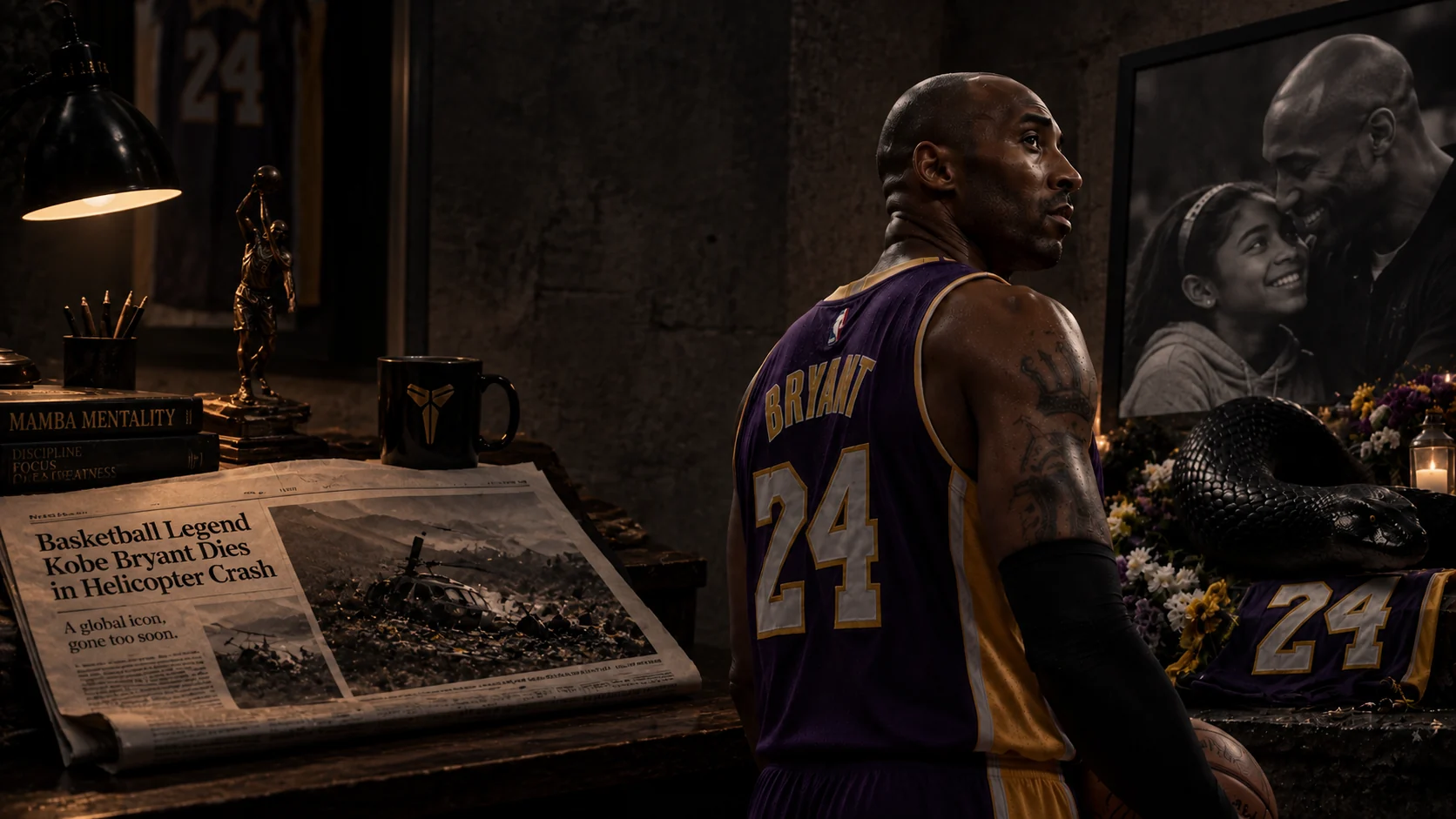
Image note: the supplied hero is a cinematic editorial memorial tribute. Its newspaper and crash imagery are illustrative, not documentary evidence or a photograph of the actual accident. Statistics and historical rankings in this biography were checked on September 15, 2026.
Philadelphia, Italy and the Language of Basketball
Kobe Bean Bryant was born in Philadelphia on August 23, 1978, to Joe and Pamela Bryant. Joe, known as “Jellybean,” had played in the NBA before continuing his professional career overseas. In 1984, the family moved to Italy. Kobe was six. The journey placed a future American basketball icon inside a childhood shaped by another country's language, schools and sporting culture.
He learned Italian and grew up around the courts where his father worked. Basketball was simultaneously a family connection, a daily environment and an ambition. The fluent Italian he retained as an adult was a reminder that his international identity preceded his international fame. He did not discover the wider world on a promotional tour after becoming a star; it had helped form him.
When the family returned to the Philadelphia area in the early 1990s, Bryant brought that experience into American school basketball. At Lower Merion High School in Ardmore, Pennsylvania, his abilities developed into national attention. He led the Aces to the 1996 Pennsylvania state championship in his senior year. The achievement belonged to a school team, but the next decision was unusually individual: he would enter the NBA directly from high school.
College could have provided an intermediate stage. Bryant chose to test himself against adults whose livelihoods depended on defeating him. The confidence was unmistakable; whether it could survive that test remained an open question. The Hall of Fame biography confirms his birthplace and career honors; ESPN's early career biography documents the Italy and Lower Merion years.
The 1996 Draft: Charlotte Selected Him, Los Angeles Developed Him
The Charlotte Hornets selected Bryant with the 13th pick in the 1996 NBA draft. The Los Angeles Lakers subsequently acquired his draft rights in a trade for center Vlade Divac. He was not drafted directly by the Lakers, and he never played a regular-season NBA game for Charlotte. Those distinctions matter because two decades with one franchise can make the beginning look simpler than it was.
Lakers executive Jerry West saw exceptional promise in the teenager. In the same summer, Los Angeles signed Shaquille O'Neal as a free agent. One arrival was already an established superstar; the other was a projection of what might become possible. Their careers would be joined before their relationship, or their team, had found its shape.
Bryant made his NBA debut on November 3, 1996, at 18, placing him among the youngest players of his era. He initially came off the bench under Del Harris. Winning the 1997 Slam Dunk Contest made his athletic gifts conspicuous, but learning when to shoot, when to move the ball and how to withstand an NBA season was a different education. NBA career records and Bryant's statistical profile distinguish the draft, debut and early seasons.
Four Airballs, and What Came After
In the decisive fifth game of the Lakers' 1997 playoff series against Utah, Bryant missed four late shots without touching the rim. One came near the end of regulation; three came in overtime. The Lakers were eliminated. The image is now frequently packaged as the first scene of an inevitable triumph. At the time, it was an 18-year-old failing publicly while the season disappeared.
The useful lesson is not that humiliation secretly guarantees greatness. Plenty of talented players suffer it. Bryant's subsequent career shows the long work that followed: stronger physical conditioning, more developed footwork, better understanding of defenses and a broader repertoire of shots. He became an All-Star in 1998 and then a central player on a championship contender. The airballs did not create those improvements by themselves. He had to make them. NBA retrospective.
Shaq, Kobe and Phil Jackson: How a Dynasty Worked
Phil Jackson became Lakers head coach in 1999. His championship experience with Chicago mattered, but so did the structure he and his staff brought to Los Angeles. The triangle offense organized spacing, passing and decisions around a powerful interior threat without reducing every possession to the same scripted play. It gave the Lakers a shared basketball language.
O'Neal distorted defenses. Guarding him with one player risked allowing a high-percentage shot near the basket; sending help created opportunities elsewhere. Bryant could attack a shifting defense, create a shot when a possession broke down and pressure opponents on the perimeter. Their skills overlapped less than their ambitions did. That complementary geometry helps explain the dominance more accurately than the idea of two stars simply taking turns scoring.
The Lakers won consecutive championships in 2000, 2001 and 2002, beating Indiana, Philadelphia and New Jersey respectively. O'Neal was Finals MVP in all three years. Bryant was increasingly indispensable, especially as a perimeter scorer and creator through the Western Conference playoffs. Their 2001 postseason finished 15–1, with their only defeat coming against the 76ers in the opening game of the Finals. It remains an extraordinary run, without requiring an outdated claim that it is the sole best postseason record.
The supporting players mattered. Derek Fisher, Robert Horry, Rick Fox and other contributors defended, spaced the floor and supplied baskets that championships require from people outside the marquee. Jackson's challenge was to keep that collective purpose functioning while his two best players contested authority. Lakers season histories and the NBA's three-peat history document the run.
Tension between Bryant and O'Neal was real. It involved leadership, preparation, touches and the question of whose team the Lakers should be. Reducing it to gossip, however, obscures both their interdependence and the organizational decisions around them. They could resent each other and still recognize an extraordinary basketball partner. Winning did not resolve every disagreement; disagreement did not make their collaboration fraudulent.
The dynasty had limits. San Antonio ended the Lakers' title defense in 2003, and Detroit defeated them in the 2004 Finals. O'Neal was traded to Miami that summer; Jackson also left before returning in 2005. Bryant remained. Later, Bryant and O'Neal publicly shared warmer moments, including the 2009 All-Star Game co-MVP award. Their relationship had more than one ending.
The 2003 Colorado Sexual-Assault Case
In July 2003, Colorado prosecutors charged Bryant with felony sexual assault after a 19-year-old hotel employee accused him of assaulting her. He denied sexual assault and maintained that the encounter was consensual. This was a criminal allegation, not merely an embarrassing publicity episode, and it belongs in a complete account of his life.
On September 1, 2004, the criminal case was dismissed at prosecutors' request after the accuser declined to testify at trial. Bryant was not convicted. There was also no trial verdict establishing that the allegation was false. The separate civil lawsuit was settled in March 2005; its terms were not publicly disclosed. A civil settlement and a criminal dismissal are different legal outcomes and should not be collapsed into a claim that one automatically proves the other.
After the criminal dismissal, Bryant issued a statement apologizing to the woman. He continued to say he believed the encounter was consensual, while acknowledging that she did not view it that way. He wrote: “I now understand how she feels that she did not consent to this encounter.” That acknowledgment should be read alongside his denial, not removed from it or converted into a conviction that never occurred.
These details are documented in contemporary reporting on the charge, the dismissal, the civil settlement and the Associated Press text of Bryant's statement, preserved from The Denver Post.
His later achievements cannot settle the question of what happened in that hotel room. Nor should the woman's experience be treated as a narrative obstacle on the way to an inspirational conclusion. A responsible biography can recognize exceptional basketball, the grief of a family and the seriousness of the allegation without asking any one of them to erase the others.
The Face of the Lakers: 81 Points and the Burden of Scoring
After O'Neal's departure, Bryant became the unmistakable center of the franchise. The resulting years produced some of his greatest individual basketball and a reminder that even overwhelming scoring does not manufacture a championship roster. The Lakers missed the 2005 playoffs and exited in the first round in 2006 and 2007. Becoming the face of the team also meant becoming the face of its shortcomings.
On January 22, 2006, Bryant scored 81 points against the Toronto Raptors in a 122–104 Lakers victory. He scored 55 after halftime. This was a regular-season game played without overtime, not an exhibition, a playoff game or a scoring total assembled over several nights. The Lakers had needed to come from behind. Bryant's response transformed a difficult evening into a permanent landmark.
He finished the 2005–06 season averaging 35.4 points per game and won the NBA scoring title, then repeated as scoring champion in 2006–07. These were sustained seasons of production, not a reputation resting on one extraordinary box score. The scoring also revealed a tension in his game: the ability to attempt almost any shot could make deciding against a difficult shot its own discipline. NBA retirement statistics and the league's account of the Toronto game establish the figures.
The 2026 Record Correction
For two decades, Bryant's 81 was second only to Wilt Chamberlain's 100-point game. That statement is now historical rather than current. On March 10, 2026, Miami's Bam Adebayo scored 83 against Washington. As of this article's September 2026 check, Bryant's 81 ranks third, behind Chamberlain's 100 and Adebayo's 83. It remains the Lakers' single-game scoring record. NBA reporting on Adebayo's 83.
No. 8 and No. 24
Bryant wore No. 8 for his first ten NBA seasons and switched to No. 24 for 2006–07. The change did not happen when O'Neal departed in 2004, and the 81-point game was played in No. 8. His first three championships belong to that number; his last two belong to No. 24.
The numbers became useful shorthand for different phases of a career: the explosive young challenger and the more experienced player responsible for leading a rebuilt team. They were not two different people, and neither phase was free of contradiction. The later Bryant still sought difficult shots; the earlier one was already capable of discipline and championship teamwork. The Lakers retired both numbers on December 18, 2017, honoring the full span. NBA jersey-retirement record.
Pau Gasol and the Return to the Top
The acquisition of Pau Gasol from Memphis in February 2008 changed the Lakers' possibilities. Gasol offered size, touch, passing and an ability to read a possession that suited Jackson's system. Bryant had another elite partner, with a different temperament and different strengths from O'Neal. The lesson was not that Bryant had finally learned to win alone. It was that another form of collaboration could work.
Bryant won the 2008 NBA Most Valuable Player award. Los Angeles reached the Finals but lost to Boston, a team whose defense and physicality exposed what the Lakers still lacked. Individual recognition had arrived; the championship had not. Gasol later described that defeat as formative in the team's response. NBA interview with Gasol and Lakers colleagues.
In 2009, the Lakers defeated Orlando in five games. Bryant won his fourth championship and his first Finals MVP. Gasol's partnership, Lamar Odom's versatility, Fisher's experience and the rest of the roster were part of that result. The achievement answered whether a Bryant-led team could win after O'Neal, but it did not validate the idea that supporting players were incidental. NBA 2008–09 season review.
The 2010 Finals brought Boston back. On June 17, Los Angeles won Game 7, 83–79. Bryant shot 6-for-24, yet contributed 23 points and 15 rebounds. Gasol's interior work, Ron Artest's scoring and the team's defense helped turn an ugly offensive evening into a championship. Bryant earned his second Finals MVP, an award for the series rather than a claim that his final game had been flawless. Official Game 7 record.
The fifth championship mattered partly because of the opponent and partly because of the career arc. Bryant had won in two substantially different Lakers eras. His final title also complicates the mythology of the unstoppable scorer: on the night that delivered it, he needed ways to contribute when the shots were missing, and he needed other people. That is a richer sporting lesson than pretending he never had an off night.
Kobe Bryant's Achievements: The Verified Record
The core record, cross-checked against NBA career summaries, Lakers records and the Hall of Fame, is substantial enough without inflation. All-Star and team-honor totals below refer to selections, not necessarily games played.
Championships and Individual Awards
Five NBA championships: 2000, 2001, 2002, 2009 and 2010. Two NBA Finals MVP awards: 2009 and 2010. One regular-season NBA MVP award: 2008.
Eighteen NBA All-Star selections; 15 All-NBA selections, including 11 First Team honors; and 12 All-Defensive Team selections, including nine First Team honors. Two scoring titles: 2005–06 and 2006–07.
Four All-Star Game MVP awards: 2002, 2007, 2009 and 2011, with the 2009 award shared with O'Neal. Winner of the 1997 NBA Slam Dunk Contest. Two Olympic gold medals with Team USA, at Beijing 2008 and London 2012. NBA awards summary and FIBA's international record.
Career Scoring and His Place in History in 2026
Bryant scored 33,643 regular-season points, all for the Lakers. As of September 15, 2026, the NBA's all-time regular-season scoring list places him fourth, behind LeBron James, Kareem Abdul-Jabbar and Karl Malone. He retired in third place; James passed him in January 2020. Those are different snapshots, and an evergreen biography should identify which one it uses. NBA all-time scoring table.
He remains the Lakers' career regular-season scoring leader, and the 81-point Toronto game remains the franchise's single-game scoring high. These are franchise records; they should not be confused with the current league-wide single-game ranking. NBA's Lakers scoring leaders.
Bryant belongs to the Naismith Basketball Hall of Fame's Class of 2020. The pandemic-delayed enshrinement ceremony took place on May 15, 2021. The class year and ceremony date are both correct. Hall of Fame profile and NBA ceremony announcement.
There is no official numerical ranking of the greatest players that resolves every debate. Scoring position is measurable; overall greatness depends on how someone weighs peak performance, longevity, defense, teamwork and championships. Bryant's record makes him central to that discussion. It does not require presenting an opinion poll as a statistic.
Black Mamba: The Man's Explanation and the Mythology
Bryant chose the Black Mamba identity himself, drawing inspiration from Quentin Tarantino's Kill Bill. In a 2014 interview with The New Yorker, he connected the snake's qualities to how he wanted to play. In his later account of the period surrounding the Colorado case, the persona also served as a way to separate the basketball competitor from a personal life under scrutiny. That is his explanation of a coping device, not a moral resolution of the case. Ben McGrath's contemporary profile.
Mamba Mentality eventually became much broader than a nickname. The phrase circulated through coaching, business, training videos and personal advice. In that process, a demanding approach to basketball sometimes became a generic promise that sufficient desire can defeat any obstacle. The distinction matters: Bryant's actual career contains missed shots, lost series, serious injuries and circumstances that effort could not reverse.
What Preparation Meant in Practice
In his 2018 book The Mamba Mentality: How I Play, Bryant described detailed study of opponents, physical preparation and the mechanics of basketball. His first-person explanations emphasize understanding another player's habits and making deliberate choices, rather than relying only on adrenaline. Foot placement, balance, angles and timing were working materials. Preparation made decisions available before the moment in which they were needed. Authorized excerpt from Bryant's book.
That is an important difference between practice and simply accumulating exhaustion. Repeating a move becomes useful when the player notices what changes its outcome. Studying a defender becomes useful when it changes a decision. Attention to detail is less photogenic than a sunrise workout, but it better explains how a difficult skill becomes repeatable under pressure.
His competitive psychology could be demanding for teammates as well as opponents. Wanting more from everyone around him did not automatically mean communicating it well. Discipline and obsession can overlap without becoming synonyms, and admiration need not turn every harsh interaction into a coaching lesson.
This biography does not repeat unsourced stories of sleepless training marathons or assign invented workout totals to him. A documented example of his later influence is Jayson Tatum's discussion of training with Bryant in 2018. It shows a skill being passed between players without requiring a superhuman fable. Tatum's NBA interview.
The Achilles: When Willpower Met the Body
On April 12, 2013, against Golden State, Bryant ruptured his left Achilles tendon. He stayed on the court long enough to make his two free throws before leaving. The sequence became one of the defining images of his competitive resolve. It was also the beginning of a long physical reckoning, not evidence that the injury had somehow been overcome on the spot. Lakers injury announcement.
He underwent surgery the next day and rehabilitation followed. Returning required recovery of strength and function, not simply a declaration of intent. He came back in December 2013, but a fracture in his left knee ended that season after only six appearances. A torn right rotator cuff ended his 2014–15 season. These were distinct injuries, not one continuous Achilles absence. Lakers medical explanation, 2013–14 review and final-season history.
For a player who had built identity around repetition and control, the final years exposed how much an athlete cannot command. Knowing the answer to a defender was not the same as having the acceleration to use it. Experience remained; availability and physical execution became less dependable. Playing through adversity had been part of his reputation, but adversity was no longer something that could always be played through.
The free throws deserve their place in his story. So does the rehabilitation that followed, with its delays and disappointments. Remembering only the few dramatic seconds risks losing the much longer reality of an injured athlete trying to return.
April 13, 2016: Sixty Points, Then “Mamba Out”
The Lakers' final game of the 2015–16 season was Bryant's final NBA appearance. Utah was the opponent, Staples Center the setting, and 60 points the result. Los Angeles won 101–96. Bryant took 50 shots and made 22. That volume is part of the historical record, not something to conceal to protect the farewell. NBA final-game record.
It was a regular-season finale, not a playoff triumph or a sixth championship. Its emotional power came from a different place: a crowd watching the last performance of a player who had occupied the franchise for twenty seasons, uncertain how much he had left. The evening delivered a concentration of the things people recognized in him: persistence, difficult shot-making and the willingness to keep taking responsibility for the possession.
Afterward, Bryant addressed the crowd and ended with “Mamba Out.” The phrase gave a simple boundary to something that had rarely seemed willing to stop. He would not return for another NBA season. Retirement had become memorable not because the final performance erased decline, but because everyone had seen the decline and understood what this last night meant.
A Second Career: Stories, an Oscar and Business
Retirement redirected Bryant's attention toward storytelling. Through Granity Studios, he developed work across books, audio and film, often connecting sport with the fears and ambitions of young people. He was no longer able to extend his playing career, but he could explore what competition had meant and how its lessons might be communicated. Contemporary reporting on Granity.
Dear Basketball adapted his retirement poem into an animated short. Bryant wrote and narrated it; Glen Keane directed and animated it, and John Williams supplied the music. At the Academy Awards on March 4, 2018, Keane and Bryant won the Oscar for Animated Short Film. It was an Academy Award for a collaborative film, not for his playing career. Film release credits and the Academy's 2018 winners.
His business activity also went beyond endorsements. Bryant partnered with Jeff Stibel in the investment firm Bryant Stibel, which dates its founding to 2013 and describes a focus on technology, media and data. He was an investor in BODYARMOR and participated in its creative and marketing work. Coca-Cola's announcements document that role. These are identifiable activities; speculative estimates of his personal fortune are not necessary to explain them. Bryant Stibel and Coca-Cola's BODYARMOR announcement.
For the wider commercial context, PRESDA's look at the world's highest-paid athletes explores the relationship between sporting achievement, sponsorship and ownership. Bryant's second career demonstrates why retirement from competition does not always end an athlete's professional influence.
Kobe and Gianna Bryant: Basketball as a Shared Language
Kobe and Vanessa Bryant had four daughters: Natalia, Gianna, Bianka and Capri. Gianna, known as Gigi, developed a strong interest in basketball. Kobe coached her youth team and attended games with her. The public saw a former player learning another role: explaining, watching and allowing a child's ambition to occupy the center of the afternoon.
Gianna admired the University of Connecticut's women's program and hoped to play there, with ambitions extending toward the WNBA. Those were a young person's dreams, not a professional future anyone could guarantee. Respecting her life means allowing her to be a developing player with her own interests, rather than treating her only as an extension of her father's achievements. She was 13 when she died. AP reporting on the women's basketball connection.
The coaching relationship was part of a wider community. Other children learned from Bryant; parents traveled to games and became friends; fellow coaches helped run the team. On January 26, 2020, the group aboard the helicopter was traveling for a youth basketball tournament at Mamba Sports Academy in Thousand Oaks. Kobe and Gianna were going there as coach and player, father and daughter. AP's interviews with former team members.
January 26, 2020: What the Final NTSB Report Establishes
The account here follows the National Transportation Safety Board's final report, AAR-21/01, adopted on February 9, 2021. It does not infer the cause from the memorial artwork, early breaking-news reports or imagined conversations inside the helicopter.
At about 9:07 a.m. Pacific Standard Time, a Sikorsky S-76B helicopter, registration N72EX, departed John Wayne Airport in Orange County. Island Express Helicopters operated the on-demand passenger flight. Pilot Ara Zobayan was flying eight passengers toward Camarillo Airport, from which they could continue by road to the basketball event. Camarillo was the aviation destination; Mamba Sports Academy was the purpose of the trip.
The route passed through the Los Angeles area, including the Burbank and Van Nuys airspace corridors, before turning west along U.S. Route 101. There was an air-traffic-related hold near Burbank. Low cloud and reduced visibility affected the region, with terrain becoming obscured along the later part of the route. The report describes the earlier passage through controlled airspace as uneventful; the fatal problem developed as the flight continued toward worse conditions near Calabasas.
At approximately 9:44 a.m., the pilot began a climb as the helicopter entered cloud. The NTSB found that he lost the outside visual references needed to judge the aircraft's orientation. The helicopter then turned left, departed the highway route and entered a descending turn. It crashed into hilly terrain near Calabasas at about 9:46 a.m. All nine people aboard died. NTSB final report: flight history and analysis.
Remembering All Nine People
The victims were Kobe Bryant; his daughter Gianna Bryant; Gianna's teammate Alyssa Altobelli and Alyssa's parents, John Altobelli and Keri Altobelli; teammate Payton Chester and her mother, Sarah Chester; assistant coach Christina Mauser; and pilot Ara Zobayan.
Their names belong together. The loss involved three young players, parents, a fellow coach and an aviation professional, not only a celebrity and an unnamed group. Each had relationships and a life outside the public story. Contemporary identification of the nine victims.
Why Did the Helicopter Crash?
The NTSB determined that the probable cause was the pilot's decision to continue flying under visual flight rules into instrument meteorological conditions, leading to spatial disorientation and loss of control. Understanding those terms makes the explanation clearer than saying only that the weather was bad.
VFR and IMC: The Conditions Stopped Matching the Flight
Visual flight rules, or VFR, require a pilot to maintain the necessary outside visual references and comply with applicable visibility and cloud-clearance requirements. Instrument meteorological conditions, or IMC, are conditions below the visual-weather minimums. Low cloud can remove the horizon and hide terrain even when an aircraft is mechanically capable of flying.
The important distinction is between an aircraft's equipment, a pilot's qualifications and the authorization and conditions for a particular operation. Island Express was authorized for VFR-only passenger operations. Zobayan's instrument rating did not turn this flight into an authorized instrument-rules operation, and the presence of instruments did not make continuing visually into cloud safe. The report's criticism concerns the decision to enter those conditions and the subsequent loss of control.
Spatial Disorientation: When Sensation Becomes Unreliable
Spatial disorientation means a pilot no longer correctly perceives the aircraft's position or movement in relation to the earth. Without reliable visual references, bodily sensations can mislead even an experienced aviator. A pilot may feel that the aircraft is climbing or level while it is actually turning or descending. Correct interpretation of flight instruments becomes essential.
The NTSB concluded that Zobayan became spatially disoriented during the climb in IMC. His reported perception of the flight did not match the helicopter's movement. The result was loss of control, followed by collision with terrain. This was not simply a pilot flying normally and encountering an unexpected hillside.
Decision-Making, Pressure and Terrain
Investigators identified the pilot's likely self-induced pressure to complete the trip, plan continuation bias and the operator's inadequate review and oversight of its safety-management processes as contributing factors. Plan continuation bias describes persisting with an original plan even as new information makes changing it more appropriate. Nearing a destination can strengthen that temptation.
The word “self-induced” matters. The NTSB did not find evidence that Bryant, his representatives, the charter broker or Island Express pressured the pilot to complete the flight. Replacing the board's finding with a story that a famous passenger demanded unsafe flying would misrepresent the evidence.
The report also found that the helicopter's speed was excessive for the weather conditions, reducing the time available to choose a different course before entering IMC. The obscured, hilly terrain made the environment particularly unforgiving after visual references were lost. Options such as diverting or landing before conditions became untenable were central to the safety analysis.
Examination found no evidence of a preimpact mechanical malfunction or failure that would have prevented normal operation. Investigators therefore did not identify catastrophic mechanical failure as the cause. The helicopter had no cockpit voice recorder or flight-data recorder, so the evidence cannot supply passengers' final words. The report reconstructs the flight from recorded tracking data, air-traffic communications, weather evidence and examination of the aircraft. NTSB final findings and probable cause.
The World Reacts: Eight, Twenty-Four and a City in Mourning
NBA games became sites of improvised remembrance. Teams accepted eight-second backcourt violations or let the 24-second shot clock expire to honor Bryant's jersey numbers. Commissioner Adam Silver issued a statement recognizing his impact. Outside Staples Center, fans gathered with jerseys, flowers and messages. A building associated with entertainment became a place where people went because they did not know where else to put their grief. NBA tribute archive.
The response extended beyond the NBA and beyond the United States. Tennis champion Novak Djokovic publicly mourned Bryant and later wore a “Mamba Forever” tribute after winning the 2023 US Open, describing Bryant's support during difficult periods. The connection was personal as well as symbolic. ATP account of Djokovic's tribute.
For many supporters, Bryant's death interrupted memories of their own childhoods: watching games across time zones, copying a move, choosing a number for a school jersey. A public figure can become a marker of private time. The international reaction reflected those accumulated connections as well as recognition of his medals and championships.
The public memorial for Kobe and Gianna took place at Staples Center on February 24, 2020. The date joined Gianna's No. 2 with her father's No. 24. Vanessa Bryant spoke about her husband and daughter; Michael Jordan, O'Neal, Diana Taurasi and Sabrina Ionescu were among those who helped remember them. The service held family grief and worldwide recognition in the same room. NBA memorial coverage.
The numbers continued to appear on clothing, shoes and tributes because they offered a shared shorthand. But remembrance becomes more meaningful when the shorthand leads back to people: the parent, the child, the teammate, and all the others whose families were grieving alongside the Bryant family.
Kobe Bryant's Legacy: Players, Women’s Basketball and the Wider World
Bryant's influence on later players is documented in their own accounts, not only in comparisons made by spectators. Tatum discussed training with him and the significance of wearing his Olympic No. 10. A younger star could represent Boston, the Lakers' historic rival, while openly admiring Bryant. The influence crossed the uniform boundary. Tatum on Bryant's Olympic number.
Devin Booker was another admirer. In March 2016, Bryant gave him signed shoes carrying the instruction “Be Legendary.” Lakers account. Such exchanges show an older player's influence moving beyond imitation: recognition from someone a young athlete had watched could become encouragement to develop a career of his own.
For women's basketball, Bryant used his visibility to take the game seriously. His relationship with Gianna, attendance at women's games and support for players made that interest public. Ionescu's memorial tribute was one visible expression of a personal basketball connection. His advocacy matters, while the Colorado allegation also remains part of how people assess that legacy. Neither needs to be concealed to acknowledge the other.
Internationally, his Olympic gold medals and his upbringing gave him connections beyond the Lakers. His willingness to compete for Team USA at Beijing and London linked individual celebrity to a shared national project. To supporters abroad, he could be both distinctly a Los Angeles player and someone who understood that basketball had many homes. For another perspective on a career crossing national sporting cultures, read PRESDA's Achraf Hakimi biography.
In Los Angeles, twenty seasons made him part of the city's sporting memory. The Lakers' retirement of both numbers made that relationship permanent inside the arena. The attachment also lived outside it, in courts, murals and the repeated stories of people who organized parts of their lives around watching him play.
Nike's Kobe footwear and apparel continue another part of the legacy. The company's 2025 Year of the Mamba releases explicitly linked products and training challenges to his identity. A 2025–26 FC Barcelona collaboration carried the Kobe emblem into football. These are documented examples of a basketball player's imagery traveling across sports; Nike's promotional language should still be understood as marketing, not independent proof of what any product can make an athlete achieve. Nike's Mamba collection and Barcelona collaboration.
The most durable part of Mamba Mentality may be its invitation to take a craft seriously. Its least useful version treats fatigue as virtue, harshness as wisdom or success as proof of moral worth. Bryant's life provides enough evidence to resist those shortcuts. Effort mattered enormously. So did teammates, opportunity, health and decisions.
Kobe Bryant: Myth vs Reality
Draft and Trade
Myth: the Lakers drafted Bryant. Reality: Charlotte selected him 13th in 1996, and Los Angeles acquired his draft rights for Vlade Divac. His entire NBA playing career was with the Lakers.
The 81-Point Game
Myth: 81 is still the NBA's second-highest single-game total. Reality: it held that position until Adebayo scored 83 on March 10, 2026. Bryant is now third behind Chamberlain and Adebayo. His Toronto performance occurred on January 22, 2006, in regulation, wearing No. 8.
No. 8 vs No. 24
Myth: the number changed as soon as Shaq left, or one number represents all five championships. Reality: Bryant switched for 2006–07. Three titles came in No. 8 and two in No. 24; both numbers were retired in 2017.
The Achilles Game and the Final 60
Myth: Bryant played an entire game after rupturing his Achilles, or his 60-point farewell was a playoff game. Reality: the April 2013 injury came late against Golden State; he made two free throws, then left. The 60 came against Utah in the regular-season finale on April 13, 2016, three years later.
Mamba Mentality and the Crash
Myth: Mamba Mentality meant never failing, and the helicopter crash was proven to be a mechanical failure or the result of a passenger's orders. Reality: Bryant's career included repeated failure and adaptation. The NTSB attributed the crash to continued VFR flight into IMC, spatial disorientation and loss of control, with the contributing factors explained above. It found no evidence of external pressure to complete the flight or a preimpact malfunction preventing normal operation.
A Legacy Larger Than a Number, and More Difficult Than a Slogan
Kobe Bryant was neither only statistics nor only tragedy. He built an extraordinary career through competitiveness and craft, and he did not build it alone. He experienced failure, contributed to conflict, faced a serious sexual-assault allegation, reinvented his working life and became a visible supporter of his daughter's basketball ambitions. His death stopped those developing relationships and projects at 41.
Remembering him honestly means allowing the achievements to remain extraordinary without making the person uncomplicated. It means recognizing Gianna as a child with her own future, and naming the seven others who died with them. It means distinguishing the historical player from the motivational character assembled after his death.
The most useful interpretation of his sporting philosophy leaves room for missed shots, other people's contributions and the limits of a body. It is an interpretation of his career, not a quotation attributed to him: Mamba Mentality was never supposed to mean that failure was impossible. It meant returning to the work after failure, again and again.
FAQ
Frequently Asked Questions
How many NBA championships did Kobe Bryant win?
Kobe Bryant won five NBA championships with the Los Angeles Lakers: 2000, 2001, 2002, 2009 and 2010. He was Finals MVP in 2009 and 2010 and regular-season MVP in 2008.
Is Kobe Bryant’s 81-point game still second in NBA history?
No. As of September 15, 2026, it ranks third. Wilt Chamberlain scored 100 in 1962, and Bam Adebayo scored 83 on March 10, 2026. Bryant scored 81 against Toronto on January 22, 2006; it remains the Lakers’ single-game record.
Where does Kobe Bryant rank in career NBA scoring in 2026?
As of September 15, 2026, Bryant ranks fourth in NBA regular-season scoring with 33,643 points, behind LeBron James, Kareem Abdul-Jabbar and Karl Malone. All his points were scored for the Lakers.
Why did Kobe Bryant’s helicopter crash?
The final NTSB report identified continued visual-rules flight into instrument meteorological conditions, causing pilot spatial disorientation and loss of control. Contributing factors included likely self-induced pressure, plan continuation bias and inadequate operator safety oversight. Investigators found no evidence of a preimpact malfunction preventing normal operation or external pressure to complete the flight.
What was Mamba Mentality?
Bryant used the idea to describe sustained preparation, detailed study and competitive commitment. His own basketball explanations are distinct from later motivational mythology: his career also included failure, injuries and dependence on teammates.
PRESDA Dispatch
Stay Informed. Stay Aware.
A sharp briefing across AI, gaming, sport, business, world affairs, paparazzi, and lifestyle.