ANTHROPIC’S RECORD IPO CREATES A PAPER-WEALTH WINDFALL FOR EMPLOYEES
Anthropic’s Nasdaq debut follows an $81.34 billion base offering. Examine estimated employee wealth, vesting, sale restrictions and the difference from cash.
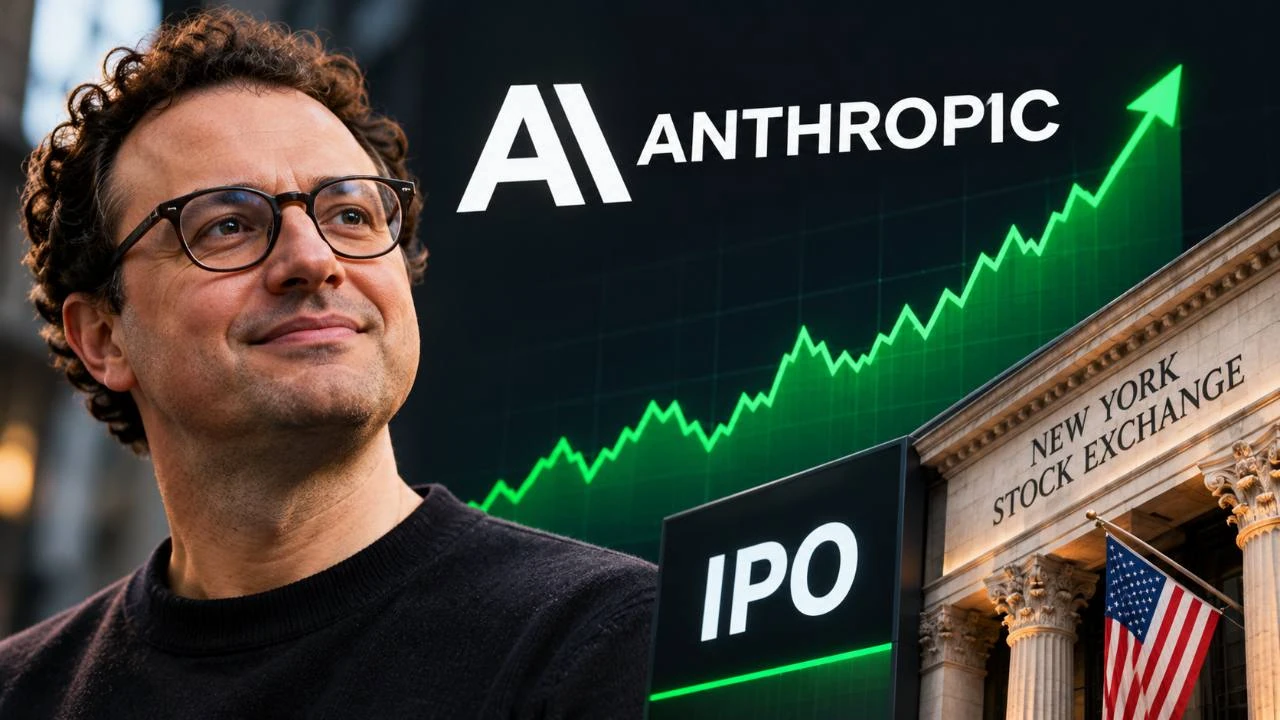
Supplied editorial illustration, not listing-event photography. The NYSE building is an artistic element; Anthropic listed on Nasdaq as ANT. The drawn chart is not market data.
Anthropic’s stock-market arrival is real, but the employee-millionaire headline needs a more careful definition of wealth. The Claude developer’s final pricing terms set an $83 offer price and an $81.34 billion base public offering. Nasdaq marked its listing on November 19, 2026. The event created a public reference price for employee holdings, not an identical cash payment to every member of staff. SEC: final November 18 pricing terms Nasdaq: November 19 opening-bell listing event
AP described the transaction as the largest IPO on record, surpassing SpaceX’s roughly $75 billion June offering. That comparison concerns offering size. It should not be confused with the company’s total valuation, its annual revenue or the amount individual employees can withdraw. AP: record IPO figures and comparison
| Figure or date | What it measures |
|---|---|
| November 19, 2026 | Nasdaq listing, ticker ANT |
| $83 per share | IPO offer price, not a permanent market price |
| $81.34 billion | Base public offering including company and shareholder sales |
| $26 billion | Separate concurrent private placement |
What the final offering documents establish
The November 18 SEC pricing document identifies 980 million Class A shares at $83, excluding the underwriters’ additional-share option. Of those shares, 956,351,354 were offered by Anthropic and 23,648,646 by selling shareholders. The $81.34 billion base figure is the price multiplied by the total shares in that offering. SEC: final November 18 pricing terms
The distinction between primary and secondary shares matters. Newly issued company shares and existing holders’ sales do not send money to the same recipient. The final prospectus expressly says Anthropic receives no proceeds from the selling shareholders’ shares. The gross offering headline therefore should not be described as entirely new cash for the company. SEC: final prospectus, November 18, 2026
The pricing document separately lists a $26 billion private placement of Class N shares. That is another transaction, not a reason to relabel the base public offering as if it were all one IPO tranche. Underwriter options, concurrent placements and fees also explain why different financing totals can appear in coverage without describing precisely the same measure. SEC: final November 18 pricing terms
The exchange is Nasdaq, not the NYSE
The SEC terms identify the Nasdaq Global Select Market and ticker ANT. Nasdaq’s own opening-bell event confirms the listing venue. The supplied hero includes a New York Stock Exchange building as part of an editorial illustration; it is not documentary evidence of where Anthropic listed. SEC: final November 18 pricing terms Nasdaq: November 19 opening-bell listing event
That distinction is small visually but important factually. An illustration can convey public markets without accurately reproducing an event. The article and its captions identify the actual venue rather than allowing a familiar building in the artwork to overwrite the primary record.
Why the employee estimates differ
Reuters reported that research firm Sacra estimated roughly 2,800 current and former employees could hold at least $1 million in pretax vested equity at a $1.35 trillion company valuation. It also reported Hill’s estimate of 598 non-founder employees with at least $100 million in equity. These are model-based assessments, not a disclosed list of individual balances. Reuters: employee equity estimates and their limitations
The same report said Reuters could not independently verify the models and noted that the filing did not reveal how the wealth was distributed among workers. Differences in valuation date, vesting, award timing, exercise costs and the population counted can materially change a millionaire estimate.
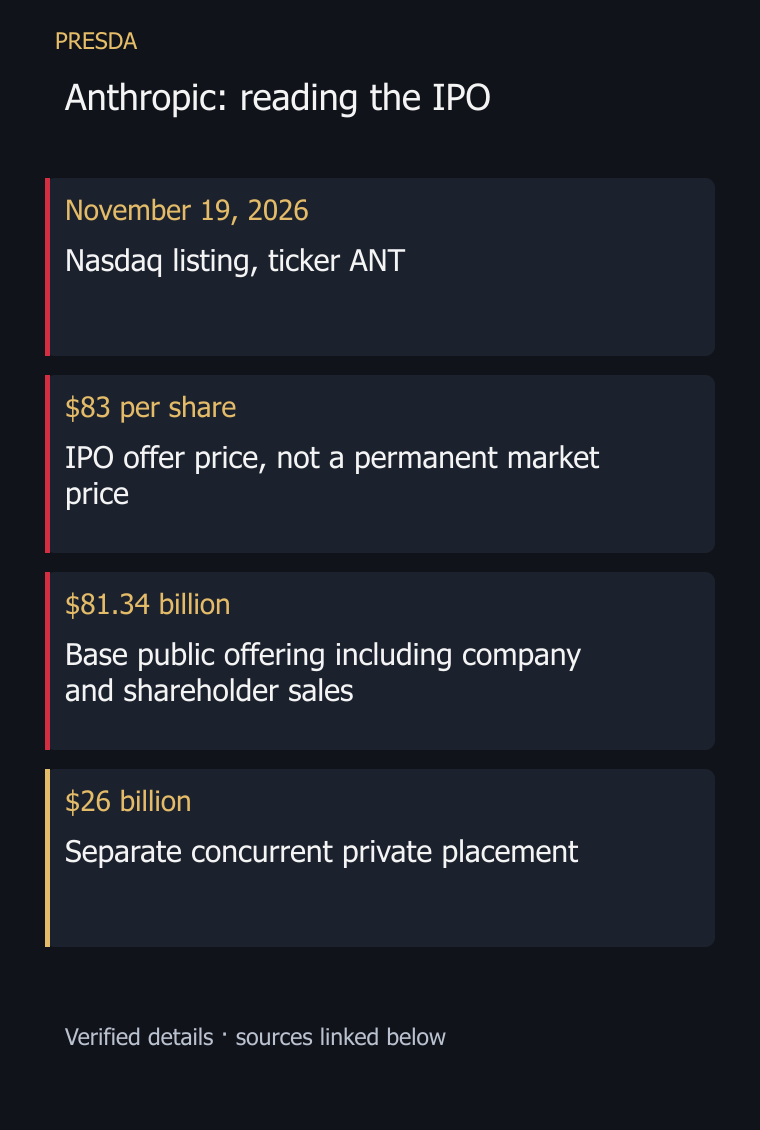
Anthropic’s IPO: figures with different meanings. Sources: SEC final pricing terms.
CNN’s November 19 coverage likewise attributed an estimate of about 600 employees with holdings above $100 million to Hill, the private-share marketplace. Rounding the number does not turn the model into a payroll audit. Nor should a group estimate be converted into a claim about any named employee whose holdings have not been disclosed. CNN: November 19 Hill employee-wealth estimates
Paper wealth is not take-home cash
The phrase paper wealth means a value assigned to holdings at a particular share price. It does not mean that the holder has sold them, received the proceeds or paid the associated costs and taxes. A share price supplies one input to the calculation; it does not describe the entire transaction required to realise the value.
Options add another layer. Their headline value cannot be understood without the exercise price and the portion that has vested. Restricted stock awards can also have conditions. Comparing a gross equity estimate with cash in a bank account omits the very details that determine what a worker can actually access.
This does not make the potential gains imaginary or insignificant. It explains why reporting should use terms such as estimated equity value or paper wealth. The economic opportunity can be substantial while remaining different from realised, after-tax proceeds.
The listing did not make every share immediately saleable
The prospectus describes lock-up arrangements and an early-release provision allowing up to 10% of the relevant holdings of non-founder directors, officers, current and former employees and consultants to be sold from the first trading day. That is a limited provision, not a declaration that all staff can immediately sell everything they hold. SEC: final prospectus, November 18, 2026
An individual’s position can still depend on their award, vesting, applicable restrictions and transaction circumstances. A general release provision should not be rewritten as proof that every employee made a sale. The cited documents establish rules and potential eligibility; actual sales and net receipts require additional evidence.
The operating business behind the share price
Anthropic’s IPO materials report $17 billion of revenue for the third quarter of 2026, alongside a $23.3 billion net loss. They explain that the loss includes a $21.9 billion non-cash charge related to changes in the fair value of convertible notes, derivative liabilities and SAFEs. Those figures describe a quarter, not a full financial year. Anthropic: IPO materials and third-quarter financial highlights
The same presentation distinguishes a 15% adjusted operating margin from a negative 3% operating margin. Adjusted and unadjusted measures are not interchangeable. Neither a large net loss nor an adjusted margin can be understood properly by dropping the accompanying definitions and reconciliation context.
These operating figures explain why the listing story should extend beyond employee fortunes. The public company must translate customer demand into an ongoing business while financing expensive technological development. Employee holdings are linked to that business and its market price; they are not detached prizes whose value is permanently fixed on the listing date.
Public investors meet an unusual governance structure
The final prospectus identifies Anthropic as a Delaware public benefit corporation and describes its Long-Term Benefit Trust. It also sets out special voting arrangements, including founder control through a dedicated class. Economic ownership and voting authority are therefore distinct parts of the structure. SEC: final prospectus, November 18, 2026
The important point is not that a mission statement guarantees a particular future decision. It is that investors and readers need to distinguish the stated public-benefit purpose, the actual governance mechanisms and the commercial results. A listing does not erase those arrangements or make every shareholder’s influence equal.
PRESDA’s account of the US–China AI race provides broader context for why capital, infrastructure and control matter in advanced AI. Anthropic’s flotation adds a public-market dimension to that competition, without proving any particular prediction about who will dominate it.
The accurate version of the millionaire story
The confirmed event is a record-sized offering followed by a Nasdaq debut. The employee story is a potentially enormous equity windfall, with outside estimates indicating thousands of paper millionaires under stated assumptions. It is not a verified count of after-tax millionaires who have already sold their holdings.
That formulation preserves the significance without inventing certainty. Future prices, disclosed sales, tax treatment and the company’s performance will shape what the holdings ultimately deliver. The IPO supplies a milestone and a market, while the distinction between a valuable holding and money realised remains essential.
FAQ
Frequently Asked Questions
Did Anthropic actually go public?
Yes. The final SEC terms specify Nasdaq and ticker ANT, and Nasdaq marked its listing on November 19, 2026.
Did every employee receive a million dollars in cash?
No such claim is established. Published estimates concern equity values, with different assumptions about valuation, vesting, costs and the people counted.
Did the entire $81.34 billion go to Anthropic?
No. The base offering includes shares sold by existing holders. The prospectus says the company receives no proceeds from those shareholder sales.
Could employees sell all their shares immediately?
The prospectus describes restrictions and a limited early-release provision, including up to 10% for the specified non-founder group on the first trading day. It does not establish unrestricted sale of every holding.
PRESDA Dispatch
Stay Informed. Stay Aware.
A sharp briefing across AI, gaming, sport, business, world affairs, paparazzi, and lifestyle.