Arnold Schwarzenegger: From an Austrian Village to Hollywood
From childhood in Thal to seven Mr. Olympia titles, The Terminator and California’s governorship: the verified stages of Arnold Schwarzenegger’s journey.
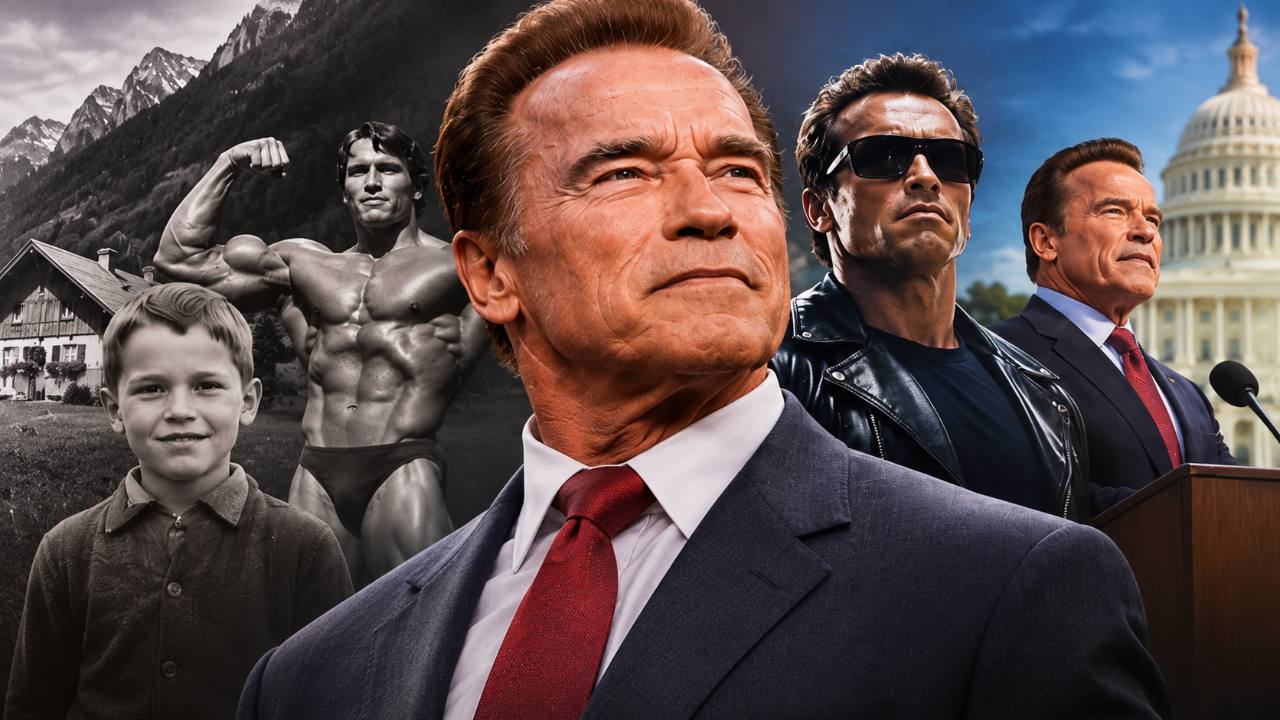
AI-generated editorial illustration supplied for PRESDA. All career scenes are reconstructions, not archival photographs. The imagined political backdrop is not California’s Capitol in Sacramento.
Arnold Schwarzenegger’s rise from a childhood in Thal, near Graz, to Hollywood and California’s governorship contains several distinct reinventions. Born in Austria on July 30, 1947, he became a champion bodybuilder, moved to the United States, developed an acting career and entered elected office. The familiar image of the action hero compresses that history. Understanding the journey means separating the teenager’s ambitions, competitive titles, screen roles and public decisions rather than treating them as one inevitable ascent. California State Library: Schwarzenegger’s official biography Graz Tourism: childhood home museum in Thal
His life is often presented as an uncomplicated success formula. The documented sequence is more interesting. A physique that made him distinctive in bodybuilding had to acquire a different meaning on film. A movie identity that could attract an audience did not automatically solve the practical problems of governing. Each transition required other people and institutions, as well as the willingness to become inexperienced again in a new field.
The Austrian childhood behind the global image
Thal is a small community near Graz in the Austrian region of Styria. The home associated with Schwarzenegger’s childhood now houses a museum, promoted by Graz’s official tourism organization as a way to explore his early life and later careers. It anchors an international story in a specific place. The child in the supplied editorial montage is an imagined reconstruction, not an authenticated family photograph. Graz Tourism: childhood home museum in Thal
| Date | Milestone |
|---|---|
| July 30, 1947 | Born in Austria; grows up in Thal near Graz |
| 1967 | Wins Mr. Universe at twenty |
| 1968 | Moves to the United States |
| 1970–1975 and 1980 | Seven Mr. Olympia titles |
| 1970 | Hercules in New York |
| 1976–1977 | Stay Hungry and Golden Globe acting-debut recognition |
| 1982 and 1984 | Conan the Barbarian and The Terminator |
| 1983 | Becomes a US citizen |
| 1988–1991 | Twins, Total Recall, Kindergarten Cop and Terminator 2 era |
| October 7 and November 17, 2003 | Wins recall election, then takes office as California governor |
| 2006 | Re-elected; signs AB 32 |
| 2011–2012 | Leaves office; USC institute follows |
| 2023 | FUBAR brings a television-series lead role |
The setting matters without requiring invented childhood scenes. He grew up in postwar Austria, far from the American entertainment industry that would later employ him. His official California biography identifies his parents as Gustav and Aurelia. It is possible to trace those origins without scripting private conversations, claiming to know what every family member thought or turning a young person’s later achievements into evidence that the outcome was always obvious. California State Library: Schwarzenegger’s official biography
Bodybuilding offered a first international stage
By twenty, Schwarzenegger had won Mr. Universe in 1967. He moved to the United States in 1968, carrying a sporting identity that could cross language barriers before he became an established English-language actor. The California State Library records both milestones. Mr. Universe and Mr. Olympia should not be collapsed into one title: they are different competitions within the history of physique sport. California State Library: Schwarzenegger’s official biography
Seven Mr. Olympia titles, not Olympic medals
Schwarzenegger won Mr. Olympia six times consecutively from 1970 through 1975, then returned to win again in 1980. Joe Weider’s published history documents those seven victories and the competitive environment around them. The name can confuse readers unfamiliar with the sport, but these were bodybuilding titles, not medals at the Olympic Games. His achievement belongs to the specific rules and judging of that competition. Joe Weider: history of Mr. Olympia
The same history describes controversy around the 1980 comeback and judging. A careful account can acknowledge that debate without declaring the official result invalid or inventing evidence of fraud. Competitive bodybuilding helped give Schwarzenegger confidence, recognition and a recognizable image. It did not mean every later professional challenge would be solved by repeating the same routine, or that his competitive physique was a universal model for health. Joe Weider: history of Mr. Olympia
Hollywood began before the famous breakthroughs
Hercules in New York appeared in 1970. The AFI catalog places it well before Conan or The Terminator, making it an important correction to the idea that he entered cinema as an immediate global star. His screen career developed alongside his later bodybuilding years. The beginnings involved learning what worked for a camera and a production, not simply transferring a trophy from one stage to another. AFI: Hercules in New York, 1970
Stay Hungry brought acting recognition
Stay Hungry, released in 1976, earned Schwarzenegger a Golden Globe for acting debut at the 1977 awards. The organization’s official record confirms the recognition. It shows that his path included a performance being noticed before the blockbuster action identity became dominant. A bodybuilding background made him unusual in a cast, but a film still demanded timing, relationships with other performers and a place inside someone else’s story. Golden Globes: Stay Hungry and acting debut award
Pumping Iron, released in 1977 and built around the 1975 bodybuilding competition, also helped make that world visible on screen. The Olympia history links the competition to the documentary. Its importance is not that filmed competition becomes a complete, neutral record of a person. It is that the camera helped turn a specialist sporting personality into someone an audience outside bodybuilding could recognize. Joe Weider: history of Mr. Olympia
Conan and The Terminator changed the scale
Conan the Barbarian in 1982 and The Terminator in 1984 were decisive steps toward international action stardom. The Library of Congress essay on The Terminator places the two films in that development. They gave his distinctive appearance dramatically useful roles. His body was no longer only something assessed by sporting judges; it could communicate danger, power and character within a film’s visual storytelling. Library of Congress: The Terminator film essay
The Terminator was also a filmmaker’s achievement
James Cameron’s film built its effect from an entire production, including its story, performances and world. Schwarzenegger’s title role became iconic, but the film cannot fairly be described as the achievement of one actor alone. The Library of Congress account also records production circumstances and the significance of the project for Cameron. A compelling star biography should leave room for the collaborators who made the image possible. Library of Congress: The Terminator film essay
That matters because the public eventually came to recognize Schwarzenegger through roles that were not his private personality. A fictional machine, a fantasy warrior and a real political officeholder belong to different categories. His ability to work with that recognizable screen identity was commercially powerful, but audiences should not mistake a character’s apparent certainty or invulnerability for the record of a real life.
Comedy expanded what the star could be
The AFI filmography places Twins in 1988, followed by Total Recall and Kindergarten Cop in 1990 and Terminator 2: Judgment Day in 1991. These films show a career extending across comedy and science fiction as well as action. The range is important: the public image was not frozen after one successful role, and changing the setting could change how familiar traits were understood. AFI: Schwarzenegger filmography
A recognizable image can be used in different ways
In a thriller, physical presence can create menace. In a comedy, the same contrast between appearance and situation can become a source of humor. That is an interpretation of the roles, not an invented private strategy or a claim about every audience response. It explains why discussing only his size misses part of the professional skill involved in sustaining a screen career over time.
Nor is there a need to attach a speculative fortune to each title. Ticket sales, studio revenues, production costs and an actor’s individual compensation are separate figures. The films themselves and their documented dates are enough to establish his place in popular cinema. A biography can be substantial without reproducing unsupported claims about the exact amount he earned from every successful project.
An immigrant became an American citizen
Schwarzenegger became a US citizen in 1983, according to the California State Library. That milestone predates his election as governor by twenty years. It belongs in the chronology because his political career was not an acting role or an honorary appointment. It was participation in an electoral system, followed by the responsibilities of an office with defined powers and limits. California State Library: Schwarzenegger’s official biography
The 2003 recall had two different dates
California’s Secretary of State records the recall election on October 7, 2003, in which Governor Gray Davis was removed and Schwarzenegger won the replacement contest. He did not take office that night. His inauguration as California’s 38th governor followed on November 17, 2003, a date preserved with his first inaugural address. Election victory and assumption of office are distinct events. California Secretary of State: recall election history California State Library: November 17, 2003 inaugural address
His celebrity was an obvious part of his public identity, but voters were choosing a real governor, not endorsing a movie character. The office was based in California, with Sacramento as its capital. The imagined political background in the supplied hero is not documentary evidence of the location of his inauguration or a suggestion that he served as US president.
Governing required more than a screen persona
Schwarzenegger served as a Republican governor and won re-election in 2006. The official list of elected candidates records that result, while the State Library dates his governorship to 2003–2011. This was a substantial second public career, not a short promotional appearance between films. It involved legislation, negotiations and choices affecting people who had not necessarily supported his campaign. California State Library: Schwarzenegger’s official biography California Secretary of State: 2006 elected candidates
Climate legislation is part of the record
In 2006, the legislature passed and Schwarzenegger signed AB 32, the California Global Warming Solutions Act. The California Air Resources Board explains that the law required statewide greenhouse-gas emissions to return to 1990 levels by 2020. That is the law’s target and framework, not a claim that the governor personally eliminated emissions or that all the policy’s work happened in a single signing ceremony. California Air Resources Board: AB 32
The distinction between individual leadership and institutional work remains important. Legislators, regulators and later administrations also shaped implementation. A governor’s signature can be a significant act without making the law a one-person creation. Recording the measure accurately is more informative than either celebrating a slogan or dismissing a long period of government as merely another form of celebrity performance.
The political legacy also includes difficult budgets
His final years in office overlapped with the Great Recession and California’s severe fiscal problems. The 2010/11 governor’s budget summary discussed further reductions across state government after the previous year’s crisis. That primary document is a reminder that governing involved scarcity and contested choices as well as internationally visible policy initiatives. It does not support an uncomplicated story in which every problem was solved through confidence or fame. California: 2010/11 governor’s budget summary
Political outcomes cannot be judged like a film ending
A film can provide a carefully constructed resolution. A state budget distributes trade-offs among real services and communities, and the consequences continue beyond a leader’s term. Explaining that difference is essential to a profile spanning Hollywood and politics. It allows recognition of the scale of Schwarzenegger’s journey without requiring readers to accept every policy decision as a success.
He left the governorship in 2011. The historical record should therefore describe him as a former governor, and avoid converting an image of a podium or a national monument into evidence of an office he never held. His political significance is already substantial within the documented role: an Austrian immigrant and film star became the elected leader of California for more than seven years. California State Library: Schwarzenegger’s official biography
Public work continued after elected office
In 2012, USC announced the establishment of the Schwarzenegger Institute focused on state and global policy. Its stated purpose included leadership beyond party divisions, with a bipartisan advisory board and priorities spanning education, environment, fiscal policy, health and political reform. Those were the institution’s announced aims. They show a continuing policy platform, not proof that all the problems identified by the institute were resolved. USC, 2012: Schwarzenegger Institute established
The screen career continued too
In 2023, Netflix’s FUBAR placed Schwarzenegger in a leading television-series role, adding another format to a career long associated with theatrical films. Netflix’s contemporary account discussed the production and its action work. That dated milestone is sufficient here; there is no need to invent future seasons, unannounced films or release plans to suggest that his later career continued to evolve. Netflix, May 2023: FUBAR and screen work
The return to performance also separates holding office from remaining publicly recognizable. He could continue acting without still governing, and advocate on policy without possessing executive authority. Treating those roles precisely gives readers a clearer picture than using a famous nickname as if it described an uninterrupted political office or a single profession.
A remarkable journey without an inevitable script
From Thal to American gyms, film sets and public office, Schwarzenegger repeatedly moved into settings with different standards of success. Bodybuilding judges assessed competition. Directors and audiences responded to performances. Voters and public institutions evaluated a governor. The continuity lies in ambition and recognizable identity; the differences lie in the skills, collaborators and responsibilities required at each stage.
That is why the story remains compelling without invented childhood photographs, private conversations or a guessed net worth. The documented milestones are unusual enough. They describe a person who carried the advantages of one career into another while confronting new limits, and a life whose achievements are clearer when the athlete, actor, immigrant and politician are allowed to remain connected but distinct.
FAQ
Frequently Asked Questions
Where did Arnold Schwarzenegger grow up?
He grew up in Thal, near Graz in Austria. His childhood home is now a museum documenting his early life and later careers. His birth date is July 30, 1947.
How many Mr. Olympia titles did he win?
Seven: six consecutively from 1970 through 1975, then a comeback victory in 1980. Mr. Olympia is a bodybuilding competition, not an Olympic Games event.
When did he become California governor?
He won the recall election on October 7, 2003, and was inaugurated on November 17. He was re-elected in 2006 and served until 2011 as California’s 38th governor. He was not US president.
Was The Terminator his first film?
No. Hercules in New York appeared in 1970, and Stay Hungry brought earlier acting recognition. Conan the Barbarian in 1982 and The Terminator in 1984 were major steps toward worldwide action stardom.
PRESDA Dispatch
Stay Informed. Stay Aware.
A sharp briefing across AI, gaming, sport, business, world affairs, paparazzi, and lifestyle.