Eric Cantona: From Football Legend to a Life in Cinema
Eric Cantona began acting before retiring from football. Explore his screen career, from a 1995 comedy to Elizabeth, Looking for Eric and television drama.
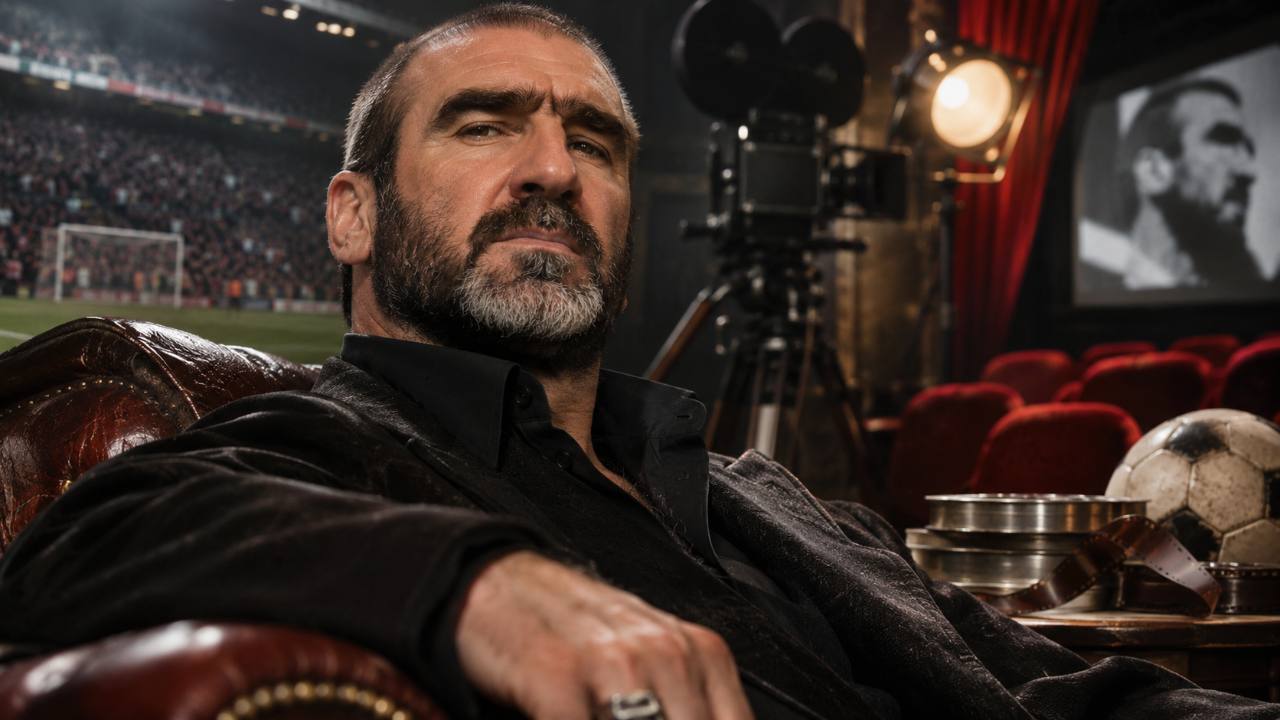
AI-generated editorial illustration supplied for PRESDA. This imagined football-and-cinema composite is not a film still or an archival portrait.
AI-generated editorial illustration of an imagined gathering. No real person, community or historical event is depicted.
Eric Cantona’s second career did not begin when the first one ended. In 1995, while he was still a Manchester United player, he appeared in Étienne Chatiliez’s Le bonheur est dans le pré. The detail complicates the familiar tale of a retired footballer discovering cinema: acting was already part of his working life before he left the pitch. His agency’s filmography records that overlap. Time Art: Cantona’s film and television credits
The football retirement came in May 1997, at 30. By then he had helped reshape Manchester United’s Premier League era. What followed was not a single celebrity cameo but a continuing screen career across historical drama, comedy, a western and television. The interesting question is how a man with such a recognisable sporting image found room to become someone else. Premier League: Eric Cantona’s Hall of Fame record Time Art: Cantona’s film and television credits
What made Cantona a football legend?
The Premier League’s Hall of Fame record identifies his move from Leeds to Manchester United in November 1992 and four league titles in five seasons at United. The first, in 1992/93, ended the club’s 26-year wait for the English league championship. Those achievements explain the scale of the public identity he carried into another profession, without requiring an invented ranking of his place among all players. Premier League: Eric Cantona’s Hall of Fame record
| Year | Milestone |
|---|---|
| 1992 | Joins Manchester United from Leeds |
| 1995 | Appears in Le bonheur est dans le pré while still playing |
| 1997 | Retires from football at 30, with four Premier League titles at United |
| 1998 | Plays the French ambassador in Elizabeth |
| 2009 | Looking for Eric screens in competition at Cannes |
| 2014 | The Salvation screens out of competition at Cannes |
| 2020 | Stars in television drama Dérapages |
| 2026 | Cantona documentary presented in Cannes Special Screenings |
A screen career already under way in 1995
Le bonheur est dans le pré matters less as a symbolic “first step after retirement” than as evidence that there was no clean boundary between the careers. Cantona was testing another form of performance while still known primarily for football. His later departure from the game created a different balance between the two, rather than creating an artistic interest from nothing. Time Art: Cantona’s film and television credits
Cinema also asks a different question of a famous athlete. Sporting recognition can secure attention, but a role exists inside a director’s film, alongside other performers and within a story that is not necessarily about the star. The transition is therefore not simply from one kind of fame to another. It involves accepting a new relationship to the audience.
From a familiar face to a fictional character
Shekhar Kapur’s Elizabeth, released in 1998, cast Cantona as the French ambassador. Cannes’ retrospective of his career identifies the role as an early example of his move into cinema. The historical setting placed his recognisable presence in a world removed from Manchester United and contemporary sporting mythology. Festival de Cannes, May 15, 2026: Cantona’s screen career and documentary
That distinction helps explain why his screen work should be assessed through particular films rather than the general phrase “footballer turned actor”. A historical supporting role, a comic appearance and a television lead make different demands. They also position a celebrity’s existing image differently, sometimes using it and sometimes working against it.
Looking for Eric: the football myth becomes a character
Ken Loach’s Looking for Eric, written by Paul Laverty, screened in competition at Cannes in 2009. Its central character is Eric Bishop, a troubled Manchester postman played by Steve Evets. Cantona appears as an imagined version of himself, offering a presence within the postman’s inner world. The film is fiction, not a documentary following the former player’s life. Festival de Cannes: Looking for Eric, 2009 selection and credits BFI: Looking for Eric film record
The arrangement is unusually revealing. Rather than asking Cantona to disappear behind an unrelated identity, the film makes his symbolic power part of the story. A football hero becomes a resource in an ordinary person’s imagination. Yet Bishop remains the character whose difficulties, relationships and decisions give the film its emotional centre.
Recognition without rewriting the award record
Looking for Eric won the Ecumenical Jury Prize at Cannes. It did not win the Palme d’Or. The distinction is worth preserving because festival participation, independent jury recognition and the main competition’s top prize are different facts. Cannes’ own 2026 account records the film’s place in that history. Festival de Cannes, May 15, 2026: Cantona’s screen career and documentary
The film’s importance to Cantona’s career does not depend on inflating the award. It offered a prominent example of cinema using a sporting icon thoughtfully: not as a decorative guest, and not as the subject of a straightforward career tribute, but as a figure through whom a fictional character could think about his life.
Beyond playing himself: The Salvation and Dérapages
In The Salvation, the western presented out of competition at Cannes in 2014, Cantona played the Corsican alongside a cast led by Mads Mikkelsen. Its genre and setting offered a different use of his physical presence. Here the audience encountered a fictional figure within a western rather than an imagined visitor from football history. Festival de Cannes, May 15, 2026: Cantona’s screen career and documentary
Television expanded that range. In the 2020 drama Dérapages, directed by Ziad Doueiri and adapted from Pierre Lemaitre’s Cadres noirs, Cantona plays unemployed executive Alain Delambre. ARTE’s programme record places the role in a story about work and insecurity. It is a television series, not another feature film to add indiscriminately to a cinema total. ARTE: Dérapages, television drama
What changes when the star is not the centre of the sporting story?
Football gave Cantona a public image built around decisive individual moments inside a collective game. Screen work places that presence in another collective process, shaped by writing, direction, editing and fellow actors. A camera can make a small gesture important, but the finished meaning also depends on decisions outside the performer’s control.
That is why the longevity of the work is more interesting than a simple claim that charisma transfers automatically between professions. A familiar face may bring viewers to a film. Continuing to take different roles requires participation in stories with their own purposes, including characters whose vulnerability or moral position is far from the heroic sporting image.
In 2026, a documentary makes the career itself a subject
Cannes presented Cantona, directed by David Tryhorn and Ben Nicholas, in Special Screenings in 2026. In this case he was the documentary’s subject, a different relationship to the screen from playing a fictional role. The festival’s dated account draws the connection between the football icon and his sustained life in cinema. Festival de Cannes, May 15, 2026: Cantona’s screen career and documentary
That distinction also separates the documentary from Looking for Eric. One examines a real public figure; the other uses an imagined version of that figure inside fiction. Keeping the forms separate lets readers understand his filmography without confusing appearances, performances and biographical storytelling.
A second career without erasing the first
Cantona’s route has a useful counterpart in Fabien Barthez’s move into motor racing: both stories become richer when the later profession is treated as actual work with its own standards. For another view of cinema’s lasting cultural power, read the history of Casablanca.
The supplied hero is an AI-generated football-and-cinema illustration, not a film still or archival photograph. The documented career is more varied than that single composite can show. Its defining feature is not that Cantona stopped being recognisable, but that he repeatedly placed that recognisable presence inside new kinds of stories.
FAQ
Frequently Asked Questions
Did Cantona start acting after retirement?
No. His credits include Le bonheur est dans le pré in 1995, before his football retirement in 1997.
Is Looking for Eric a documentary about him?
No. Ken Loach’s 2009 fiction centres on postman Eric Bishop, played by Steve Evets. Cantona appears as an imagined version of himself.
Did Looking for Eric win the Palme d’Or?
No. It competed at Cannes in 2009 and won the Ecumenical Jury Prize, a distinct award.
What is Dérapages?
A 2020 television drama directed by Ziad Doueiri, with Cantona as unemployed executive Alain Delambre. It is a series, not a feature film.
PRESDA Dispatch
Stay Informed. Stay Aware.
A sharp briefing across AI, gaming, sport, business, world affairs, paparazzi, and lifestyle.