Fabien Barthez: From World Cup Winner to Racing Driver
How France’s World Cup-winning goalkeeper became a French GT champion and raced three times at Le Mans, with verified results and the teamwork behind them.
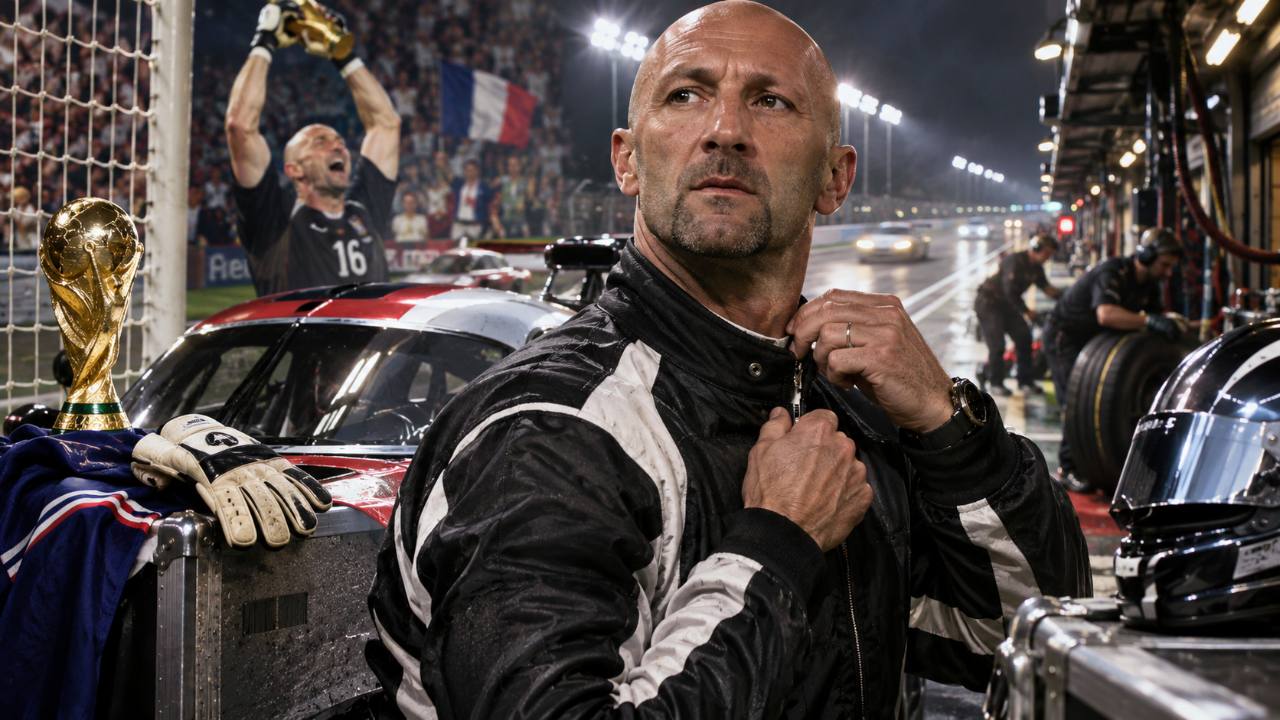
AI-generated editorial illustration supplied for PRESDA. This imagined sporting montage is not a photograph of an actual race, victory or trophy presentation.
AI-generated editorial illustration of an imagined gathering. No real person, community or historical event is depicted.
Fabien Barthez’s sporting reinvention can be measured in results. France’s World Cup-winning goalkeeper became a French GT champion in 2013 and later contested the 24 Hours of Le Mans three times. The second career was more than a famous footballer taking a demonstration lap: it involved a national championship, shared driving duties and the demands of endurance competition. French Football Federation: Barthez’s international record SRO: Barthez’s 2013 French GT title with Morgan Moullin-Traffort ACO, January 8, 2020: three Le Mans appearances
The distinction is also important for his record. Barthez won a world title in football, then a French title in motor racing. He did not win Le Mans, and he was not a Formula One driver. The real achievements are substantial enough when their categories and scale remain clear.
What did Barthez achieve in motor racing?
SRO’s official driver profile records the 2013 French FFSA GT championship with Morgan Moullin-Traffort. The Le Mans organiser, the Automobile Club de l’Ouest, documents his appearances in 2014, 2016 and 2017. His best overall finish there was 12th in 2016, while his car placed ninth within the LMP2 category. These are different rankings within the same race. SRO: Barthez’s 2013 French GT title with Morgan Moullin-Traffort ACO, January 8, 2020: three Le Mans appearances ACO: Fabien Barthez’s Le Mans results
| Year | Verified milestone |
|---|---|
| 1998 | World Cup winner with France |
| 2000 | European champion with France |
| 2013 | French FFSA GT champion with Morgan Moullin-Traffort |
| 2014 Le Mans | 29th overall, ninth in LMGTE Am, Ferrari 458 Italia GT2 |
| 2016 Le Mans | 12th overall, ninth in LMP2, Ligier JS P2-Nissan |
| 2017 Le Mans | Retirement in a Ligier JS P217-Gibson |
The goalkeeper’s record before the racing overalls
The French Football Federation records 87 senior international appearances for Barthez. He was part of France’s winning teams at the 1998 World Cup and Euro 2000. Those honours explain why his arrival in another sport attracted attention, but they did not carry a competitive advantage on a timing screen. A lap time had to be earned in the new discipline. French Football Federation: Barthez’s international record
There is a temptation to describe such a transition through personality alone: nerve, reflexes or a taste for risk. Those ideas may make an attractive comparison, but they do not explain a racing result. The more revealing evidence concerns the work he undertook, the teammates he shared a car with and the competitions in which he actually took part.
Starting again inside a different team
Goalkeeping is a specialised position within a football team. Endurance racing also places an individual performance inside a collective structure, but its tasks are different. Drivers share one car across the event, while preparation, mechanical reliability and decisions made around the car shape the outcome. Being recognisable cannot substitute for learning that environment.
The transition therefore offered a new form of dependence on others. A driver hands over equipment and track position to a teammate, then receives the same car back later in the race. The final classification belongs to an entry and its shared effort, even when one person’s name attracts most of the public attention.
The 2013 title made the new career concrete
Barthez’s French GT championship came with Morgan Moullin-Traffort, a pairing recorded by SRO and contemporary reporting in L’Équipe. The shared credit matters. Describing him as a champion is correct; describing the success as a solo achievement would miss the structure of the competition. The title gave the racing career a clear competitive milestone. SRO: Barthez’s 2013 French GT title with Morgan Moullin-Traffort L’Équipe, October 28, 2013: French GT championship
It also changed the meaning of the story. A celebrity appearance can be remembered for who attended. A championship can be checked against the sport’s own record. Barthez’s achievement belongs in that second category, with the precise qualification that it was the French FFSA GT title, not a world championship or a Le Mans victory.
Le Mans in 2014: a first finish in GT
His Le Mans debut came in 2014 with Team Sofrev ASP. He shared the number 58 Ferrari 458 Italia GT2 with Anthony Pons and Soheil Ayari. The car finished 29th overall and ninth in LMGTE Am. The ACO’s account records both positions, avoiding the misleading shorthand of calling ninth his overall result. ACO, January 8, 2020: three Le Mans appearances
That first finish belongs to a particular class and a particular shared entry. Le Mans brings different categories together in one event, so readers need both the overall result and the category position to understand performance. The distinction is essential whenever a well-known participant’s result is summarised outside specialist motor-racing coverage.
Preparation included learning the circuit’s procedures
An ACO report from 2016 describes Barthez’s simulator preparation alongside teammate Timothé Buret. It records three hours of work in six half-hour sessions, covering the circuit and procedures such as safety cars and slow zones, in daylight and darkness. It is a practical glimpse of the learning behind an appearance on the starting grid. ACO, 2016: simulator preparation for Le Mans
That preparation is more informative than an invented claim that the skills of a goalkeeper automatically made him a racing driver. He had to learn a different set of signals, hazards and responses. The organiser’s account shows repetition and instruction, the less photogenic parts of changing sports.
The Panis partnership and a move into prototypes
Barthez returned to Le Mans in 2016 with Panis-Barthez Compétition, the team associated with former Formula One driver Olivier Panis. The ACO’s retrospective describes this move into LMP2, a prototype category, after his earlier Ferrari entry. Panis’s F1 background should not be transferred to Barthez by association. ACO: 2016 retrospective on Barthez and Panis
In a Ligier JS P2-Nissan, the 2016 entry finished 12th overall and ninth in LMP2. He returned in 2017 in a Ligier JS P217-Gibson, but that attempt ended in retirement. A non-finish is part of the record too. It illustrates the uncertainty of endurance racing more honestly than selecting only the most flattering result. ACO, January 8, 2020: three Le Mans appearances ACO: Fabien Barthez’s Le Mans results
What the classifications say about a second sporting life
The progression from a national GT title to Le Mans entries gives this career a clear shape. It does not need to be turned into a narrative of inevitable ascent. A championship, a completed endurance race and a retirement are different experiences, each with its own significance for the competitors and their teams.
The shared element is commitment to another sport’s demands. Barthez could bring the experience of elite competition, but he still had to operate within new machinery, rules and relationships. The documented simulator work and the shared results make that commitment visible in a way that a photograph beside a racing car cannot.
Reinvention with its own standards
There is a useful comparison with Eric Cantona’s acting career. Both former players entered fields where an existing reputation could attract attention but could not define every performance. Taking the later work seriously means looking at films or race classifications, rather than treating it as an extended celebrity appearance.
The hero supplied for this feature is an AI-generated editorial montage combining football and racing imagery. It does not document an actual victory or trophy presentation. Barthez’s real record supplies the better ending: a World Cup-winning goalkeeper who became a national racing champion, learned endurance competition and earned three starts at one of its most demanding events.
FAQ
Frequently Asked Questions
Did Fabien Barthez become a racing champion?
Yes. He won the 2013 French FFSA GT championship with Morgan Moullin-Traffort.
Did he win the 24 Hours of Le Mans?
No. He competed in 2014, 2016 and 2017. His best overall finish was 12th in 2016, ninth in the LMP2 class.
Was Barthez a Formula One driver?
No. His racing record discussed here is in GT and endurance prototypes. His former team partner Olivier Panis raced in Formula One.
How many times did he play for France?
The French Football Federation records 87 senior appearances. He won the 1998 World Cup and Euro 2000.
PRESDA Dispatch
Stay Informed. Stay Aware.
A sharp briefing across AI, gaming, sport, business, world affairs, paparazzi, and lifestyle.