Robert Downey Jr.: From Prison to an Oscar
The verified story of Robert Downey Jr.’s imprisonment, recovery and acting comeback, from early Oscar recognition to Iron Man and Oppenheimer.
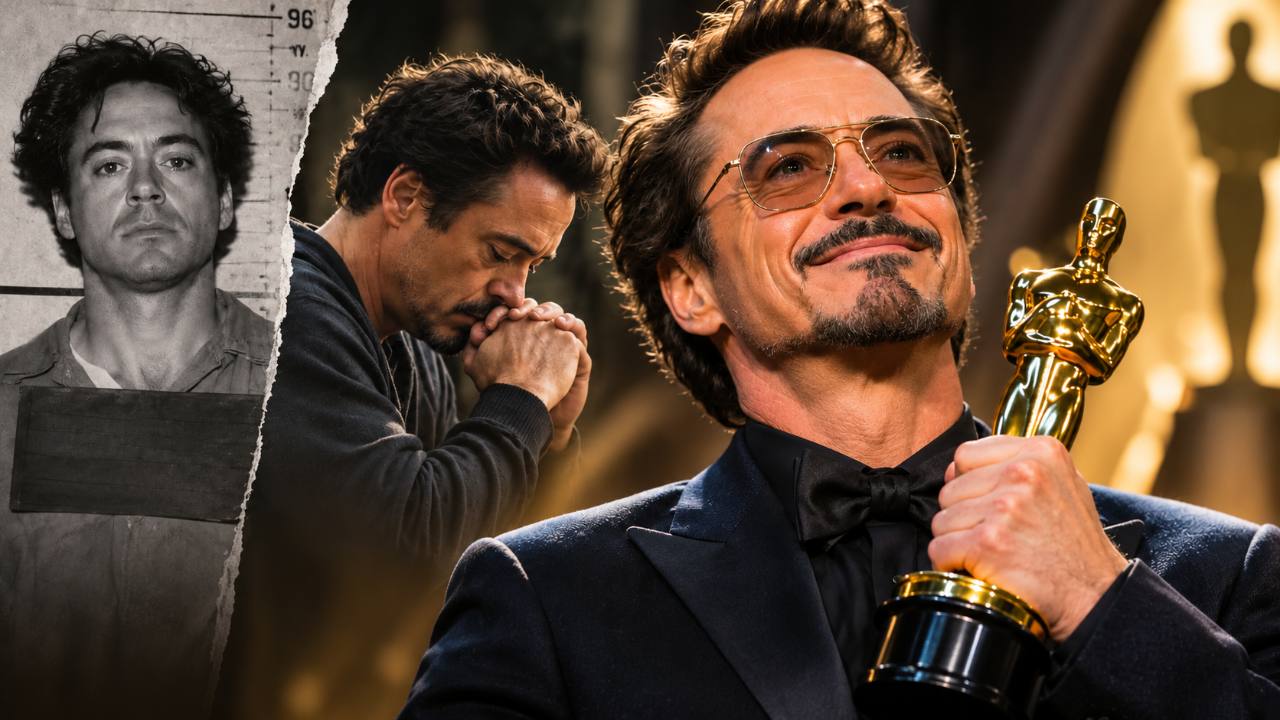
AI-generated editorial illustration supplied for PRESDA. Every scene, including the simulated booking portrait and award image, is a reconstruction, not a police record or documentary photograph.
Robert Downey Jr.’s journey from imprisonment to an Academy Award was not a single miraculous reversal. It unfolded through legal consequences, treatment, setbacks, renewed professional trust and performances that reminded audiences why he had been admired long before Iron Man. On March 10, 2024, he won his first Oscar, for supporting actor in Oppenheimer. The award was a career milestone, not proof that suffering was necessary for great art or that a person’s recovery can be measured by Hollywood’s applause. Academy, March 10, 2024: supporting actor winner
His story is compelling precisely because its stages are different. Release from prison was a legal event. Recovery was a sustained personal process described in public accounts. Returning to work required relationships and opportunities. Becoming a global franchise star was another transformation, while winning for Lewis Strauss recognized a specific performance. Combining those stages into one slogan would lose much of what makes the comeback remarkable.
A respected actor before the crisis
Downey was already an Oscar nominee at the 1993 ceremony, recognized for playing Charlie Chaplin in the film released the previous year. That early nomination is important: the later comeback did not create his ability from nothing. Hollywood had seen the precision and range of an actor capable of carrying a demanding biographical role before his legal troubles came to dominate public discussion. Academy: 1993 Chaplin nomination
| Date | Verified event |
|---|---|
| 1993 ceremony | Best actor nomination for the 1992 film Chaplin |
| August 1999 | Three-year prison sentence after probation violations |
| August 2000 | Released following an appellate ruling on time credit |
| April 2001 | Removed from Ally McBeal after another arrest |
| 2003 | Gothika; later public accounts place sustained sobriety from this period |
| 2005 | Kiss Kiss, Bang Bang |
| 2008–2009 | Iron Man and Tropic Thunder released; supporting Oscar nomination at the 2009 ceremony |
| December 24, 2015 | California Governor Jerry Brown grants a pardon |
| 2019 | Avengers: Endgame |
| 2022 | Sr. documentary |
| March 10, 2024 | First Oscar, supporting actor for Oppenheimer |
It also changes the meaning of the word comeback. He was returning to a profession in which he had demonstrated substantial promise, rather than entering one for the first time. The gap between artistic ability and the practical capacity to sustain a career became central to the following years. Talent could explain why people wanted to work with him; it could not by itself settle the problems that interrupted that work.
What the prison sentence actually was
Contemporaneous ABC reporting records a three-year sentence imposed in August 1999 after violations of probation in a 1996 drug case, including repeatedly missing required drug tests. This was not a sentence imposed for an invented violent offense. It was also not three uninterrupted years ultimately served. Accurate reporting needs to distinguish the term announced by a court from the time a person actually spends in custody. ABC News, August 2000: release and earlier sentence
Release did not mean every problem was over
In August 2000, an appellate ruling concerning credit for time already spent in rehabilitation led to his release. ABC reported that he entered a residential rehabilitation setting afterward. The chronology should not be simplified into a scene in which a studio rescued him directly from prison and placed him inside an Iron Man suit. Years of additional work and difficulty lay between those events. ABC News, August 2000: release and earlier sentence
The next professional opportunity did not produce a clean upward line. He joined Ally McBeal, but after another arrest in 2001 the series continued without him. AP’s contemporaneous report, preserved in a university newspaper archive, records the departure. Placing that setback after his release prevents a misleading narrative in which leaving custody and finding lasting stability happened at the same moment. AP, April 2001, preserved by Texas Tech: Ally McBeal departure
Recovery belongs to a different kind of story
In later public accounts, Downey described sustained sobriety from 2003. That is his account of his experience, not a clinical assessment made by this publication. There is no need to invent a precise private treatment regimen, a single curative event or a current medical status. The documented point is that his later professional rebuilding developed alongside a longer commitment to recovery. The Standard: Downey’s account of sobriety since 2003
Not a lesson about willpower alone
The CDC explains that overcoming substance use disorder is not simply a matter of resisting temptation through willpower. That wider health context matters when telling a famous person’s story. Determination, support and treatment should not be reduced to an inspirational slogan, and a relapse should not be used to portray a person as incapable of change. The record here is a biography, not a prescription. CDC: understanding addiction and recovery
It is equally misleading to imply that imprisonment itself produced recovery. The setbacks after his release show why the sequence is more complicated. His later success can be acknowledged without claiming that the punishment was medically beneficial or that another person will recover by following the same life events. The human achievement and the commercial achievement are related parts of the biography, but they are not the same measure.
The comeback was built through work before Marvel
Gothika, released in 2003, belongs in the timeline of his renewed screen work. The American Film Institute lists him in the cast alongside Halle Berry. Looking back only from the enormous visibility of Iron Man makes such intermediate steps disappear. Yet a functioning career is rebuilt through actual productions, colleagues and performances, not simply through a public declaration that a difficult period is over. AFI: Gothika, 2003
Kiss Kiss, Bang Bang showed another register
Shane Black’s Kiss Kiss, Bang Bang followed in 2005, with Downey, Val Kilmer and Michelle Monaghan. Its combination of crime story and comedy gave him a very different setting from a superhero franchise. The AFI record fixes the film’s place in the chronology: it came three years before Iron Man, when the rebuilding was already taking shape rather than waiting for a single studio decision. AFI: Kiss Kiss, Bang Bang, 2005
Those films also restore other people to the story. Directors, producers and fellow actors made projects in which Downey could work and be judged again as a performer. Calling the comeback entirely self-made erases that professional environment. Calling it solely a favor bestowed by others would erase his work. The more convincing account holds the two together: opportunities mattered, and so did what he did with them.
Iron Man changed the scale of his career
In 2008, Downey became Tony Stark in Iron Man, directed by Jon Favreau. Marvel’s later anniversary conversation between Favreau and Kevin Feige revisited the casting and the film’s role in shaping the studio’s wider cinematic project. The character gave Downey a platform on a new commercial scale, linking his screen presence to a story that could continue across multiple films and ensembles. Marvel: Feige and Favreau on Iron Man’s casting and legacy
Why casting was part of the turning point
The importance of the decision was not that a previously unknown actor had suddenly been discovered. His Chaplin nomination was already fifteen years old. It was that a performer with an established talent and a troubled professional history was trusted with a central role in a major long-term project. The chronology makes the risk and the opportunity more understandable than an account in which fame simply erased the past.
Iron Man also made the difference between individual celebrity and collaborative filmmaking especially clear. A franchise depends on writing, direction, production, design, editing and many other contributions. Downey became one of its most recognizable faces, but the scale of that success cannot be converted into an unsupported claim about his personal earnings or attributed to a single performance acting independently of the production around it.
Recognition extended beyond the suit
Tropic Thunder, also released in 2008, brought a supporting-actor nomination at the 2009 Academy Awards. It demonstrates that his renewed visibility was not limited to Tony Stark. The Academy’s records distinguish a nomination from a win, and the ceremony year from the film’s release year. Downey had not won an Oscar for Iron Man, Chaplin or Tropic Thunder before the 2024 ceremony. Academy: 2009 Tropic Thunder nomination
Endgame became a major chapter, not the whole career
Disney dates Avengers: Endgame to April 26, 2019, in the United States. The film brought together the narrative built across Marvel’s earlier movies and gave his Tony Stark era a defining screen moment. It is useful as a milestone in the scale of his commercial career, but it does not replace the earlier films or the later work that would lead to a different kind of recognition. Disney: Avengers: Endgame, 2019
The contrast with Chaplin and Oppenheimer helps show his range without claiming that popular filmmaking is less legitimate. These projects ask different things from an actor and reach audiences in different ways. One supplies a continuing character within a shared fictional universe; another interprets a historical person within a self-contained film. A substantial career can include both, without turning box-office success into an automatic artistic verdict.
A pardon and a more reflective public account
On December 24, 2015, California Governor Jerry Brown granted Downey a pardon. The Los Angeles Times’ document page records the action and the earlier completion of parole. A pardon is a legal decision with its own meaning; it is not evidence that the original events never occurred. It belongs in the timeline as an official milestone, separate from both his recovery and the awards attached to his later work. Los Angeles Times, December 24, 2015: pardon record
Sr. returned to family history
The 2022 documentary Sr. explored the life and work of his filmmaker father, Robert Downey Sr., and their relationship. Netflix described the project as an intimate portrait involving art, fatherhood and healing. That later willingness to revisit family history adds a reflective dimension to a career often narrated only through its lowest point and its biggest films. It should not be treated as an independent medical record. Netflix: Sr., 2022 documentary
A responsible account also leaves room for what is not public. There is no need to recreate private conversations, assign motives to family members or invent a moment when every relationship was repaired. The published record already contains enough to explain the importance of continuity, personal effort and support. Adding fictional intimacy would make a biography more dramatic at the cost of making it less trustworthy.
Oppenheimer brought the first Academy Award
In Christopher Nolan’s Oppenheimer, released in 2023, Downey played Lewis Strauss. On March 10, 2024, the Academy named him the winner for actor in a supporting role. It was his first Oscar after the earlier nominations. The official result is precise: this was an acting award for a particular supporting performance, not a lifetime-achievement Oscar or the leading-actor prize won by Cillian Murphy. Academy, March 10, 2024: supporting actor winner AP, March 2024: first Oscar and Lewis Strauss performance
A different form of screen authority
Strauss placed him within a historical drama rather than inside Tony Stark’s familiar fictional identity. AP’s awards reporting described the role as one of his most acclaimed performances in years. The point is not that he had to abandon popular cinema to deserve recognition. It is that a long career still allowed room for a new performance to alter how audiences and colleagues discussed his abilities. AP, March 2024: first Oscar and Lewis Strauss performance
The award also created an obvious temptation to rewrite every earlier hardship as preparation for triumph. That is an attractive dramatic shape, but it is not a factual explanation. Addiction, legal trouble and damaged professional relationships were not necessary steps toward an Oscar. The achievement lies in rebuilding a life and a working career despite those difficulties, not in suggesting that the difficulties were fortunate or useful.
The comeback is larger than its ending
Downey’s record contains an early Oscar nomination, imprisonment, further setbacks, a return through smaller and larger productions, years of franchise work and finally a supporting Oscar. Keeping those stages distinct preserves the scale of the change. It also makes the story less dependent on a misleading overnight transformation: the career that reached the Academy stage in 2024 had been rebuilt over many years.
The lasting lesson is not that everyone can reproduce a famous actor’s opportunities. It is that a person should not be reduced permanently to the worst period of a life, and that professional success is not the only form of recovery worth recognizing. Downey’s Oscar is a documented cinematic achievement. His public story of rebuilding deserves to be told with the same care for people and facts as the films that made the comeback visible.
FAQ
Frequently Asked Questions
Why was Robert Downey Jr. sent to prison?
Contemporaneous ABC reporting says an August 1999 three-year sentence followed violations of probation arising from a 1996 drug case, including missed mandatory drug tests. He did not serve the entire three-year sentence; an appellate time-credit decision led to release in August 2000.
When did Robert Downey Jr. win his first Oscar?
On March 10, 2024, at the 96th Academy Awards. He won actor in a supporting role for Lewis Strauss in Christopher Nolan’s Oppenheimer, released in 2023.
Was Iron Man the beginning of his acting recognition?
No. He was nominated for best actor at the 1993 Oscars for Chaplin. Iron Man in 2008 transformed the scale of his commercial career, rather than revealing a previously unknown performer.
Did prison or fame cure his addiction?
That conclusion is not supported. Public accounts describe treatment, setbacks and sustained recovery over time. Substance use disorder is a health condition, and an individual celebrity’s history is not a treatment formula or evidence that awards measure recovery.
PRESDA Dispatch
Stay Informed. Stay Aware.
A sharp briefing across AI, gaming, sport, business, world affairs, paparazzi, and lifestyle.